
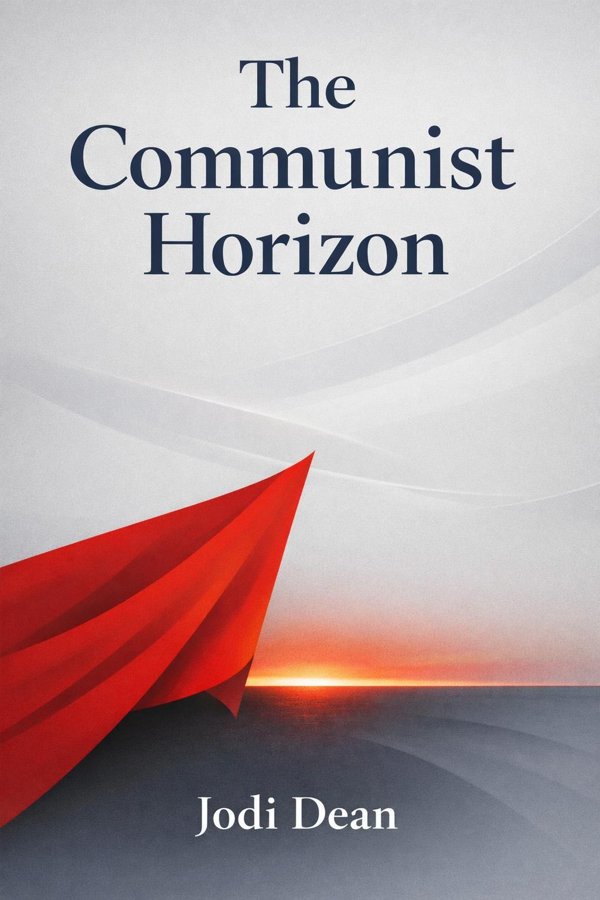
The Communist Horizon: Summary & Key Insights
by Jodi Dean
 10 min8 chaptersAudio available
What Is The Communist Horizon About?
The Communist Horizon by Jodi Dean is a politics book spanning 8 pages. In this provocative work, political theorist Jodi Dean reclaims the idea of communism as a vital horizon for contemporary leftist politics. Drawing on Marxist theory, psychoanalysis, and political philosophy, Dean argues that the collapse of the Soviet Union and the rise of neoliberal capitalism have not invalidated communism but rather made its rearticulation necessary. She critiques the fragmentation of leftist movements and calls for a renewed collective subject capable of confronting global capitalism.
This FizzRead summary covers all 8 key chapters of The Communist Horizon in approximately 10 minutes, distilling the most important ideas, arguments, and takeaways from Jodi Dean's work. Also available as an audio summary and Key Quotes Podcast.
The Communist Horizon
In this provocative work, political theorist Jodi Dean reclaims the idea of communism as a vital horizon for contemporary leftist politics. Drawing on Marxist theory, psychoanalysis, and political philosophy, Dean argues that the collapse of the Soviet Union and the rise of neoliberal capitalism have not invalidated communism but rather made its rearticulation necessary. She critiques the fragmentation of leftist movements and calls for a renewed collective subject capable of confronting global capitalism.
Who Should Read The Communist Horizon?
This book is perfect for anyone interested in politics and looking to gain actionable insights in a short read. Whether you're a student, professional, or lifelong learner, the key ideas from The Communist Horizon by Jodi Dean will help you think differently.
- ✓Readers who enjoy politics and want practical takeaways
- ✓Professionals looking to apply new ideas to their work and life
- ✓Anyone who wants the core insights of The Communist Horizon in just 10 minutes
Want the full summary?
Get instant access to this book summary and 100K+ more with Fizz Moment.
Get Free SummaryAvailable on App Store • Free to download
Key Chapters
To speak of communism as a horizon is to disavow the idea that it belongs solely to a past era. The horizon is not a place we arrive at; it is what shapes our view of the world, what orders our perspective even when we cannot reach it directly. I draw this metaphor to move beyond the teleological tendencies of earlier Marxist thought and to recover communism as an ever-present orientation. The horizon locates our struggle—it provides the sense of direction that enables collective subjects to act coherently.
Communism as a horizon means we do not seek purity or perfection. It means accepting that our politics must always be processual and open-ended, yet grounded in a shared commitment to equality and solidarity. When we lose the horizon, we lose our sense of movement. Neoliberal capitalism tells us that there is no beyond—no horizon other than endless competition and consumption. Reclaiming the communist horizon means reasserting that beyond: insisting that the social totality can be transformed, that the common can be recovered from the logic of private accumulation. In this way, communism remains not a ghost of the twentieth century, but the only viable framework through which hope for collective emancipation can be meaningfully articulated today.
After 1989, the Left suffered a profound fragmentation. Movements turned toward the local, the particular, the affective. Identity politics replaced class struggle, and pluralism replaced universality. In the name of inclusivity, collective organization was abandoned. I argue that this fragmentation was not innocent—it mirrored the logic of neoliberal capitalism itself, which thrives on division, individualization, and competition among social identities.
The new Left movements that emerged after the Cold War often defined themselves negatively, against power, hierarchy, or representation. Yet resistance without collective organization tends to dissipate. It becomes an endless performance of difference rather than a project of transformation. My critique is not of diversity per se but of the political paralysis that accompanies the refusal of commonality. Without a shared horizon, struggles are atomized. The emphasis on the local diverts attention from the global structures of exploitation that shape everyday life.
Rearticulating the Left requires acknowledging that political pluralism, while valuable, cannot replace the need for a unified historical subject. The multiplicity of struggles—racial, gendered, ecological—must find convergence in the collective form capable of confronting capitalism systemically. This is the political meaning of communism as horizon: it is the form that allows the many to become one, without erasing difference but beyond fragmentation.
+ 6 more chapters — available in the FizzRead app
All Chapters in The Communist Horizon
About the Author
Get This Summary in Your Preferred Format
Read or listen to the The Communist Horizon summary by Jodi Dean anytime, anywhere. FizzRead offers multiple formats so you can learn on your terms — all free.
Available formats: App · Audio · PDF · EPUB — All included free with FizzRead
Download The Communist Horizon PDF and EPUB Summary
Key Quotes from The Communist Horizon
“To speak of communism as a horizon is to disavow the idea that it belongs solely to a past era.”
“After 1989, the Left suffered a profound fragmentation.”
Frequently Asked Questions about The Communist Horizon
The Communist Horizon by Jodi Dean is a politics book that explores key ideas across 8 chapters. In this provocative work, political theorist Jodi Dean reclaims the idea of communism as a vital horizon for contemporary leftist politics. Drawing on Marxist theory, psychoanalysis, and political philosophy, Dean argues that the collapse of the Soviet Union and the rise of neoliberal capitalism have not invalidated communism but rather made its rearticulation necessary. She critiques the fragmentation of leftist movements and calls for a renewed collective subject capable of confronting global capitalism.
You Might Also Like

Antifa: The Anti-Fascist Handbook
Mark Bray
10 min
Attack from Within: How Disinformation Is Sabotaging America
Barbara McQuade
10 min
Coercion, Capital, and European States, AD 990–1992
Charles Tilly
10 min
Digital Democracy: Concepts, Methodologies, Tools, and Applications
Various Authors
10 min
Fascism
Stanley G. Payne
10 min
Fire And Fury: Inside The Trump White House
Michael Wolff
10 minBrowse by Category
Ready to read The Communist Horizon?
Get the full summary and 100K+ more books with Fizz Moment.