
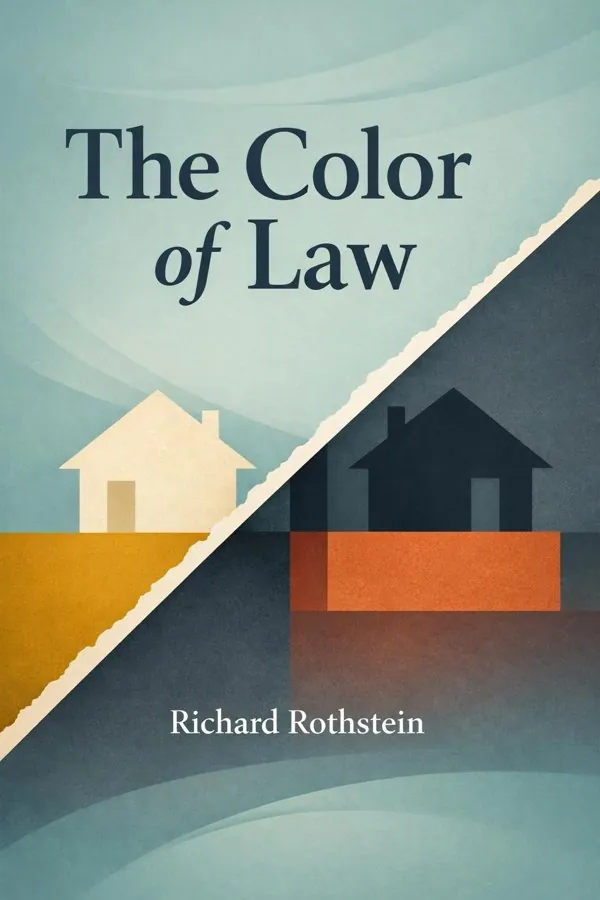
The Color of Law: A Forgotten History of How Our Government Segregated America: Summary & Key Insights
 10 min11 chaptersAudio available
What Is The Color of Law: A Forgotten History of How Our Government Segregated America About?
The Color of Law: A Forgotten History of How Our Government Segregated America by Richard Rothstein is a politics book spanning 11 pages. In this groundbreaking work, Richard Rothstein exposes the forgotten history of how American governments—federal, state, and local—deliberately imposed residential segregation through law and policy. Challenging the myth that segregation was merely the result of private prejudice or individual choices, Rothstein meticulously documents how public housing programs, zoning laws, and discriminatory lending practices created and reinforced racial divisions that persist today.
This FizzRead summary covers all 11 key chapters of The Color of Law: A Forgotten History of How Our Government Segregated America in approximately 10 minutes, distilling the most important ideas, arguments, and takeaways from Richard Rothstein's work. Also available as an audio summary and Key Quotes Podcast.
The Color of Law: A Forgotten History of How Our Government Segregated America
In this groundbreaking work, Richard Rothstein exposes the forgotten history of how American governments—federal, state, and local—deliberately imposed residential segregation through law and policy. Challenging the myth that segregation was merely the result of private prejudice or individual choices, Rothstein meticulously documents how public housing programs, zoning laws, and discriminatory lending practices created and reinforced racial divisions that persist today.
Who Should Read The Color of Law: A Forgotten History of How Our Government Segregated America?
This book is perfect for anyone interested in politics and looking to gain actionable insights in a short read. Whether you're a student, professional, or lifelong learner, the key ideas from The Color of Law: A Forgotten History of How Our Government Segregated America by Richard Rothstein will help you think differently.
- ✓Readers who enjoy politics and want practical takeaways
- ✓Professionals looking to apply new ideas to their work and life
- ✓Anyone who wants the core insights of The Color of Law: A Forgotten History of How Our Government Segregated America in just 10 minutes
Want the full summary?
Get instant access to this book summary and 100K+ more with Fizz Moment.
Get Free SummaryAvailable on App Store • Free to download
Key Chapters
For years, Americans have comforted themselves with the story that segregation simply happened—that people of similar race or class chose to live together, and the government merely stood by, neutral and passive. This is what I call the myth of de facto segregation. But the evidence shows something starkly different. From federal courts to local zoning boards, public agencies at every level actively crafted racially homogenous communities and prevented African Americans from owning or renting homes in white areas.
The term 'de jure segregation'—segregation by law—is often reserved for the South before the civil rights era. Yet in housing, such segregation was nationwide. Through documented government actions, black families were systematically denied access to the same housing and wealth-building opportunities granted to white families. Local governments enforced racial zoning ordinances. State legislatures upheld restrictive covenants. Federal agencies incorporated racial maps that codified discrimination. These were not private choices; they were mandates of public policy.
This distinction matters deeply because our Constitution forbids state action that discriminates on the basis of race. If we accept segregation as de jure, we must accept that our nation has ongoing constitutional and moral obligations to undo it. The myth of de facto segregation is not just historically inaccurate—it is a moral escape hatch that allows us to rationalize inequality as unfortunate but unfixable.
One of the clearest examples of government-engineered segregation lies in the Federal Housing Administration’s practices during the 20th century. The FHA, created during the New Deal, shaped modern homeownership by insuring mortgages. But in doing so, it institutionalized racial discrimination through explicit guidelines. The underwriting manuals issued to lenders openly warned against insuring mortgages in or near neighborhoods where African Americans lived. Neighborhoods were graded for financial risk, and those with black residents or even proximity to black neighborhoods were marked in red, giving birth to the term 'redlining.'
This was no marginal bureaucratic footnote—it was a nationwide system. FHA insurance enabled millions of working-class white families to buy homes in newly developed suburbs with low down payments, while black families were effectively frozen out. The federal government did not simply tolerate the private biases of lenders; it mandated them. Entire communities grew around these federal maps, which became self-fulfilling prophecies of value. Houses in redlined areas depreciated because investment was blocked, while those in white suburbs appreciated—launching the great American wealth divide that continues today.
The tragedy of redlining is that it shaped expectations for generations. Homeownership became the primary vehicle for accumulating wealth, and as white families passed assets to their children, black families were kept perpetually behind. The FHA's legacy was not contained in the 1930s or 40s; its distortions echo through the racial wealth gap of the 21st century.
+ 9 more chapters — available in the FizzRead app
All Chapters in The Color of Law: A Forgotten History of How Our Government Segregated America
About the Author
Richard Rothstein is a research associate at the Economic Policy Institute and a fellow at the Thurgood Marshall Institute of the NAACP Legal Defense Fund. He has written extensively on education, housing, and civil rights policy, focusing on the intersection of government policy and racial inequality in the United States.
Get This Summary in Your Preferred Format
Read or listen to the The Color of Law: A Forgotten History of How Our Government Segregated America summary by Richard Rothstein anytime, anywhere. FizzRead offers multiple formats so you can learn on your terms — all free.
Available formats: App · Audio · PDF · EPUB — All included free with FizzRead
Download The Color of Law: A Forgotten History of How Our Government Segregated America PDF and EPUB Summary
Key Quotes from The Color of Law: A Forgotten History of How Our Government Segregated America
“This is what I call the myth of de facto segregation.”
“One of the clearest examples of government-engineered segregation lies in the Federal Housing Administration’s practices during the 20th century.”
Frequently Asked Questions about The Color of Law: A Forgotten History of How Our Government Segregated America
The Color of Law: A Forgotten History of How Our Government Segregated America by Richard Rothstein is a politics book that explores key ideas across 11 chapters. In this groundbreaking work, Richard Rothstein exposes the forgotten history of how American governments—federal, state, and local—deliberately imposed residential segregation through law and policy. Challenging the myth that segregation was merely the result of private prejudice or individual choices, Rothstein meticulously documents how public housing programs, zoning laws, and discriminatory lending practices created and reinforced racial divisions that persist today.
You Might Also Like

Antifa: The Anti-Fascist Handbook
Mark Bray
10 min
Attack from Within: How Disinformation Is Sabotaging America
Barbara McQuade
10 min
Coercion, Capital, and European States, AD 990–1992
Charles Tilly
10 min
Digital Democracy: Concepts, Methodologies, Tools, and Applications
Various Authors
10 min
Fascism
Stanley G. Payne
10 min
Fire And Fury: Inside The Trump White House
Michael Wolff
10 minBrowse by Category
Ready to read The Color of Law: A Forgotten History of How Our Government Segregated America?
Get the full summary and 100K+ more books with Fizz Moment.