
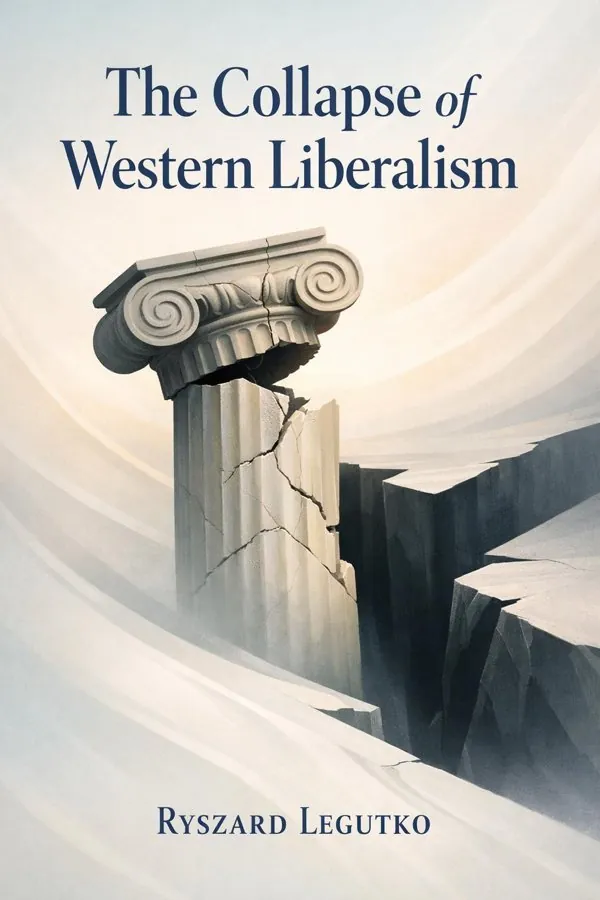
The Collapse of Western Liberalism: Summary & Key Insights
 10 min10 chaptersAudio available
What Is The Collapse of Western Liberalism About?
The Collapse of Western Liberalism by Ryszard Legutko is a politics book spanning 10 pages. In this book, Polish philosopher and politician Ryszard Legutko examines the ideological and cultural decline of Western liberalism. He argues that liberal democracy, once a system of freedom and pluralism, has evolved into a dogmatic worldview intolerant of dissent. Drawing on historical and philosophical analysis, Legutko explores how liberalism’s moral relativism and bureaucratic uniformity have eroded traditional values and civic life.
This FizzRead summary covers all 10 key chapters of The Collapse of Western Liberalism in approximately 10 minutes, distilling the most important ideas, arguments, and takeaways from Ryszard Legutko's work. Also available as an audio summary and Key Quotes Podcast.
The Collapse of Western Liberalism
In this book, Polish philosopher and politician Ryszard Legutko examines the ideological and cultural decline of Western liberalism. He argues that liberal democracy, once a system of freedom and pluralism, has evolved into a dogmatic worldview intolerant of dissent. Drawing on historical and philosophical analysis, Legutko explores how liberalism’s moral relativism and bureaucratic uniformity have eroded traditional values and civic life.
Who Should Read The Collapse of Western Liberalism?
This book is perfect for anyone interested in politics and looking to gain actionable insights in a short read. Whether you're a student, professional, or lifelong learner, the key ideas from The Collapse of Western Liberalism by Ryszard Legutko will help you think differently.
- ✓Readers who enjoy politics and want practical takeaways
- ✓Professionals looking to apply new ideas to their work and life
- ✓Anyone who wants the core insights of The Collapse of Western Liberalism in just 10 minutes
Want the full summary?
Get instant access to this book summary and 100K+ more with Fizz Moment.
Get Free SummaryAvailable on App Store • Free to download
Key Chapters
To grasp the collapse of Western liberalism, we must first understand where liberalism came from and what it sought to accomplish. Liberal thought emerged in the Enlightenment as a rebellion against absolutist power and theological dogma. Its founders—Locke, Montesquieu, and later Mill—believed that rationality and tolerance could liberate humanity from fanaticism and war. The liberal faith was born out of distrust of metaphysics and longing for moderation. It promised that reason and individual rights would replace divine authority as the guiding principles of political life.
In its historical evolution, liberalism defined itself by negation—opposing tyranny, religious imposition, and collective ideologies. But this negation carried a hidden seed. By rejecting metaphysical sources of truth, liberalism implicitly denied that there could be any transcendent measure of the good. The result was an autonomous moral framework sustained by human preference and procedural fairness rather than objective value. The Enlightenment dream of universal freedom thus gradually turned into a managerial project. Politics became administration of needs; ethics became equality of choices; meaning was displaced by efficiency.
In the 19th century, liberalism fused with democracy. It was a marriage of convenience: democracy contributed emotional legitimacy, while liberalism provided philosophical justification. Over time, however, this union transformed the liberal idea from an intellectual defense of autonomy into a mass ideology of sameness. The liberal citizen no longer sought self-control or civic virtue; he sought emancipation from any hierarchy. The democratic age converted liberalism into a cultural orthodoxy—an apparatus ensuring that emancipation remained the only moral horizon.
This historical arc—from the sober rationalism of Locke to the bureaucratic egalitarianism of modern Europe—forms the background of my argument. Liberalism once fought for freedom from coercion; now, it exercises coercion through the moral imperative of freedom itself. Its collapse is not sudden but internal—the inevitable consequence of its own philosophical trajectory.
One of the great illusions of our time is that liberal democracy is ideologically neutral. It claims to permit all beliefs while privileging none. Yet in practice, it functions like an orthodoxy, demanding allegiance to its moral vocabulary. It preaches freedom, but only freedom within its borders; tolerance, but only toward its approved modes of life. The language may sound benign, yet it operates as a cultural software shaping how we speak, think, and even imagine.
This ideological character emerged gradually as liberalism shifted from a political doctrine to a total worldview. When liberal thinkers abandoned metaphysical foundations, they had to invent an alternative moral coherence. Thus, liberalism began to claim universality—asserting that its principles of rights, autonomy, and equality were valid regardless of culture or tradition. What was once a pragmatic system became a theological substitute.
Under liberal democracy, institutions such as schools, media, and bureaucracies serve not merely to regulate society but to instruct citizens in the proper moral sentiments. One must not only obey laws but feel the correct emotions—sympathy toward approved victims, indignation toward outdated hierarchies, enthusiasm for progress. That emotional education is essential to maintaining ideological unity. Neutrality becomes the mask of persuasion; pluralism becomes the rhetoric of uniformity.
From my perspective, this transformation reveals liberalism’s paradox. It began as a reaction to dogmatism but ended as a dogma. Its ‘freedom’ demands ideological conformity; its ‘diversity’ requires moral homogeneity. Liberal democracy now defines virtue not by truth but by alignment. And because it claims neutrality, its power is almost invisible—enforced through institutions that appear merely administrative but carry profound cultural authority. In this way, liberal ideology colonizes the moral imagination of the modern citizen.
+ 8 more chapters — available in the FizzRead app
All Chapters in The Collapse of Western Liberalism
About the Author
Ryszard Legutko is a Polish philosopher, political theorist, and professor at Jagiellonian University. He has written extensively on political philosophy, particularly on the nature of liberal democracy and its cultural consequences. Legutko has also served as a member of the European Parliament.
Get This Summary in Your Preferred Format
Read or listen to the The Collapse of Western Liberalism summary by Ryszard Legutko anytime, anywhere. FizzRead offers multiple formats so you can learn on your terms — all free.
Available formats: App · Audio · PDF · EPUB — All included free with FizzRead
Download The Collapse of Western Liberalism PDF and EPUB Summary
Key Quotes from The Collapse of Western Liberalism
“To grasp the collapse of Western liberalism, we must first understand where liberalism came from and what it sought to accomplish.”
“One of the great illusions of our time is that liberal democracy is ideologically neutral.”
Frequently Asked Questions about The Collapse of Western Liberalism
The Collapse of Western Liberalism by Ryszard Legutko is a politics book that explores key ideas across 10 chapters. In this book, Polish philosopher and politician Ryszard Legutko examines the ideological and cultural decline of Western liberalism. He argues that liberal democracy, once a system of freedom and pluralism, has evolved into a dogmatic worldview intolerant of dissent. Drawing on historical and philosophical analysis, Legutko explores how liberalism’s moral relativism and bureaucratic uniformity have eroded traditional values and civic life.
You Might Also Like
Antifa: The Anti-Fascist Handbook
Mark Bray
10 min
Attack from Within: How Disinformation Is Sabotaging America
Barbara McQuade
10 min
Coercion, Capital, and European States, AD 990–1992
Charles Tilly
10 min
Digital Democracy: Concepts, Methodologies, Tools, and Applications
Various Authors
10 min
Fascism
Stanley G. Payne
10 min
Fire And Fury: Inside The Trump White House
Michael Wolff
10 minBrowse by Category
Ready to read The Collapse of Western Liberalism?
Get the full summary and 100K+ more books with Fizz Moment.