
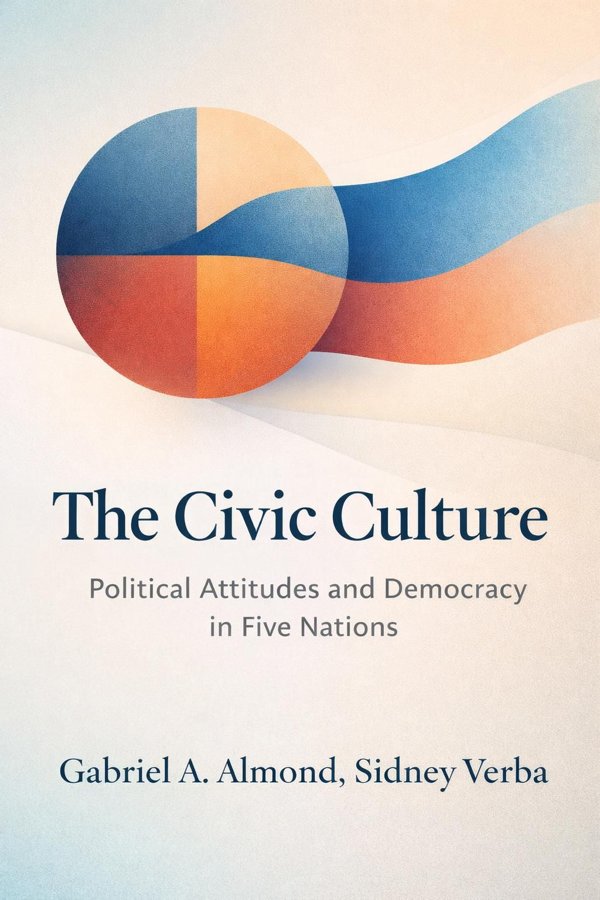
The Civic Culture: Political Attitudes and Democracy in Five Nations: Summary & Key Insights
by Gabriel A. Almond, Sidney Verba
 10 min9 chaptersAudio available
What Is The Civic Culture: Political Attitudes and Democracy in Five Nations About?
The Civic Culture: Political Attitudes and Democracy in Five Nations by Gabriel A. Almond, Sidney Verba is a politics book spanning 9 pages. This seminal work in political science explores the relationship between political culture and democratic stability. Based on extensive surveys conducted in the United States, United Kingdom, Germany, Italy, and Mexico, the authors analyze how citizens' attitudes toward politics influence the functioning and endurance of democratic systems. The book introduces the concept of 'civic culture' as a balanced blend of participant, subject, and parochial orientations that supports democratic governance.
This FizzRead summary covers all 9 key chapters of The Civic Culture: Political Attitudes and Democracy in Five Nations in approximately 10 minutes, distilling the most important ideas, arguments, and takeaways from Gabriel A. Almond, Sidney Verba's work. Also available as an audio summary and Key Quotes Podcast.
The Civic Culture: Political Attitudes and Democracy in Five Nations
This seminal work in political science explores the relationship between political culture and democratic stability. Based on extensive surveys conducted in the United States, United Kingdom, Germany, Italy, and Mexico, the authors analyze how citizens' attitudes toward politics influence the functioning and endurance of democratic systems. The book introduces the concept of 'civic culture' as a balanced blend of participant, subject, and parochial orientations that supports democratic governance.
Who Should Read The Civic Culture: Political Attitudes and Democracy in Five Nations?
This book is perfect for anyone interested in politics and looking to gain actionable insights in a short read. Whether you're a student, professional, or lifelong learner, the key ideas from The Civic Culture: Political Attitudes and Democracy in Five Nations by Gabriel A. Almond, Sidney Verba will help you think differently.
- ✓Readers who enjoy politics and want practical takeaways
- ✓Professionals looking to apply new ideas to their work and life
- ✓Anyone who wants the core insights of The Civic Culture: Political Attitudes and Democracy in Five Nations in just 10 minutes
Want the full summary?
Get instant access to this book summary and 100K+ more with Fizz Moment.
Get Free SummaryAvailable on App Store • Free to download
Key Chapters
The term *political culture* captures the subjective dimension of politics—the way in which individuals perceive their roles, their government, and their ability to influence political outcomes. For us, this concept was not abstract theory; it was an analytical tool for understanding how ordinary people make sense of their political world. We delineated three primary orientations: parochial, subject, and participant.
In a parochial political culture, individuals have minimal awareness of the political system. Their loyalty and concern lie primarily with local, personal, or familial affairs. Politics remains distant, irrelevant, almost foreign to their daily experience. Traditional societies often exhibit this orientation, where allegiance is to kin or clan rather than state.
The subject culture, on the other hand, emerges when people recognize the existence of a political system and government authority but view themselves as passive recipients of its actions. They obey the law, pay taxes, and perhaps even feel pride in their nation—but they do not see themselves as active agents capable of influencing policy. Their posture is one of deference rather than engagement.
Finally, the participant orientation represents the citizen’s active awareness and involvement. Individuals understand their rights, monitor leaders, debate public issues, and see politics as an arena in which they can act. This orientation underlies modern democratic citizenship.
Democracies, however, cannot survive on participation alone. If everyone were constantly mobilized, questioning authority, and demanding change, the system would devolve into chaos. Thus, the healthiest political culture, as our analyses revealed, is not purely participatory but a balanced combination of all three orientations—a civic culture in which some defer, others engage, and most trust institutions enough to permit continuity.
To move beyond theory, we designed an extensive empirical study across five distinct nations: the United States, the United Kingdom, Germany, Italy, and Mexico. Each represented a unique political tradition—mature democracies, emerging democracies, and societies struggling toward modernization. We relied heavily on structured surveys that captured people’s attitudes toward political authority, efficacy, trust, and civic obligation. This was one of the first comparative studies of political culture employing systematic social science methods.
Our quantitative approach did not reduce politics to statistics; instead, it opened a window into the emotional and moral underpinnings of civic life. We questioned citizens about their sense of influence, pride in government, party loyalty, attitudes toward bureaucracy, and the value they placed on participation. The data revealed consistent cross-national patterns, but also deep divergences shaped by history and national experience. The comparative perspective was vital—it allowed us to isolate cultural tendencies rather than institutional form alone, letting us discern the psychological currents that sustain democratic systems.
+ 7 more chapters — available in the FizzRead app
All Chapters in The Civic Culture: Political Attitudes and Democracy in Five Nations
About the Authors
Gabriel A. Almond (1911–2002) was an American political scientist known for his pioneering work in comparative politics and political culture. Sidney Verba (1932–2019) was an American political scientist and professor at Harvard University, recognized for his contributions to the study of political behavior and civic engagement.
Get This Summary in Your Preferred Format
Read or listen to the The Civic Culture: Political Attitudes and Democracy in Five Nations summary by Gabriel A. Almond, Sidney Verba anytime, anywhere. FizzRead offers multiple formats so you can learn on your terms — all free.
Available formats: App · Audio · PDF · EPUB — All included free with FizzRead
Download The Civic Culture: Political Attitudes and Democracy in Five Nations PDF and EPUB Summary
Key Quotes from The Civic Culture: Political Attitudes and Democracy in Five Nations
“The term *political culture* captures the subjective dimension of politics—the way in which individuals perceive their roles, their government, and their ability to influence political outcomes.”
“To move beyond theory, we designed an extensive empirical study across five distinct nations: the United States, the United Kingdom, Germany, Italy, and Mexico.”
Frequently Asked Questions about The Civic Culture: Political Attitudes and Democracy in Five Nations
The Civic Culture: Political Attitudes and Democracy in Five Nations by Gabriel A. Almond, Sidney Verba is a politics book that explores key ideas across 9 chapters. This seminal work in political science explores the relationship between political culture and democratic stability. Based on extensive surveys conducted in the United States, United Kingdom, Germany, Italy, and Mexico, the authors analyze how citizens' attitudes toward politics influence the functioning and endurance of democratic systems. The book introduces the concept of 'civic culture' as a balanced blend of participant, subject, and parochial orientations that supports democratic governance.
You Might Also Like

Antifa: The Anti-Fascist Handbook
Mark Bray
10 min
Attack from Within: How Disinformation Is Sabotaging America
Barbara McQuade
10 min
Coercion, Capital, and European States, AD 990–1992
Charles Tilly
10 min
Digital Democracy: Concepts, Methodologies, Tools, and Applications
Various Authors
10 min
Fascism
Stanley G. Payne
10 min
Fire And Fury: Inside The Trump White House
Michael Wolff
10 minBrowse by Category
Ready to read The Civic Culture: Political Attitudes and Democracy in Five Nations?
Get the full summary and 100K+ more books with Fizz Moment.