
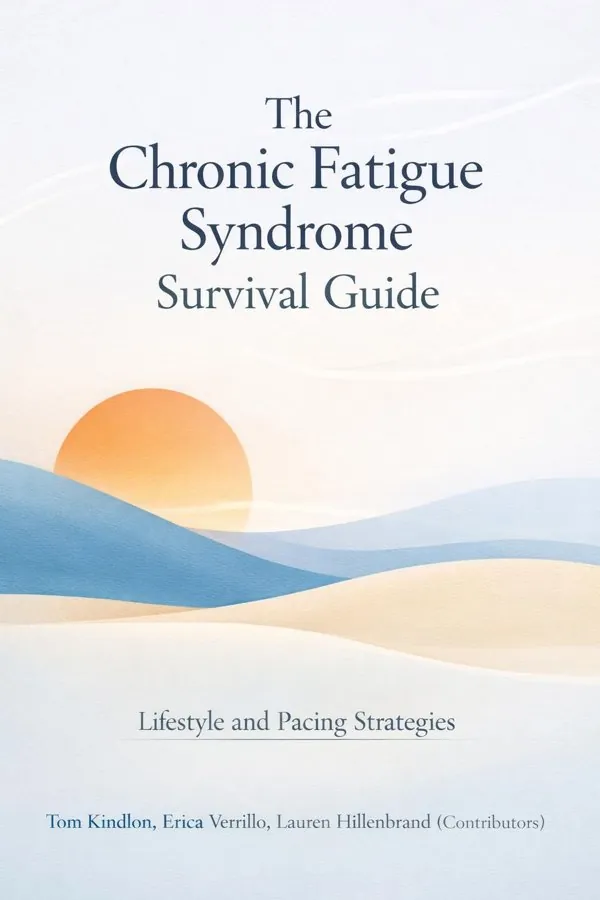
The Chronic Fatigue Syndrome Survival Guide: Lifestyle and Pacing Strategies: Summary & Key Insights
by Tom Kindlon, Erica Verrillo, Lauren Hillenbrand (Contributors)
 10 min10 chaptersAudio available
Key Takeaways from The Chronic Fatigue Syndrome Survival Guide: Lifestyle and Pacing Strategies
One of the most damaging misunderstandings about CFS/ME is hidden in its name: people hear “fatigue” and imagine ordinary tiredness.
The book’s central lesson is simple but profound: survival with CFS/ME depends less on willpower than on restraint.
If pacing is the guiding principle, an energy budget is the tool that makes it concrete.
Small lifestyle adjustments can mean the difference between constant depletion and manageable stability.
A chronic illness does not begin and end in the body; it reshapes emotional life as well.
What Is The Chronic Fatigue Syndrome Survival Guide: Lifestyle and Pacing Strategies About?
The Chronic Fatigue Syndrome Survival Guide: Lifestyle and Pacing Strategies by Tom Kindlon, Erica Verrillo, Lauren Hillenbrand (Contributors) is a health_med book spanning 11 pages. The Chronic Fatigue Syndrome Survival Guide: Lifestyle and Pacing Strategies is a practical, compassionate manual for people living with Chronic Fatigue Syndrome/Myalgic Encephalomyelitis (CFS/ME), as well as for families trying to understand it. Rather than promising a miracle cure, the book focuses on something far more useful: how to live more safely and sustainably with a poorly understood, often disabling illness. It explains the realities of post-exertional worsening, the necessity of pacing, the importance of adapting routines, and the emotional strain of managing a condition that others may not easily see or believe. What makes this guide especially valuable is its blend of patient wisdom and advocacy-based insight. Tom Kindlon is known for his work in CFS/ME research and public education, Erica Verrillo brings the authority of lived experience and long-term writing on chronic illness, and contributor Lauren Hillenbrand adds further credibility through her visibility as a person living with severe illness. Together, they offer guidance that is realistic, humane, and deeply informed by the day-to-day challenges patients face. For readers seeking validation, structure, and workable strategies, this book serves as both a survival toolkit and a reminder that careful self-management matters.
This FizzRead summary covers all 10 key chapters of The Chronic Fatigue Syndrome Survival Guide: Lifestyle and Pacing Strategies in approximately 10 minutes, distilling the most important ideas, arguments, and takeaways from Tom Kindlon, Erica Verrillo, Lauren Hillenbrand (Contributors)'s work. Also available as an audio summary and Key Quotes Podcast.
The Chronic Fatigue Syndrome Survival Guide: Lifestyle and Pacing Strategies
The Chronic Fatigue Syndrome Survival Guide: Lifestyle and Pacing Strategies is a practical, compassionate manual for people living with Chronic Fatigue Syndrome/Myalgic Encephalomyelitis (CFS/ME), as well as for families trying to understand it. Rather than promising a miracle cure, the book focuses on something far more useful: how to live more safely and sustainably with a poorly understood, often disabling illness. It explains the realities of post-exertional worsening, the necessity of pacing, the importance of adapting routines, and the emotional strain of managing a condition that others may not easily see or believe.
What makes this guide especially valuable is its blend of patient wisdom and advocacy-based insight. Tom Kindlon is known for his work in CFS/ME research and public education, Erica Verrillo brings the authority of lived experience and long-term writing on chronic illness, and contributor Lauren Hillenbrand adds further credibility through her visibility as a person living with severe illness. Together, they offer guidance that is realistic, humane, and deeply informed by the day-to-day challenges patients face. For readers seeking validation, structure, and workable strategies, this book serves as both a survival toolkit and a reminder that careful self-management matters.
Who Should Read The Chronic Fatigue Syndrome Survival Guide: Lifestyle and Pacing Strategies?
This book is perfect for anyone interested in health_med and looking to gain actionable insights in a short read. Whether you're a student, professional, or lifelong learner, the key ideas from The Chronic Fatigue Syndrome Survival Guide: Lifestyle and Pacing Strategies by Tom Kindlon, Erica Verrillo, Lauren Hillenbrand (Contributors) will help you think differently.
- ✓Readers who enjoy health_med and want practical takeaways
- ✓Professionals looking to apply new ideas to their work and life
- ✓Anyone who wants the core insights of The Chronic Fatigue Syndrome Survival Guide: Lifestyle and Pacing Strategies in just 10 minutes
Want the full summary?
Get instant access to this book summary and 100K+ more with Fizz Moment.
Get Free SummaryAvailable on App Store • Free to download
Key Chapters
One of the most damaging misunderstandings about CFS/ME is hidden in its name: people hear “fatigue” and imagine ordinary tiredness. The book makes clear that this illness is not simply feeling run-down. It is a complex, often disabling condition that can affect cognition, sleep, pain levels, autonomic function, and the body’s ability to recover from effort. A defining feature is that exertion—physical, mental, or emotional—can trigger a delayed worsening of symptoms, often called post-exertional malaise or post-exertional symptom exacerbation. That means an activity that seems manageable in the moment can produce a crash hours or even days later.
This distinction matters because misunderstanding leads to harmful advice. Someone with CFS/ME is often told to “push through,” “exercise more,” or “stay positive,” when those strategies may worsen the condition. The book reframes the illness as one that requires respect for biological limits, not a failure of motivation. It also helps patients understand why they may fluctuate so dramatically: a person can appear functional one day and be bedridden the next, not because the illness is imaginary, but because the body’s energy systems are unstable.
Practical examples make this clearer. A short grocery trip may involve standing, lights, noise, decision-making, and travel—all of which draw from the same limited reserve. Likewise, answering emails, attending a social event, or taking a shower may be as taxing as formal exercise. Recognizing this broader picture allows patients and caregivers to stop judging symptoms by appearances and start managing them by consequence.
Actionable takeaway: Replace the word “fatigue” in your own thinking with “system-wide energy impairment,” and begin tracking which physical, mental, and emotional activities trigger delayed worsening.
The book’s central lesson is simple but profound: survival with CFS/ME depends less on willpower than on restraint. Pacing is the disciplined practice of staying within your energy envelope so that you do not repeatedly trigger crashes. It is not laziness, avoidance, or giving up. It is a strategic response to a body that can no longer tolerate normal levels of exertion.
Many patients fall into a destructive boom-and-bust cycle. On a relatively good day, they try to catch up on chores, work, errands, or social plans. Because they may not feel the full cost immediately, they overdo it. Then comes the relapse: intensified symptoms, sometimes lasting days or weeks. The book argues that preventing these avoidable crashes is one of the most effective ways to preserve function over time.
Pacing often requires redefining success. Instead of asking, “How much can I get done today?” the better question becomes, “How can I end today without worsening tomorrow?” That shift changes decision-making. It may mean splitting one task into three shorter sessions, using a shower stool, resting before and after appointments, or setting strict time limits on screen use, conversation, and housework. It also means stopping before you feel exhausted, because by the time exhaustion arrives, you may already have exceeded your limit.
Importantly, pacing is highly individual. There is no universal threshold. One person may tolerate a ten-minute walk; another may need to pace speech or sitting upright. The point is not comparison but calibration.
Actionable takeaway: For one week, set a lower activity ceiling than you think you need, schedule regular rest before symptoms spike, and observe whether fewer crashes follow.
If pacing is the guiding principle, an energy budget is the tool that makes it concrete. The book encourages readers to think of energy as a limited daily allowance rather than an endlessly renewable resource. Every activity withdraws from that account, and CFS/ME sharply reduces both the amount available and the body’s capacity to recover after overspending.
This budgeting mindset can be transformative because it makes invisible costs visible. A patient may naturally count vacuuming or shopping as effort, but overlook the drain of phone calls, problem-solving, scrolling online, dealing with conflict, or sitting through a noisy appointment. Yet all of these can consume energy. Once readers start categorizing activities by cost, they can make better trade-offs. For example, if a medical visit is unavoidable, then cooking, socializing, or administrative tasks may need to be reduced that day and the day after.
The book’s approach invites experimentation. Some patients use a diary to note activity, symptoms, sleep, and delayed effects. Others assign rough energy points to tasks: showering might be 3 points, answering messages 2, laundry 4, and a family dinner 5. The exact numbers matter less than the pattern they reveal. Over time, people often discover that consistency is safer than bursts of productivity.
An energy budget also helps with communication. Instead of saying “I just can’t,” patients can explain, “If I spend energy on this appointment, I won’t have enough for cooking or childcare later.” That framing is easier for family members and employers to understand.
Actionable takeaway: Keep a seven-day energy log that includes physical, cognitive, and emotional activities, then identify your three most expensive recurring drains and plan reductions or supports for them.
Small lifestyle adjustments can mean the difference between constant depletion and manageable stability. The book shows that for people with CFS/ME, daily life itself must often be redesigned. This is not about becoming more efficient in the usual productivity sense; it is about reducing unnecessary energy expenditure in every routine possible.
That redesign can begin in the home. Organizing frequently used items within easy reach, using lightweight cookware, sitting while preparing food, breaking laundry into smaller loads, or using delivery services can all lessen strain. Assistive devices—such as shower chairs, wheelchairs, stools, meal-prep tools, or voice-to-text technology—should be seen as resources, not signs of defeat. The book’s tone is especially helpful here: it validates adaptation instead of framing it as failure.
Sleep hygiene and environmental control also matter. Although rest is not a cure, more predictable sleep routines, reduced sensory overload, and calmer surroundings may lower symptom burden. Some patients do better by limiting noise, harsh light, crowded outings, and multitasking. Others benefit from simplifying meals, clothing, transportation, and scheduling to conserve decision-making energy.
The larger message is that an unsympathetic routine can keep a patient in a constant state of overexertion. Many people try to preserve their old lifestyle for too long because scaling back feels emotionally painful. But the book argues that adaptation is often what preserves dignity and function. When daily systems fit your body better, you waste less energy merely getting through the day.
Actionable takeaway: Choose three routine tasks you do most often and redesign each one to require less standing, lifting, thinking, or sensory exposure.
A chronic illness does not begin and end in the body; it reshapes emotional life as well. The book carefully distinguishes between saying CFS/ME is “caused by stress” and acknowledging that stress can worsen symptoms and make self-management harder. That distinction is crucial. Patients are too often dismissed as anxious or depressed, when in reality they are struggling with a debilitating physical condition that naturally generates fear, grief, uncertainty, and frustration.
Stress in CFS/ME is not merely emotional. It can be physiological and situational: financial pressure, repeated disbelief from others, overtaxing medical appointments, sensory overload, and the constant need to monitor one’s body. Emotional strain can intensify pain, disturb sleep, impair concentration, and tempt patients to overexert themselves in an effort to prove they are still capable.
The book promotes realistic coping rather than forced optimism. Helpful strategies may include reducing avoidable conflict, limiting stressful interactions, planning recovery time after demanding events, practicing brief relaxation techniques, and giving oneself permission to say no. Emotional health also improves when patients stop measuring their worth by productivity. Grieving losses honestly, while still building meaning within constraints, is healthier than pretending nothing has changed.
Supportive counseling can be useful when it validates the illness and helps with adjustment, boundaries, and coping skills. But the book does not present therapy as a cure. Its role is to reduce the extra burden that emotional turmoil places on an already strained system.
Actionable takeaway: Identify your top two recurring stress triggers and build one protective boundary around each, such as shorter calls, delayed replies, or mandatory recovery time after difficult appointments.
Getting medical care for CFS/ME can be exhausting in itself. The book recognizes that many patients encounter skepticism, fragmented care, or clinicians who underestimate the condition’s complexity. As a result, navigating healthcare becomes a skill as important as symptom management. Patients need not only information, but also strategy.
A key principle is preparation. Because appointments are brief and energy is limited, it helps to arrive with a concise symptom history, a short list of priorities, and written notes about patterns such as post-exertional worsening, sleep disruption, orthostatic symptoms, pain, or cognitive impairment. The goal is not to tell the entire story every time, but to communicate the most useful facts clearly. Bringing someone to the appointment, if possible, can also reduce cognitive load and provide support.
The book encourages readers to seek doctors who are willing to listen, rule out other conditions, manage symptoms pragmatically, and respect patient reports. Even when no definitive cure exists, good medical care still matters. It can help identify comorbid issues, improve symptom control, document disability, and reduce harm from inappropriate recommendations. Equally important is learning to recognize when an intervention—whether exercise advice, medication, or testing—may be too taxing or poorly suited to the illness.
Medical care also involves conservation. Some appointments, tests, and treatment experiments are worth the energy cost; others may not be. Patients must often weigh benefit against relapse risk.
Actionable takeaway: Before your next appointment, prepare a one-page health summary with your top symptoms, main questions, recent changes, and the practical impact of your illness on daily functioning.
Illness does not occur in isolation; it alters families, friendships, and social identity. One of the book’s most useful contributions is its recognition that CFS/ME often creates relational strain not because patients care less, but because their capacity has changed. The mismatch between outward appearance and internal limitation can lead to misunderstanding, guilt, resentment, or disbelief.
Clear communication helps. Many patients feel pressure to accept invitations, explain repeatedly, or perform wellness for the comfort of others. But the book suggests that sustainable relationships are built on realism, not pretense. Saying, “I may need to cancel if symptoms flare,” or “I can talk for fifteen minutes, not an hour,” is kinder in the long run than repeatedly overcommitting and crashing. Loved ones also benefit from concrete explanations. It is often easier for them to understand energy limits when they are framed in practical terms: attending a birthday dinner may mean two recovery days afterward.
Family dynamics may require renegotiation of chores, caregiving, finances, and expectations. This can be emotionally difficult, especially for parents, partners, or ambitious individuals used to contributing heavily. Yet refusing adaptation can deepen conflict and illness. The book normalizes the use of scripts, routines, and shared plans to reduce friction.
Social connection still matters. It may simply need to take lower-cost forms: brief visits, texting instead of calls, quiet one-on-one time instead of group events, or asking others to come to you.
Actionable takeaway: Write a short explanation of your current limits that you can share with friends or family, and pair it with one specific way they can stay connected without overtaxing you.
One of the harshest realities of CFS/ME is that it can destabilize the structures adults and young people rely on for identity and survival: work, education, and financial security. The book approaches this area with welcome practicality. Rather than assuming readers can simply continue as before, it addresses the hard truth that many will need reduced hours, accommodations, pauses, or disability support.
For those still working or studying, the central question is sustainability. A schedule that is technically possible for a week but causes severe relapse afterward is not truly workable. The book encourages gradual realism: Can tasks be done from home? Can hours be reduced? Can deadlines be extended? Can sitting, standing, travel, screen time, or cognitive load be modified? Formal accommodations may include flexible attendance, rest breaks, note-taking support, remote participation, or adjusted responsibilities.
Documentation becomes important here. Symptom diaries, clinician letters, and records of functional limitations can support requests for accommodations or disability benefits. The book implicitly acknowledges how demoralizing these processes can be, especially when patients must prove an invisible illness while already depleted. But planning ahead reduces chaos.
There is also an emotional dimension. Scaling back work or school can feel like surrender, especially in cultures that equate worth with productivity. The book counters that preserving health is not failure; it is often the most responsible long-term decision. Sometimes doing less now prevents far greater loss later.
Actionable takeaway: Review your current work or school demands and identify which three elements most reliably worsen symptoms, then explore one accommodation, reduction, or substitute for each.
Setbacks are one of the most discouraging aspects of CFS/ME, and the book treats them with the seriousness they deserve. Relapses can be triggered by overexertion, infection, travel, stress, poor sleep, sensory overload, or cumulative activity that did not seem excessive at the time. Because progress is rarely linear, patients can feel as though every setback erases all prior effort. The book’s message is steadier: relapses are not moral failures, but signals that the system has been overstrained.
What matters most is responding early. Many patients make a relapse worse by trying to push through it, hoping to maintain obligations despite worsening symptoms. The wiser strategy is often immediate reduction of demands: more rest, fewer commitments, simpler meals, reduced sensory input, and stricter pacing. The earlier one responds, the greater the chance of limiting the severity or duration of the crash.
The book also encourages analysis without self-blame. A relapse can teach useful lessons. Did you underestimate cognitive effort? Stack too many appointments in one week? Ignore early warning signs like poor sleep, rising pain, dizziness, or mental fog? Patterns matter. Over time, patients can often identify personal triggers and build preventive buffers around them.
Emotionally, relapses call for self-compassion. Fear and frustration are understandable, but panic consumes energy too. A stable response plan reduces that burden.
Actionable takeaway: Create a written relapse protocol with your early warning signs, top triggers, immediate cutbacks, helpful supports, and a short list of nonessential tasks to suspend as soon as symptoms worsen.
Serious chronic illness can shrink a person’s world, but it does not have to erase connection or purpose. The book highlights the value of community support, patient education, and long-term resilience—not as sentimental add-ons, but as practical supports for survival. When a condition is misunderstood, one of the most healing experiences is being believed by people who understand its realities.
Community can take many forms: patient organizations, carefully moderated online groups, advocacy networks, informed friends, compassionate relatives, or a small circle of fellow patients. These spaces can offer emotional validation, practical tips, doctor recommendations, disability guidance, and language for explaining symptoms. The book also suggests that informed support reduces isolation and helps patients make more grounded decisions. At the same time, it is wise to avoid communities that encourage constant comparison, hopelessness, or pressure to try every new intervention.
Resilience in the book is not defined as heroic positivity. It is the quieter capacity to adapt, conserve, learn from experience, and build a life within limits. That may include finding low-energy pleasures, maintaining spiritual practices, keeping a journal, contributing in small ways, or redefining achievement. Meaning often survives in miniature: a thoughtful message, a creative project done in fragments, a deeper relationship, a well-managed day.
The guide’s deeper wisdom is that while CFS/ME may impose severe constraints, patients are not reducible to their symptoms. Practical support and a reworked sense of purpose can coexist with uncertainty.
Actionable takeaway: Identify one reliable support source and one low-energy activity that gives you meaning, then make both part of your weekly routine.
All Chapters in The Chronic Fatigue Syndrome Survival Guide: Lifestyle and Pacing Strategies
About the Authors
Tom Kindlon is a prominent Irish CFS/ME advocate and researcher known for his careful analysis of scientific evidence and his long-standing efforts to improve public understanding of the illness. Erica Verrillo is an American writer, editor, and patient advocate who has lived with Chronic Fatigue Syndrome for many years and has authored several books on chronic illness, recovery, and coping. Her work is respected for combining practical guidance with firsthand experience. Contributor Lauren Hillenbrand is the bestselling author of Seabiscuit and Unbroken and has also become a visible voice through her own experiences with severe chronic illness. Together, Kindlon, Verrillo, and Hillenbrand bring a rare combination of research literacy, advocacy, and lived experience, making their guidance especially credible and compassionate for readers navigating CFS/ME.
Get This Summary in Your Preferred Format
Read or listen to the The Chronic Fatigue Syndrome Survival Guide: Lifestyle and Pacing Strategies summary by Tom Kindlon, Erica Verrillo, Lauren Hillenbrand (Contributors) anytime, anywhere. FizzRead offers multiple formats so you can learn on your terms — all free.
Available formats: App · Audio · PDF · EPUB — All included free with FizzRead
Download The Chronic Fatigue Syndrome Survival Guide: Lifestyle and Pacing Strategies PDF and EPUB Summary
Key Quotes from The Chronic Fatigue Syndrome Survival Guide: Lifestyle and Pacing Strategies
“One of the most damaging misunderstandings about CFS/ME is hidden in its name: people hear “fatigue” and imagine ordinary tiredness.”
“The book’s central lesson is simple but profound: survival with CFS/ME depends less on willpower than on restraint.”
“If pacing is the guiding principle, an energy budget is the tool that makes it concrete.”
“Small lifestyle adjustments can mean the difference between constant depletion and manageable stability.”
“A chronic illness does not begin and end in the body; it reshapes emotional life as well.”
Frequently Asked Questions about The Chronic Fatigue Syndrome Survival Guide: Lifestyle and Pacing Strategies
The Chronic Fatigue Syndrome Survival Guide: Lifestyle and Pacing Strategies by Tom Kindlon, Erica Verrillo, Lauren Hillenbrand (Contributors) is a health_med book that explores key ideas across 10 chapters. The Chronic Fatigue Syndrome Survival Guide: Lifestyle and Pacing Strategies is a practical, compassionate manual for people living with Chronic Fatigue Syndrome/Myalgic Encephalomyelitis (CFS/ME), as well as for families trying to understand it. Rather than promising a miracle cure, the book focuses on something far more useful: how to live more safely and sustainably with a poorly understood, often disabling illness. It explains the realities of post-exertional worsening, the necessity of pacing, the importance of adapting routines, and the emotional strain of managing a condition that others may not easily see or believe. What makes this guide especially valuable is its blend of patient wisdom and advocacy-based insight. Tom Kindlon is known for his work in CFS/ME research and public education, Erica Verrillo brings the authority of lived experience and long-term writing on chronic illness, and contributor Lauren Hillenbrand adds further credibility through her visibility as a person living with severe illness. Together, they offer guidance that is realistic, humane, and deeply informed by the day-to-day challenges patients face. For readers seeking validation, structure, and workable strategies, this book serves as both a survival toolkit and a reminder that careful self-management matters.
You Might Also Like

On Immunity
Eula Biss
10 min
The Three-Body Problem
Liu Cixin
10 min
Community Health Volunteer Toolkit: Training and Practical Activities
World Health Organization
10 min
Healing Back Pain: The Mind-Body Connection
John E. Sarno
10 min
Health Literacy for All: Practical Guides to Communicate Health Information (Compilations)
World Health Organization
10 min
The Complete Guide to Sports Supplements: An Evidence-Based Review
Anita Bean
10 minBrowse by Category
Ready to read The Chronic Fatigue Syndrome Survival Guide: Lifestyle and Pacing Strategies?
Get the full summary and 100K+ more books with Fizz Moment.