
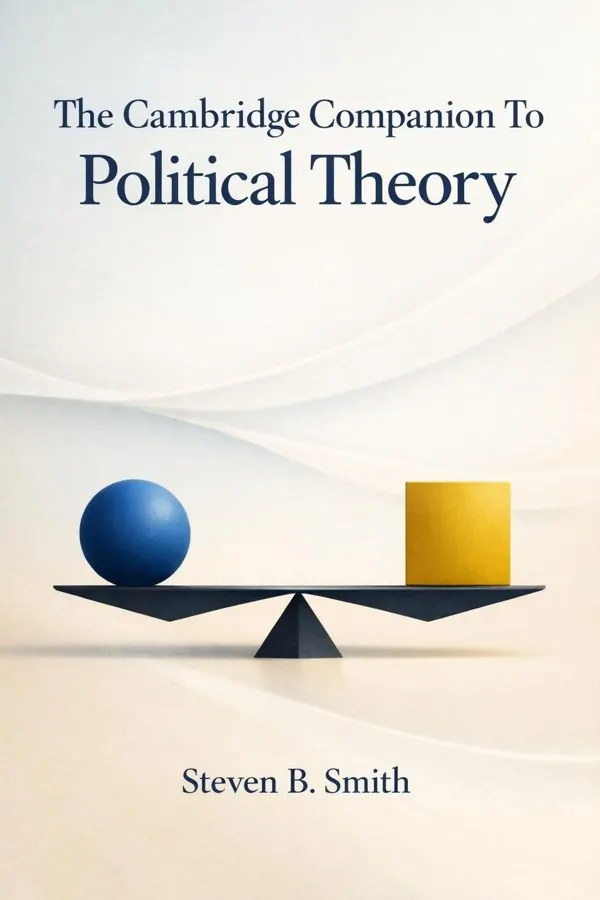
The Cambridge Companion To Political Theory: Summary & Key Insights
 10 min9 chaptersAudio available
Key Takeaways from The Cambridge Companion To Political Theory
A society reveals itself not only by how it distributes power, but by what it believes power is for.
Every serious political argument still carries echoes of Athens.
Political theory changed dramatically when classical philosophy entered a world shaped by biblical religion.
A government is strongest not when it inspires fear, but when people can explain why it has the right to rule.
Liberalism is often treated as common sense in modern democracies, but it is actually a contested and historically layered achievement.
What Is The Cambridge Companion To Political Theory About?
The Cambridge Companion To Political Theory by Steven B. Smith is a politics book spanning 11 pages. Political life is never just about institutions, elections, or policy. Beneath every law and public dispute lies a deeper set of questions: What is justice? Why should anyone obey authority? What makes freedom meaningful? The Cambridge Companion To Political Theory brings readers into this larger conversation by surveying the major ideas, traditions, and controversies that have defined political thought from antiquity to the present. Rather than treating politics as mere strategy or administration, the volume shows political theory as a discipline concerned with first principles, moral judgment, and the purposes of collective life. Edited by Steven B. Smith, a distinguished scholar of the history of political thought at Yale, the book gathers leading interpreters to explain how foundational thinkers and enduring concepts continue to shape contemporary debates. Topics such as liberty, equality, democracy, power, religion, gender, and global justice are explored not as abstract academic themes, but as live questions with real consequences. The result is both a map of the field and an invitation to think more rigorously about public life. For anyone who wants to understand politics beyond headlines, this volume offers a rich and intellectually serious starting point.
This FizzRead summary covers all 9 key chapters of The Cambridge Companion To Political Theory in approximately 10 minutes, distilling the most important ideas, arguments, and takeaways from Steven B. Smith's work. Also available as an audio summary and Key Quotes Podcast.
The Cambridge Companion To Political Theory
Political life is never just about institutions, elections, or policy. Beneath every law and public dispute lies a deeper set of questions: What is justice? Why should anyone obey authority? What makes freedom meaningful? The Cambridge Companion To Political Theory brings readers into this larger conversation by surveying the major ideas, traditions, and controversies that have defined political thought from antiquity to the present. Rather than treating politics as mere strategy or administration, the volume shows political theory as a discipline concerned with first principles, moral judgment, and the purposes of collective life.
Edited by Steven B. Smith, a distinguished scholar of the history of political thought at Yale, the book gathers leading interpreters to explain how foundational thinkers and enduring concepts continue to shape contemporary debates. Topics such as liberty, equality, democracy, power, religion, gender, and global justice are explored not as abstract academic themes, but as live questions with real consequences. The result is both a map of the field and an invitation to think more rigorously about public life. For anyone who wants to understand politics beyond headlines, this volume offers a rich and intellectually serious starting point.
Who Should Read The Cambridge Companion To Political Theory?
This book is perfect for anyone interested in politics and looking to gain actionable insights in a short read. Whether you're a student, professional, or lifelong learner, the key ideas from The Cambridge Companion To Political Theory by Steven B. Smith will help you think differently.
- ✓Readers who enjoy politics and want practical takeaways
- ✓Professionals looking to apply new ideas to their work and life
- ✓Anyone who wants the core insights of The Cambridge Companion To Political Theory in just 10 minutes
Want the full summary?
Get instant access to this book summary and 100K+ more with Fizz Moment.
Get Free SummaryAvailable on App Store • Free to download
Key Chapters
A society reveals itself not only by how it distributes power, but by what it believes power is for. That insight sits at the heart of political theory, and it is the starting point of this volume. Political theory does not merely describe institutions; it asks what justifies them. It pushes beyond the practical business of governing into questions of legitimacy, obligation, freedom, equality, and the common good.
The Cambridge Companion To Political Theory presents the field as a long argument across centuries. Thinkers disagree sharply, yet they are joined by a shared concern: how human beings can live together under rules they regard as rightful rather than merely coercive. Political theory therefore stands between philosophy and politics. It deals with constitutions, laws, sovereignty, rights, and citizenship, but it also investigates moral principles, human nature, and historical change.
This matters because political life constantly forces us to choose among competing goods. A state may increase security while reducing liberty. A democracy may respect majority rule while failing minorities. Economic growth may coexist with deep inequality. Political theory helps us name these conflicts and judge them more carefully. For example, debates over free speech on university campuses, emergency powers during crises, or welfare policy all involve hidden assumptions about autonomy, authority, and justice.
The volume’s broad achievement is to show that political theory is not a luxury for specialists. It is a practical discipline of reflection that clarifies the values already embedded in public life. The actionable takeaway is simple: whenever you encounter a political argument, ask not only whether it works, but what vision of human beings and society it assumes.
Every serious political argument still carries echoes of Athens. The companion begins with the classical foundations because Greek thought first turned politics into an object of rational inquiry. Plato and Aristotle did not treat public life as a matter of custom alone; they asked what the best regime is, what civic virtue requires, and whether justice can be known.
Plato’s political philosophy begins from dissatisfaction with ordinary opinion. In works such as the Republic, he examines how desire, power, education, and the soul shape political order. His ideal city may seem remote, but its deeper concern is enduring: can politics be guided by knowledge rather than appetite or manipulation? Aristotle, by contrast, approaches politics more empirically. He sees the polis as a natural association aimed at the good life, not merely survival. His discussions of citizenship, mixed government, virtue, and constitutional balance still inform modern conversations about republicanism and civic responsibility.
These thinkers matter because they frame tensions we still live with. Should politics cultivate virtue or simply protect rights? Is equality always good, or can it become a form of leveling that ignores excellence? Are people primarily private individuals, or are they fulfilled through public participation? Consider current debates over civic education, national service, or the moral aims of schooling. These are not new questions; they are classical ones in contemporary dress.
The companion uses these foundations to show that modern political problems are often legible only in light of old arguments. The actionable takeaway: when facing a political dispute, identify whether the disagreement is about interests alone or about competing ideas of the good life, because that distinction changes the entire debate.
Political theory changed dramatically when classical philosophy entered a world shaped by biblical religion. The medieval and Renaissance traditions did not simply preserve Greek ideas; they transformed them by placing politics within a moral and theological cosmos. In this period, questions of authority, law, sin, conscience, and salvation became inseparable from thinking about the state.
Augustine is central because he presents politics as necessary in a fallen world. Human beings seek peace, but pride and disorder make coercive authority unavoidable. Earthly political communities can secure limited goods, yet they cannot deliver ultimate redemption. Aquinas later offers a more harmonizing vision, integrating Aristotelian reason with Christian theology. For him, law is not merely command; it participates in a rational and moral order that includes natural law. This becomes foundational for later ideas about rights, justice, and limits on rulers.
The Renaissance shifts the scene again. Thinkers and statesmen grapple with republics, principalities, civic ambition, and the realities of power. Here politics starts to detach from purely theological framing and recover an interest in agency, history, and institutional design. You can see this transition in modern disputes over whether law should reflect moral truths, how religious belief belongs in public life, or whether political leaders must sometimes act outside ordinary ethical rules.
In practical terms, these traditions shape contemporary arguments about conscientious objection, church-state relations, constitutional morality, and the language of human dignity. The volume helps readers see that secular politics has deep theological ancestry. The actionable takeaway: when a political debate invokes morality, natural rights, or the sanctity of the person, ask what religious or metaphysical inheritance is silently doing the work.
Liberalism is often treated as common sense in modern democracies, but it is actually a contested and historically layered achievement. At its core, liberalism prizes individual liberty, legal equality, toleration, limited government, and protection from arbitrary power. It insists that persons are not merely members of tribes, classes, or confessions; they are bearers of rights and claims that political institutions must respect.
The companion presents liberalism not as a finished doctrine but as an ongoing argument. Classical liberals emphasize negative liberty, property, and restraint on state power. Later liberals expand concern for fair opportunity, social welfare, and the conditions that make freedom substantive rather than merely formal. Yet liberalism’s critics are equally important. Conservatives charge that it can weaken moral authority and communal bonds. Marxists argue that legal equality masks economic domination. Communitarians say it imagines individuals as too detached from tradition and shared identity. Postcolonial and critical theorists question whether liberal universalism has sometimes traveled with empire and exclusion.
These disagreements are not abstract. Consider debates over hate speech, welfare programs, affirmative action, religious exemptions, or public health mandates. A narrow liberalism may prioritize noninterference; a more egalitarian liberalism may stress capacity, fairness, and structural barriers. Critics may reply that both approaches miss deeper questions of belonging, virtue, or power.
One of the volume’s strengths is that it neither canonizes nor dismisses liberalism. Instead, it treats liberal thought as a central arena in which modern politics defines itself. The actionable takeaway: when someone invokes freedom, ask what kind of freedom they mean, freedom from interference, freedom to develop capacities, or freedom within a morally sustaining community.
Counting votes is easy; creating self-government is hard. The companion’s treatment of democracy and representation shows why democratic politics cannot be reduced to periodic elections. Democracy raises deeper questions about participation, deliberation, accountability, competence, majority rule, minority rights, and the relationship between citizens and institutions.
Representation is especially complex. In large modern states, direct democracy is rare, so citizens govern through elected officials, parties, courts, bureaucracies, and media systems. But what does it mean for representatives truly to represent? Are they delegates who mirror public opinion, trustees who exercise independent judgment, or party agents who implement a collective platform? Different answers produce different models of legitimacy.
The volume also addresses democracy’s internal tensions. Popular rule can empower citizens, yet mass publics can be manipulated, polarized, or inattentive. Democratic equality is normatively attractive, but expertise remains necessary in areas such as central banking, public health, or environmental regulation. Contemporary examples include arguments about campaign finance, gerrymandering, disinformation, voter suppression, citizens’ assemblies, and the role of unelected institutions. A society may have elections and still fall short of democratic ideals if participation is unequal or if public discussion is distorted.
Political theory sharpens these issues by asking not simply whether a system is democratic in name, but whether citizens are authors of collective decisions in a meaningful sense. Democracy requires habits as well as structures: trust, civic education, tolerance, and willingness to lose without abandoning the regime.
The actionable takeaway is to judge democracy by more than turnout or election outcomes. Ask whether institutions create informed participation, fair representation, and genuine accountability, because those conditions determine whether popular rule is real or merely ceremonial.
No political community can avoid deciding who gets what, who decides, and on what grounds. That is why justice, equality, power, and authority belong together. The companion explores these concepts not as isolated themes but as overlapping dimensions of every political order.
Justice concerns fair treatment, rightful distribution, and legitimate institutions. Equality asks in what respects human beings should be treated alike: before the law, in access to opportunity, in political voice, or in social standing. Power refers to the ability to shape outcomes, while authority concerns the recognized right to do so. A regime may possess power without legitimacy, or legitimacy without sufficient capacity to govern effectively.
Modern political theory has produced many competing answers. Some focus on distributive justice and material fairness. Others emphasize procedural justice, rights, recognition, or non-domination. Equality can mean equal opportunity, equal resources, equal civic status, or reducing unjust hierarchies. Likewise, authority may arise from consent, tradition, legal office, democratic authorization, or expertise. These distinctions matter in practical life. Debates over taxation, policing, labor rights, school funding, and algorithmic decision-making all involve struggles over distribution and rule. For instance, a workplace may formally treat employees equally while preserving large power asymmetries that limit real freedom.
The companion encourages readers to see politics not just as competition but as justified order. It asks when inequality becomes domination, when law commands obedience, and when resistance is morally warranted. This lens is especially useful in evaluating institutions that appear neutral but reproduce asymmetries of influence.
The actionable takeaway: when assessing any policy or institution, examine three things together, who benefits, who decides, and why those decisions should be considered legitimate.
Political theory becomes richer when it asks who was left out of its original categories. One of the most important developments covered in this volume is the expansion of political theory through questions of gender, identity, exclusion, and recognition. Feminist and identity-conscious approaches do not merely add new topics to the canon; they challenge the assumptions built into earlier ideas of citizenship, public reason, family, labor, and personhood.
Traditional political thought often treated the public sphere as universal while quietly assuming male, propertied, or culturally dominant subjects. Feminist theory reveals how the supposedly private sphere of family and care is deeply political, shaping dependency, labor, and power. It asks who performs reproductive work, whose voices count as rational, and how institutions encode gendered expectations. Broader theories of identity extend this critique to race, sexuality, colonial history, and cultural belonging. Recognition matters because injustice is not only economic or legal; it can also involve status injury, stereotyping, invisibility, or exclusion from the terms of public membership.
These ideas are immediately relevant to debates over parental leave, reproductive rights, equal pay, bathroom laws, representation in leadership, school curricula, and citizenship policy. A legal rule may look neutral while disadvantaging groups whose lived conditions differ from the assumed norm. Political theory helps uncover such hidden baselines.
The companion’s value here lies in showing that inclusion requires more than extending old rights language. It may require rethinking the categories themselves. The actionable takeaway: when a policy claims to be neutral, ask whose experience defines that neutrality and which forms of labor, vulnerability, or identity it may be overlooking.
Political theory once took the sovereign state as its obvious frame, but contemporary life constantly spills across borders. Migration, climate change, trade, war, digital networks, pandemics, and human rights all expose the limits of purely national thinking. The companion therefore turns to globalization, cosmopolitanism, religion, secularism, and other contemporary challenges that test inherited categories.
Cosmopolitan approaches argue that moral concern cannot stop at national boundaries. If all persons possess equal worth, then duties of justice may extend globally, not just domestically. This raises difficult questions about humanitarian intervention, refugee protection, global poverty, and international institutions. Critics reply that democratic accountability and solidarity remain strongest within bounded political communities. The tension between universal obligation and political membership is one of the defining issues of our time.
Religion and secularism complicate matters further. Modern states often aspire to neutrality, yet religion continues to shape identity, law, and public argument. Should political reasons be secular to count as legitimate? Can liberal democracies accommodate strong religious commitments without fragmenting civic unity? Similar tensions appear in controversies over religious symbols, faith-based schools, conscientious exemptions, and the political role of majoritarian cultures.
The volume also addresses newer pressures such as technological surveillance, ecological crisis, and transnational inequality. These problems reveal that old concepts like sovereignty and citizenship need reinterpretation rather than abandonment.
In practical terms, this means political judgment today requires multiple scales of analysis: local, national, and global. The actionable takeaway is to test any political position against cross-border consequences. Ask whether your preferred principle still makes sense in a world where actions in one society routinely transform the lives of people in another.
All Chapters in The Cambridge Companion To Political Theory
About the Author
Steven B. Smith is the Alfred Cowles Professor of Political Science and Professor of Philosophy at Yale University, where he has become one of the most respected interpreters of political thought in the English-speaking world. His scholarship focuses on the history of political philosophy, with particular attention to figures such as Machiavelli, Spinoza, Leo Strauss, and major thinkers in the liberal tradition. Smith is widely recognized for combining historical rigor with clarity of explanation, making difficult texts accessible to students and general readers without sacrificing complexity. In addition to his academic writing, he is known as an outstanding teacher whose lectures have introduced many readers to the enduring questions of political philosophy. As editor of The Cambridge Companion To Political Theory, he brings both breadth of knowledge and deep engagement with the tradition.
Get This Summary in Your Preferred Format
Read or listen to the The Cambridge Companion To Political Theory summary by Steven B. Smith anytime, anywhere. FizzRead offers multiple formats so you can learn on your terms — all free.
Available formats: App · Audio · PDF · EPUB — All included free with FizzRead
Download The Cambridge Companion To Political Theory PDF and EPUB Summary
Key Quotes from The Cambridge Companion To Political Theory
“A society reveals itself not only by how it distributes power, but by what it believes power is for.”
“Every serious political argument still carries echoes of Athens.”
“Political theory changed dramatically when classical philosophy entered a world shaped by biblical religion.”
“A government is strongest not when it inspires fear, but when people can explain why it has the right to rule.”
“Liberalism is often treated as common sense in modern democracies, but it is actually a contested and historically layered achievement.”
Frequently Asked Questions about The Cambridge Companion To Political Theory
The Cambridge Companion To Political Theory by Steven B. Smith is a politics book that explores key ideas across 9 chapters. Political life is never just about institutions, elections, or policy. Beneath every law and public dispute lies a deeper set of questions: What is justice? Why should anyone obey authority? What makes freedom meaningful? The Cambridge Companion To Political Theory brings readers into this larger conversation by surveying the major ideas, traditions, and controversies that have defined political thought from antiquity to the present. Rather than treating politics as mere strategy or administration, the volume shows political theory as a discipline concerned with first principles, moral judgment, and the purposes of collective life. Edited by Steven B. Smith, a distinguished scholar of the history of political thought at Yale, the book gathers leading interpreters to explain how foundational thinkers and enduring concepts continue to shape contemporary debates. Topics such as liberty, equality, democracy, power, religion, gender, and global justice are explored not as abstract academic themes, but as live questions with real consequences. The result is both a map of the field and an invitation to think more rigorously about public life. For anyone who wants to understand politics beyond headlines, this volume offers a rich and intellectually serious starting point.
You Might Also Like

Antifa: The Anti-Fascist Handbook
Mark Bray
10 min
Attack from Within: How Disinformation Is Sabotaging America
Barbara McQuade
10 min
Coercion, Capital, and European States, AD 990–1992
Charles Tilly
10 min
Digital Democracy: Concepts, Methodologies, Tools, and Applications
Various Authors
10 min
Fascism
Stanley G. Payne
10 min
Fire And Fury: Inside The Trump White House
Michael Wolff
10 minBrowse by Category
Ready to read The Cambridge Companion To Political Theory?
Get the full summary and 100K+ more books with Fizz Moment.