
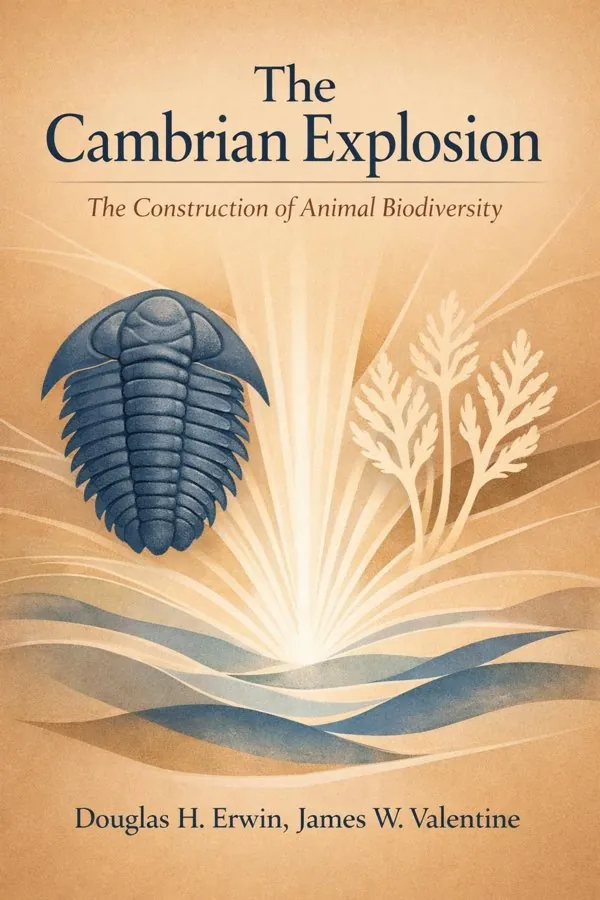
The Cambrian Explosion: The Construction of Animal Biodiversity: Summary & Key Insights
by Douglas H. Erwin, James W. Valentine
 10 min9 chaptersAudio available
Key Takeaways from The Cambrian Explosion: The Construction of Animal Biodiversity
Few episodes in natural history have provoked as much wonder as the Cambrian Explosion.
Explosions in history are often preceded by long, quiet preparation.
Life does not diversify in a vacuum; it diversifies within a planet whose chemistry and climate set the boundaries of possibility.
Evolution does not merely add species; it alters the rules by which bodies can be built.
A new body plan matters more when other organisms respond to it.
What Is The Cambrian Explosion: The Construction of Animal Biodiversity About?
The Cambrian Explosion: The Construction of Animal Biodiversity by Douglas H. Erwin, James W. Valentine is a life_science book spanning 11 pages. How did Earth go from a planet dominated by microbes and simple multicellular life to one crowded with animals that could crawl, burrow, sense, hunt, and defend themselves? In The Cambrian Explosion, paleobiologist Douglas H. Erwin and evolutionary biologist James W. Valentine tackle one of the most important transitions in the history of life: the relatively rapid appearance of most major animal body plans roughly 540 million years ago. Rather than treating the Cambrian Explosion as a single mystery with a single cause, they show it as the outcome of interacting processes—environmental change, genetic and developmental innovation, ecological feedback, and evolutionary opportunity. The book matters because it explains not just when animal diversity emerged, but how complex biological systems are built over time. Erwin and Valentine are especially well qualified guides: both are leading scholars in paleobiology, macroevolution, and marine biodiversity. Their synthesis draws on fossils, molecular biology, developmental science, and Earth history to create a rigorous, nuanced account of how animal life became possible—and why the Cambrian remains central to understanding evolution itself.
This FizzRead summary covers all 9 key chapters of The Cambrian Explosion: The Construction of Animal Biodiversity in approximately 10 minutes, distilling the most important ideas, arguments, and takeaways from Douglas H. Erwin, James W. Valentine's work. Also available as an audio summary and Key Quotes Podcast.
The Cambrian Explosion: The Construction of Animal Biodiversity
How did Earth go from a planet dominated by microbes and simple multicellular life to one crowded with animals that could crawl, burrow, sense, hunt, and defend themselves? In The Cambrian Explosion, paleobiologist Douglas H. Erwin and evolutionary biologist James W. Valentine tackle one of the most important transitions in the history of life: the relatively rapid appearance of most major animal body plans roughly 540 million years ago. Rather than treating the Cambrian Explosion as a single mystery with a single cause, they show it as the outcome of interacting processes—environmental change, genetic and developmental innovation, ecological feedback, and evolutionary opportunity. The book matters because it explains not just when animal diversity emerged, but how complex biological systems are built over time. Erwin and Valentine are especially well qualified guides: both are leading scholars in paleobiology, macroevolution, and marine biodiversity. Their synthesis draws on fossils, molecular biology, developmental science, and Earth history to create a rigorous, nuanced account of how animal life became possible—and why the Cambrian remains central to understanding evolution itself.
Who Should Read The Cambrian Explosion: The Construction of Animal Biodiversity?
This book is perfect for anyone interested in life_science and looking to gain actionable insights in a short read. Whether you're a student, professional, or lifelong learner, the key ideas from The Cambrian Explosion: The Construction of Animal Biodiversity by Douglas H. Erwin, James W. Valentine will help you think differently.
- ✓Readers who enjoy life_science and want practical takeaways
- ✓Professionals looking to apply new ideas to their work and life
- ✓Anyone who wants the core insights of The Cambrian Explosion: The Construction of Animal Biodiversity in just 10 minutes
Want the full summary?
Get instant access to this book summary and 100K+ more with Fizz Moment.
Get Free SummaryAvailable on App Store • Free to download
Key Chapters
Few episodes in natural history have provoked as much wonder as the Cambrian Explosion. Early paleontologists found a striking pattern: rocks older than the Cambrian seemed to contain little obvious evidence of complex animal life, while Cambrian strata suddenly revealed abundant, varied, and anatomically sophisticated organisms. This apparent discontinuity became a central puzzle in evolutionary biology because it seemed to compress major innovation into a relatively short geological interval.
Erwin and Valentine show that the mystery is real, but often misunderstood. The Cambrian Explosion was not a magical instant in which animals appeared from nowhere. It was a prolonged evolutionary episode, rooted in earlier biological and environmental changes, during which animal ecosystems, body architectures, and developmental capacities expanded dramatically. The significance lies not only in the first appearances of many lineages, but in the construction of biodiversity itself: new ways of building bodies, interacting ecologically, and occupying environments.
A practical way to understand this is to compare the Cambrian to the launch of a new technological platform. Innovations do not emerge in isolation; they depend on infrastructure, compatible systems, and feedback from users. Likewise, animal diversification required genetic tools, oxygen-rich environments, ecological openings, and developmental flexibility.
For readers today, this reframes how we think about major change. Breakthroughs in science, business, or society rarely have one cause. They arise when enabling conditions converge. Actionable takeaway: when evaluating any major transformation, look for interacting systems rather than searching for a single dramatic trigger.
Explosions in history are often preceded by long, quiet preparation. Before the Cambrian, Earth was not lifeless or biologically simple in any trivial sense. For billions of years, microbial life shaped the planet’s chemistry, especially through oxygen-producing photosynthesis. Later, the Ediacaran world introduced large multicellular organisms, many of them soft-bodied and anatomically unlike most later animals. This earlier world mattered because it established both opportunities and constraints for what followed.
Erwin and Valentine argue that the Precambrian was a period of experimentation in multicellularity, tissue organization, and ecological structure. The Ediacaran biota may not have been direct ancestors of many Cambrian animals, but they reveal that complex multicellular forms had already evolved. At the same time, the absence of widespread predation, biomineralized skeletons, and deeply mixed seafloor sediments meant that ecosystems functioned very differently from later marine communities.
Think of the Precambrian as a prototype environment. The basic components of complexity existed, but they had not yet been assembled into the more dynamic, competitive, and mobile animal ecosystems of the Cambrian. In modern terms, it resembles an innovation landscape before mass adoption: many ideas exist, but the rules, incentives, and interactions that will scale them have not yet formed.
This idea has broad relevance. Major visible change often depends on long periods of hidden groundwork—skill accumulation, infrastructure building, or ecological conditioning. Actionable takeaway: pay attention to the overlooked preparatory phases behind any visible breakthrough, because they often determine what later becomes possible.
Life does not diversify in a vacuum; it diversifies within a planet whose chemistry and climate set the boundaries of possibility. One of the book’s central contributions is its careful treatment of environmental and geochemical change as enabling factors in the Cambrian Explosion. Rising oxygen levels, shifts in ocean chemistry, nutrient availability, and changing redox conditions likely expanded the metabolic and ecological room in which animals could evolve.
Higher oxygen concentrations may have supported larger body sizes, more active movement, and energetically expensive tissues and behaviors. Changes in seawater chemistry may also have made it easier for some organisms to biomineralize, contributing to the spread of shells and other hard parts. Meanwhile, alterations in nutrient cycles could have increased productivity, supporting more complex food webs.
Importantly, Erwin and Valentine resist simplistic explanations. They do not claim that oxygen alone “caused” the Cambrian Explosion. Instead, they show that environmental shifts created permissive conditions. A better analogy is opening a gate rather than writing the script. Once the gate opened, biological and ecological processes determined what came through.
This systems view is useful beyond paleobiology. In organizations, for example, talent may exist for years without flourishing until resources, tools, and incentives improve. Better conditions do not guarantee innovation, but they make it more achievable.
Actionable takeaway: distinguish between causes that trigger outcomes directly and conditions that make outcomes possible; successful analysis depends on recognizing both.
Evolution does not merely add species; it alters the rules by which bodies can be built. A major theme of the book is that the Cambrian Explosion involved developmental innovation—changes in the genetic and regulatory systems that pattern animal form. The emergence and elaboration of developmental toolkits, including gene regulatory networks and body-patterning genes, helped create new possibilities for organizing tissues, axes, appendages, and differentiated structures.
Erwin and Valentine emphasize that genes are not blueprints in a simple architectural sense. What matters is how genes interact in regulatory systems during development. When those systems become more modular, hierarchical, or flexible, evolution can produce greater morphological disparity—the range of body forms—not just more species. This helps explain why the Cambrian is associated with the appearance of major body plans rather than merely variations on one theme.
A practical analogy comes from software. Having more code is not enough; what matters is whether the underlying architecture allows new functions to be added without crashing the system. Likewise, developmental architecture determines whether evolution can generate novelty while maintaining viability.
This perspective also tempers overly adaptationist thinking. Not every possible form can evolve at every time. Evolution works within developmental constraints and opportunities, which themselves evolve.
Actionable takeaway: whenever you study innovation—biological or human—look beneath visible outcomes to the generative architecture. Lasting novelty depends not just on ideas, but on the systems that allow new combinations to emerge reliably.
A new body plan matters more when other organisms respond to it. One of the most powerful insights in The Cambrian Explosion is that ecological interaction did not merely accompany diversification—it accelerated and structured it. As animals evolved mobility, predation, burrowing, sensory organs, and defensive structures, they changed one another’s selective environments. This generated feedback loops in which one innovation created incentives for another.
Predators favored prey with armor, speed, camouflage, or refuge-seeking behavior. Burrowers disrupted microbial mats and transformed sedimentary habitats, opening new niches while undermining old ones. Suspension feeders, grazers, scavengers, and deposit feeders partitioned resources in increasingly complex ways. Over time, ecosystems became more engineered by the organisms within them.
This helps explain why diversification can be self-reinforcing. In a static ecosystem, opportunities are limited. In a dynamic ecosystem, every innovation can create more opportunities and more threats. The result is not random proliferation but structured escalation. The Cambrian, in this sense, was not just an evolutionary event; it was an ecological reorganization.
Modern examples are everywhere. In business ecosystems, one company’s new product leads competitors, suppliers, and consumers to adapt, creating cascades of change. In cities, one infrastructural shift changes transportation, housing, and commerce patterns.
Actionable takeaway: if you want to understand rapid change, examine the feedback loops among interacting agents. Transformations become explosive when participants continually reshape the environment for one another.
The fossil record is often criticized as incomplete, yet this very imperfection has taught scientists how to ask better questions. Erwin and Valentine use fossil evidence not as a flawless archive, but as a structured record that can reveal the timing, pace, and pattern of the Cambrian diversification. Lagerstätten such as the Burgess Shale and Chengjiang deposits preserve soft-bodied organisms with extraordinary detail, allowing researchers to reconstruct early animal anatomy and ecology far beyond what shells alone could show.
These fossils demonstrate that the Cambrian Explosion was both impressive and uneven. Different groups appeared at different times, body plans diversified in stages, and some lineages flourished briefly before disappearing. The authors stress that biodiversity involves several dimensions: taxonomic diversity, ecological diversity, and morphological disparity. These do not always rise together. A period may generate radically new body forms before it produces large numbers of species.
This distinction is important in many fields. Quantity and novelty are not the same. A company can launch many products without changing its underlying design language; conversely, one new platform can alter an entire industry.
The fossil record also reminds us to think probabilistically. Absence of evidence is not always evidence of absence, but repeated patterns across well-sampled intervals still carry meaning. Scientific interpretation improves when uncertainty is acknowledged rather than ignored.
Actionable takeaway: use imperfect evidence strategically—separate what the data clearly show, what they plausibly suggest, and what remains unresolved.
When genes are used as historical tools, they often tell a more ancient story than fossils alone. Molecular clock studies have suggested that some animal lineages diverged before their clear appearance in the Cambrian fossil record. This creates a productive tension: did animals evolve much earlier and simply leave few fossils, or did molecular methods overestimate divergence times? Erwin and Valentine engage this question carefully, treating neither source of evidence as automatically superior.
Their broader point is that the origin of lineages and the visible establishment of ecosystems are not the same event. Genetic divergence can precede ecological prominence, anatomical innovation, or fossil detectability by long intervals. A lineage may exist in small, soft-bodied, or ecologically restricted forms before it becomes abundant enough—or morphologically distinct enough—to leave a clear record.
This distinction has wide application. In culture, technology, and institutions, foundational shifts often begin quietly before becoming visible. The moment the public notices a trend is rarely the moment it began.
The discussion of molecular clocks also models scientific maturity. Conflicting methods need not force a winner-takes-all conclusion. Instead, disagreement can reveal that the problem itself has multiple timescales: genetic origin, developmental innovation, ecological expansion, and fossil expression.
Actionable takeaway: when timelines conflict, ask whether different measures are tracking different stages of the same process rather than assuming one must be entirely wrong.
Evolution is creative, but not infinitely so. A major strength of this book is its insistence that the Cambrian Explosion involved both opportunity and constraint. Not every conceivable body plan emerged, and not every successful early experiment persisted. Developmental systems channel variation, physical laws limit viable structures, and ecological contexts reward some forms while eliminating others.
Erwin and Valentine explore how developmental constraints and constructional rules shaped the range of available animal architectures. Bilateral symmetry, segmentation, appendage placement, and body cavity organization are not arbitrary features; they arise from deep interactions between developmental processes and functional demands. This means that macroevolutionary history is not just a story of selection choosing among endless options. It is also a story of which options can be generated, stabilized, and integrated.
A useful comparison is engineering. Designers cannot create any object whatsoever; materials, physics, manufacturing processes, and system compatibility narrow the feasible design space. Yet within those limits, remarkable innovation is still possible. The same was true in the Cambrian: constraints did not prevent novelty, they shaped its pathways.
This has practical importance for anyone working on complex systems. Creativity improves when constraints are understood as productive boundaries rather than mere obstacles. Good strategy emerges from designing within reality, not fantasizing beyond it.
Actionable takeaway: identify the real constraints in any system early; they often reveal the most promising directions for durable innovation.
The Cambrian Explosion was not only about the appearance of strange animals; it was about the assembly of ecological processes that still govern marine life today. As animals began burrowing, filtering water, preying on one another, and reworking sediments, they transformed habitats in ways that altered nutrient cycling, oxygen penetration, food-web structure, and the distribution of later organisms. In other words, animals became ecosystem engineers.
Erwin and Valentine show that once these processes took hold, they changed the baseline conditions of evolution. Microbial matgrounds gave way to more mixed and oxygenated seafloors. New trophic levels stabilized and diversified. Habitat complexity increased. The world became more biologically constructed, meaning organisms inherited not just genes and environments, but environments already modified by earlier organisms.
This idea is central to modern evolutionary thought. Organisms are not passive recipients of natural selection; they actively shape the contexts in which selection operates. Coral reefs, forests, beaver dams, and human cities all illustrate this principle. The Cambrian marks one of the earliest large-scale examples of such feedback on a planetary ecological stage.
Readers can apply this insight broadly. Institutions, technologies, and habits all create inherited environments that influence future choices. What gets built today becomes tomorrow’s condition of possibility.
Actionable takeaway: evaluate systems not only by their immediate outputs, but by how they reshape the environment for future participants and future change.
All Chapters in The Cambrian Explosion: The Construction of Animal Biodiversity
About the Authors
Douglas H. Erwin is a prominent American paleobiologist and senior scientist and curator of paleobiology at the Smithsonian National Museum of Natural History. His work focuses on macroevolution, the history of early animal life, and major transitions in Earth history, including mass extinctions and evolutionary innovation. James W. Valentine was professor emeritus of integrative biology at the University of California, Berkeley, and one of the most influential thinkers in marine paleobiology and the evolution of biodiversity. He made foundational contributions to understanding large-scale evolutionary patterns in the oceans and the origins of animal diversity. Together, Erwin and Valentine brought exceptional interdisciplinary expertise to the study of the Cambrian Explosion, combining fossil evidence, evolutionary theory, ecology, and developmental biology into a landmark synthesis.
Get This Summary in Your Preferred Format
Read or listen to the The Cambrian Explosion: The Construction of Animal Biodiversity summary by Douglas H. Erwin, James W. Valentine anytime, anywhere. FizzRead offers multiple formats so you can learn on your terms — all free.
Available formats: App · Audio · PDF · EPUB — All included free with FizzRead
Download The Cambrian Explosion: The Construction of Animal Biodiversity PDF and EPUB Summary
Key Quotes from The Cambrian Explosion: The Construction of Animal Biodiversity
“Few episodes in natural history have provoked as much wonder as the Cambrian Explosion.”
“Explosions in history are often preceded by long, quiet preparation.”
“Life does not diversify in a vacuum; it diversifies within a planet whose chemistry and climate set the boundaries of possibility.”
“Evolution does not merely add species; it alters the rules by which bodies can be built.”
“A new body plan matters more when other organisms respond to it.”
Frequently Asked Questions about The Cambrian Explosion: The Construction of Animal Biodiversity
The Cambrian Explosion: The Construction of Animal Biodiversity by Douglas H. Erwin, James W. Valentine is a life_science book that explores key ideas across 9 chapters. How did Earth go from a planet dominated by microbes and simple multicellular life to one crowded with animals that could crawl, burrow, sense, hunt, and defend themselves? In The Cambrian Explosion, paleobiologist Douglas H. Erwin and evolutionary biologist James W. Valentine tackle one of the most important transitions in the history of life: the relatively rapid appearance of most major animal body plans roughly 540 million years ago. Rather than treating the Cambrian Explosion as a single mystery with a single cause, they show it as the outcome of interacting processes—environmental change, genetic and developmental innovation, ecological feedback, and evolutionary opportunity. The book matters because it explains not just when animal diversity emerged, but how complex biological systems are built over time. Erwin and Valentine are especially well qualified guides: both are leading scholars in paleobiology, macroevolution, and marine biodiversity. Their synthesis draws on fossils, molecular biology, developmental science, and Earth history to create a rigorous, nuanced account of how animal life became possible—and why the Cambrian remains central to understanding evolution itself.
You Might Also Like
The Selfish Gene
Richard Dawkins
10 min
Awakenings
Oliver Sacks
10 min
Parasite Rex: Inside the Bizarre World of Nature's Most Dangerous Creatures
Carl Zimmer
10 min
The Atlas of Life on Earth
Various
10 min
The Book of Humans: The Story of How We Became Us
Adam Rutherford
10 min
The Horse
Wendy Williams
10 minBrowse by Category
Ready to read The Cambrian Explosion: The Construction of Animal Biodiversity?
Get the full summary and 100K+ more books with Fizz Moment.