
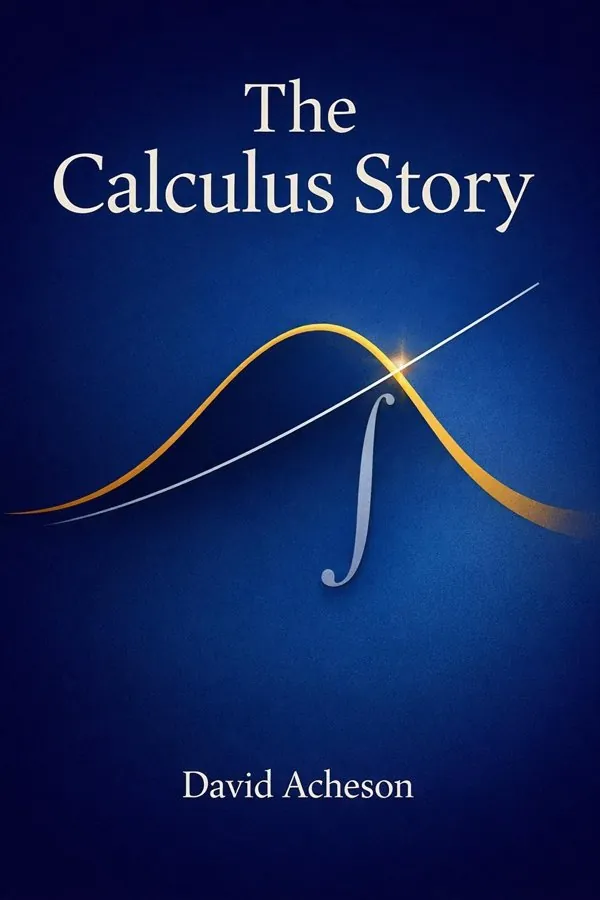
The Calculus Story: A Mathematical Adventure: Summary & Key Insights
 10 min10 chaptersAudio available
Key Takeaways from The Calculus Story: A Mathematical Adventure
Every mathematical revolution begins with a simple irritation: reality does not fit neatly into straight lines and whole numbers.
Great discoveries often arise when two minds see the same mountain from different sides.
One of the boldest ideas in mathematics is that you can measure change at a single instant.
If differentiation tells you how things change, integration tells you what those changes add up to.
Sometimes the deepest ideas are also the most surprising.
What Is The Calculus Story: A Mathematical Adventure About?
The Calculus Story: A Mathematical Adventure by David Acheson is a popular_sci book spanning 10 pages. The Calculus Story: A Mathematical Adventure is a lively, elegant tour through one of humanity’s greatest intellectual inventions. Rather than presenting calculus as a forbidding school subject full of symbols and rules, David Acheson shows it as a dramatic human story: a centuries-long effort to understand motion, change, shape, area, growth, and the hidden patterns of the physical world. Beginning with the geometric insights of the ancient Greeks and moving through the breakthroughs of Newton and Leibniz, the book explains how calculus emerged from practical questions about curves, speed, planets, and measurement. What makes the book matter is its central claim that calculus is not merely a branch of mathematics; it is a language for describing reality. It helps explain everything from falling apples and orbiting planets to engineering design and modern science. Acheson, an applied mathematician and gifted popularizer, writes with authority, humor, and clarity, making difficult ideas feel approachable without stripping away their beauty. The result is a book for curious readers, students, and anyone who has ever wondered how mathematics became powerful enough to map change itself.
This FizzRead summary covers all 10 key chapters of The Calculus Story: A Mathematical Adventure in approximately 10 minutes, distilling the most important ideas, arguments, and takeaways from David Acheson's work. Also available as an audio summary and Key Quotes Podcast.
The Calculus Story: A Mathematical Adventure
The Calculus Story: A Mathematical Adventure is a lively, elegant tour through one of humanity’s greatest intellectual inventions. Rather than presenting calculus as a forbidding school subject full of symbols and rules, David Acheson shows it as a dramatic human story: a centuries-long effort to understand motion, change, shape, area, growth, and the hidden patterns of the physical world. Beginning with the geometric insights of the ancient Greeks and moving through the breakthroughs of Newton and Leibniz, the book explains how calculus emerged from practical questions about curves, speed, planets, and measurement.
What makes the book matter is its central claim that calculus is not merely a branch of mathematics; it is a language for describing reality. It helps explain everything from falling apples and orbiting planets to engineering design and modern science. Acheson, an applied mathematician and gifted popularizer, writes with authority, humor, and clarity, making difficult ideas feel approachable without stripping away their beauty. The result is a book for curious readers, students, and anyone who has ever wondered how mathematics became powerful enough to map change itself.
Who Should Read The Calculus Story: A Mathematical Adventure?
This book is perfect for anyone interested in popular_sci and looking to gain actionable insights in a short read. Whether you're a student, professional, or lifelong learner, the key ideas from The Calculus Story: A Mathematical Adventure by David Acheson will help you think differently.
- ✓Readers who enjoy popular_sci and want practical takeaways
- ✓Professionals looking to apply new ideas to their work and life
- ✓Anyone who wants the core insights of The Calculus Story: A Mathematical Adventure in just 10 minutes
Want the full summary?
Get instant access to this book summary and 100K+ more with Fizz Moment.
Get Free SummaryAvailable on App Store • Free to download
Key Chapters
Every mathematical revolution begins with a simple irritation: reality does not fit neatly into straight lines and whole numbers. Long before calculus had a name, ancient thinkers were already wrestling with the kinds of problems it would eventually solve. How do you measure the area of a circle? How do you compare curved and straight boundaries? How can something be divided again and again without disappearing entirely? These questions pushed Greek mathematicians such as Eudoxus and Archimedes toward methods that anticipated the spirit of calculus.
Acheson shows that Archimedes, in particular, was astonishingly close to modern ideas. By slicing shapes into ever-finer pieces and reasoning about what happens as those pieces become extremely small, he developed methods for finding areas and volumes of figures that could not be handled by ordinary geometry. His “method of exhaustion” was not calculus in the full modern sense, but it relied on the key intuition that difficult continuous quantities can be understood through limiting processes.
This matters because it reveals that calculus did not appear suddenly as a finished invention. It grew out of persistent attempts to solve practical and philosophical puzzles about the continuous world. Even today, when engineers approximate curved surfaces with many tiny straight segments or when software models smooth motion frame by frame, they are using the same underlying habit of thought.
The practical lesson is to respect approximations. When a problem seems too complex to grasp all at once, break it into smaller parts, study the pattern, and ask what happens as the pieces become finer. That habit is one of the deepest roots of calculus.
Great discoveries often arise when two minds see the same mountain from different sides. In the seventeenth century, Isaac Newton and Gottfried Wilhelm Leibniz independently created what we now recognize as calculus. Acheson presents this not just as a historical milestone but as a turning point in human thought: for the first time, mathematics could systematically describe change.
Newton approached the subject through motion and physics. He wanted to understand velocity, acceleration, planetary orbits, and the laws governing bodies in motion. Leibniz, by contrast, developed a wonderfully flexible notation and a more formal method for dealing with infinitesimal changes. Newton thought in terms of flowing quantities; Leibniz thought in terms of differentials. Their rivalry became famous, but Acheson emphasizes that both contributions mattered enormously.
The real breakthrough was not merely technical. Calculus provided a bridge between geometry, algebra, and the physical world. Suddenly, curves were not static drawings but records of changing quantities. A moving body could be described mathematically at each instant, and complicated natural phenomena became open to prediction and analysis.
The modern world still runs on this dual inheritance. Physicists use Newton’s vision whenever they model motion under forces. Students and scientists use Leibniz’s notation whenever they write derivatives and integrals. Even economics, biology, and machine learning rely on this calculus mindset: if a system changes, it can often be modeled.
The actionable takeaway is to remember that major ideas can have multiple origins and styles. If one explanation of a hard concept fails to make sense, try another angle. Calculus itself became powerful precisely because it was approached in more than one way.
One of the boldest ideas in mathematics is that you can measure change at a single instant. At first this seems impossible. How can you calculate speed at exactly one moment if speed normally means distance traveled over time? Acheson uses this apparent paradox to introduce differentiation, the central tool for finding rates of change.
Differentiation begins with the slope of a graph. Over an interval, slope is straightforward: rise divided by run. But if you want the slope of a curve at one exact point, you look at the slopes of secant lines connecting that point to nearby points. As the nearby point gets closer and closer, the secant approaches a tangent, and the limiting slope becomes the derivative. This is how average change turns into instantaneous change.
The power of the derivative is immense. In physics, it gives velocity from position and acceleration from velocity. In economics, it can show how revenue changes when price changes slightly. In medicine, it can help model how fast a drug concentration rises or falls in the bloodstream. In everyday life, even the speedometer in a car reflects the derivative idea: how position changes with time.
Acheson excels at making this feel intuitive rather than mystical. He shows that the derivative is not a trick with symbols but a disciplined way of asking, “What is happening right now?” Once you understand that, the formulas become meaningful.
Your practical takeaway is to look for changing quantities around you: temperature, speed, population, battery charge, costs. Ask not only what their values are, but how fast they are changing. That question is the doorway into differential thinking.
If differentiation tells you how things change, integration tells you what those changes add up to. Acheson presents integration as the natural answer to a fundamental question: how do you measure a total when the pieces are continuously varying? This is the problem of area, accumulation, and summation over a continuum.
Imagine trying to find the area under a curve. If the boundary were a rectangle, the answer would be easy. But a curved line defeats ordinary formulas. The brilliant move is to divide the region into many thin strips, estimate each strip’s area, and then add them together. As the strips become narrower and more numerous, the approximation improves. In the limit, you get the exact integral.
This same idea appears everywhere. Distance traveled can be found by integrating speed over time. The total amount of rainfall over a day can be determined from a changing rate of precipitation. Engineers calculate loads, fluid flow, and energy using integrals. Economists aggregate marginal changes into total costs or benefits. Even probability theory relies heavily on integration when dealing with continuous distributions.
Acheson makes clear that integration is not only about area. It is about accumulation from infinitely many tiny contributions. That is what makes it such a universal concept. Whenever a total emerges from continuously changing parts, integration is nearby.
The actionable lesson is to train yourself to recognize totals built from rates. When you see a graph of something changing over time, ask what the accumulated effect might be. Thinking in terms of “small pieces adding up” is one of the most useful habits calculus can teach.
Sometimes the deepest ideas are also the most surprising. The Fundamental Theorem of Calculus links differentiation and integration, two concepts that at first seem unrelated. One measures instantaneous change; the other measures total accumulation. Acheson shows that the astonishment of calculus lies in discovering that these are, in a profound sense, inverse processes.
If you know how a quantity changes, integration can reconstruct the total amount accumulated. If you know an accumulated quantity as a function, differentiation can recover its rate of change. This connection gives calculus its extraordinary efficiency. Instead of laboriously summing infinitely many tiny pieces directly, one can often find an antiderivative and evaluate it at the endpoints. A hard accumulation problem becomes a manageable symbolic one.
This theorem is one reason calculus transformed science so dramatically. It created a coherent system rather than a bag of techniques. Motion, area, growth, decay, and waves could all be handled within the same framework. In practical terms, it lets physicists move between force and energy, engineers move between rates and totals, and scientists convert local behavior into global understanding.
Acheson treats this theorem not merely as a computational convenience but as an intellectual revelation. It says that the world’s smooth changes and its accumulated outcomes are deeply connected. Local and global are not separate realms.
The practical takeaway is simple but powerful: when faced with a complicated total, search for the underlying rate; when faced with a changing rate, think about the total it produces. Moving back and forth between these two viewpoints is one of the core strengths of mathematical reasoning.
Calculus depends on a daring act of thought: taking something unfinished and giving it precise meaning. That is what limits do. Acheson explains that without limits, ideas like instantaneous velocity, tangent lines, and infinite sums would remain vague intuitions. Limits provide the discipline that turns them into mathematics.
A limit asks what value a quantity approaches as some process continues. A point moves closer, an interval shrinks, or a sum extends further and further. The key is that the quantity need not literally arrive in a simple finite way; what matters is the value it tends toward. This subtle concept allows calculus to talk rigorously about the infinitely small and the infinitely many without falling into contradiction.
Infinite series offer a vivid example. Acheson explores how a sequence of terms can continue forever and yet add up to a finite result. This seems paradoxical at first, but familiar situations make it believable. If you walk halfway to a wall, then half the remaining distance, and so on, the number of steps is infinite in description but the total distance is finite. Such reasoning is central to mathematics, physics, signal processing, and numerical methods.
Limits also shape modern computation. Calculators, simulations, and engineering models often rely on iterative approximations that get closer and closer to the correct answer. In that sense, limits are not abstract decorations; they are practical tools for working with complex reality.
Your actionable takeaway is to become comfortable with approximation that improves systematically. Instead of demanding immediate exactness, ask whether a process converges toward a stable answer. That mindset is essential not only in calculus but in science, coding, and decision-making.
The triumph of calculus was not just that it solved mathematical puzzles, but that it unlocked the mechanics of the universe. Acheson shows how closely calculus is tied to motion. Once you can describe how position changes with time, and how that rate itself changes, you can write laws of motion with unprecedented precision.
This is where Newton’s genius shines. Force becomes linked to acceleration, and acceleration is the derivative of velocity, which is the derivative of position. Suddenly, motion is no longer a matter of philosophical speculation alone; it becomes calculable. Falling objects, cannonballs, pendulums, and planets all submit to the same mathematical treatment. This was revolutionary because it suggested that nature itself has a hidden mathematical order.
The applications extend far beyond classical mechanics. Electrical circuits, population growth, heat flow, fluid dynamics, and wave motion can all be expressed through differential equations, which are essentially calculus statements about how systems change. Modern engineering depends on solving such equations to design bridges, aircraft, satellites, and medical devices.
Acheson’s achievement is to convey the excitement of this development without drowning readers in technical machinery. He helps us see why a simple derivative can have cosmic consequences. Calculus became the engine of physics because the world is always in motion, and motion demands a language of change.
The practical takeaway is to notice dynamic systems in everyday life. Whether you are tracking fitness progress, business growth, or traffic flow, think in terms of variables influencing rates of change. That habit connects ordinary observation to the same logic that powers scientific modeling.
Mathematics becomes memorable when it unsettles intuition before restoring it at a higher level. Acheson understands this, and one of the pleasures of The Calculus Story is his willingness to linger over paradoxes, surprises, and elegant results. He shows that calculus is not only useful; it is intellectually beautiful because it repeatedly turns apparent impossibilities into coherent truths.
Zeno’s paradoxes are a classic example. How can motion occur if one must first cover half a distance, then half the remainder, and so on forever? Calculus resolves the puzzle by distinguishing between infinitely many conceptual subdivisions and a finite total limit. Likewise, the idea of a tangent line touching a curve at a single point yet still having a meaningful slope initially seems strange. The derivative makes it precise. Infinite series that sum to finite values, or curved areas computed by straight-edged approximations, create similar moments of productive astonishment.
Acheson uses these tensions to show how mathematical rigor grows out of imaginative discomfort. We advance not by avoiding perplexity but by confronting it carefully. This is one reason calculus has enduring educational value: it trains the mind to hold subtle ideas without collapsing into confusion.
There is practical value here too. Many modern problems, from probability to economics to data science, involve counterintuitive outcomes. A mathematical habit of mind helps us resist snap judgments and investigate structure instead.
The actionable takeaway is to treat confusion as a signal of possible insight. When a result seems paradoxical, do not dismiss it immediately. Slow down, test the assumptions, and let the puzzle teach you how your intuition can expand.
A great invention rarely stays confined to its original purpose. Acheson makes clear that calculus did not stop with Newton and Leibniz. Once the basic machinery existed, generations of mathematicians refined it, generalized it, and pushed it into new territories. Questions about rigor, notation, proof, and application led to a much richer and more powerful subject than the founders could have fully anticipated.
Early calculus often relied on intuitive infinitesimals that worked brilliantly but lacked precise foundations. Later thinkers such as Cauchy and Weierstrass helped formalize limits and continuity, giving the subject greater logical stability. At the same time, calculus expanded into multivariable analysis, vector calculus, complex analysis, and differential equations. These developments allowed mathematicians and scientists to study surfaces, fields, fluids, electromagnetism, and more complicated systems than simple one-dimensional motion.
This growth matters because it shows how knowledge matures. A powerful idea usually begins with practical success, then undergoes clarification and expansion. Modern science depends on this extended family of calculus concepts. Weather prediction, electromagnetism, fluid mechanics, and relativity all build on tools that evolved from the original insights about change and accumulation.
Acheson presents this development as part of the adventure. Calculus is not a static monument but a living tradition of refinement. Its history reminds us that understanding deepens over time, often through criticism and reconstruction as much as through initial inspiration.
The practical takeaway is to view learning as iterative. First aim for useful intuition, then strengthen it with precision. Mastery often comes in layers, just as calculus itself became stronger by evolving from rough brilliance into rigorous power.
The most important technologies often become invisible. Acheson’s story ends by reminding us that calculus is woven into modern life so thoroughly that we rarely notice it. What began as a method for understanding curves and motion now underpins science, engineering, economics, and much of the digital world.
Whenever an aircraft wing is designed, a bridge is stress-tested, a signal is processed, or an epidemic is modeled, calculus is at work. GPS systems rely on physics and satellite motion described through calculus-based equations. Medical imaging, pharmacology, and biomechanics all depend on rates of change and continuous models. In finance, derivatives in the mathematical sense help analyze risk and changing values. In computing and machine learning, optimization methods often use gradients, which are direct descendants of differentiation.
What makes this especially striking is that calculus remains conceptually simple at its core. It asks two master questions: how fast is something changing, and what total results from that change over time or space? Those questions are timeless. As long as the world contains motion, growth, flow, and variation, calculus will remain relevant.
Acheson therefore does more than tell a historical tale. He restores our sense of wonder about a tool we often treat as merely academic. Calculus is one of the central reasons modern civilization can predict, build, and innovate at scale.
The actionable takeaway is to connect abstract learning with real systems around you. The next time you encounter a graph, a forecast, a moving object, or a technological device, ask what changing quantities lie beneath it. That simple question reveals calculus in everyday life.
All Chapters in The Calculus Story: A Mathematical Adventure
About the Author
David Acheson is a British mathematician and acclaimed popular science writer best known for making complex mathematical ideas clear, lively, and enjoyable. He is an Emeritus Fellow of Jesus College, Oxford, where he taught and worked in applied mathematics. His academic background gives him strong authority on subjects such as mechanics, motion, and the mathematical tools used in science and engineering. Beyond the university, Acheson has built a reputation as an exceptional communicator who can translate difficult concepts for general readers without draining them of their depth or charm. His other books include 1089 and All That and The Wonder Book of Geometry, both of which reflect his gift for combining rigor, curiosity, and humor. In The Calculus Story, he brings that same style to one of mathematics’ most transformative ideas.
Get This Summary in Your Preferred Format
Read or listen to the The Calculus Story: A Mathematical Adventure summary by David Acheson anytime, anywhere. FizzRead offers multiple formats so you can learn on your terms — all free.
Available formats: App · Audio · PDF · EPUB — All included free with FizzRead
Download The Calculus Story: A Mathematical Adventure PDF and EPUB Summary
Key Quotes from The Calculus Story: A Mathematical Adventure
“Every mathematical revolution begins with a simple irritation: reality does not fit neatly into straight lines and whole numbers.”
“Great discoveries often arise when two minds see the same mountain from different sides.”
“One of the boldest ideas in mathematics is that you can measure change at a single instant.”
“If differentiation tells you how things change, integration tells you what those changes add up to.”
“Sometimes the deepest ideas are also the most surprising.”
Frequently Asked Questions about The Calculus Story: A Mathematical Adventure
The Calculus Story: A Mathematical Adventure by David Acheson is a popular_sci book that explores key ideas across 10 chapters. The Calculus Story: A Mathematical Adventure is a lively, elegant tour through one of humanity’s greatest intellectual inventions. Rather than presenting calculus as a forbidding school subject full of symbols and rules, David Acheson shows it as a dramatic human story: a centuries-long effort to understand motion, change, shape, area, growth, and the hidden patterns of the physical world. Beginning with the geometric insights of the ancient Greeks and moving through the breakthroughs of Newton and Leibniz, the book explains how calculus emerged from practical questions about curves, speed, planets, and measurement. What makes the book matter is its central claim that calculus is not merely a branch of mathematics; it is a language for describing reality. It helps explain everything from falling apples and orbiting planets to engineering design and modern science. Acheson, an applied mathematician and gifted popularizer, writes with authority, humor, and clarity, making difficult ideas feel approachable without stripping away their beauty. The result is a book for curious readers, students, and anyone who has ever wondered how mathematics became powerful enough to map change itself.
You Might Also Like

Structures: Or Why Things Don"t Fall Down
J.E. Gordon
10 min
The Road to Wigan Pier
George Orwell
10 min
Bonk: The Curious Coupling of Science and Sex
Mary Roach
10 min
First Bite: How We Learn to Eat
Bee Wilson
10 min
In Pursuit Of The Unknown: 17 Equations That Changed The World
Ian Stewart
10 min
Napoleon's Buttons: 17 Molecules That Changed History
Penny Le Couteur and Jay Burreson
10 minBrowse by Category
Ready to read The Calculus Story: A Mathematical Adventure?
Get the full summary and 100K+ more books with Fizz Moment.