
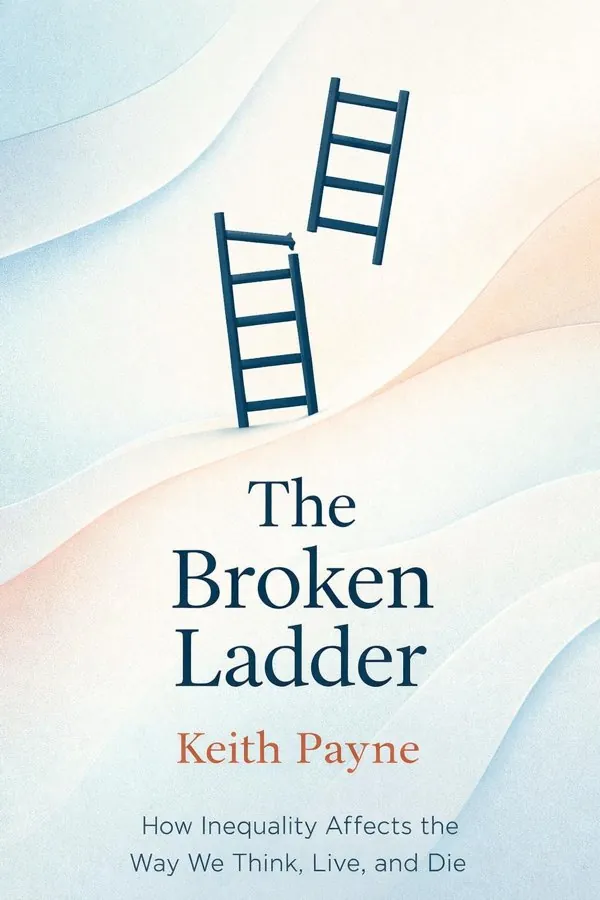
The Broken Ladder: How Inequality Affects the Way We Think, Live, and Die: Summary & Key Insights
by Keith Payne
 10 min9 chaptersAudio available
What Is The Broken Ladder: How Inequality Affects the Way We Think, Live, and Die About?
The Broken Ladder: How Inequality Affects the Way We Think, Live, and Die by Keith Payne is a sociology book spanning 9 pages. In The Broken Ladder, social psychologist Keith Payne explores how economic inequality shapes our perceptions, decisions, and health. Drawing on psychological and neuroscientific research, Payne argues that inequality distorts how people see themselves and others, influencing everything from trust and happiness to political polarization and physical well-being. The book reveals how relative status, not just absolute wealth, profoundly affects human behavior and social cohesion.
This FizzRead summary covers all 9 key chapters of The Broken Ladder: How Inequality Affects the Way We Think, Live, and Die in approximately 10 minutes, distilling the most important ideas, arguments, and takeaways from Keith Payne's work. Also available as an audio summary and Key Quotes Podcast.
The Broken Ladder: How Inequality Affects the Way We Think, Live, and Die
In The Broken Ladder, social psychologist Keith Payne explores how economic inequality shapes our perceptions, decisions, and health. Drawing on psychological and neuroscientific research, Payne argues that inequality distorts how people see themselves and others, influencing everything from trust and happiness to political polarization and physical well-being. The book reveals how relative status, not just absolute wealth, profoundly affects human behavior and social cohesion.
Who Should Read The Broken Ladder: How Inequality Affects the Way We Think, Live, and Die?
This book is perfect for anyone interested in sociology and looking to gain actionable insights in a short read. Whether you're a student, professional, or lifelong learner, the key ideas from The Broken Ladder: How Inequality Affects the Way We Think, Live, and Die by Keith Payne will help you think differently.
- ✓Readers who enjoy sociology and want practical takeaways
- ✓Professionals looking to apply new ideas to their work and life
- ✓Anyone who wants the core insights of The Broken Ladder: How Inequality Affects the Way We Think, Live, and Die in just 10 minutes
Want the full summary?
Get instant access to this book summary and 100K+ more with Fizz Moment.
Get Free SummaryAvailable on App Store • Free to download
Key Chapters
The first step to grasping inequality is to understand that our minds are wired for comparison. Humans are social creatures whose sense of value depends on how we measure ourselves against others. This is not about greed or jealousy; it is about our brain’s built-in system for navigating hierarchies. In psychological experiments, we find that people instinctively note cues of status—clothing, speech, posture, possessions—and immediately assess where they stand.
Social comparison theory shows that people rarely think in absolutes. When they judge their success or contentment, they rely on relative metrics: not how much money they have, but how much more or less than their peers. In an unequal society, the reference points shift dramatically, magnifying feelings of inadequacy and resentment. We internalize inequality as a mirror reflecting back our imagined worth. This is how inequality invades the psychology of even those who appear materially comfortable.
In experiments and data from societies with deep wealth gaps, individuals at every level report heightened anxiety, lower trust, and decreased social engagement. They feel constantly measured, and every interaction becomes a subtle negotiation of rank. The uncertainty of where one stands becomes a chronic stressor, activating the same neural pathways that respond to physical threat. To perceive inequality, then, is not simply to notice others’ advantages—it is to feel those differences in your body.
Our bodies respond to rank as if it were a physical condition. When inequality increases, so does stress-related illness, cardiovascular problems, and even mortality. Research shows that social status can predict health outcomes more strongly than medical access or lifestyle habits. That’s because status itself is biologically encoded. The hormone cortisol, for example, surges when people are reminded of their lower rank or feel undervalued. Chronic exposure to these conditions reshapes the brain’s architecture, impairing memory, creativity, and decision-making.
In animal studies, primates in rigid hierarchies exhibit intense stress at lower ranks. In humans, the same patterns appear: inequality generates constant vigilance. People monitor others’ signals of superiority or inferiority, keeping them trapped in cycles of self-consciousness and competition. The result is not only mental fatigue but reduced physical resilience. High-status individuals experience greater control and predictability in their lives, which dampens stress responses. Lower-status individuals experience uncertainty and lack of control, which amplify them.
This biological dimension means that inequality is not just unfair—it’s unhealthy. It corrodes the fundamental systems that keep us balanced and capable of long-term thinking. The ladder is broken not just socially but physiologically.
+ 7 more chapters — available in the FizzRead app
All Chapters in The Broken Ladder: How Inequality Affects the Way We Think, Live, and Die
About the Author
Keith Payne is a professor of psychology and neuroscience at the University of North Carolina at Chapel Hill. His research focuses on inequality, discrimination, and the psychology of social status. He has published widely in academic journals and is known for his work on implicit bias and the social effects of economic disparity.
Get This Summary in Your Preferred Format
Read or listen to the The Broken Ladder: How Inequality Affects the Way We Think, Live, and Die summary by Keith Payne anytime, anywhere. FizzRead offers multiple formats so you can learn on your terms — all free.
Available formats: App · Audio · PDF · EPUB — All included free with FizzRead
Download The Broken Ladder: How Inequality Affects the Way We Think, Live, and Die PDF and EPUB Summary
Key Quotes from The Broken Ladder: How Inequality Affects the Way We Think, Live, and Die
“The first step to grasping inequality is to understand that our minds are wired for comparison.”
“Our bodies respond to rank as if it were a physical condition.”
Frequently Asked Questions about The Broken Ladder: How Inequality Affects the Way We Think, Live, and Die
The Broken Ladder: How Inequality Affects the Way We Think, Live, and Die by Keith Payne is a sociology book that explores key ideas across 9 chapters. In The Broken Ladder, social psychologist Keith Payne explores how economic inequality shapes our perceptions, decisions, and health. Drawing on psychological and neuroscientific research, Payne argues that inequality distorts how people see themselves and others, influencing everything from trust and happiness to political polarization and physical well-being. The book reveals how relative status, not just absolute wealth, profoundly affects human behavior and social cohesion.
You Might Also Like

Between the World and Me
Ta-Nehisi Coates
10 min
Half the Sky
Nicholas D. Kristof, Sheryl WuDunn
10 min
Men Explain Things To Me
Rebecca Solnit
10 min
Rational Ritual
Michael Suk-Young Chwe
10 min
The New Jim Crow
Michelle Alexander
10 min
Beyond Culture
Edward T. Hall
10 minBrowse by Category
Ready to read The Broken Ladder: How Inequality Affects the Way We Think, Live, and Die?
Get the full summary and 100K+ more books with Fizz Moment.