
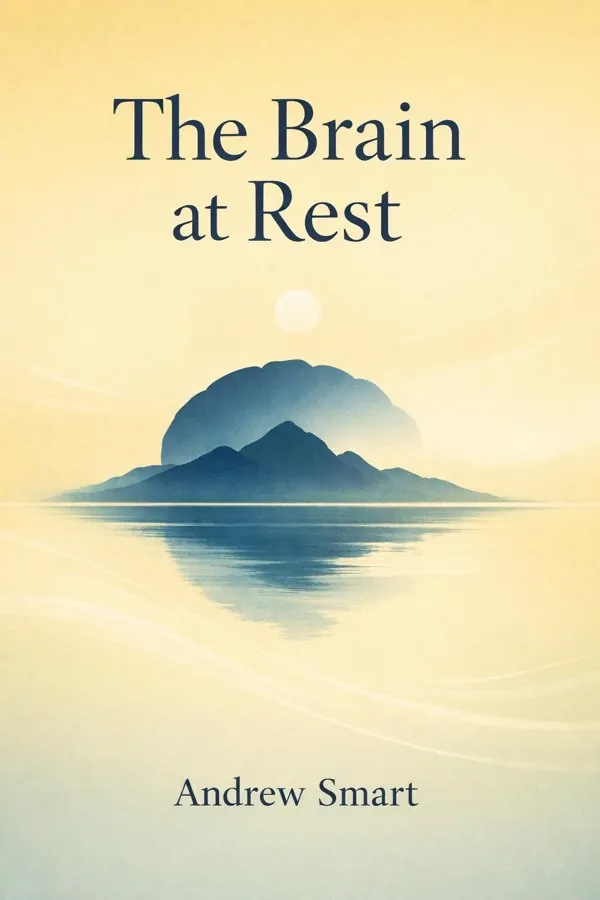
The Brain at Rest: Summary & Key Insights
by Andrew Smart
 10 min9 chaptersAudio available
Key Takeaways from The Brain at Rest
One of the book’s most surprising claims is that rest is not the absence of mental activity but a different kind of intelligence at work.
Boredom feels uncomfortable because it removes the usual scaffolding of stimulation, but Smart argues that this discomfort is often the beginning of deeper thinking.
A powerful theme in The Brain at Rest is that our resistance to idleness is not purely personal; it is cultural.
Smart’s defense of idleness is not sentimental.
One of Smart’s sharpest warnings is that modern technology has made idleness harder than ever to experience.
What Is The Brain at Rest About?
The Brain at Rest by Andrew Smart is a neuroscience book spanning 5 pages. In The Brain at Rest, cognitive scientist Andrew Smart challenges one of modern life’s most unquestioned assumptions: that constant activity is the highest form of intelligence. Drawing on neuroscience, psychology, and philosophy, he argues that idleness is not laziness, wasted time, or mental decline. It is a vital state in which the brain performs some of its most important work. When we stop forcing attention outward, the mind turns inward, linking memories, imagining possibilities, regulating emotion, and generating insight. At the center of Smart’s argument is the brain’s default mode network, a system that becomes active when we are not focused on a specific external task. Rather than going offline, the resting brain becomes deeply engaged in self-reflection, creativity, and long-range thinking. Smart uses research on consciousness, mind-wandering, and mental health to show why rest is essential for both individual well-being and intellectual performance. The book matters because it speaks directly to a culture obsessed with productivity, speed, and distraction. With scientific authority and a provocative voice, Smart offers a powerful defense of downtime as a condition for clearer thinking, emotional balance, and a more human way of living.
This FizzRead summary covers all 9 key chapters of The Brain at Rest in approximately 10 minutes, distilling the most important ideas, arguments, and takeaways from Andrew Smart's work. Also available as an audio summary and Key Quotes Podcast.
The Brain at Rest
In The Brain at Rest, cognitive scientist Andrew Smart challenges one of modern life’s most unquestioned assumptions: that constant activity is the highest form of intelligence. Drawing on neuroscience, psychology, and philosophy, he argues that idleness is not laziness, wasted time, or mental decline. It is a vital state in which the brain performs some of its most important work. When we stop forcing attention outward, the mind turns inward, linking memories, imagining possibilities, regulating emotion, and generating insight.
At the center of Smart’s argument is the brain’s default mode network, a system that becomes active when we are not focused on a specific external task. Rather than going offline, the resting brain becomes deeply engaged in self-reflection, creativity, and long-range thinking. Smart uses research on consciousness, mind-wandering, and mental health to show why rest is essential for both individual well-being and intellectual performance.
The book matters because it speaks directly to a culture obsessed with productivity, speed, and distraction. With scientific authority and a provocative voice, Smart offers a powerful defense of downtime as a condition for clearer thinking, emotional balance, and a more human way of living.
Who Should Read The Brain at Rest?
This book is perfect for anyone interested in neuroscience and looking to gain actionable insights in a short read. Whether you're a student, professional, or lifelong learner, the key ideas from The Brain at Rest by Andrew Smart will help you think differently.
- ✓Readers who enjoy neuroscience and want practical takeaways
- ✓Professionals looking to apply new ideas to their work and life
- ✓Anyone who wants the core insights of The Brain at Rest in just 10 minutes
Want the full summary?
Get instant access to this book summary and 100K+ more with Fizz Moment.
Get Free SummaryAvailable on App Store • Free to download
Key Chapters
One of the book’s most surprising claims is that rest is not the absence of mental activity but a different kind of intelligence at work. For a long time, scientists assumed that the brain became relatively idle when it was not solving problems, reading, or responding to the outside world. Modern imaging research overturned that assumption. When external demands fade, the brain does not simply power down. Instead, a distinct pattern of activity emerges, especially in regions now associated with the default mode network.
This network becomes active during daydreaming, reflection, remembering, imagining, and mentally simulating the future. In other words, the resting brain is busy organizing experience. It helps us build a coherent sense of self, revisit unfinished emotional material, connect unrelated ideas, and prepare for future choices. That means some of the most meaningful mental work happens when we appear to be doing nothing at all.
This insight reshapes the way we think about productivity. If a person stares out a window after a difficult meeting, takes a quiet walk without headphones, or pauses between tasks, that time may be cognitively rich rather than empty. Students often discover a solution after stepping away from a problem. Writers may find language after a period of drifting thought. Professionals may clarify priorities only once meetings and notifications stop.
The practical implication is simple but profound: stop treating every idle moment as a void to be filled. Build small spaces of unstructured time into the day. Sit for ten minutes without checking a device. Walk without a goal. Let your mind settle and wander. Actionable takeaway: deliberately protect at least one short period of tech-free mental downtime each day, and treat it as essential brain work rather than wasted time.
Boredom feels uncomfortable because it removes the usual scaffolding of stimulation, but Smart argues that this discomfort is often the beginning of deeper thinking. When novelty disappears and tasks no longer grip our attention, the mind starts generating its own material. Memories rise, future scenarios appear, unfinished worries resurface, and unexpected associations form. What we call mind-wandering is not a defect of attention in every case. It is one of the ways consciousness explores itself.
This is why some of our best ideas arrive in the shower, on a train, or while waiting in line. In those moments, the brain is freed from strict task demands and can move across broader mental territory. That wandering allows distant ideas to meet. It also creates room for self-understanding. A person who is bored during a quiet afternoon may suddenly realize what has been bothering them for weeks. Another may imagine a career change, solve a design problem, or remember a forgotten promise.
Smart does not romanticize every drifting thought. Rest can also surface anxiety, rumination, or unresolved conflict. But that is part of its value. Silence reveals the content of the mind. When we constantly escape boredom through phones, entertainment, or work, we avoid not only discomfort but also insight.
A practical example is family life. Children who are endlessly scheduled or constantly entertained lose opportunities to invent games, ask strange questions, and develop inner resources. Adults too can relearn this capacity by resisting the urge to fill every pause.
Actionable takeaway: the next time boredom appears, delay the automatic reach for stimulation. Stay with the feeling for a few minutes and observe where your thoughts go before deciding whether you truly need distraction.
A powerful theme in The Brain at Rest is that our resistance to idleness is not purely personal; it is cultural. Modern societies, especially those shaped by industrial discipline and knowledge-economy pressure, tend to moralize busyness. We admire overloaded schedules, celebrate multitasking, and often equate visible effort with value. A person who says they are overwhelmed is frequently treated as more serious, ambitious, or important than someone who has margin in their day.
Smart argues that this cultural bias distorts our understanding of the mind. It encourages people to remain constantly occupied even when rest would improve judgment, creativity, and emotional stability. It also produces guilt. Many people cannot relax without feeling they are falling behind. Even leisure becomes optimized, measured, and turned into another performance metric.
This mindset harms both individuals and institutions. Workplaces may demand endless responsiveness while quietly reducing the very forms of reflection that lead to strategic thinking. Schools may privilege constant assignment completion over contemplation. Families may become so activity-driven that no one has time simply to think, talk, or be still.
The book invites readers to question who benefits from the idea that all visible inactivity is waste. Historically, leisure and contemplation have been tied to philosophy, art, science, and civic life. Some of humanity’s deepest advances emerged not from frantic output but from sustained reflection.
In practical terms, this means redefining what counts as valuable time. A team that includes thinking space in its workflow may make better decisions. A leader who leaves room for reflection may avoid impulsive choices. A parent who allows an unscheduled evening may create emotional ease at home.
Actionable takeaway: audit your language around work and rest for one week. Notice how often you praise busyness by default, and consciously replace that habit with a broader definition of usefulness that includes recovery, reflection, and depth.
Smart’s defense of idleness is not sentimental. It is grounded in a growing body of scientific evidence showing that the brain needs downtime to function well. Studies using functional MRI and related methods have revealed stable patterns of resting activity, while psychological research links periods of incubation to improved problem solving, insight, and learning consolidation. Rest is not a luxury added after the real work is done. In many cases, it is part of the work itself.
This matters because people often assume performance improves in a straight line with effort. Push longer, focus harder, remove pauses, and output should rise. But the brain is not a machine that scales cleanly under constant strain. Attention fatigues. Emotional regulation weakens. Decision quality declines. By contrast, strategically stepping away can improve memory, sharpen judgment, and restore mental flexibility.
We see this in ordinary life all the time. A programmer stuck on a bug often solves it after a walk. A musician hears the right phrase after putting the instrument down. A student recalls material more effectively after spacing study sessions and sleeping well than after a marathon cram session. Scientific findings on sleep, memory replay, and rest-related consolidation all support the idea that important processing continues when direct effort stops.
Smart also points toward mental health research suggesting that chronic overstimulation and relentless task-switching may interfere with the mind’s capacity to integrate experience. Rest helps us metabolize life cognitively and emotionally.
The practical lesson is not to abandon effort but to understand rhythm. Deep work requires deep breaks. Focus needs release. Thinking benefits from intervals rather than endless continuity.
Actionable takeaway: pair demanding cognitive work with real recovery. After every 60 to 90 minutes of concentrated effort, take a short break without screens or incoming information, allowing your brain to reset instead of merely switching tasks.
One of Smart’s sharpest warnings is that modern technology has made idleness harder than ever to experience. Smartphones, social media, constant notifications, and endless streams of content fill spaces that once invited reflection. Waiting, commuting, walking, and even brief pauses in conversation have become opportunities for instant stimulation. The result is not just distraction but the erosion of mental silence.
This constant input has consequences. If the default mode network supports self-reflection, memory integration, and creative association, then a life with no empty intervals may weaken those processes. We become highly reactive but less reflective. We know what is happening everywhere but less about what is happening within us. The mind loses the chance to wander because it is continuously captured.
Smart’s concern is not simply that devices waste time. It is that they change the texture of consciousness. A person who checks a phone whenever stillness appears never fully encounters boredom, uncertainty, or spontaneous thought. This can narrow creativity and increase anxiety because there is no gap in which emotional material can settle and be understood.
Practical examples are easy to recognize. Many people wake and immediately enter a stream of messages, news, and alerts before their own thoughts have formed. Others interrupt every small lull with scrolling, leaving the day fragmented. Over time, it becomes difficult to tolerate any unscripted mental space.
The answer is not total rejection of technology but intentional boundaries. Device-free meals, phone-free walks, notification control, and screen-free transition periods can restore cognitive breathing room. Small changes can reopen access to the resting mind.
Actionable takeaway: choose one recurring daily moment that is currently filled by your phone, such as your commute, lunch break, or first 15 minutes after waking, and make it completely device-free for the next week.
Great ideas often arrive sideways. Smart emphasizes that creativity is not only the product of intense concentration but also of release. After the mind gathers material through study, work, and observation, rest allows hidden processing to continue in the background. This is why breakthroughs often emerge when attention loosens. The brain starts recombining information in ways that deliberate logic alone may not produce.
This process is sometimes called incubation. You wrestle with a question, get nowhere, then leave it alone. Hours later, perhaps while walking, cooking, or staring into space, the solution appears unexpectedly. It feels mysterious, but neuroscience gives it structure. During restful states, broader associative networks can interact more freely, enabling novel connections.
Artists have long understood this intuitively. So have scientists and inventors. Many have used walks, solitude, and unscheduled thinking time as part of their creative process. The lesson is not that discipline is unnecessary. Creative work still requires effort, skill, and revision. But nonstop forcing can become counterproductive when it shuts down the diffuse, integrative modes of thought that produce originality.
In practical terms, this means designing projects with cycles of engagement and stepping back. If you are writing, draft intensely, then leave the page. If you are solving a strategic problem at work, gather the facts, then stop trying to force a conclusion for a while. If you are brainstorming with a team, avoid ending the session with immediate pressure for final answers; allow time for ideas to mature.
Many people mistake pause for loss of momentum. Smart suggests the opposite: the right pause can deepen momentum by letting subconscious processing do its work.
Actionable takeaway: when stuck on a difficult problem, stop pushing for at least 20 minutes and switch to a low-stimulation activity like walking or washing dishes, then return and notice whether new connections have formed.
Rest matters not only for creativity and performance but for identity itself. Smart highlights how inward-directed brain activity supports autobiographical memory, self-evaluation, and the ongoing story we tell about who we are. When the mind is not consumed by immediate tasks, it often turns to personal meaning: what happened to me, what do I feel, what matters now, what kind of future am I moving toward? These are not trivial mental leftovers. They are central to human consciousness.
Without time for this inner work, life can become strangely thin. A person may stay busy for years yet remain unclear about their values, relationships, and motivations. Continuous activity can prevent honest encounter with one’s own mind. That is why periods of quiet sometimes feel unsettling. They strip away distraction and reveal unresolved tensions, grief, longing, or confusion. Yet this confrontation is often the beginning of growth.
Rest also helps integrate experience. After a major event, whether joyful or painful, we need time to process it. Reflection allows emotions to be named, memories to be organized, and lessons to take shape. This can happen through solitude, journaling, slow conversation, meditation, or simply sitting without input.
In a practical sense, this idea is especially important during transitions: career changes, parenthood, loss, adolescence, retirement, or burnout. In such periods, more activity does not always produce more clarity. Sometimes clarity comes only when the pace slows enough for the self to catch up.
Smart’s broader point is that a life without idleness may be externally full but internally underdeveloped. Reflection is not self-indulgence; it is how consciousness becomes coherent.
Actionable takeaway: create a weekly ritual of unstructured reflection, such as 30 minutes of walking, journaling, or silent sitting, and use it to ask not what you need to do next, but what your mind is trying to tell you.
Another key insight in the book is that the brain functions best in rhythms rather than in nonstop intensity. Our culture often imagines an ideal worker or student as someone capable of sustained, uninterrupted output for as long as necessary. But human cognition is cyclical. Attention rises and falls. Motivation fluctuates. Mental energy depletes and recovers. Ignoring these rhythms does not create excellence; it often creates exhaustion, shallow thinking, and diminishing returns.
Smart’s argument helps explain why people can spend long hours at a desk yet produce very little of real value. When breaks disappear, focus becomes brittle. We may still be physically present, but the quality of thinking declines. Rest is not merely recovery after effort. It is part of the architecture of effective effort.
This has important implications for work design. Instead of measuring commitment by time spent online or by constant responsiveness, organizations could value quality, originality, and judgment. Meetings could be reduced to create reflection time. Individuals could stop confusing task-switching with true productivity. Even high performers often do their best work in concentrated bursts followed by real disengagement.
At home, rhythm matters too. Parents, caregivers, and students need periods where nothing is demanded of them. A family schedule with no breathing space may increase stress even when every activity is worthwhile. A sustainable life has alternation: engagement and retreat, speech and silence, effort and pause.
Smart suggests that reclaiming rhythm is not laziness but biological realism. A rested mind does not simply feel better; it often thinks better.
Actionable takeaway: redesign one workday this week around cognitive rhythm by grouping focused tasks into blocks, scheduling breaks before you feel depleted, and protecting at least one uninterrupted period for mental recovery.
Perhaps the most useful implication of The Brain at Rest is that rest is not just something that happens when life accidentally slows down. It can be cultivated as a discipline. In a hyperstimulated environment, idleness often requires intention. We have to protect it, because the world is structured to consume every available second.
Smart’s message is not that everyone should withdraw from ambition or live in permanent leisure. Rather, he asks readers to restore a lost capacity: the ability to be mentally unoccupied without panic. This can begin with surprisingly modest practices. Walking without audio input. Leaving small gaps between meetings. Taking a lunch break without a screen. Sitting outside for ten minutes. Letting children complain of boredom before intervening. Refusing to turn every hobby into a side hustle or every quiet hour into self-improvement.
The value of these habits lies in repetition. As people reacquaint themselves with stillness, they often notice that their thoughts become less fragmented. Ideas emerge more naturally. Emotional reactions become easier to understand. Rest stops feeling like a void and starts feeling like cognitive space.
There is also a deeper philosophical shift here. Deliberate idleness affirms that human worth does not depend entirely on visible output. A person is not a machine for generating measurable results. The mind needs room to wander, not only to perform better but to live more fully.
The most practical approach is to start small and make rest normal rather than exceptional. If downtime is always postponed until burnout, it will never be sufficient. It must be built into ordinary life.
Actionable takeaway: choose one simple rest practice you can sustain for two weeks, such as a daily 10-minute silent walk or a screen-free evening break, and treat it as a non-negotiable appointment with your mind.
All Chapters in The Brain at Rest
About the Author
Andrew Smart is a cognitive and neuroscientist whose work explores consciousness, brain networks, and the role of rest in human thought. He has held research positions at institutions including New York University and the Max Planck Institute for Human Cognitive and Brain Sciences, where he engaged with questions about how the brain functions in both active and passive states. Smart is especially interested in the neuroscience of mind-wandering, self-reflection, and the default mode network, subjects that sit at the center of The Brain at Rest. Writing for a general audience, he brings scientific findings into conversation with cultural questions about work, technology, and well-being. His work stands out for challenging the assumption that constant productivity is the best path to intelligence, creativity, and a meaningful life.
Get This Summary in Your Preferred Format
Read or listen to the The Brain at Rest summary by Andrew Smart anytime, anywhere. FizzRead offers multiple formats so you can learn on your terms — all free.
Available formats: App · Audio · PDF · EPUB — All included free with FizzRead
Download The Brain at Rest PDF and EPUB Summary
Key Quotes from The Brain at Rest
“One of the book’s most surprising claims is that rest is not the absence of mental activity but a different kind of intelligence at work.”
“Boredom feels uncomfortable because it removes the usual scaffolding of stimulation, but Smart argues that this discomfort is often the beginning of deeper thinking.”
“A powerful theme in The Brain at Rest is that our resistance to idleness is not purely personal; it is cultural.”
“Smart’s defense of idleness is not sentimental.”
“One of Smart’s sharpest warnings is that modern technology has made idleness harder than ever to experience.”
Frequently Asked Questions about The Brain at Rest
The Brain at Rest by Andrew Smart is a neuroscience book that explores key ideas across 9 chapters. In The Brain at Rest, cognitive scientist Andrew Smart challenges one of modern life’s most unquestioned assumptions: that constant activity is the highest form of intelligence. Drawing on neuroscience, psychology, and philosophy, he argues that idleness is not laziness, wasted time, or mental decline. It is a vital state in which the brain performs some of its most important work. When we stop forcing attention outward, the mind turns inward, linking memories, imagining possibilities, regulating emotion, and generating insight. At the center of Smart’s argument is the brain’s default mode network, a system that becomes active when we are not focused on a specific external task. Rather than going offline, the resting brain becomes deeply engaged in self-reflection, creativity, and long-range thinking. Smart uses research on consciousness, mind-wandering, and mental health to show why rest is essential for both individual well-being and intellectual performance. The book matters because it speaks directly to a culture obsessed with productivity, speed, and distraction. With scientific authority and a provocative voice, Smart offers a powerful defense of downtime as a condition for clearer thinking, emotional balance, and a more human way of living.
You Might Also Like
Anxious
Joseph LeDoux
10 min
Hallucinations
Oliver Sacks
10 min
The Biological Mind: How Brain, Body, and Environment Collaborate to Make Us Who We Are
Alan Jasanoff
10 min
The Feeling of Life Itself: Why Consciousness Is Widespread but Can't Be Computed
Christof Koch
10 min
The No-Nonsense Meditation Book
Steven Laureys
10 min
A General Theory of Love
Thomas Lewis, Fari Amini, Richard Lannon
10 minBrowse by Category
Ready to read The Brain at Rest?
Get the full summary and 100K+ more books with Fizz Moment.