
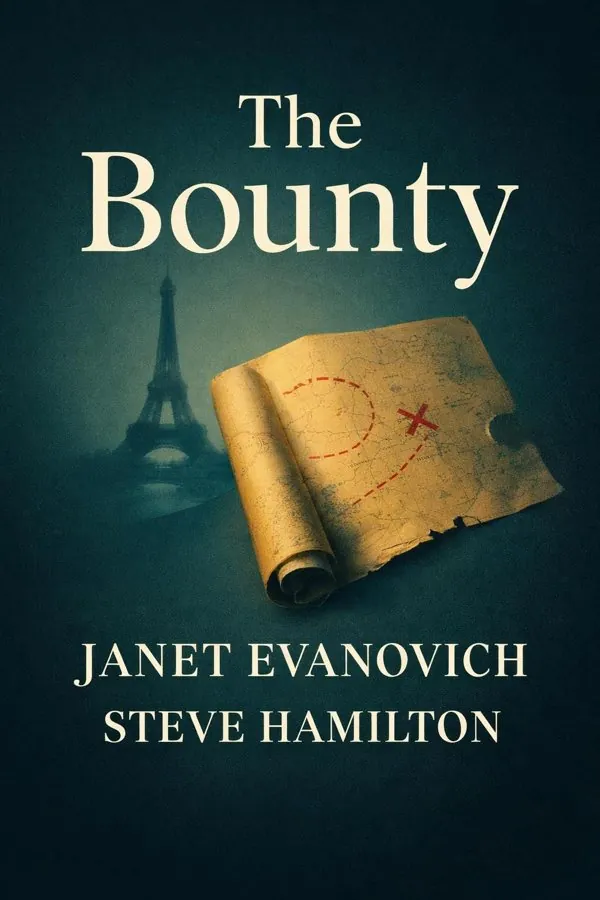
The Bounty: Summary & Key Insights
by Janet Evanovich, Steve Hamilton
 10 min8 chaptersAudio available
Key Takeaways from The Bounty
A mystery becomes irresistible the moment it promises more than money.
The past rarely stays buried when money and memory are involved.
Partnerships become believable when they survive danger, not when they avoid it.
Treasure stories endure because hidden wealth reveals visible character.
Not every battlefield is won by force; many are won by performance.
What Is The Bounty About?
The Bounty by Janet Evanovich, Steve Hamilton is a mystery book spanning 4 pages. What makes a thriller memorable is not just danger, but the chemistry between the people running toward it. In The Bounty, Janet Evanovich and Steve Hamilton deliver exactly that kind of high-energy entertainment, pairing sharp suspense with playful banter, globe-trotting adventure, and a treasure hunt rooted in wartime secrets. The novel follows FBI agent Kate O’Hare and charismatic con man Nick Fox as they pursue a hidden Nazi fortune linked to an old map, a dangerous criminal network, and a trail of clues stretching across Europe. What begins as a hunt for lost treasure quickly becomes a race against ruthless adversaries willing to kill for what history left buried. Beyond the action, the book matters because it blends classic caper storytelling with modern intelligence work, showing how trust, improvisation, and nerve can outmatch brute force. Evanovich brings her trademark humor and fast pacing, while Hamilton contributes atmosphere, tension, and crime-fiction precision. Together, they create a mystery-thriller that feels cinematic but never loses its emotional center. The result is a fun, clever, and highly readable adventure that rewards anyone who enjoys mystery with momentum and personality.
This FizzRead summary covers all 8 key chapters of The Bounty in approximately 10 minutes, distilling the most important ideas, arguments, and takeaways from Janet Evanovich, Steve Hamilton's work. Also available as an audio summary and Key Quotes Podcast.
The Bounty
What makes a thriller memorable is not just danger, but the chemistry between the people running toward it. In The Bounty, Janet Evanovich and Steve Hamilton deliver exactly that kind of high-energy entertainment, pairing sharp suspense with playful banter, globe-trotting adventure, and a treasure hunt rooted in wartime secrets. The novel follows FBI agent Kate O’Hare and charismatic con man Nick Fox as they pursue a hidden Nazi fortune linked to an old map, a dangerous criminal network, and a trail of clues stretching across Europe. What begins as a hunt for lost treasure quickly becomes a race against ruthless adversaries willing to kill for what history left buried. Beyond the action, the book matters because it blends classic caper storytelling with modern intelligence work, showing how trust, improvisation, and nerve can outmatch brute force. Evanovich brings her trademark humor and fast pacing, while Hamilton contributes atmosphere, tension, and crime-fiction precision. Together, they create a mystery-thriller that feels cinematic but never loses its emotional center. The result is a fun, clever, and highly readable adventure that rewards anyone who enjoys mystery with momentum and personality.
Who Should Read The Bounty?
This book is perfect for anyone interested in mystery and looking to gain actionable insights in a short read. Whether you're a student, professional, or lifelong learner, the key ideas from The Bounty by Janet Evanovich, Steve Hamilton will help you think differently.
- ✓Readers who enjoy mystery and want practical takeaways
- ✓Professionals looking to apply new ideas to their work and life
- ✓Anyone who wants the core insights of The Bounty in just 10 minutes
Want the full summary?
Get instant access to this book summary and 100K+ more with Fizz Moment.
Get Free SummaryAvailable on App Store • Free to download
Key Chapters
A mystery becomes irresistible the moment it promises more than money. In The Bounty, the story ignites with the discovery of a secret Nazi treasure map, a relic tied to wartime chaos, hidden wealth, and unfinished history. This is not merely a device to launch the plot; it is the force that pulls every major character into motion. For Kate O’Hare, the map represents a dangerous assignment with international consequences. For Nick Fox, it is an irresistible puzzle, the kind of challenge that rewards intelligence, daring, and theatrical deception. For the criminals circling the map, it is power in its purest form.
The authors use the map to establish one of the novel’s central pleasures: a race in which every clue raises the stakes. The treasure hunt works because it is layered. It promises gold and artifacts, but it also carries questions about wartime theft, greed, and who has the right to claim what was stolen. That moral ambiguity makes the mission richer than a simple chase.
In practical terms, the novel shows how a compelling objective sharpens every decision. Once the map appears, alliances form, risks escalate, and strategy becomes essential. Kate and Nick do not just follow instructions; they interpret, improvise, and constantly reassess the people around them.
In everyday life, the lesson is simple: the clearest missions are often the most energizing, especially when they connect practical reward with deeper meaning. Whether in work, study, or personal goals, a strong “why” fuels persistence when circumstances grow messy. Actionable takeaway: define the real value behind any goal before pursuing it, because purpose is what sustains effort under pressure.
The past rarely stays buried when money and memory are involved. One of the most enjoyable aspects of The Bounty is the way it turns European history into a living puzzle. As Kate and Nick trace the map’s clues across France and Austria, they are not simply moving from one action sequence to another; they are decoding layers of history embedded in landscapes, architecture, wartime records, and local legends. The treasure hunt becomes a lesson in how the physical world stores secrets for those patient enough to read it.
This idea matters because mystery fiction often depends on pattern recognition, and here the patterns are historical. The heroes must think beyond obvious interpretations. A symbol may refer to a military unit, a building may hide an altered past, and a route may make sense only when viewed through the logic of wartime retreat. The novel rewards curiosity, not just courage.
Evanovich and Hamilton also show that knowledge is collaborative. Kate brings discipline and investigative instincts. Nick contributes lateral thinking and con-man creativity. Together, they make sense of clues neither would solve in quite the same way alone. That partnership turns research into action.
Outside fiction, this idea applies to problem-solving in general. We often assume answers lie in direct data, but context is just as valuable. A workplace conflict, for example, may only make sense once you understand the history behind it. A stalled project may reveal its solution when you revisit assumptions made at the beginning.
The book’s broader insight is that successful investigation depends on seeing beyond the surface. Actionable takeaway: when faced with a confusing problem, gather context before forcing a conclusion; often the hidden history explains the present better than the visible facts.
Partnerships become believable when they survive danger, not when they avoid it. The relationship between Kate O’Hare and Nick Fox remains the emotional engine of The Bounty, and this installment deepens that bond by placing them in situations where trust must be tested repeatedly. Kate is a committed FBI agent trained to impose order. Nick is a former con man whose greatest talents involve illusion, performance, and misdirection. On paper, they should be unstable allies. In practice, they work because each recognizes the other’s competence.
The novel uses action scenes, close calls, and strategic disagreements to show how trust evolves. Kate does not blindly accept Nick’s instincts, and Nick does not simply follow authority. Instead, they build a working rhythm based on evidence: each has seen the other deliver under pressure. That is a more convincing foundation than sentiment alone.
Their partnership also reflects a useful real-world principle. Effective teams are often composed of people with very different strengths. The challenge is not eliminating those differences but learning when to rely on them. A risk-aware planner and a creative improviser can become an exceptional pair if they respect each other’s role.
The chemistry between Kate and Nick adds charm and romantic tension, but it also serves the mechanics of the story. Their ability to read one another quickly allows them to pivot in dangerous moments, run convincing deceptions, and maintain control when plans begin to fracture.
The practical lesson is that trust grows from repeated proof, honest communication, and mutual usefulness. It is earned in moments of uncertainty. Actionable takeaway: if you want stronger collaboration, do not just discuss trust abstractly; create opportunities to solve hard problems together and pay attention to who remains reliable when the stakes rise.
Treasure stories endure because hidden wealth reveals visible character. In The Bounty, the hunt for Nazi riches draws in not only skilled investigators but also ruthless criminals, opportunists, and people whose loyalty lasts only as long as profit seems guaranteed. This is where the novel’s suspense sharpens. The map is valuable, but the greater danger comes from those who believe possession alone entitles them to everything attached to it.
The criminal syndicate pursuing the treasure embodies a central truth of the book: greed accelerates betrayal. Alliances that seem solid quickly turn fragile once the fortune appears within reach. Information becomes currency, deception becomes routine, and violence becomes the fastest method of negotiation. The threat is not abstract. Kate and Nick are hunted by people who treat history as a vault to be raided and human life as collateral damage.
This dynamic gives the novel its edge. The treasure hunt is exciting, but the unpredictability of human motives makes it dangerous. The heroes must evaluate not just clues but intentions. They have to ask who is lying, who is desperate, and who might switch sides if circumstances change.
There is a practical lesson here for readers beyond fiction. High-value situations—business deals, inheritance disputes, leadership contests—often expose weak ethics faster than ordinary moments do. Pressure clarifies priorities. People may present themselves as trustworthy when little is at stake, only to reveal something else when reward becomes substantial.
The book suggests that caution is not cynicism; it is wisdom. Understanding incentives helps you predict behavior more accurately than words alone. Actionable takeaway: whenever something valuable is being pursued, examine the motives of everyone involved, because the greatest risk often comes not from the objective itself but from the people competing to control it.
Not every battlefield is won by force; many are won by performance. One of Nick Fox’s defining strengths in The Bounty is his ability to use charm, confidence, and social fluency as strategic tools. He understands that people reveal more when they feel flattered, intrigued, or slightly off-balance. In a novel full of guns, maps, and hidden rooms, this softer form of manipulation becomes just as powerful as any weapon.
The authors handle this idea with humor, but they also take it seriously. Nick’s charm is not random charisma. It is observation turned into action. He studies what others want to hear, how they want to be seen, and what emotional cues lower their guard. Kate, by contrast, often relies on preparation and procedure, creating a useful contrast between institutional power and personal persuasion.
This theme matters because mystery stories frequently celebrate intellect while overlooking presentation. The Bounty reminds readers that delivery shapes outcomes. The right information, offered in the wrong tone, can fail. A well-timed joke, disguise, or polished lie can open doors that direct confrontation never could.
In everyday life, this does not mean becoming dishonest. It means recognizing that influence often depends on empathy, timing, and communication style. A manager trying to motivate a team, a job seeker in an interview, or a student presenting an idea all benefit from understanding how people respond emotionally as well as logically.
The novel’s caution is equally important: charm is effective, but it can be used for good or ill. It should be paired with ethics. Actionable takeaway: strengthen your ability to read a room and adapt your communication, because knowing how to present yourself persuasively can change the outcome of high-stakes situations.
Suspense becomes more enjoyable when it allows room for laughter. A major reason The Bounty stands out among action mysteries is its refusal to become grim for long. Janet Evanovich and Steve Hamilton understand that humor is not a distraction from danger; it is what makes danger emotionally bearable and the characters more memorable. Witty exchanges, absurd predicaments, and the playful friction between Kate and Nick create a tone that keeps the story moving at high speed without becoming heavy.
This tonal balance is harder to achieve than it looks. If a thriller leans too far into jokes, it loses urgency. If it leans too far into darkness, it can become exhausting. The Bounty finds a middle path. Humor works here because it grows naturally from personality. Nick’s swagger, Kate’s grounded practicality, and their contrasting approaches produce banter that reveals character while also easing tension.
The result is a story that feels accessible even when the stakes are deadly. Readers are invited to enjoy the ride rather than merely endure it. That is one of the novel’s greatest strengths as entertainment.
There is also a real-world insight beneath the fun. In stressful circumstances, humor can restore perspective, reinforce bonds, and help people think more clearly. Teams under pressure often perform better when they can release tension without losing focus. A well-placed moment of levity can interrupt panic and remind people that they are still capable of acting effectively.
The key, as the book demonstrates, is using humor to support resilience rather than deny reality. Actionable takeaway: when pressure rises, do not eliminate lightness entirely; use humor thoughtfully to keep morale high, preserve connection, and prevent stress from narrowing your judgment.
No plan remains elegant once real people start interfering with it. Throughout The Bounty, Kate and Nick enter situations with strategy, but their success depends less on flawless preparation than on rapid adaptation. Clues shift meaning, enemies appear unexpectedly, and supposedly controlled operations turn chaotic. Rather than presenting its heroes as invincible masterminds, the novel makes them effective because they are flexible.
This is one of the book’s most practical ideas. Kate’s training gives structure to missions, while Nick’s improvisational instincts help when structure collapses. Together, they show that planning and spontaneity are not opposites but partners. A good framework provides direction; resourcefulness handles the inevitable surprises.
The treasure hunt format amplifies this principle. Every location introduces new constraints—language barriers, local dangers, hidden agendas, unstable alliances. The characters cannot rely on one method repeatedly. They must adjust tools, identities, and assumptions to match changing circumstances.
Readers can apply this lesson immediately. In careers, travel, parenting, entrepreneurship, or creative work, uncertainty is normal. People often overvalue perfect plans and undervalue the skill of responding well when plans fail. But resilience is built in the moments after expectations are disrupted. The person who can stay calm, gather new information, and try another angle often outperforms the person who only knows how to follow the original script.
The novel ultimately argues that competence is dynamic. It is not the absence of setbacks but the ability to turn setbacks into workable opportunities. Actionable takeaway: prepare carefully, but hold your plans loosely; when conditions change, focus less on preserving the original plan and more on preserving the mission.
What people seek often reveals who they already are. At the surface level, The Bounty is about pursuing hidden Nazi loot across Europe. At a deeper level, it is about the motivations that drive each player toward the same objective for different reasons. Kate is motivated by duty and justice. Nick is energized by challenge, strategy, and loyalty to the team he has built with Kate. Their enemies are drawn by greed, dominance, and the fantasy of instant power. The treasure may be singular, but the meanings attached to it are not.
This is why the novel feels more substantial than a simple chase. The hunt acts like a pressure chamber. Strip away ordinary routines, add danger and reward, and people reveal their priorities quickly. Some become courageous. Some become reckless. Some become treacherous. The treasure is less important than what the pursuit exposes.
This theme is reinforced by the book’s connection to wartime theft. The hidden bounty is not morally neutral wealth; it is tied to a history of violence and appropriation. That context challenges the reader to think about ownership, justice, and whether recovering stolen riches can ever be separate from reckoning with the crimes that produced them.
In practical life, goals have a similar effect. Ambition can clarify values. A promotion, major sale, public recognition, or financial opportunity often reveals whether someone prioritizes integrity or convenience. The pursuit itself becomes a character test.
The novel leaves readers with an enduring insight: the object of desire matters less than the person one becomes while trying to obtain it. Actionable takeaway: before chasing any major reward, ask what your methods will say about your values, because success achieved at the cost of character rarely feels like victory for long.
All Chapters in The Bounty
About the Authors
Janet Evanovich is a bestselling American novelist widely known for her Stephanie Plum series, which combines crime, comedy, and memorable character dynamics. Her work has attracted a large global readership thanks to its fast pacing, humor, and accessible storytelling. Steve Hamilton is an Edgar Award–winning American author recognized for his Alex McKnight mystery novels and his strong command of suspense, atmosphere, and crime plotting. Together, Evanovich and Hamilton bring complementary talents to their collaborations: she contributes wit, energy, and commercial flair, while he adds tension, structure, and investigative depth. Their coauthored Kate O’Hare and Nick Fox series blends thriller stakes with caper-style fun, creating mystery novels that are both highly entertaining and expertly crafted.
Get This Summary in Your Preferred Format
Read or listen to the The Bounty summary by Janet Evanovich, Steve Hamilton anytime, anywhere. FizzRead offers multiple formats so you can learn on your terms — all free.
Available formats: App · Audio · PDF · EPUB — All included free with FizzRead
Download The Bounty PDF and EPUB Summary
Key Quotes from The Bounty
“A mystery becomes irresistible the moment it promises more than money.”
“The past rarely stays buried when money and memory are involved.”
“Partnerships become believable when they survive danger, not when they avoid it.”
“Treasure stories endure because hidden wealth reveals visible character.”
“Not every battlefield is won by force; many are won by performance.”
Frequently Asked Questions about The Bounty
The Bounty by Janet Evanovich, Steve Hamilton is a mystery book that explores key ideas across 8 chapters. What makes a thriller memorable is not just danger, but the chemistry between the people running toward it. In The Bounty, Janet Evanovich and Steve Hamilton deliver exactly that kind of high-energy entertainment, pairing sharp suspense with playful banter, globe-trotting adventure, and a treasure hunt rooted in wartime secrets. The novel follows FBI agent Kate O’Hare and charismatic con man Nick Fox as they pursue a hidden Nazi fortune linked to an old map, a dangerous criminal network, and a trail of clues stretching across Europe. What begins as a hunt for lost treasure quickly becomes a race against ruthless adversaries willing to kill for what history left buried. Beyond the action, the book matters because it blends classic caper storytelling with modern intelligence work, showing how trust, improvisation, and nerve can outmatch brute force. Evanovich brings her trademark humor and fast pacing, while Hamilton contributes atmosphere, tension, and crime-fiction precision. Together, they create a mystery-thriller that feels cinematic but never loses its emotional center. The result is a fun, clever, and highly readable adventure that rewards anyone who enjoys mystery with momentum and personality.
You Might Also Like

Browse by Category
Ready to read The Bounty?
Get the full summary and 100K+ more books with Fizz Moment.