
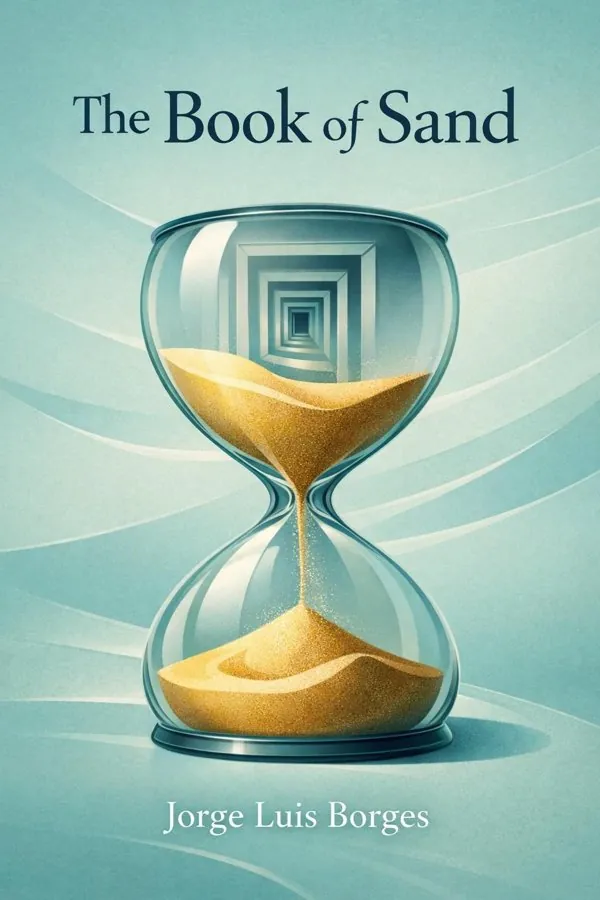
The Book of Sand: Summary & Key Insights
 10 min9 chaptersAudio available
Key Takeaways from The Book of Sand
One of Borges’s most unsettling insights is that the self is never fully singular.
Love, in Borges, is rarely only romantic; it is often a transformation of reality itself.
Human beings long to create systems that include everyone, everything, and every point of view.
Some realities are not denied by reason so much as they overflow it.
We usually assume that art aims toward better and better expression.
What Is The Book of Sand About?
The Book of Sand by Jorge Luis Borges is a classics book spanning 8 pages. The Book of Sand is Jorge Luis Borges’s final major collection of short stories, first published in 1975, and it reads like the distilled essence of a lifetime spent thinking about infinity, identity, memory, language, and the strange instability of reality. In these stories, Borges returns to the themes that made him one of the most influential writers of the twentieth century: doubles who unsettle the self, books that behave like impossible universes, mirrors that divide existence, and quests for absolute meaning that end in mystery. Yet this collection also carries the weight of age. Written late in Borges’s life, many of the stories feel quieter, more intimate, and more haunted by mortality than his earlier masterpieces. That maturity gives the book unusual emotional depth. Borges matters because he transformed the short story into a philosophical instrument, proving that fiction can contain the force of metaphysics without losing wonder. The Book of Sand is not a conventional narrative collection but a chamber of intellectual enchantments, where each story invites readers to question what is real, what is remembered, and whether human beings can ever grasp the infinite they so obsessively pursue.
This FizzRead summary covers all 9 key chapters of The Book of Sand in approximately 10 minutes, distilling the most important ideas, arguments, and takeaways from Jorge Luis Borges's work. Also available as an audio summary and Key Quotes Podcast.
The Book of Sand
The Book of Sand is Jorge Luis Borges’s final major collection of short stories, first published in 1975, and it reads like the distilled essence of a lifetime spent thinking about infinity, identity, memory, language, and the strange instability of reality. In these stories, Borges returns to the themes that made him one of the most influential writers of the twentieth century: doubles who unsettle the self, books that behave like impossible universes, mirrors that divide existence, and quests for absolute meaning that end in mystery. Yet this collection also carries the weight of age. Written late in Borges’s life, many of the stories feel quieter, more intimate, and more haunted by mortality than his earlier masterpieces. That maturity gives the book unusual emotional depth. Borges matters because he transformed the short story into a philosophical instrument, proving that fiction can contain the force of metaphysics without losing wonder. The Book of Sand is not a conventional narrative collection but a chamber of intellectual enchantments, where each story invites readers to question what is real, what is remembered, and whether human beings can ever grasp the infinite they so obsessively pursue.
Who Should Read The Book of Sand?
This book is perfect for anyone interested in classics and looking to gain actionable insights in a short read. Whether you're a student, professional, or lifelong learner, the key ideas from The Book of Sand by Jorge Luis Borges will help you think differently.
- ✓Readers who enjoy classics and want practical takeaways
- ✓Professionals looking to apply new ideas to their work and life
- ✓Anyone who wants the core insights of The Book of Sand in just 10 minutes
Want the full summary?
Get instant access to this book summary and 100K+ more with Fizz Moment.
Get Free SummaryAvailable on App Store • Free to download
Key Chapters
One of Borges’s most unsettling insights is that the self is never fully singular. In “The Other,” an older Borges meets his younger self on a bench, and what begins as a conversation becomes a meditation on time, memory, and the instability of identity. The encounter is not framed as a simple fantasy. Instead, Borges presents it with calm precision, as though the impossible were merely another fact to be examined. The younger man and the older man share memories, challenge one another, and expose the distance between who we once were and who we become.
The story suggests that time does not simply move forward in a straight line. It folds, doubles back, and allows one version of the self to haunt another. We often think of our identity as continuous, but Borges reveals how much of life involves estrangement from our earlier selves. The dreams, ambitions, fears, and illusions of youth can feel like the possessions of someone else. Yet they remain ours. This is what gives the story its emotional power: the recognition that we are both one person and many people across time.
In practical terms, this idea helps explain why journals, photographs, and old letters can feel uncanny. They remind us that personal growth is not the replacement of one self by another, but an ongoing dialogue among former and present versions of who we are. In work, relationships, and creative life, this perspective can foster humility. Today’s certainties may become tomorrow’s curiosities.
Actionable takeaway: Revisit a past version of yourself through an old notebook, email, or memory, and ask what that earlier self still has to teach you.
Love, in Borges, is rarely only romantic; it is often a transformation of reality itself. In “Ulrica,” a brief and luminous story, an encounter between a man and a woman becomes charged with mythic resonance. Their meeting is filtered through names, literary echoes, and Norse associations, so that desire seems to shift both language and identity. The story is intimate, but it also suggests that love allows us to step outside the ordinary limits of the self.
What makes “Ulrica” unusual in Borges’s body of work is its tenderness. He was more often associated with labyrinths, metaphysical puzzles, and intellectual designs than with emotional openness. Here, however, he shows that love can be another kind of labyrinth: not a trap of confusion, but a passage into symbolic transformation. The woman is not merely a person; she becomes a figure through whom myth enters the present. The experience is brief, but its intensity grants it permanence.
This story also reveals how language shapes emotional reality. The names we give to one another, the stories we borrow, and the metaphors we inhabit influence how we experience intimacy. In real life, relationships often deepen through shared vocabularies, private references, and meaningful symbols. A place, phrase, or book can become sacred because two people have invested it with feeling.
The practical lesson is not that love must be grand or dramatic, but that attentiveness gives it depth. When we notice the symbolic texture of experience, ordinary encounters become more vivid and memorable. Literature, memory, and affection enrich one another.
Actionable takeaway: Think about one relationship in your life and identify the shared words, stories, or rituals that give it meaning; strengthen one of them intentionally.
Human beings long to create systems that include everyone, everything, and every point of view. “The Congress,” one of the most ambitious stories in the collection, explores that longing through an organization that seeks to represent the whole world. The project sounds noble, even magnificent: a congress vast enough to contain all nations, classes, professions, languages, and experiences. But as the story unfolds, the dream of total inclusion becomes unwieldy, absurd, and finally self-consuming.
Borges uses the tale to expose a paradox at the heart of every universal system. To represent reality completely, one must make choices. But each choice excludes something. Every classification simplifies what it claims to contain. The greater the ambition for total representation, the more impossible the task becomes. The Congress is therefore both a satire of bureaucracy and a profound philosophical reflection on knowledge itself.
This idea has immediate relevance today. Institutions, databases, algorithms, and political movements often promise comprehensive understanding. Companies claim to know their customers; governments seek to count populations; digital platforms sort identities into categories. Borges reminds us that total representation is an illusion. Reality exceeds our labels. A spreadsheet can be useful, but it never captures the full complexity of a human life.
At the same time, the story does not mock aspiration altogether. It recognizes the beauty of the desire to connect disparate people under a common vision. Its warning is simply that the world is larger, stranger, and less manageable than our systems allow.
Actionable takeaway: Whenever you encounter a grand framework that claims to explain everything, ask what it leaves out, and make room for complexity rather than forcing false completeness.
Some realities are not denied by reason so much as they overflow it. In “There Are More Things,” Borges offers a tale of eerie discovery in which a man investigates a house altered by a mysterious occupant. The story evokes Lovecraftian horror, but Borges transforms that mode into something more philosophical. The terror does not come only from a monster. It comes from architecture, scale, and the dawning realization that the human mind may not be built to comprehend everything that exists.
The house becomes a symbol of reality itself: familiar at first glance, but increasingly alien as one notices details that do not fit ordinary human use. Doors, furniture, dimensions, and arrangements suggest a mode of being outside normal human categories. Borges’s genius lies in restraint. He lets implication do the work. The unknown is frightening not because it is fully described, but because it resists description.
This story speaks to modern life more than it first appears. We regularly confront systems, technologies, and events whose full complexity exceeds our understanding. Financial markets crash through invisible mechanisms. Artificial intelligence produces results few can fully explain. Social trends emerge from forces too distributed to grasp. In such moments, uncertainty produces anxiety, and people rush to invent simple explanations.
Borges advises another response: intellectual honesty. Not everything immediately yields to understanding, and pretending otherwise can be more dangerous than admitting our limits. Wonder and fear often arise together when reality exceeds our conceptual furniture.
Actionable takeaway: The next time you face something confusing or unfamiliar, resist the urge for premature certainty; write down what you know, what you suspect, and what remains genuinely unknown.
We usually assume that art aims toward better and better expression. “The Mirror and the Mask” complicates that belief by showing a poet and a king engaged in a quest for the perfect poem. Each new work becomes more refined, more exact, and more devastating, until the highest achievement can no longer be comfortably possessed or publicly repeated. The story suggests that true perfection may exceed ordinary language and even destroy the conditions of communication.
At one level, Borges is exploring aesthetics: What would it mean for a work of art to be complete? At another, he is examining power. The king commissions the poem, but the poem’s ultimate force cannot be controlled by patronage, reward, or institution. Once language approaches something absolute, it ceases to behave like a social tool. It becomes dangerous, sacred, and isolating.
This is a useful antidote to modern productivity culture, which often treats creativity as output to be optimized. Borges reminds us that some of the most meaningful human experiences cannot be endlessly improved through technique alone. There is a threshold beyond which refinement becomes transformation. In everyday life, this appears when a conversation, insight, or artistic gesture says exactly enough and no more. Excess explanation can weaken impact.
The story also raises an ethical question: are we ready for what we say we want? Perfection is often imagined as a harmless ideal, but Borges reveals that absolutes can unsettle human life rather than complete it.
Actionable takeaway: In your next piece of writing, presentation, or difficult conversation, revise for precision, then stop when the core truth is clear instead of adding more to feel safer.
Borges repeatedly returns to the idea that language both reveals and conceals reality. In “Undr,” this fascination takes the form of a quest for a single perfect word, one capable of encapsulating something ultimate. The story unfolds like a legend or scholarly puzzle, inviting readers to consider whether meaning can ever be compressed into one final utterance. Is there a word that contains truth without remainder, or is the longing for such a word itself a human illusion?
The power of the story lies in its tension between mystical hope and linguistic skepticism. On one hand, many traditions have imagined sacred words, secret names, or primal sounds that carry transformative power. On the other, Borges understood better than most writers that words are unstable signs, dependent on context, interpretation, and memory. “Undr” holds both possibilities in suspension. It neither dismisses the dream of perfect language nor fully grants it.
This has practical implications for communication. People often search for the perfect phrase to define a relationship, summarize a project, explain a trauma, or express an aspiration. Sometimes the search is valuable, because language clarifies thought. Yet Borges shows that no single word can fully replace the complexity of lived experience. Precision matters, but finality may be impossible.
The story encourages reverence for words without naïveté about them. The right term can illuminate, heal, or transform. But language is strongest when we recognize both its power and its limits. The mystery is not a failure of speech; it is part of what makes speech necessary.
Actionable takeaway: When you struggle to find the exact words, aim first for honest and vivid language rather than perfect language; clarity often emerges through approximation and revision.
What happens when civilization survives but its passions fade? In “Utopia of a Tired Man,” Borges imagines a distant future stripped of many familiar ambitions: nationalism, possession, reproduction, and even the urgency of individuality have weakened. The result is not a triumphant technological paradise, nor a conventional dystopia, but a world marked by weariness, detachment, and eerie calm. Humanity seems to have outlived many of its historical compulsions, but it has also lost some of its vitality.
The story’s brilliance lies in its refusal of simple judgment. Borges does not say this future is purely better or worse. Instead, he asks what remains of meaning when struggle diminishes. Much of human life is driven by desire, conflict, scarcity, and longing. Remove those pressures, and suffering may lessen, but so may intensity. The tale becomes a meditation on whether progress can accidentally flatten the very energies that made culture, love, and ambition possible.
This question is deeply contemporary. Many modern conveniences are designed to reduce friction: streaming replaces searching, automation replaces labor, optimization replaces effort. Yet people in highly efficient societies often report boredom, fatigue, and disconnection. Borges anticipates this paradox. A life with fewer burdens is not automatically a life with richer purpose.
The story encourages us to distinguish comfort from meaning. Ease can be valuable, but a fully human existence may still require challenge, commitment, and forms of risk. A civilization can solve many practical problems while leaving existential hunger untouched.
Actionable takeaway: Notice one area of life that has become merely convenient, and reintroduce a meaningful challenge, craft, or responsibility that demands your active engagement.
Few Borges stories capture his metaphysical imagination more memorably than “The Disk” and “The Book of Sand,” both centered on impossible objects that seem to violate the laws of ordinary reality. In “The Disk,” an enigmatic object carries singularity and obsession. In “The Book of Sand,” a mysterious volume has no first page, no last page, and an apparently infinite number of leaves. Every attempt to master it fails. The object is both mundane and monstrous: a book, the most civilized of forms, transformed into an abyss.
These stories dramatize a recurring Borgesian theme: human beings desire the infinite, but cannot safely possess it. The mind seeks totality, whether in religion, knowledge, art, or collection. Yet when infinity appears in material form, it becomes unbearable. The narrator of “The Book of Sand” does not gain enlightenment from the volume. He becomes consumed by it, isolated by it, and finally desperate to hide it. The infinite here is not liberating transcendence. It is existential suffocation.
This idea applies to modern forms of excess. Endless feeds, limitless digital archives, infinite scrolling, and constant information access all promise abundance. Yet they often produce anxiety rather than wisdom. More is not the same as meaning. Without boundaries, attention fractures. Borges understood that finitude is not merely a limitation; it is what makes orientation possible.
The stories are therefore cautionary tales about obsession, collecting, and the fantasy of complete access. A finite life requires selection, and selection is not failure. It is the precondition of understanding.
Actionable takeaway: Reduce one source of informational infinity in your life by setting a boundary, such as a reading list, time limit, or curated set of sources, and treat limitation as a form of freedom.
Borges’s stories often feel like intellectual puzzles, but beneath their elegance lies a persistent question: how do we know what is real? Across The Book of Sand, mirrors, repetitions, scholarly references, dreams, books, and altered spaces create a world in which certainty is always under pressure. Reality is not denied, but it is filtered through memory, language, and symbol so thoroughly that every perception becomes suspect.
Mirrors are central to this effect because they duplicate without truly reproducing. A reflection resembles the original but also estranges it. Memory works similarly. We revisit events not as they were, but as they have been shaped by later interpretation. Borges uses these structures to show that human consciousness is inherently labyrinthine. We do not move through reality directly. We move through representations, recollections, and narratives.
This insight is especially important in an age saturated with images and mediated identities. Social media profiles, digital archives, edited memories, and algorithmically filtered information all produce mirror-worlds that resemble life while subtly reshaping it. Borges helps readers become alert to the difference between experience and its endless reflections.
Yet his message is not despairing. The fact that reality comes to us through symbols does not make life meaningless. It makes interpretation unavoidable. Wisdom depends less on escaping mediation than on becoming conscious of it. To read Borges well is to practice intellectual vigilance: to ask who is speaking, what frame is operating, and how illusion may be constructed.
Actionable takeaway: When reflecting on an important memory or belief, distinguish between what happened, what you felt, and the story you now tell about it; that separation can reveal hidden assumptions.
All Chapters in The Book of Sand
About the Author
Jorge Luis Borges (1899–1986) was an Argentine writer, poet, essayist, and translator whose work transformed modern literature. Born in Buenos Aires, he grew up in a multilingual, book-filled household and developed an early fascination with philosophy, mythology, and language. Borges became internationally renowned for short story collections such as Ficciones and The Aleph, where he fused intellectual rigor with dreamlike imagination. His recurring themes include infinity, labyrinths, mirrors, memory, and the shifting boundaries between reality and fiction. He also served as director of the National Library of Argentina, an especially poignant role as he gradually lost his sight. Borges’s influence extends far beyond Latin American literature, shaping postmodern fiction, literary theory, and philosophical storytelling across the world.
Get This Summary in Your Preferred Format
Read or listen to the The Book of Sand summary by Jorge Luis Borges anytime, anywhere. FizzRead offers multiple formats so you can learn on your terms — all free.
Available formats: App · Audio · PDF · EPUB — All included free with FizzRead
Download The Book of Sand PDF and EPUB Summary
Key Quotes from The Book of Sand
“One of Borges’s most unsettling insights is that the self is never fully singular.”
“Love, in Borges, is rarely only romantic; it is often a transformation of reality itself.”
“Human beings long to create systems that include everyone, everything, and every point of view.”
“Some realities are not denied by reason so much as they overflow it.”
“We usually assume that art aims toward better and better expression.”
Frequently Asked Questions about The Book of Sand
The Book of Sand by Jorge Luis Borges is a classics book that explores key ideas across 9 chapters. The Book of Sand is Jorge Luis Borges’s final major collection of short stories, first published in 1975, and it reads like the distilled essence of a lifetime spent thinking about infinity, identity, memory, language, and the strange instability of reality. In these stories, Borges returns to the themes that made him one of the most influential writers of the twentieth century: doubles who unsettle the self, books that behave like impossible universes, mirrors that divide existence, and quests for absolute meaning that end in mystery. Yet this collection also carries the weight of age. Written late in Borges’s life, many of the stories feel quieter, more intimate, and more haunted by mortality than his earlier masterpieces. That maturity gives the book unusual emotional depth. Borges matters because he transformed the short story into a philosophical instrument, proving that fiction can contain the force of metaphysics without losing wonder. The Book of Sand is not a conventional narrative collection but a chamber of intellectual enchantments, where each story invites readers to question what is real, what is remembered, and whether human beings can ever grasp the infinite they so obsessively pursue.
More by Jorge Luis Borges


You Might Also Like




Browse by Category
Ready to read The Book of Sand?
Get the full summary and 100K+ more books with Fizz Moment.