
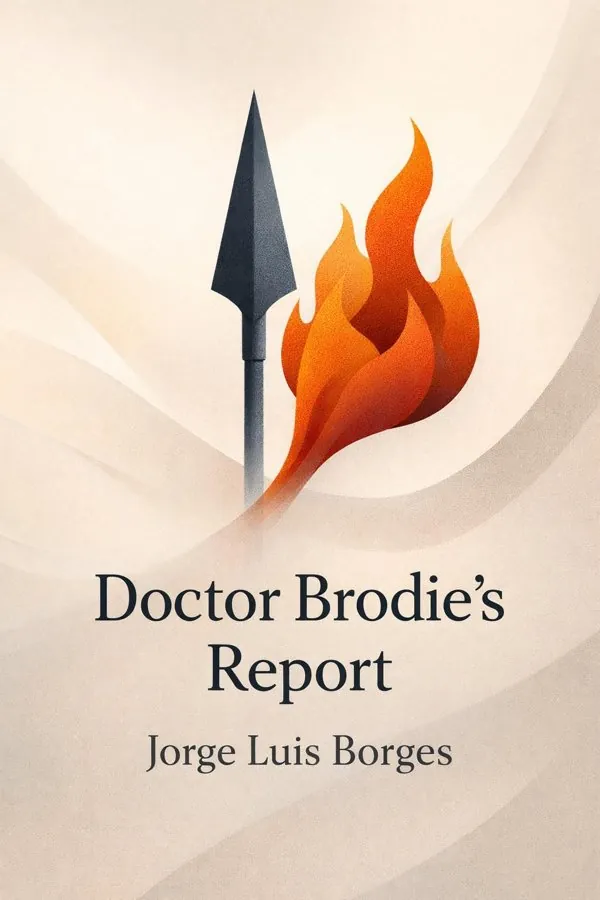
Doctor Brodie's Report: Summary & Key Insights
 10 min10 chaptersAudio available
Key Takeaways from Doctor Brodie's Report
A sacred text can comfort, guide, or inspire—but in the wrong setting, it can also become a script for catastrophe.
The deepest betrayals do not come from strangers; they come from people close enough to wound us from within.
Some conflicts continue long after their real purpose has disappeared.
We often imagine that conflict ends with a final event, but life is messier than that.
Codes of honor promise dignity, but they also force people into roles they can no longer freely choose.
What Is Doctor Brodie's Report About?
Doctor Brodie's Report by Jorge Luis Borges is a classics book spanning 10 pages. Doctor Brodie's Report is a late Borges collection that trades some of his famous intellectual glitter for a rougher, clearer, and more direct narrative voice. First published in 1970, these stories move through ranches, knife fights, family rivalries, acts of betrayal, obscure documents, and uneasy encounters with faith. Yet beneath their apparent simplicity, they remain unmistakably Borgesian: each tale tests the limits of morality, identity, and civilization. Borges turns away from abstract labyrinths only to discover that human behavior itself is the deepest maze. What makes this book matter is its combination of accessibility and depth. Readers who find Borges intimidating often discover here a more approachable entry point, while longtime admirers can see how his lifelong concerns—fate, violence, memory, honor, and the instability of truth—survive in more grounded forms. The title story, a pseudo-anthropological report about a strange society, distills the collection’s central question: when we think we are describing others, are we really uncovering ourselves? Borges, one of the 20th century’s most influential writers, uses these stories to suggest that beneath law, religion, and culture lies a stubborn, unsettling core of human nature.
This FizzRead summary covers all 10 key chapters of Doctor Brodie's Report in approximately 10 minutes, distilling the most important ideas, arguments, and takeaways from Jorge Luis Borges's work. Also available as an audio summary and Key Quotes Podcast.
Doctor Brodie's Report
Doctor Brodie's Report is a late Borges collection that trades some of his famous intellectual glitter for a rougher, clearer, and more direct narrative voice. First published in 1970, these stories move through ranches, knife fights, family rivalries, acts of betrayal, obscure documents, and uneasy encounters with faith. Yet beneath their apparent simplicity, they remain unmistakably Borgesian: each tale tests the limits of morality, identity, and civilization. Borges turns away from abstract labyrinths only to discover that human behavior itself is the deepest maze.
What makes this book matter is its combination of accessibility and depth. Readers who find Borges intimidating often discover here a more approachable entry point, while longtime admirers can see how his lifelong concerns—fate, violence, memory, honor, and the instability of truth—survive in more grounded forms. The title story, a pseudo-anthropological report about a strange society, distills the collection’s central question: when we think we are describing others, are we really uncovering ourselves? Borges, one of the 20th century’s most influential writers, uses these stories to suggest that beneath law, religion, and culture lies a stubborn, unsettling core of human nature.
Who Should Read Doctor Brodie's Report?
This book is perfect for anyone interested in classics and looking to gain actionable insights in a short read. Whether you're a student, professional, or lifelong learner, the key ideas from Doctor Brodie's Report by Jorge Luis Borges will help you think differently.
- ✓Readers who enjoy classics and want practical takeaways
- ✓Professionals looking to apply new ideas to their work and life
- ✓Anyone who wants the core insights of Doctor Brodie's Report in just 10 minutes
Want the full summary?
Get instant access to this book summary and 100K+ more with Fizz Moment.
Get Free SummaryAvailable on App Store • Free to download
Key Chapters
A sacred text can comfort, guide, or inspire—but in the wrong setting, it can also become a script for catastrophe. That is the chilling insight at the heart of “The Gospel According to Mark,” one of the most memorable stories in the collection. Borges imagines Baltasar Espinosa, a medical student stranded by floodwaters at an isolated ranch, passing time by reading the Gospel of Mark aloud to the illiterate Gutre family. At first, the scene seems almost pastoral: a polite young man, a remote landscape, and a simple act of reading. But as the family listens, the line between hearing a story and reenacting it begins to collapse.
What makes the tale so unsettling is not only the ending, but the logic that leads to it. Baltasar does not intend to preach. He reads casually, perhaps generously, and certainly naively. The Gutres, meanwhile, receive the words not as literature or metaphor, but as immediate truth. Borges exposes a frightening gap between modern, educated interpretation and literal, mythic belief. The story becomes a lesson in how context determines meaning. The same words that seem familiar and symbolic to one listener may become commands to another.
This idea has practical resonance far beyond religion. It applies to political slogans, legal language, social media posts, and even workplace communication. A message is never just what the speaker intends; it is also what the hearer is prepared to make of it. Leaders, teachers, and communicators ignore this at their peril.
Actionable takeaway: Never assume your audience receives words the way you do—always consider the beliefs, fears, and frameworks through which they will interpret them.
The deepest betrayals do not come from strangers; they come from people close enough to wound us from within. In “The Unworthy Friend,” Borges returns to one of his oldest fascinations: the unstable bond between loyalty and treachery. The story presents male friendship in Buenos Aires not as a sentimental ideal, but as a field of rivalry, code, memory, and moral ambiguity. Affection exists, but so does vanity. Admiration exists, but so does resentment. A friend may become the witness of our honor—or the instrument of our ruin.
Borges refuses to simplify betrayal into villainy. Instead, he shows how weakness, self-preservation, pride, and social pressure can erode personal bonds. The “unworthy” friend is not necessarily monstrous; he is painfully human. That is what gives the story its force. Honor cultures often demand absolute loyalty, yet real people are inconsistent creatures. We hesitate, rationalize, and rewrite our motives after the fact. Borges is especially interested in the stories people tell themselves to survive their own failures.
This theme remains contemporary. Professional partnerships collapse over ambition. Old friends drift into silence after moments of cowardice. Families fracture not because affection was false, but because character proved thinner than feeling. The story encourages readers to look beyond declarations of loyalty and ask what someone will actually do under pressure.
There is also a private challenge here: we like to imagine ourselves faithful and brave, but Borges suggests that self-knowledge begins when we admit our own capacity for compromise. Trust matters, but so does realism.
Actionable takeaway: Judge relationships less by words of loyalty than by repeated actions in moments of difficulty, including your own.
Some conflicts continue long after their real purpose has disappeared. “The Duel” explores this haunting truth through the rivalry between two women whose competition becomes a structure of identity. On the surface, the story is about social comparison, artistic ambition, and personal antagonism. At a deeper level, it is about how human beings come to need opposition. The rival is no longer merely an obstacle; she becomes the person through whom one defines oneself.
Borges handles the idea with restraint. There is no melodramatic explosion, only the slow accumulation of tension, vanity, and mutual fixation. What matters is not who is objectively superior, but the fact that each woman’s sense of self is sharpened through contrast with the other. The duel is psychological before it is anything else. In that sense, Borges broadens his usual concern with doubles and mirrored identities into the social world. We become legible to ourselves through comparison, and that process can be both energizing and destructive.
Modern life offers countless examples. Colleagues compete for prestige long after promotions cease to matter. Artists measure themselves against peers instead of the work itself. Even online, people define success less by personal meaning than by relative visibility. Rivalry can motivate excellence, but it can also trap us in permanent reaction.
Borges’s insight is that old rivalries often survive because they provide emotional coherence. To relinquish them would require a more difficult task: inventing a self that is not dependent on another person’s presence. This is why grudges linger and competitions become rituals.
Actionable takeaway: If a rivalry dominates your thinking, ask whether it still serves a real purpose—or whether it has simply become a habit that defines you too narrowly.
We often imagine that conflict ends with a final event, but life is messier than that. “The End of the Duel” continues Borges’s interest in rivalry by showing that closure is rarely as complete or satisfying as stories promise. The title itself is suggestive: an ending should settle things, yet Borges implies that even the end of open struggle leaves residues—memory, interpretation, regret, and the stubborn afterlife of emotion.
This story reflects one of Borges’s recurring formal achievements: he takes a familiar narrative pattern and quietly empties it of certainty. A duel, in literary tradition, offers symmetry, confrontation, and judgment. Someone wins, someone loses, and the audience is meant to infer meaning. Borges resists that neatness. He suggests that the significance of a conflict lies not only in what happened, but in how it is remembered and narrated afterward. The event ends; its interpretations do not.
This has broad human application. A divorce may finalize legally while bitterness continues internally. A workplace dispute may close officially, yet reputational consequences linger. Even when we “move on,” we carry stories about who was right, who was wrong, and what the conflict proved. Those stories often shape future choices more than the original event itself.
Borges reminds us that narrative closure is an aesthetic pleasure, not always a psychological reality. To mature is partly to accept incomplete resolution. Not every score is settled. Not every explanation heals. Sometimes the true end of a duel is the recognition that one can stop living inside it.
Actionable takeaway: When a conflict ends, focus not only on the outcome but on the story you continue telling yourself about it—because that story may be what keeps it alive.
Codes of honor promise dignity, but they also force people into roles they can no longer freely choose. In “Rosendo’s Tale,” Borges revisits the knife-fighting world of his earlier fiction, where masculinity, reputation, and public expectation carry tremendous weight. Rosendo is measured not by private conscience but by what others see, expect, and remember. In such a world, identity is staged before witnesses. To refuse the script is itself an act with consequences.
What makes the story rich is Borges’s refusal to romanticize toughness. He understands the allure of courage and style, but he also sees how social codes imprison the individual. A man may act violently not because he desires violence, but because honor leaves him no alternative that preserves his standing. Equally, a refusal to fight can be interpreted either as cowardice or as a deeper kind of independence. Borges lets that ambiguity stand.
The story’s relevance extends beyond physical violence. Modern versions of honor culture exist in corporate ambition, peer-group conformity, online image management, and family expectations. People still perform versions of strength because they fear humiliation. We may not carry knives, but we often defend reputations at the expense of peace, honesty, or self-understanding.
Borges’s genius lies in showing that performance can become destiny. Once others identify you with a role—the brave one, the dangerous one, the respectable one—you may begin to inhabit it even against your better judgment. The public self hardens, and inward freedom shrinks.
Actionable takeaway: Before acting to defend your image, ask whether you are protecting a genuine value—or merely obeying a role that others have imposed on you.
Violence is rarely spontaneous in Borges; it is usually the visible eruption of old loyalties, old fears, and inherited stories. “The Meeting” illustrates this beautifully. On the surface, it concerns an encounter shaped by tension and the possibility of bloodshed. Underneath, it suggests that violence may travel through objects, traditions, and remembered identities, almost as if individuals are being inhabited by a past larger than themselves.
Borges was deeply interested in recurrence—the way old forms return in new bodies. In “The Meeting,” a present event seems charged by prior violence, as though history itself were demanding reenactment. This gives the story an uncanny quality. The characters act, but they also seem acted upon by codes and memories they may not fully control. Borges does not deny responsibility; rather, he complicates it by showing how culture and history script behavior in advance.
This matters because many human conflicts are not really about the immediate trigger. A small insult ignites because it touches a buried grievance. A political clash intensifies because communities carry generational memories of harm. In families, arguments about trivial matters often conceal old wounds. Borges reveals that what looks like an isolated event may be a continuation.
The practical lesson is sobering. To prevent violence—literal or symbolic—we must learn to identify the inherited narratives inside present disputes. If we respond only to the surface incident, we miss the force driving it. Understanding history does not excuse harm, but it helps explain why reason alone often fails in heated moments.
Actionable takeaway: When conflict escalates unexpectedly, look for the older memory, identity, or grievance hiding beneath the immediate confrontation.
Families do not live by facts alone; they live by legends, symbols, and charged objects. In “Juan Muraña,” Borges turns a seemingly simple domestic setting into a study of inherited menace and mythic presence. The story centers on a feared male figure whose identity persists through memory, rumor, and a knife that becomes more than a weapon. The object gathers emotional force until it seems to contain personality itself.
Borges is interested here in how stories create reality. A family passes down not only names and possessions, but also moods, expectations, and scripts for fear. An heirloom may become a vessel of identity because those around it keep investing it with significance. The knife in “Juan Muraña” is powerful partly because people believe in what it represents. In this sense, Borges is not writing fantasy so much as social psychology in symbolic form.
This insight is surprisingly practical. Many households preserve items that carry disproportionate emotional power: a letter, a ring, a photograph, a uniform, a tool. Such objects can anchor memory and belonging, but they can also perpetuate unresolved grief, intimidation, or idealization. Families often continue obeying old emotional arrangements because a symbol keeps the past active in the present.
Borges shows how difficult it is to separate material things from the narratives attached to them. We do not simply inherit possessions; we inherit meanings. Sometimes those meanings enrich life. Sometimes they prevent change by preserving fear or authority long after the original person is gone.
Actionable takeaway: Identify the objects in your life that carry inherited emotional power, and ask whether the story attached to them still deserves your loyalty.
The past does not come to us directly; it reaches us through documents, interpreters, and rival ambitions. “Guayaquil” explores this idea through a meeting between scholars concerned with a historical mystery linked to Simón Bolívar and José de San Martín. At one level, the story is about academic research and a disputed archive. At another, it is a meditation on power: who gets to narrate the past, who gains legitimacy from that narrative, and how scholarship can conceal vanity beneath its claims to objectivity.
Borges, himself a master of fictional erudition, understands that documents do not end interpretation—they provoke it. Evidence matters, but so do the personalities of those who handle it. In “Guayaquil,” scholarship becomes a contest of intellect, prestige, and access. The historian is not outside the story; he is part of it. This is a crucial Borgesian insight. Every archive is filtered through desire.
The lesson extends beyond literary history. In politics, organizations, families, and nations, disputes often center less on facts than on authoritative versions of events. Meeting minutes, emails, official statements, memoirs, and news reports all shape what later counts as truth. Those who control framing frequently control memory.
Borges does not argue that truth is impossible. Rather, he insists that truth is entangled with perspective, ego, and omission. Good reading therefore requires skepticism without cynicism. We must respect evidence while remaining alert to the motives surrounding it.
Actionable takeaway: Whenever you encounter a confident account of the past, ask not only what evidence it cites, but who benefits from that version becoming the accepted one.
What if the line between civilized and primitive is thinner than we want to believe? The title story, “Doctor Brodie’s Report,” stages this disturbing question through a fictional manuscript attributed to a Scottish missionary who describes an isolated people, the Yahoos. The report mimics anthropology, travel writing, and colonial testimony, but Borges uses those forms ironically. The point is not simply to depict a strange society; it is to unsettle the reader’s confidence in moral distance.
The Yahoos appear brutal, irrational, and governed by customs that affront enlightened sensibility. Yet as the account proceeds, Borges invites a deeper discomfort. Are these beings truly alien, or are they a distorted mirror of human nature? The report format creates apparent objectivity, but that objectivity is itself suspect. Doctor Brodie classifies, judges, and explains—but classification can become a way of protecting the observer from recognizing his kinship with what he describes.
This story condenses many of the collection’s concerns: violence, custom, hierarchy, sexuality, power, and the precariousness of moral order. Borges suggests that civilization may be less an essence than a discipline, a set of fragile restraints laid over impulses that remain available beneath the surface. The “primitive” may not be elsewhere; it may be a latent possibility within every society.
The practical application is profound. Whenever we condemn another group as barbaric, we should ask what conditions allow our own norms to hold. History repeatedly shows how quickly refined cultures can justify cruelty under pressure.
Actionable takeaway: Treat claims of moral superiority with suspicion, and remember that civilization depends on practices and restraints that must be actively maintained.
All Chapters in Doctor Brodie's Report
About the Author
Jorge Luis Borges (1899–1986) was an Argentine writer, poet, essayist, and translator whose work reshaped modern literature. Born in Buenos Aires, he published across multiple genres, but he is best known for his short stories, which combine philosophical inquiry with compressed, elegant prose. Collections such as Ficciones and The Aleph made him internationally famous for themes including infinity, labyrinths, mirrors, dreams, identity, and the strange power of books. Borges also worked as a librarian and later became director of the National Library of Argentina. Though he lost much of his eyesight over time, he continued to write, lecture, and dictate important works. Today he is regarded as one of the most influential literary figures of the 20th century and a major precursor to postmodern fiction.
Get This Summary in Your Preferred Format
Read or listen to the Doctor Brodie's Report summary by Jorge Luis Borges anytime, anywhere. FizzRead offers multiple formats so you can learn on your terms — all free.
Available formats: App · Audio · PDF · EPUB — All included free with FizzRead
Download Doctor Brodie's Report PDF and EPUB Summary
Key Quotes from Doctor Brodie's Report
“A sacred text can comfort, guide, or inspire—but in the wrong setting, it can also become a script for catastrophe.”
“The deepest betrayals do not come from strangers; they come from people close enough to wound us from within.”
“Some conflicts continue long after their real purpose has disappeared.”
“We often imagine that conflict ends with a final event, but life is messier than that.”
“Codes of honor promise dignity, but they also force people into roles they can no longer freely choose.”
Frequently Asked Questions about Doctor Brodie's Report
Doctor Brodie's Report by Jorge Luis Borges is a classics book that explores key ideas across 10 chapters. Doctor Brodie's Report is a late Borges collection that trades some of his famous intellectual glitter for a rougher, clearer, and more direct narrative voice. First published in 1970, these stories move through ranches, knife fights, family rivalries, acts of betrayal, obscure documents, and uneasy encounters with faith. Yet beneath their apparent simplicity, they remain unmistakably Borgesian: each tale tests the limits of morality, identity, and civilization. Borges turns away from abstract labyrinths only to discover that human behavior itself is the deepest maze. What makes this book matter is its combination of accessibility and depth. Readers who find Borges intimidating often discover here a more approachable entry point, while longtime admirers can see how his lifelong concerns—fate, violence, memory, honor, and the instability of truth—survive in more grounded forms. The title story, a pseudo-anthropological report about a strange society, distills the collection’s central question: when we think we are describing others, are we really uncovering ourselves? Borges, one of the 20th century’s most influential writers, uses these stories to suggest that beneath law, religion, and culture lies a stubborn, unsettling core of human nature.
More by Jorge Luis Borges

You Might Also Like





Browse by Category
Ready to read Doctor Brodie's Report?
Get the full summary and 100K+ more books with Fizz Moment.