
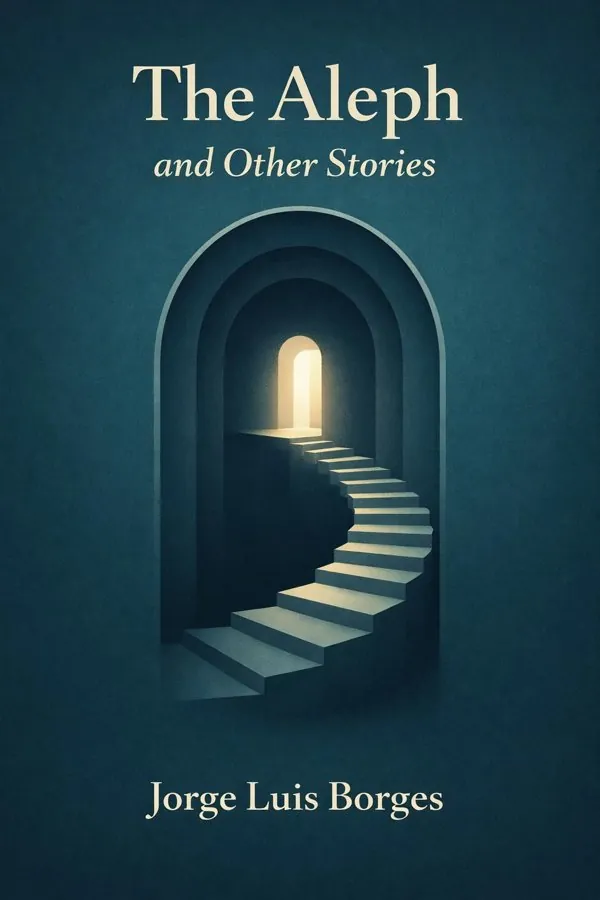
The Aleph and Other Stories: 1933–1969: Summary & Key Insights
 10 min9 chaptersAudio available
Key Takeaways from The Aleph and Other Stories: 1933–1969
One of Borges’s sharpest paradoxes is this: the dream humans chase most passionately may also be the one that destroys significance.
Borges often shows that people are most vulnerable when they feel most in control.
Borges understood that intellectual conflict is never purely abstract.
In “Story of the Warrior and the Captive,” Borges dismantles one of the oldest myths in cultural history: that civilization and barbarism are clear, opposite states.
Few Borges stories are as psychologically intense as “Emma Zunz,” which begins with a wrong that cannot be undone and proceeds through a meticulously planned act of revenge.
What Is The Aleph and Other Stories: 1933–1969 About?
The Aleph and Other Stories: 1933–1969 by Jorge Luis Borges is a classics book spanning 9 pages. The Aleph and Other Stories: 1933–1969 is one of the essential gateways into the brilliant, unsettling, and endlessly rewarding fiction of Jorge Luis Borges. Spanning decades of his work and translated by Norman Thomas Di Giovanni in collaboration with Borges himself, this collection gathers stories that turn brief narratives into vast intellectual adventures. Assassins, scholars, dreamers, prisoners, impostors, and seekers move through deserts, libraries, labyrinths, and memory, only to confront questions that have no simple answer: What is identity? Can truth survive interpretation? What would infinity look like if it appeared in ordinary life? What makes this collection matter is not only its originality, but its lasting power. Borges fused philosophy, myth, theology, detective fiction, and fantasy into a form uniquely his own, proving that a short story can hold the depth of a metaphysical treatise. His influence stretches across modern literature, from postmodern fiction to speculative writing, yet his stories remain strikingly human beneath their formal brilliance. This book is both a landmark of world literature and a practical invitation to think more deeply about reality, knowledge, time, and the fragile stories by which we define ourselves.
This FizzRead summary covers all 9 key chapters of The Aleph and Other Stories: 1933–1969 in approximately 10 minutes, distilling the most important ideas, arguments, and takeaways from Jorge Luis Borges's work. Also available as an audio summary and Key Quotes Podcast.
The Aleph and Other Stories: 1933–1969
The Aleph and Other Stories: 1933–1969 is one of the essential gateways into the brilliant, unsettling, and endlessly rewarding fiction of Jorge Luis Borges. Spanning decades of his work and translated by Norman Thomas Di Giovanni in collaboration with Borges himself, this collection gathers stories that turn brief narratives into vast intellectual adventures. Assassins, scholars, dreamers, prisoners, impostors, and seekers move through deserts, libraries, labyrinths, and memory, only to confront questions that have no simple answer: What is identity? Can truth survive interpretation? What would infinity look like if it appeared in ordinary life?
What makes this collection matter is not only its originality, but its lasting power. Borges fused philosophy, myth, theology, detective fiction, and fantasy into a form uniquely his own, proving that a short story can hold the depth of a metaphysical treatise. His influence stretches across modern literature, from postmodern fiction to speculative writing, yet his stories remain strikingly human beneath their formal brilliance. This book is both a landmark of world literature and a practical invitation to think more deeply about reality, knowledge, time, and the fragile stories by which we define ourselves.
Who Should Read The Aleph and Other Stories: 1933–1969?
This book is perfect for anyone interested in classics and looking to gain actionable insights in a short read. Whether you're a student, professional, or lifelong learner, the key ideas from The Aleph and Other Stories: 1933–1969 by Jorge Luis Borges will help you think differently.
- ✓Readers who enjoy classics and want practical takeaways
- ✓Professionals looking to apply new ideas to their work and life
- ✓Anyone who wants the core insights of The Aleph and Other Stories: 1933–1969 in just 10 minutes
Want the full summary?
Get instant access to this book summary and 100K+ more with Fizz Moment.
Get Free SummaryAvailable on App Store • Free to download
Key Chapters
One of Borges’s sharpest paradoxes is this: the dream humans chase most passionately may also be the one that destroys significance. In “The Immortal,” a Roman soldier follows the rumor of a hidden river that grants eternal life. What begins as heroic quest slowly turns into philosophical horror. If time has no end, then action loses urgency, memory becomes unstable, and identity itself starts to dissolve. The immortals in the story are not exalted beings but exhausted remnants of consciousness, stripped of purpose by endless duration.
Borges uses the fantastic premise to examine a deeply practical truth. Much of what gives human life shape comes from limitation. We choose because we cannot do everything. We love because time is finite. We remember because forgetting is always near. By imagining a life without death, Borges reveals how mortality creates value. The story also unsettles the idea of a fixed self: over vast stretches of time, a person may become unrecognizable even to himself.
You can apply this insight to ordinary life. Deadlines, aging, and finite opportunities often feel like burdens, but they are also what make commitment possible. A conversation matters because it will end. A career matters because it cannot contain every path. Even creative work gains force from incompleteness.
Borges is not simply warning against literal immortality; he is questioning every fantasy of limitless postponement. If you always assume there will be another day, another season, another chance, meaning begins to thin out.
Actionable takeaway: Treat finitude as a source of clarity. Choose one important thing you have been delaying and do it now, precisely because your time is not infinite.
Borges often shows that people are most vulnerable when they feel most in control. In “The Dead Man,” Otálora enters the rough world of the South American plains convinced that courage, cunning, and boldness will allow him to rise. He believes power is something one can seize through nerve and calculation. Yet the story steadily reveals a darker truth: he is not mastering the game, but moving within a script already written by forces he barely understands.
What makes the story powerful is its compression. Borges takes the familiar narrative of social ascent and transforms it into a meditation on pride, misreading, and doomed self-confidence. Otálora sees gestures, symbols, and relationships as signs of his success, but he misinterprets them. The very things he thinks prove his dominance are, in retrospect, stages in his humiliation. Borges suggests that human beings are often worst at reading situations in which ego is heavily invested.
This idea extends well beyond outlaw codes or frontier violence. In work, politics, and personal relationships, ambition can distort perception. A promotion may look like trust when it is really a setup. Flattery may feel like recognition when it is manipulation. The desire to win can make us ignore the structure we are operating inside.
Borges is not condemning ambition itself. He is exposing the danger of confusing symbolic victories with actual understanding. To rise without reading the deeper loyalties, histories, and power arrangements around you is to walk blindly toward collapse.
Actionable takeaway: In any high-stakes situation, ask not only “What am I gaining?” but also “Who benefits from me believing I am winning?” That question can reveal hidden realities before they become fatal.
Borges understood that intellectual conflict is never purely abstract. In “The Theologians,” a dispute over doctrine unfolds between learned men whose devotion to truth becomes inseparable from rivalry, vanity, and hatred. The story is not merely about theological nuance; it is about how the defense of purity can deform the soul. Borges examines the frightening ease with which ideas that promise salvation can justify cruelty and self-righteousness.
The brilliance of the story lies in how it refuses simple moral sorting. Both theologians believe themselves servants of truth. Both oppose heresy. Both inhabit a world in which language, interpretation, and belief carry eternal consequences. Yet Borges gradually reveals that the line between defending faith and feeding ego is perilously thin. The search for correctness becomes a disguised struggle for supremacy.
This is one of Borges’s most modern insights. Ideological battles today often follow the same pattern. Whether in religion, academia, politics, or online discourse, people can become more committed to defeating rivals than to understanding reality. Once identity fuses with belief, disagreement feels like contamination, and opponents become enemies rather than fellow seekers.
Borges also hints at a higher perspective in which apparent oppositions blur. Human beings may imagine their conflicts as absolute, while from a transcendent viewpoint their differences are far smaller than they think. That possibility is both humbling and unsettling.
The practical application is clear: conviction without self-examination can turn moral seriousness into fanaticism. Intellectual rigor matters, but so does the ability to recognize ambition, resentment, and fear inside one’s own certainty.
Actionable takeaway: The next time you feel morally or intellectually superior in an argument, pause and ask what personal need might be hiding beneath your righteousness. That question can transform conflict into insight.
In “Story of the Warrior and the Captive,” Borges dismantles one of the oldest myths in cultural history: that civilization and barbarism are clear, opposite states. The story juxtaposes two figures who cross boundaries that others regard as absolute. A warrior leaves one world for another; a captive woman, absorbed into an Indigenous society, no longer fits the values of the culture that claims to have lost her. Borges treats both movements not as simple betrayals, but as revelations of how fragile cultural identity really is.
The story matters because it resists comforting hierarchies. Instead of celebrating one side and condemning the other, Borges asks what happens when identity is shaped by contact, adaptation, and transformation. The categories people use to classify others often conceal anxiety more than truth. “Civilized” and “savage” can become moral shortcuts that prevent genuine understanding.
This insight remains highly relevant. Modern societies still divide the world into insiders and outsiders, refined and primitive, normal and alien. Yet real lives rarely conform to those labels. Migration, assimilation, hybridity, and cultural exchange continuously unsettle neat narratives of belonging. Borges reminds us that the self is not only inherited but also remade by circumstance.
The story also invites personal reflection. Many people discover that the roles, values, or communities they were taught to honor no longer fully define them. Crossing social, geographic, or emotional boundaries can feel like loss to some and liberation to others. Borges asks us to sit with that ambiguity rather than erase it.
Actionable takeaway: Examine one identity label you use for yourself or others and ask what complexity it hides. Replacing rigid categories with curiosity is a concrete step toward deeper understanding.
Few Borges stories are as psychologically intense as “Emma Zunz,” which begins with a wrong that cannot be undone and proceeds through a meticulously planned act of revenge. Emma learns of her father’s death and sets in motion a scheme to punish the man she holds responsible. What makes the story unforgettable is not the external plot alone, but the moral ambiguity Borges builds into every step. Emma’s accusation is both false and true; her story is invented, yet it serves a justice the legal system may never have delivered.
Borges uses this compressed narrative to explore a difficult ethical terrain. Human beings often hunger for clean distinctions between fact and justice, innocence and guilt, lawful order and moral right. “Emma Zunz” refuses those simplifications. Emma manipulates appearances, sacrifices part of herself to make her account credible, and commits a crime in pursuit of a deeper rectification. Borges does not ask us to approve or condemn too quickly. He asks us to confront how often reality resists pure moral accounting.
In practical life, people face smaller versions of this conflict constantly. Whistleblowers use strategic storytelling to expose hidden wrongdoing. Victims struggle to communicate experiences that institutions are poorly equipped to recognize. Individuals weigh whether technical honesty can coexist with emotional truth. Borges warns that when systems fail, people may resort to morally compromised forms of correction.
The story also reveals the personal cost of vengeance. Even when revenge feels justified, it leaves scars. Justice achieved through self-violation is not wholeness.
Actionable takeaway: When confronting wrongdoing, distinguish between what is factually provable, morally true, and emotionally satisfying. Seek accountability that does not require you to become what you oppose.
Borges had a rare gift for collapsing centuries of myth into a few pages, and “The House of Asterion” is a masterclass in that art. The story appears at first to be the monologue of an isolated, grandiose figure wandering an enormous house. Only near the end does Borges reveal that the speaker is the Minotaur. With that single reversal, the reader is forced to reconsider everything: the labyrinth is home, not prison; the monster is lonely, not merely savage; the legend itself has been shaped by perspective.
This story captures one of Borges’s deepest themes: narratives produce reality as much as they describe it. Asterion sees himself as singular, misunderstood, and perhaps destined for redemption. The world, by contrast, remembers him as an abomination. Borges invites us to ask who gets to define monstrosity and how many enemies are made first by story, then by violence.
The practical relevance is profound. In social life, organizations, families, and nations often simplify complex people into roles: villain, outsider, threat, failure. Once that identity hardens, empathy shrinks. Borges does not deny danger or wrongdoing, but he insists that perspective matters. Sometimes what seems like arrogance conceals pain; what looks like hostility may be defensive solitude.
The story also teaches us to reread our assumptions. Much misunderstanding comes from entering another person’s world too late, after a label has already done its work. The “monster” may still be dangerous, but he is no longer simple.
Actionable takeaway: Before accepting a one-dimensional story about someone, seek the missing perspective. Ask what that person’s inner monologue might sound like. This habit can make you wiser, fairer, and less easily manipulated by inherited narratives.
In “Deutsches Requiem,” Borges does something morally risky and artistically extraordinary: he gives voice to a Nazi official awaiting execution. Rather than portraying evil as monstrous incoherence, Borges presents a mind capable of reflection, discipline, and chilling self-justification. The result is unsettling because it denies readers the comfort of distance. Atrocities are not always committed by people who sound insane; they are often defended by people who sound convinced.
The story investigates ideology as a corruption of moral language. The narrator frames suffering, domination, and destruction as signs of historical necessity and spiritual strength. He rejects pity as weakness and embraces brutality as a purifying force. Borges exposes how evil can masquerade as courage, rigor, or destiny when stripped from empathy and accountability.
This insight remains urgent. In every era, harmful systems recruit respectable vocabulary: order, renewal, security, sacrifice, realism. People are persuaded not only by hatred, but by arguments that make cruelty seem principled. Borges shows that the danger lies not just in violent acts but in the mental frameworks that render them admirable.
The story is also a warning against aestheticizing force. Intelligence, culture, and eloquence do not inoculate anyone against barbarism. On the contrary, they can become tools for rationalizing it. Readers are invited to examine not only historical totalitarianism, but any worldview that glorifies hardness while scorning vulnerability.
Actionable takeaway: When you encounter rhetoric that celebrates strength and dismisses compassion as weakness, examine it carefully. A useful test is simple: if a worldview requires dehumanizing others to feel coherent, reject it before its logic hardens into action.
The title story, “The Aleph,” begins with grief, vanity, and literary rivalry, yet it opens onto one of the most astonishing images in modern fiction: a point in space that contains all other points, allowing a person to see the entire universe simultaneously from every angle. Borges’s genius lies in locating this impossible totality in a mundane setting, as if infinity were hidden in a basement waiting to be noticed.
The story works on several levels at once. It is a satire of ego and artistic pretension, a meditation on memory and loss, and a philosophical challenge to human perception. To see everything at once should be a form of transcendence, yet Borges also suggests it may be unbearable. The mind depends on sequence, selection, and forgetting. Total vision does not simply complete knowledge; it threatens to overwhelm the knower.
This has practical implications in the information age. People often seek total access: endless data, constant updates, complete visibility into systems and lives. But Borges anticipates a modern problem: more information does not automatically produce wisdom. Without structure, perspective, and limits, abundance becomes noise. The Aleph is both revelation and overload.
The story also offers a subtler lesson about ordinary life. Moments of total significance do not always arrive in grand forms. A room, a memory, a sentence, or a person can suddenly hold more reality than we thought possible. The infinite may not be elsewhere; it may be hidden within the overlooked.
Actionable takeaway: Resist the urge to consume everything. Instead, choose one ordinary object, place, or memory and attend to it deeply. Borges reminds us that depth often reveals more than endless accumulation.
“The Maker” broadens the collection from story into artistic philosophy. Across these brief, luminous pieces, Borges reflects on what it means to create when language is inherited, reality is partial, and the self is unstable. The “maker” is not a god creating from nothing, but a human being shaping fragments—memories, readings, sensations, myths—into form. Art becomes less an act of pure originality than one of arrangement, fidelity, and renewed perception.
This is a liberating idea. Many readers and writers are intimidated by the myth of complete novelty, as if worthwhile work must emerge untouched by influence. Borges rejects that fantasy. He openly builds from prior texts, traditions, and symbols, showing that creation often happens through transformation rather than invention ex nihilo. What matters is not whether a work comes from nowhere, but whether it sees freshly and composes meaningfully.
The relevance extends beyond literature. Anyone who solves problems, designs systems, teaches, leads, or interprets experience is a maker in Borges’s sense. We draw from incomplete materials and try to shape coherence. Memory, however flawed, becomes raw material for insight. Attention becomes an ethical act: to notice truly is already to begin making.
Borges also suggests that art is a form of humility. The maker does not conquer reality; he traces patterns within it. Even failure can be fruitful, because every attempt clarifies perception.
Actionable takeaway: Stop waiting for a perfectly original idea. Begin with what you already have—one memory, one question, one image—and shape it carefully. In Borges’s world, making starts not with genius, but with disciplined attention.
All Chapters in The Aleph and Other Stories: 1933–1969
About the Author
Jorge Luis Borges (1899–1986) was an Argentine writer, poet, and essayist whose work transformed modern literature. Born in Buenos Aires and educated in both Argentina and Europe, he developed a style that fused philosophical inquiry with myth, fantasy, and dazzling formal control. His stories and essays often revolve around labyrinths, mirrors, books, doubles, dreams, and the paradoxes of time and identity. Borges later became director of the National Library of Argentina, a role made especially poignant by his increasing blindness. Though he never received the Nobel Prize, he is widely regarded as one of the twentieth century’s most influential authors. His impact can be seen across literary fiction, postmodernism, speculative writing, and contemporary philosophy-inflected storytelling. Borges remains celebrated for proving that short fiction can contain entire worlds of thought.
Get This Summary in Your Preferred Format
Read or listen to the The Aleph and Other Stories: 1933–1969 summary by Jorge Luis Borges anytime, anywhere. FizzRead offers multiple formats so you can learn on your terms — all free.
Available formats: App · Audio · PDF · EPUB — All included free with FizzRead
Download The Aleph and Other Stories: 1933–1969 PDF and EPUB Summary
Key Quotes from The Aleph and Other Stories: 1933–1969
“One of Borges’s sharpest paradoxes is this: the dream humans chase most passionately may also be the one that destroys significance.”
“Borges often shows that people are most vulnerable when they feel most in control.”
“Borges understood that intellectual conflict is never purely abstract.”
“In “Story of the Warrior and the Captive,” Borges dismantles one of the oldest myths in cultural history: that civilization and barbarism are clear, opposite states.”
“Few Borges stories are as psychologically intense as “Emma Zunz,” which begins with a wrong that cannot be undone and proceeds through a meticulously planned act of revenge.”
Frequently Asked Questions about The Aleph and Other Stories: 1933–1969
The Aleph and Other Stories: 1933–1969 by Jorge Luis Borges is a classics book that explores key ideas across 9 chapters. The Aleph and Other Stories: 1933–1969 is one of the essential gateways into the brilliant, unsettling, and endlessly rewarding fiction of Jorge Luis Borges. Spanning decades of his work and translated by Norman Thomas Di Giovanni in collaboration with Borges himself, this collection gathers stories that turn brief narratives into vast intellectual adventures. Assassins, scholars, dreamers, prisoners, impostors, and seekers move through deserts, libraries, labyrinths, and memory, only to confront questions that have no simple answer: What is identity? Can truth survive interpretation? What would infinity look like if it appeared in ordinary life? What makes this collection matter is not only its originality, but its lasting power. Borges fused philosophy, myth, theology, detective fiction, and fantasy into a form uniquely his own, proving that a short story can hold the depth of a metaphysical treatise. His influence stretches across modern literature, from postmodern fiction to speculative writing, yet his stories remain strikingly human beneath their formal brilliance. This book is both a landmark of world literature and a practical invitation to think more deeply about reality, knowledge, time, and the fragile stories by which we define ourselves.
More by Jorge Luis Borges



You Might Also Like






Browse by Category
Ready to read The Aleph and Other Stories: 1933–1969?
Get the full summary and 100K+ more books with Fizz Moment.