
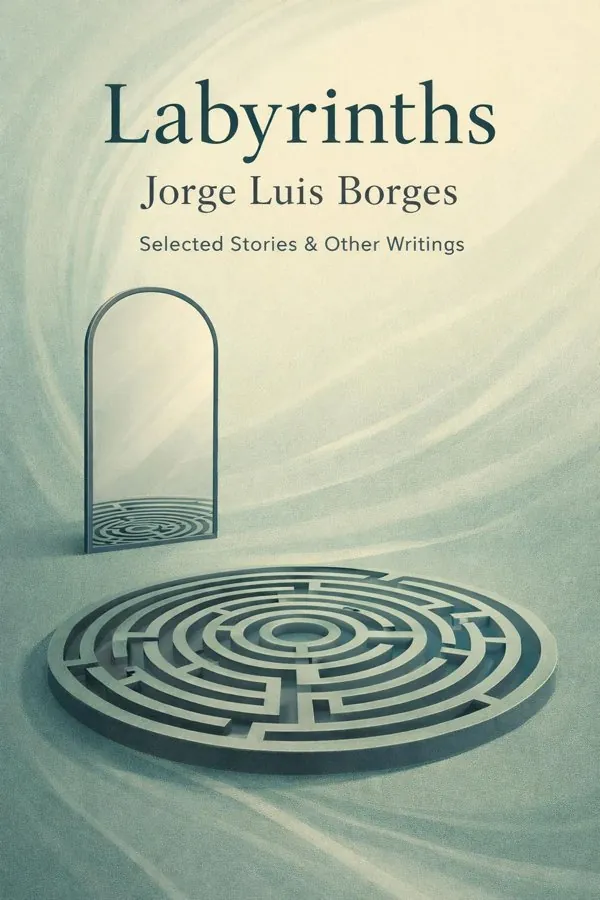
Labyrinths: Selected Stories & Other Writings: Summary & Key Insights
 10 min9 chaptersAudio available
Key Takeaways from Labyrinths: Selected Stories & Other Writings
A false idea becomes dangerous when people begin to live inside it.
We often imagine time as a straight line, but Borges asks what happens if every choice creates a new path.
More information does not always produce more wisdom.
Randomness feels harmless until a society organizes itself around it.
A text does not stay the same just because its words do.
What Is Labyrinths: Selected Stories & Other Writings About?
Labyrinths: Selected Stories & Other Writings by Jorge Luis Borges is a classics book spanning 8 pages. Labyrinths: Selected Stories & Other Writings is not a conventional story collection but a dazzling map of the mind. First published in English in 1962, it gathers some of Jorge Luis Borges’s most influential fiction and essays, largely drawn from Ficciones and El Aleph. Across these pieces, Borges turns libraries into metaphysical puzzles, encyclopedias into engines of reality, and seemingly simple plots into meditations on time, identity, memory, authorship, and the limits of human understanding. His stories are short, but they open onto immense intellectual spaces. What makes Labyrinths endure is its rare ability to be both playful and profound. Borges writes like a philosopher disguised as a fabulist: he invents detectives, scholars, spies, dreamers, and heretics, then uses their obsessions to ask whether reality is stable, whether language can ever capture truth, and whether infinite knowledge would clarify life or destroy it. Borges’s authority comes not only from his reputation as one of the twentieth century’s great writers, but from his extraordinary command of literature, philosophy, theology, and history. To read Labyrinths is to enter a book that reshaped modern fiction by proving that the shortest stories can contain the largest ideas.
This FizzRead summary covers all 9 key chapters of Labyrinths: Selected Stories & Other Writings in approximately 10 minutes, distilling the most important ideas, arguments, and takeaways from Jorge Luis Borges's work. Also available as an audio summary and Key Quotes Podcast.
Labyrinths: Selected Stories & Other Writings
Labyrinths: Selected Stories & Other Writings is not a conventional story collection but a dazzling map of the mind. First published in English in 1962, it gathers some of Jorge Luis Borges’s most influential fiction and essays, largely drawn from Ficciones and El Aleph. Across these pieces, Borges turns libraries into metaphysical puzzles, encyclopedias into engines of reality, and seemingly simple plots into meditations on time, identity, memory, authorship, and the limits of human understanding. His stories are short, but they open onto immense intellectual spaces.
What makes Labyrinths endure is its rare ability to be both playful and profound. Borges writes like a philosopher disguised as a fabulist: he invents detectives, scholars, spies, dreamers, and heretics, then uses their obsessions to ask whether reality is stable, whether language can ever capture truth, and whether infinite knowledge would clarify life or destroy it. Borges’s authority comes not only from his reputation as one of the twentieth century’s great writers, but from his extraordinary command of literature, philosophy, theology, and history. To read Labyrinths is to enter a book that reshaped modern fiction by proving that the shortest stories can contain the largest ideas.
Who Should Read Labyrinths: Selected Stories & Other Writings?
This book is perfect for anyone interested in classics and looking to gain actionable insights in a short read. Whether you're a student, professional, or lifelong learner, the key ideas from Labyrinths: Selected Stories & Other Writings by Jorge Luis Borges will help you think differently.
- ✓Readers who enjoy classics and want practical takeaways
- ✓Professionals looking to apply new ideas to their work and life
- ✓Anyone who wants the core insights of Labyrinths: Selected Stories & Other Writings in just 10 minutes
Want the full summary?
Get instant access to this book summary and 100K+ more with Fizz Moment.
Get Free SummaryAvailable on App Store • Free to download
Key Chapters
A false idea becomes dangerous when people begin to live inside it. That is the unsettling power at the heart of “Tlön, Uqbar, Orbis Tertius,” one of Borges’s most famous stories. It begins almost casually, with a mysterious encyclopedia entry about an unknown place called Uqbar. From that minor anomaly emerges the vast invention of Tlön, an entire imaginary world constructed by secret scholars. At first Tlön is merely a curiosity, then an intellectual fascination, and finally a replacement for reality itself as its concepts, language, and metaphysics begin to reshape human thought.
Borges is doing far more than telling a clever fantasy. He is exploring how systems of ideas gain authority. People often believe that reality is fixed, but Borges shows how culture, institutions, and language continuously mediate what we call real. A fabricated worldview can become persuasive if it is detailed enough, repeated often enough, and embraced by enough people. In modern terms, the story feels prophetic: ideologies, online narratives, conspiracy systems, and branded identities can all begin as fictions yet acquire practical power once they organize collective attention.
The story also questions our hunger for order. Tlön appeals because it is elegant and complete. It offers a total system where everything seems to fit. That makes it more seductive than messy reality. This is why people are often drawn to simplified explanations, even when they distort truth.
In everyday life, the lesson applies to media literacy, political thinking, and personal belief. When a narrative is coherent and emotionally satisfying, we are more likely to mistake it for truth. Borges asks us to notice that temptation before it governs us.
Actionable takeaway: whenever you encounter a compelling worldview, ask not only whether it is coherent, but whether it is true, incomplete, or dangerously convenient.
We often imagine time as a straight line, but Borges asks what happens if every choice creates a new path. “The Garden of Forking Paths” begins as a wartime suspense story: Yu Tsun, a Chinese spy working for Germany during World War I, is pursued by a British agent and must deliver a crucial message before capture. Yet beneath the chase plot lies one of Borges’s most radical ideas: time may be a labyrinth in which all possible outcomes coexist.
The key image is the unfinished work of Yu Tsun’s ancestor, Ts’ui Pên, who tried to create both a novel and a labyrinth. Borges fuses the two. The novel is the labyrinth because it does not choose a single sequence of events; instead, it imagines all possible alternatives unfolding. In one branch, a character dies. In another, he survives. In one, two people are enemies. In another, friends. Time is not one road but an expanding structure of diverging and converging possibilities.
This idea matters because it challenges how we think about decision-making, regret, and destiny. In ordinary life, we feel haunted by the path not taken. Borges reframes that anxiety. The unlived possibilities may not vanish conceptually; they remain part of the structure of thought, memory, and imagination. While we cannot live every life, we can recognize that every decision contains many unrealized versions of ourselves.
Practically, the story encourages a more nuanced approach to choices. Instead of seeking the one perfect decision, we can accept that every path opens some possibilities and closes others. Good judgment does not eliminate uncertainty; it moves through it.
Actionable takeaway: when facing a major decision, stop searching for a flawless path and instead choose the future whose trade-offs you are most willing to inhabit.
More information does not always produce more wisdom. “The Library of Babel” imagines the universe as an infinite library made of hexagonal rooms containing every possible book formed from a fixed set of symbols. This means the library holds all truth, all falsehood, all coherent masterpieces, all gibberish, all future histories, and all mistaken interpretations of those histories. In principle, everything can be found there. In practice, almost nothing can be meaningfully used.
Borges turns the dream of total knowledge into a nightmare of excess. The librarians search desperately for catalogs, vindications, prophecies, and books that explain the library itself. Some become mystics, some fanatics, some nihilists. The tragedy is not ignorance but overload. When everything exists, significance becomes difficult to locate. Truth is buried beneath endless error.
This story feels strikingly modern in an age of search engines, social platforms, and constant content production. We have access to more information than any generation in history, yet confusion remains widespread. Borges anticipates a central problem of modern intellectual life: abundance does not guarantee understanding. Without filters, judgment, and interpretive discipline, infinite access can paralyze rather than enlighten.
The library also raises a spiritual question. If meaning exists somewhere but is inaccessible amid noise, how should one live? Borges does not provide easy comfort. Instead, he suggests that the human task is not to possess total knowledge but to continue seeking patterns, provisional truths, and forms of order that make life bearable.
In work, study, or personal growth, this means curating inputs rather than worshipping quantity. Reading ten thoughtful pages may matter more than skimming a thousand irrelevant ones.
Actionable takeaway: build a deliberate information diet by choosing a few trusted sources and returning regularly to reflection, not just accumulation.
Randomness feels harmless until a society organizes itself around it. In “The Lottery in Babylon,” Borges imagines a civilization in which a simple lottery gradually expands until chance governs everything: wealth, disgrace, punishment, privilege, and even life itself. What begins as a game becomes a total institution, and eventually an invisible Company appears to administer this system of arbitrary outcomes. Citizens no longer know where accident ends and design begins.
The story explores a disturbing paradox: people often crave chance when it appears to promise fairness or excitement, yet once randomness becomes absolute, it becomes another form of tyranny. If every event may be determined by lottery, then responsibility, merit, and intention lose their power. Life becomes opaque. Individuals can neither predict consequences nor trust institutions.
Borges’s vision resonates beyond fiction. Many real systems contain elements of Babylon: opaque bureaucracies, algorithmic rankings, volatile markets, and social environments in which outcomes seem disconnected from effort. The story does not deny that chance is part of life. Rather, it warns against treating randomness as sacred or confusing unpredictability with justice.
It also suggests how quickly humans adapt to irrational structures. Once chance becomes normalized, people start interpreting it as destiny, morality, or divine will. We do this in smaller ways too: reading too much into coincidence, letting luck define self-worth, or assuming success always proves merit.
A practical application is to distinguish controllables from uncontrollables. We cannot eliminate uncertainty, but we can build habits, institutions, and relationships that reduce needless arbitrariness. Fair rules, transparent criteria, and resilient routines help keep chance in its proper place.
Actionable takeaway: identify one area of your life dominated by avoidable randomness—finances, work processes, scheduling, or goals—and replace guesswork with a clearer system.
A text does not stay the same just because its words do. In “Pierre Menard, Author of the Quixote,” Borges invents a fictional writer who undertakes an absurd project: not copying Don Quixote, but writing it again, word for word, through his own intellectual journey. The joke is brilliant, but the argument underneath is serious. When the narrator compares Cervantes’s original passages with Menard’s identical ones, he declares Menard’s version richer and more ironic because it emerges from a different historical and cultural context.
Borges is dismantling simplistic ideas about authorship, originality, and interpretation. We usually think originality means producing something entirely new. Borges suggests that novelty can also arise from position, framing, and reception. The same sentence can mean something different depending on who writes it, when it is read, and what traditions surround it. Meaning is not locked inside words alone; it also comes from history.
This idea has enormous implications for readers, writers, artists, and thinkers. It explains why classics feel different in each era, why adaptation matters, and why criticism can itself become a creative act. It also helps us understand modern remix culture, reinterpretation, and quotation. Repetition is never pure repetition because every act of re-use occurs under altered conditions.
On a personal level, the story invites humility. Many of our “original” thoughts are inherited, reframed, or rediscovered. Yet this does not make them worthless. Our task is not to invent from nothing, but to engage tradition consciously and transform it through perspective.
Whether you are writing, presenting ideas, or revisiting old beliefs, ask how context alters meaning. Often the deepest creativity lies not in abandoning the past, but in reading it differently.
Actionable takeaway: revisit one classic book, old project, or long-held belief and ask how your current experience changes its meaning.
We tend to assume the dreamer stands above the dream, but Borges delights in reversing hierarchies. In “The Circular Ruins,” a mysterious man arrives at ancient ruins with a single purpose: to dream another human being into existence. Through intense concentration and ritual effort, he attempts to create a son in dreams and send him into the world as real. The undertaking is both artistic and divine. Yet in the story’s haunting final revelation, the dreamer discovers that he too is the product of another’s dream.
This twist transforms the story from a fantasy about creation into a meditation on dependency, identity, and the limits of self-knowledge. The creator imagines himself autonomous, yet he is embedded in a larger structure he does not perceive. Borges suggests that human beings may occupy the same position. We see ourselves as authors of our lives, but we are also shaped by languages, histories, parents, myths, institutions, and unconscious forces that predate us.
The story speaks powerfully to artists, parents, teachers, and leaders. Anyone who creates or influences others may feel godlike for a moment, but Borges reminds us that every creator is also formed by prior creations. Innovation emerges from inheritance. Authority is never absolute.
There is also a metaphysical challenge here. If we are partly dreamed by culture, how much of our identity is truly our own? Borges does not answer directly. Instead, he teaches a more subtle lesson: selfhood is layered, unstable, and relational. What matters is not achieving perfect independence, but becoming more aware of the structures that shape us.
In practical life, this can mean questioning default assumptions, inherited ambitions, and borrowed definitions of success.
Actionable takeaway: trace one important belief or ambition back to its sources and decide consciously whether it is truly yours.
We usually treat memory as an unqualified gift, but Borges asks what happens when memory becomes absolute. In “Funes the Memorious,” a young man named Ireneo Funes acquires the astonishing ability to remember everything in exact detail after an accident. He recalls every leaf, every cloud formation, every instant of perception. Nothing fades, blurs, or compresses. At first this seems miraculous. Soon it becomes unbearable.
The brilliance of the story lies in showing that thought depends on forgetting. To think conceptually, we must group particulars into categories. We say “dog,” “tree,” “morning,” or “chair” because we ignore countless differences among individual instances. Funes cannot do this easily. Every moment is too dense, too unique, too vivid. His perfect memory traps him inside an overwhelming flood of particulars, making abstraction, generalization, and reasoning difficult.
Borges reveals a profound truth about intelligence: cognition requires selection. Forgetting is not merely loss; it is a necessary filter. This insight applies strongly today, when digital tools encourage constant recording and archiving. We often assume more captured data means better understanding. Yet without synthesis, reflection, and compression, stored experience can remain inert.
On a human level, Funes also represents the pain of being unable to let go. People burdened by trauma, regret, or obsessive recall know that memory can imprison as much as preserve. Healing and wisdom often require not total erasure, but a softening of detail so life can move forward.
In study, work, and relationships, the goal is not remembering everything but retaining what matters and integrating it meaningfully.
Actionable takeaway: after reading, meetings, or difficult experiences, write down three essential insights instead of trying to preserve every detail.
Human beings long for total vision, for some impossible perspective from which everything can be seen at once. “The Aleph” gives that longing a startling image: a tiny point in space, hidden in a cellar, that contains all other points. Whoever looks into it sees the entire universe simultaneously from every angle, without confusion or overlap. Borges’s narrator witnesses cities, oceans, faces, animals, stars, memories, and intimate secrets all at once in a vision so complete it exceeds language.
This is one of Borges’s most powerful reflections on the relationship between experience and expression. The Aleph offers total perception, but the narrator can only describe it sequentially, one sentence after another. Language unfolds in time; the vision does not. The result is a gap between reality and representation. Even when truth is glimpsed, it cannot be fully transmitted.
The story also exposes the vanity hidden inside grand claims of possession. The character Carlos Argentino Daneri wants to use the Aleph to compose an encyclopedic poem that captures the whole earth. Borges quietly mocks this ambition. To see everything is not necessarily to understand it, and to catalog the world is not the same as transforming it into art.
For modern readers, the Aleph resembles our desire for total access: complete archives, total maps, universal dashboards, endless feeds. Yet Borges reminds us that comprehensiveness can overwhelm and that seeing everything may not produce wisdom. What matters is selection, form, and insight.
In daily life, this means accepting that no perspective can be complete. We can aim for breadth while honoring the limits of our understanding.
Actionable takeaway: when overwhelmed by too many inputs, stop trying to grasp everything and ask what one view, pattern, or priority matters most right now.
The self feels solid until reflection reveals its fractures. Across Labyrinths, Borges returns again and again to doubles, mirrors, aliases, masks, and divided selves. Even when a story does not center explicitly on identity, it often treats persons as unstable constructions shaped by memory, language, role, and interpretation. A narrator may resemble Borges but not be Borges. A writer may become another writer by reproducing the same text. A dreamer may turn out to be dreamed. The self is less a core than a hall of reflections.
This theme matters because Borges challenges one of our most comforting assumptions: that identity is singular, continuous, and transparent to itself. In his fiction, people are multiple. They inhabit inherited stories, social expectations, and alternate possibilities. They are seen differently by themselves and by others. Sometimes they become trapped in those representations.
This does not mean identity is fake in a trivial sense. Rather, it is constructed, relational, and dynamic. We are partly the stories we tell about ourselves and partly the stories others tell about us. That insight is especially relevant in modern life, where public image, digital profiles, professional roles, and private experience often diverge sharply.
Borges’s contribution is not a self-help formula but a liberating complication. If identity is not fixed, it can be revised. We are not only prisoners of our past descriptions. We can reinterpret memory, shed labels, and adopt more truthful forms of self-understanding.
In practical terms, this invites more flexible thinking about career, personality, and personal history. A person who has always said “I’m not creative” or “I’m this kind of person” may simply be repeating an outdated narrative.
Actionable takeaway: notice one identity label you use automatically and test whether it still describes who you are becoming.
All Chapters in Labyrinths: Selected Stories & Other Writings
About the Author
Jorge Luis Borges (1899–1986) was an Argentine writer, poet, essayist, and translator whose work transformed modern literature. Born in Buenos Aires and educated in both Argentina and Europe, he developed an early passion for philosophy, mythology, and world literature, all of which shaped his distinctive style. Borges became famous for short stories and essays that fused erudition with imagination, often exploring infinity, labyrinths, mirrors, time, memory, and the instability of identity. He later served as director of the National Library of Argentina, an irony he noted after losing much of his eyesight. Though he never received the Nobel Prize, Borges remains one of the most influential authors of the twentieth century, inspiring generations of writers through the precision, wit, and metaphysical daring of his work.
Get This Summary in Your Preferred Format
Read or listen to the Labyrinths: Selected Stories & Other Writings summary by Jorge Luis Borges anytime, anywhere. FizzRead offers multiple formats so you can learn on your terms — all free.
Available formats: App · Audio · PDF · EPUB — All included free with FizzRead
Download Labyrinths: Selected Stories & Other Writings PDF and EPUB Summary
Key Quotes from Labyrinths: Selected Stories & Other Writings
“A false idea becomes dangerous when people begin to live inside it.”
“We often imagine time as a straight line, but Borges asks what happens if every choice creates a new path.”
“More information does not always produce more wisdom.”
“Randomness feels harmless until a society organizes itself around it.”
“A text does not stay the same just because its words do.”
Frequently Asked Questions about Labyrinths: Selected Stories & Other Writings
Labyrinths: Selected Stories & Other Writings by Jorge Luis Borges is a classics book that explores key ideas across 9 chapters. Labyrinths: Selected Stories & Other Writings is not a conventional story collection but a dazzling map of the mind. First published in English in 1962, it gathers some of Jorge Luis Borges’s most influential fiction and essays, largely drawn from Ficciones and El Aleph. Across these pieces, Borges turns libraries into metaphysical puzzles, encyclopedias into engines of reality, and seemingly simple plots into meditations on time, identity, memory, authorship, and the limits of human understanding. His stories are short, but they open onto immense intellectual spaces. What makes Labyrinths endure is its rare ability to be both playful and profound. Borges writes like a philosopher disguised as a fabulist: he invents detectives, scholars, spies, dreamers, and heretics, then uses their obsessions to ask whether reality is stable, whether language can ever capture truth, and whether infinite knowledge would clarify life or destroy it. Borges’s authority comes not only from his reputation as one of the twentieth century’s great writers, but from his extraordinary command of literature, philosophy, theology, and history. To read Labyrinths is to enter a book that reshaped modern fiction by proving that the shortest stories can contain the largest ideas.
More by Jorge Luis Borges

You Might Also Like

Browse by Category
Ready to read Labyrinths: Selected Stories & Other Writings?
Get the full summary and 100K+ more books with Fizz Moment.