
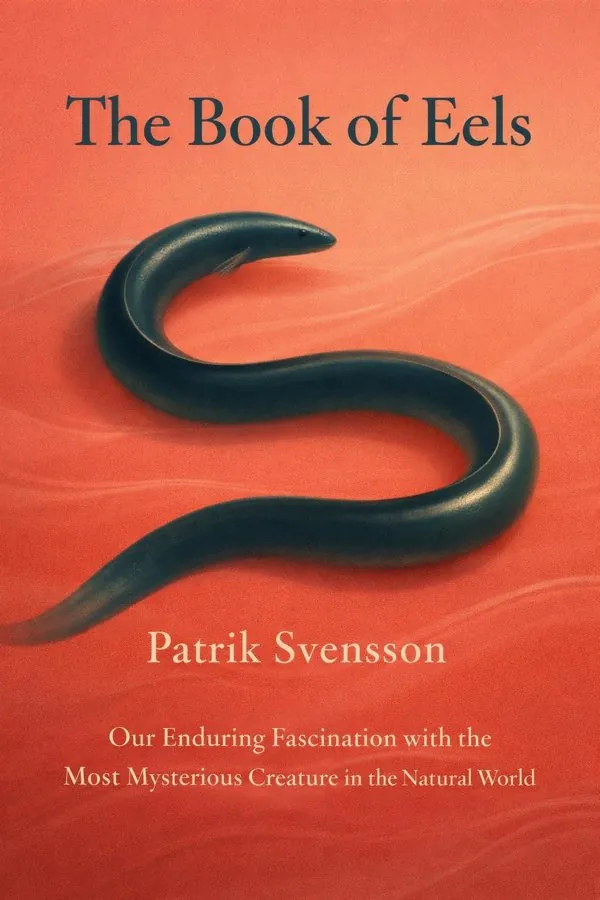
The Book of Eels: Our Enduring Fascination with the Most Mysterious Creature in the Natural World: Summary & Key Insights
 10 min9 chaptersAudio available
What Is The Book of Eels: Our Enduring Fascination with the Most Mysterious Creature in the Natural World About?
The Book of Eels: Our Enduring Fascination with the Most Mysterious Creature in the Natural World by Patrik Svensson is a life_science book spanning 9 pages. The Book of Eels is a blend of nature writing, memoir, and scientific exploration that delves into the mysteries of the eel—one of the most enigmatic creatures on Earth. Patrik Svensson weaves together the history of eel research, philosophical reflections, and personal memories of fishing with his father to explore humanity’s enduring fascination with this elusive animal.
This FizzRead summary covers all 9 key chapters of The Book of Eels: Our Enduring Fascination with the Most Mysterious Creature in the Natural World in approximately 10 minutes, distilling the most important ideas, arguments, and takeaways from Patrik Svensson's work. Also available as an audio summary and Key Quotes Podcast.
The Book of Eels: Our Enduring Fascination with the Most Mysterious Creature in the Natural World
The Book of Eels is a blend of nature writing, memoir, and scientific exploration that delves into the mysteries of the eel—one of the most enigmatic creatures on Earth. Patrik Svensson weaves together the history of eel research, philosophical reflections, and personal memories of fishing with his father to explore humanity’s enduring fascination with this elusive animal.
Who Should Read The Book of Eels: Our Enduring Fascination with the Most Mysterious Creature in the Natural World?
This book is perfect for anyone interested in life_science and looking to gain actionable insights in a short read. Whether you're a student, professional, or lifelong learner, the key ideas from The Book of Eels: Our Enduring Fascination with the Most Mysterious Creature in the Natural World by Patrik Svensson will help you think differently.
- ✓Readers who enjoy life_science and want practical takeaways
- ✓Professionals looking to apply new ideas to their work and life
- ✓Anyone who wants the core insights of The Book of Eels: Our Enduring Fascination with the Most Mysterious Creature in the Natural World in just 10 minutes
Want the full summary?
Get instant access to this book summary and 100K+ more with Fizz Moment.
Get Free SummaryAvailable on App Store • Free to download
Key Chapters
The fascination with eels begins far before modern science. In his *History of Animals*, Aristotle wrote of eels as if they materialized spontaneously from mud. He studied their anatomy closely but lacked any evidence of their reproductive organs. No eggs had ever been seen, no mating behaviors observed. It was as though eels came from nothing, and so he concluded that they must indeed arise from the earth itself. To Aristotle, this was not ignorance, but philosophy; where observation ended, reasoning stepped in.
This ancient confusion about the eel was the first glimpse of humanity’s relationship with the unknowable. The eel became a symbol of boundaries—between the seen and unseen, the known and unknown. Centuries later, as naturalists collected specimens and dissected bodies, the question remained: where do eels come from? The more we studied, the more we realized that nature hid her secrets not out of malice, but out of her own deep complexity.
For me, returning to Aristotle’s speculation is not quaint history. It speaks to an enduring humility in science. The eel forced even the greatest thinkers to admit what they did not know, and that admission is a form of truth. When I first learned of this as a boy, sitting beside my father after a long night by the river, I realized that wonder does not die in the face of ignorance—it begins there.
For two thousand years, eels kept their secret. Every river in Europe teemed with them, yet where they were born and how they reproduced remained invisible. Unlike salmon, which spawn in clear upstream shallows, eels seemed to vanish into the seas and return as if reborn. Theories abounded: that eels transformed from horsehairs fallen into the water, that they were immortal creatures reborn from their own decay.
When scientists began to trace their life cycle, they found delicate, transparent larvae—leptocephali—drifting in the Atlantic. These were thought to be unrelated species until, in the early twentieth century, researchers discovered they metamorphosed into glass eels, then yellow eels, and finally into silvery, ocean-ready adults. Yet even then, no one had witnessed their spawning. The eel’s reproductive secret lay hidden somewhere deep in the ocean.
It was the Danish scientist Johannes Schmidt who, after years of expeditions, deduced that all European eels originated from a single mysterious place: the Sargasso Sea, an area of the Atlantic clouded with floating weeds and bound by circular currents. By examining the size of the larvae he collected—smaller the farther west he sailed—Schmidt traced their birthplace to that elusive region. It was a triumph of persistence and imagination, and yet Schmidt himself never saw an eel mate, egg, or fry. The core mystery endured.
To me, this enduring uncertainty is not failure; it is a lesson in patience. The eel mirrors our own lives: we, too, are pushed by invisible currents, driven by instincts we do not fully understand, toward destinations from which we may never return.
+ 7 more chapters — available in the FizzRead app
All Chapters in The Book of Eels: Our Enduring Fascination with the Most Mysterious Creature in the Natural World
About the Author
Patrik Svensson is a Swedish journalist and author born in 1972. He has worked as a culture journalist for the newspaper Sydsvenskan. His debut book, The Book of Eels, became an international success and has been translated into multiple languages.
Get This Summary in Your Preferred Format
Read or listen to the The Book of Eels: Our Enduring Fascination with the Most Mysterious Creature in the Natural World summary by Patrik Svensson anytime, anywhere. FizzRead offers multiple formats so you can learn on your terms — all free.
Available formats: App · Audio · PDF · EPUB — All included free with FizzRead
Download The Book of Eels: Our Enduring Fascination with the Most Mysterious Creature in the Natural World PDF and EPUB Summary
Key Quotes from The Book of Eels: Our Enduring Fascination with the Most Mysterious Creature in the Natural World
“The fascination with eels begins far before modern science.”
“For two thousand years, eels kept their secret.”
Frequently Asked Questions about The Book of Eels: Our Enduring Fascination with the Most Mysterious Creature in the Natural World
The Book of Eels: Our Enduring Fascination with the Most Mysterious Creature in the Natural World by Patrik Svensson is a life_science book that explores key ideas across 9 chapters. The Book of Eels is a blend of nature writing, memoir, and scientific exploration that delves into the mysteries of the eel—one of the most enigmatic creatures on Earth. Patrik Svensson weaves together the history of eel research, philosophical reflections, and personal memories of fishing with his father to explore humanity’s enduring fascination with this elusive animal.
You Might Also Like
The Selfish Gene
Richard Dawkins
10 min
Awakenings
Oliver Sacks
10 min
Parasite Rex: Inside the Bizarre World of Nature's Most Dangerous Creatures
Carl Zimmer
10 min
The Atlas of Life on Earth
Various
10 min
The Book of Humans: The Story of How We Became Us
Adam Rutherford
10 min
The Horse
Wendy Williams
10 minBrowse by Category
Ready to read The Book of Eels: Our Enduring Fascination with the Most Mysterious Creature in the Natural World?
Get the full summary and 100K+ more books with Fizz Moment.