
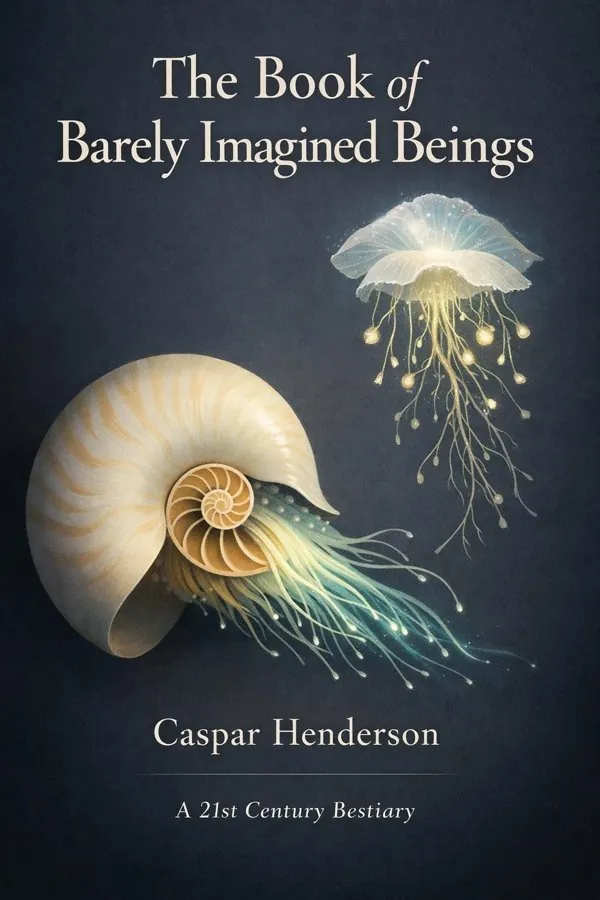
The Book of Barely Imagined Beings: A 21st Century Bestiary: Summary & Key Insights
 10 min5 chaptersAudio available
What Is The Book of Barely Imagined Beings: A 21st Century Bestiary About?
The Book of Barely Imagined Beings: A 21st Century Bestiary by Caspar Henderson is a popular_sci book spanning 5 pages. A modern bestiary that explores extraordinary creatures from the natural world and human imagination, blending science, philosophy, and wonder. Henderson reimagines the medieval tradition of cataloging animals to reflect contemporary knowledge and environmental awareness, inviting readers to marvel at biodiversity and the limits of human understanding.
This FizzRead summary covers all 5 key chapters of The Book of Barely Imagined Beings: A 21st Century Bestiary in approximately 10 minutes, distilling the most important ideas, arguments, and takeaways from Caspar Henderson's work. Also available as an audio summary and Key Quotes Podcast.
The Book of Barely Imagined Beings: A 21st Century Bestiary
A modern bestiary that explores extraordinary creatures from the natural world and human imagination, blending science, philosophy, and wonder. Henderson reimagines the medieval tradition of cataloging animals to reflect contemporary knowledge and environmental awareness, inviting readers to marvel at biodiversity and the limits of human understanding.
Who Should Read The Book of Barely Imagined Beings: A 21st Century Bestiary?
This book is perfect for anyone interested in popular_sci and looking to gain actionable insights in a short read. Whether you're a student, professional, or lifelong learner, the key ideas from The Book of Barely Imagined Beings: A 21st Century Bestiary by Caspar Henderson will help you think differently.
- ✓Readers who enjoy popular_sci and want practical takeaways
- ✓Professionals looking to apply new ideas to their work and life
- ✓Anyone who wants the core insights of The Book of Barely Imagined Beings: A 21st Century Bestiary in just 10 minutes
Want the full summary?
Get instant access to this book summary and 100K+ more with Fizz Moment.
Get Free SummaryAvailable on App Store • Free to download
Key Chapters
Among the beings that challenge the limits of imagination, the axolotl stands first in line. In its unmatured form, this salamander lives perpetually underwater, retaining larval features that never quite metamorphose. Yet under the right conditions, it reveals an astonishing gift—it can regenerate limbs, lungs, even parts of its brain and spine. When I learned of this creature’s resilience, it struck me as a messenger from biology’s twilight zones, where evolution experiments with possibilities that defy conventional logic.
The axolotl’s story is both biological and philosophical. On one level, it teaches us about pluripotent cells, about nature’s capacity to rebuild itself. But symbolically, it embodies transformation without completion, a state of suspended becoming. Its perpetual youth recalls myths of immortality, yet its real lesson is adaptability. To live as the axolotl does—halfway between worlds, capable of self-renewal—invites us to rethink change as cyclical, not terminal. As humans, often fixated on progress and outcome, we could learn from this amphibian’s fluid boundaries. Adaptation may be less about advancing and more about revisiting our own inner potential.
In the shrinking lakes of Mexico, the axolotl teeters on extinction, caught between urban sprawl and pollution. Its fragility mirrors ours: our technologies promise renewal, yet our environments degrade. To protect beings like the axolotl is, in truth, to protect the regenerative spirit of life itself. I see it as an emblem of resilience, a living metaphor that suggests that regeneration—biological or moral—is not merely possible but essential.
Deep beneath the ocean’s surface, where sunlight fades into eternal twilight, lives the barreleye fish, one of evolution’s most surreal visions. Its head is a transparent dome, and within that dome two tubular eyes gaze upward toward the faint glow above. Imagine it: a creature looking through its own skull, a living experiment in perception.
I have always been fascinated by how such an organism alters our metaphors of vision. Humans equate seeing with knowing, yet the barreleye shows that perception itself is selective and incomplete. Its transparency is anatomical fact and philosophical symbol all at once. It reminds us that clarity is not simply the removal of obstacles but the adjustment of perspective.
Observing this fish, I feel a humbling awe. Our own vision—biological and mental—is so conditioned by surface impressions. The barreleye’s gaze pierces opacity not by choice but design, adapting to a darkness thicker than any ignorance we’ve known. It reminds me that living well may depend not on seeing everything, but on learning what to see and how.
In the history of thought, transparency is often idealized—truth revealed, obscurity gone. The barreleye, however, suggests a deeper truth: that perception itself is embodied, limited, and wondrous. When we encounter nature’s constructs like this, we rediscover an ancient humility. Even a tiny fish hidden in the deep can provoke the philosopher’s question—what does it mean to truly perceive?
+ 3 more chapters — available in the FizzRead app
All Chapters in The Book of Barely Imagined Beings: A 21st Century Bestiary
About the Author
Caspar Henderson is a British writer and journalist known for his works on science, nature, and environmental issues. He has written for major publications such as The Financial Times, The Guardian, and New Scientist, and is recognized for his ability to combine scientific insight with literary creativity.
Get This Summary in Your Preferred Format
Read or listen to the The Book of Barely Imagined Beings: A 21st Century Bestiary summary by Caspar Henderson anytime, anywhere. FizzRead offers multiple formats so you can learn on your terms — all free.
Available formats: App · Audio · PDF · EPUB — All included free with FizzRead
Download The Book of Barely Imagined Beings: A 21st Century Bestiary PDF and EPUB Summary
Key Quotes from The Book of Barely Imagined Beings: A 21st Century Bestiary
“Among the beings that challenge the limits of imagination, the axolotl stands first in line.”
“Deep beneath the ocean’s surface, where sunlight fades into eternal twilight, lives the barreleye fish, one of evolution’s most surreal visions.”
Frequently Asked Questions about The Book of Barely Imagined Beings: A 21st Century Bestiary
The Book of Barely Imagined Beings: A 21st Century Bestiary by Caspar Henderson is a popular_sci book that explores key ideas across 5 chapters. A modern bestiary that explores extraordinary creatures from the natural world and human imagination, blending science, philosophy, and wonder. Henderson reimagines the medieval tradition of cataloging animals to reflect contemporary knowledge and environmental awareness, inviting readers to marvel at biodiversity and the limits of human understanding.
You Might Also Like
Structures: Or Why Things Don"t Fall Down
J.E. Gordon
10 min
The Road to Wigan Pier
George Orwell
10 min
Bonk: The Curious Coupling of Science and Sex
Mary Roach
10 min
First Bite: How We Learn to Eat
Bee Wilson
10 min
In Pursuit Of The Unknown: 17 Equations That Changed The World
Ian Stewart
10 min
Napoleon's Buttons: 17 Molecules That Changed History
Penny Le Couteur and Jay Burreson
10 minBrowse by Category
Ready to read The Book of Barely Imagined Beings: A 21st Century Bestiary?
Get the full summary and 100K+ more books with Fizz Moment.