
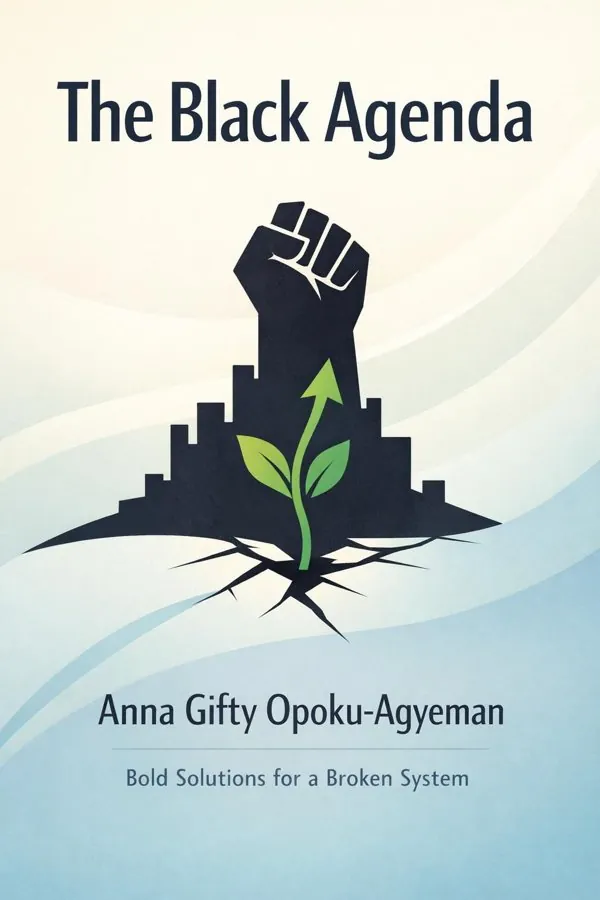
The Black Agenda: Bold Solutions for a Broken System: Summary & Key Insights
 10 min9 chaptersAudio available
Key Takeaways from The Black Agenda: Bold Solutions for a Broken System
A society reveals its values by what it teaches, whom it funds, and who gets left behind.
Wealth gaps do not emerge from personal failure; they are built through policy, protected by institutions, and passed from generation to generation.
Health is often treated as a matter of personal choice, but The Black Agenda insists that health outcomes are deeply political.
Climate change is often discussed as a universal threat, but not everyone is exposed to it in the same way.
A broken system often mistakes control for safety.
What Is The Black Agenda: Bold Solutions for a Broken System About?
The Black Agenda: Bold Solutions for a Broken System by Anna Gifty Opoku-Agyeman is a politics book spanning 8 pages. The Black Agenda: Bold Solutions for a Broken System is not just a diagnosis of racial inequality in America; it is a blueprint for rebuilding the systems that shape everyday life. Edited by Anna Gifty Opoku-Agyeman, the collection brings together Black scholars, organizers, policymakers, and public thinkers to answer a vital question: what would society look like if the people most affected by injustice were trusted to design the solutions? Across topics including education, economics, health, climate, criminal justice, political representation, gender, and media, the book argues that inequity is not accidental. It is structured, reproduced through policy, and therefore open to redesign. What makes this book especially powerful is its refusal to separate analysis from action. The contributors do not merely describe problems; they offer bold, practical alternatives rooted in Black experience, research, and imagination. Opoku-Agyeman’s authority as a researcher, activist, and founder of The Sadie Collective gives the volume both intellectual rigor and movement energy. For readers seeking a serious, future-oriented account of justice, The Black Agenda is a compelling reminder that real reform begins by centering the people who have long been pushed to the margins.
This FizzRead summary covers all 9 key chapters of The Black Agenda: Bold Solutions for a Broken System in approximately 10 minutes, distilling the most important ideas, arguments, and takeaways from Anna Gifty Opoku-Agyeman's work. Also available as an audio summary and Key Quotes Podcast.
The Black Agenda: Bold Solutions for a Broken System
The Black Agenda: Bold Solutions for a Broken System is not just a diagnosis of racial inequality in America; it is a blueprint for rebuilding the systems that shape everyday life. Edited by Anna Gifty Opoku-Agyeman, the collection brings together Black scholars, organizers, policymakers, and public thinkers to answer a vital question: what would society look like if the people most affected by injustice were trusted to design the solutions? Across topics including education, economics, health, climate, criminal justice, political representation, gender, and media, the book argues that inequity is not accidental. It is structured, reproduced through policy, and therefore open to redesign.
What makes this book especially powerful is its refusal to separate analysis from action. The contributors do not merely describe problems; they offer bold, practical alternatives rooted in Black experience, research, and imagination. Opoku-Agyeman’s authority as a researcher, activist, and founder of The Sadie Collective gives the volume both intellectual rigor and movement energy. For readers seeking a serious, future-oriented account of justice, The Black Agenda is a compelling reminder that real reform begins by centering the people who have long been pushed to the margins.
Who Should Read The Black Agenda: Bold Solutions for a Broken System?
This book is perfect for anyone interested in politics and looking to gain actionable insights in a short read. Whether you're a student, professional, or lifelong learner, the key ideas from The Black Agenda: Bold Solutions for a Broken System by Anna Gifty Opoku-Agyeman will help you think differently.
- ✓Readers who enjoy politics and want practical takeaways
- ✓Professionals looking to apply new ideas to their work and life
- ✓Anyone who wants the core insights of The Black Agenda: Bold Solutions for a Broken System in just 10 minutes
Want the full summary?
Get instant access to this book summary and 100K+ more with Fizz Moment.
Get Free SummaryAvailable on App Store • Free to download
Key Chapters
A society reveals its values by what it teaches, whom it funds, and who gets left behind. In The Black Agenda, education is presented not as a neutral system but as a battleground where opportunity and exclusion are constantly reproduced. For many Black students, schooling has too often meant underfunded districts, biased discipline, culturally detached curricula, and admissions systems that reward inherited privilege while calling it merit. The book challenges the comforting myth that access alone is enough. Being allowed into a system designed without you in mind is not the same as being served by it.
The contributors push readers to think beyond narrow debates about test scores or elite college admissions. They ask what education is for: compliance, sorting, and gatekeeping, or empowerment, critical thinking, and collective advancement. That means examining school funding formulas, ending punitive disciplinary policies that feed the school-to-prison pipeline, supporting Black teachers and administrators, and building curricula that reflect Black history and intellectual contributions as foundational rather than optional.
Practical applications include expanding need-based support in higher education, investing in historically Black colleges and universities, creating mentorship pipelines, and redesigning admissions to account for structural inequality rather than pretending every applicant starts from the same place. It also means valuing emotional safety, belonging, and civic education alongside academic outcomes.
The deeper argument is that educational justice is not simply about helping individuals “escape” inequity. It is about building institutions that stop reproducing inequity in the first place. Actionable takeaway: evaluate any education policy by asking not only who can enter the system, but who is actually able to thrive once inside it.
Wealth gaps do not emerge from personal failure; they are built through policy, protected by institutions, and passed from generation to generation. The Black Agenda treats economics as central to racial justice because economic inequality is one of the clearest ways historical exclusion continues to shape present life. Black communities were systematically blocked from land ownership, fair lending, labor protections, business capital, and wealth-building opportunities. As a result, the Black wealth gap is not evidence of a lack of discipline or ambition. It is evidence of a rigged system.
The essays in this section challenge the tendency to reduce economic justice to financial literacy or individual entrepreneurship. While personal budgeting and business ownership can matter, they cannot solve problems created by discriminatory housing policy, wage suppression, occupational segregation, debt burdens, and intergenerational exclusion from assets. The book therefore moves the conversation from behavior to structure.
Examples of more serious solutions include baby bonds, stronger labor protections, student debt relief, fairer taxation, targeted investment in Black-owned businesses, and reparative policies that directly address accumulated disadvantage. The contributors also emphasize data: if race-neutral economic policy leaves racial disparities untouched, then it is not neutral in effect.
One of the book’s strongest insights is that Black economic justice benefits democracy as a whole. When more people have access to stability, credit, housing, and dignified work, society becomes less extractive and more resilient. Actionable takeaway: shift your thinking from “How can individuals overcome inequality?” to “What public policies are still producing inequality, and how can they be redesigned?”
Health is often treated as a matter of personal choice, but The Black Agenda insists that health outcomes are deeply political. Where people live, what care they can access, whether they are believed by medical professionals, and how chronic stress affects their bodies all shape who gets to live well and who is forced merely to survive. For Black communities, health disparities are not random. They reflect environmental exposure, unequal insurance access, biased treatment, underinvestment in care, and the physical toll of racism itself.
The book expands the definition of health beyond hospitals and emergency response. Maternal mortality, mental health, reproductive justice, food access, disability inclusion, and community care all become part of the conversation. This matters because a system can technically provide treatment while still failing to create the conditions for wellness. A neighborhood without clean air, nearby clinics, affordable groceries, and trauma-informed support is not healthy simply because an emergency room exists somewhere across town.
Concrete applications include increasing Black representation in medicine, investing in community health workers, expanding Medicaid and preventive care, addressing bias in diagnostic and pain-management practices, and funding culturally competent mental health services. It also means recognizing that public health cannot be separated from labor, housing, transportation, and environmental policy.
The section’s larger lesson is that justice in health is not achieved when marginalized people become more resilient in the face of harm. It is achieved when the sources of harm are removed. Actionable takeaway: whenever you hear about a health disparity, ask what upstream policies and conditions created it rather than assuming the problem begins with individual behavior.
Climate change is often discussed as a universal threat, but not everyone is exposed to it in the same way. The Black Agenda makes clear that Black communities have long lived at the front lines of environmental harm, from toxic water and air pollution to heat vulnerability, flooding, and industrial siting. Before climate disaster becomes a headline, environmental racism has already determined whose neighborhoods are treated as disposable.
This section reframes climate justice as both an ecological and a racial issue. It is not enough to support broad sustainability goals if the benefits of green policy bypass the communities that have endured the greatest harm. A city may celebrate new parks, cleaner transit, or green redevelopment while pushing longtime Black residents out through rising rents and displacement. In that case, environmental progress becomes another form of exclusion.
The contributors call for climate policy that is locally grounded and equity-centered. Examples include investing in resilient infrastructure in historically neglected neighborhoods, enforcing stricter pollution standards, expanding access to clean energy jobs, protecting residents from climate-driven displacement, and ensuring Black voices are represented in environmental planning. They also emphasize that grassroots knowledge matters. Communities facing contamination and flooding often understand the stakes long before institutions respond.
One practical insight here is that climate adaptation cannot be separated from housing, transportation, labor, and public health. Cooling centers do not help enough if people cannot safely reach them; clean-energy jobs do not transform communities if hiring pipelines remain exclusionary.
The core idea is simple but profound: there is no serious climate agenda without racial justice. Actionable takeaway: support environmental solutions that measure success not only by emissions reduced, but by whether the most burdened communities are safer, healthier, and able to remain in place.
A broken system often mistakes control for safety. In The Black Agenda, the criminal justice section argues that the United States has built an architecture of punishment that falls hardest on Black communities while failing to deliver true security. Over-policing, cash bail, harsh sentencing, surveillance, and incarceration are presented not as isolated excesses but as interconnected features of a system designed to manage inequality rather than resolve it.
The essays urge readers to question assumptions that punishment automatically produces justice. If schools are underfunded, housing is unstable, mental health care is inaccessible, and jobs are scarce, policing becomes a blunt response to social failure. The result is a cycle in which Black people are disproportionately criminalized for conditions created by public neglect. Meanwhile, the harms of incarceration extend far beyond prison walls, disrupting families, voting rights, income, housing access, and community stability.
The book highlights practical alternatives: reducing reliance on cash bail, ending mandatory minimums, investing in diversion and restorative justice programs, treating substance use and mental health crises through care rather than force, and strengthening reentry support so people are not set up to fail upon release. It also asks readers to take survivors seriously while recognizing that punishment-heavy systems often fail them too.
This section’s strength lies in shifting the conversation from reforming misconduct at the margins to rethinking the purpose of the system itself. Safety should mean freedom from violence, but also freedom from hunger, eviction, untreated trauma, and state abuse.
Actionable takeaway: when evaluating public safety proposals, ask whether they reduce harm at its root or simply expand the reach of punishment.
Seeing Black faces in public office can be inspiring, but symbolism alone does not transform institutions. The Black Agenda treats political representation as necessary but incomplete. Descriptive representation matters because lived experience shapes what leaders notice, prioritize, and fight for. Yet the book warns against confusing visibility with victory. A system can diversify its image without changing its outcomes.
The contributors argue that meaningful representation requires access to decision-making power, policy capacity, and accountable institutions. It is not enough to elect a few exceptional individuals into spaces still governed by exclusionary rules, donor influence, voter suppression, and procedural barriers. Black political participation has historically been met with resistance precisely because democratic power can reshape budgets, laws, and public priorities.
Examples in this section include protecting voting rights, challenging gerrymandering, expanding ballot access, supporting Black candidates at local as well as national levels, and investing in civic education that helps communities understand not just how to vote but how policy gets made. The essays also highlight movement infrastructure: organizers, local advocates, policy researchers, and community leaders often do as much to shape public life as elected officials do.
A particularly important point is that representation should not be judged only by whether Black leaders occupy office, but by whether public policy reflects Black communities’ needs and aspirations. Are budgets equitable? Are schools funded? Are housing protections real? Are public agencies accountable?
The lesson is that democracy is strongest when participation is broad, informed, and materially consequential. Actionable takeaway: support political inclusion beyond election day by paying attention to local governance, policy implementation, and the rules that determine whose voice truly counts.
No community is one-dimensional, and no serious justice framework can afford to be. The Black Agenda emphasizes that Black political and social life is shaped by intersecting identities, including gender, sexuality, class, disability, immigration status, and more. Intersectionality is not a trend word here; it is an analytic tool that reveals how systems of power overlap. Without it, policy can claim to address racial inequality while leaving many Black people unseen.
The book pays particular attention to Black women, queer and trans Black people, and others whose experiences often sit at the margins of mainstream debates. For example, labor policy looks different when we consider care work and wage inequity affecting Black women. Health policy changes when reproductive justice and maternal mortality are centered. Safety looks different when trans Black people face both interpersonal violence and state neglect. An apparently broad racial policy can fail in practice if it assumes a single, universal Black experience.
This section also challenges leadership models that celebrate Black advancement while ignoring who within Black communities remains underprotected. It calls for movement strategies and policy design that are attentive to those carrying multiple burdens. In practical terms, that can mean collecting better disaggregated data, funding services tailored to specific community needs, and ensuring that those most affected are present in leadership and agenda-setting.
The larger insight is that widening the frame does not weaken solidarity; it strengthens it. A justice movement that works for the most vulnerable becomes more durable and honest for everyone.
Actionable takeaway: when considering any policy or movement claim, ask which Black experiences are being centered, which are being assumed, and which might still be missing from view.
Before policy changes, stories usually do. The Black Agenda argues that media, culture, and public narrative are not secondary to politics; they actively shape what society believes is normal, dangerous, deserving, or imaginable. If Black people are consistently portrayed through frames of deficiency, threat, or spectacle, those narratives become excuses for punitive policy and public indifference. Conversely, when Black communities control their own stories, they expand the range of solutions people are willing to support.
This section explores how news media, entertainment, social platforms, and cultural institutions influence political common sense. A misleading story about crime can justify over-policing. A narrow story about poverty can individualize structural deprivation. A distorted story about protest can turn demands for justice into fears of disorder. Representation in media therefore matters not only for dignity, but for governance.
The contributors encourage critical media literacy and greater investment in Black storytelling, journalism, scholarship, and cultural production. Practical applications include supporting independent Black media, questioning sensational coverage, diversifying newsroom leadership, and examining who gets treated as an expert in public debate. Narrative change also happens in classrooms, museums, and everyday conversation, not only on television.
The key point is that ideas about Black life are politically consequential. If the public imagination is constrained, policy ambition will be constrained too. Reclaiming narrative power means refusing inherited scripts and creating richer, more truthful accounts of Black history, intellect, joy, struggle, and possibility.
Actionable takeaway: pay close attention to the stories that accompany policy debates, because the frame used to describe a problem often determines which solutions are considered legitimate.
One of the book’s most unifying arguments is that the people closest to injustice often have the clearest understanding of how to solve it. The Black Agenda is built on the premise that Black expertise has long been ignored, extracted, or treated as supplemental rather than authoritative. Yet across economics, health, climate, education, and governance, Black scholars and organizers have produced rigorous analyses and practical ideas that should be central to policymaking.
This is a powerful reversal of the usual pattern. Too often, institutions invite marginalized communities to share personal stories while reserving technical authority for others. The book rejects that division. Lived experience and professional expertise are not opposites. Black communities contain researchers, practitioners, data scientists, advocates, and public thinkers whose work should shape agenda-setting from the start, not just serve as moral testimony after decisions are mostly made.
Examples of this principle include participatory policymaking, community-based research, investing in Black academic and civic institutions, and creating pipelines that move Black talent into leadership roles in government, media, philanthropy, and universities. Opoku-Agyeman’s own work with The Sadie Collective embodies this approach by expanding who gets seen as an expert in economics and public policy.
The broader lesson is that inclusion is not simply about fairness in representation. It is about improving the quality of decisions. Systems fail when they exclude knowledge from the people who understand the stakes most intimately.
Actionable takeaway: in any conversation about reform, ask who is defining the problem, whose expertise is being treated as credible, and whether those most affected are shaping the solution rather than merely reacting to it.
All Chapters in The Black Agenda: Bold Solutions for a Broken System
About the Author
Anna Gifty Opoku-Agyeman is a Ghanaian-American researcher, writer, and activist known for her work at the intersection of economics, data, and equity. She is the founder of The Sadie Collective, an influential organization dedicated to increasing the representation of Black women in economics, public policy, and related fields. Through her scholarship and advocacy, she has helped push conversations about inequality beyond abstract debate and toward concrete institutional change. Opoku-Agyeman is especially recognized for centering Black expertise in spaces that have historically excluded it. As the editor of The Black Agenda, she brings together scholars, organizers, and public thinkers to present a bold, policy-driven vision for justice. Her work reflects a commitment to rigorous analysis, inclusive leadership, and transforming systems rather than merely critiquing them.
Get This Summary in Your Preferred Format
Read or listen to the The Black Agenda: Bold Solutions for a Broken System summary by Anna Gifty Opoku-Agyeman anytime, anywhere. FizzRead offers multiple formats so you can learn on your terms — all free.
Available formats: App · Audio · PDF · EPUB — All included free with FizzRead
Download The Black Agenda: Bold Solutions for a Broken System PDF and EPUB Summary
Key Quotes from The Black Agenda: Bold Solutions for a Broken System
“A society reveals its values by what it teaches, whom it funds, and who gets left behind.”
“Wealth gaps do not emerge from personal failure; they are built through policy, protected by institutions, and passed from generation to generation.”
“Health is often treated as a matter of personal choice, but The Black Agenda insists that health outcomes are deeply political.”
“Climate change is often discussed as a universal threat, but not everyone is exposed to it in the same way.”
“A broken system often mistakes control for safety.”
Frequently Asked Questions about The Black Agenda: Bold Solutions for a Broken System
The Black Agenda: Bold Solutions for a Broken System by Anna Gifty Opoku-Agyeman is a politics book that explores key ideas across 9 chapters. The Black Agenda: Bold Solutions for a Broken System is not just a diagnosis of racial inequality in America; it is a blueprint for rebuilding the systems that shape everyday life. Edited by Anna Gifty Opoku-Agyeman, the collection brings together Black scholars, organizers, policymakers, and public thinkers to answer a vital question: what would society look like if the people most affected by injustice were trusted to design the solutions? Across topics including education, economics, health, climate, criminal justice, political representation, gender, and media, the book argues that inequity is not accidental. It is structured, reproduced through policy, and therefore open to redesign. What makes this book especially powerful is its refusal to separate analysis from action. The contributors do not merely describe problems; they offer bold, practical alternatives rooted in Black experience, research, and imagination. Opoku-Agyeman’s authority as a researcher, activist, and founder of The Sadie Collective gives the volume both intellectual rigor and movement energy. For readers seeking a serious, future-oriented account of justice, The Black Agenda is a compelling reminder that real reform begins by centering the people who have long been pushed to the margins.
You Might Also Like

Antifa: The Anti-Fascist Handbook
Mark Bray
10 min
Attack from Within: How Disinformation Is Sabotaging America
Barbara McQuade
10 min
Coercion, Capital, and European States, AD 990–1992
Charles Tilly
10 min
Digital Democracy: Concepts, Methodologies, Tools, and Applications
Various Authors
10 min
Fascism
Stanley G. Payne
10 min
Fire And Fury: Inside The Trump White House
Michael Wolff
10 minBrowse by Category
Ready to read The Black Agenda: Bold Solutions for a Broken System?
Get the full summary and 100K+ more books with Fizz Moment.