
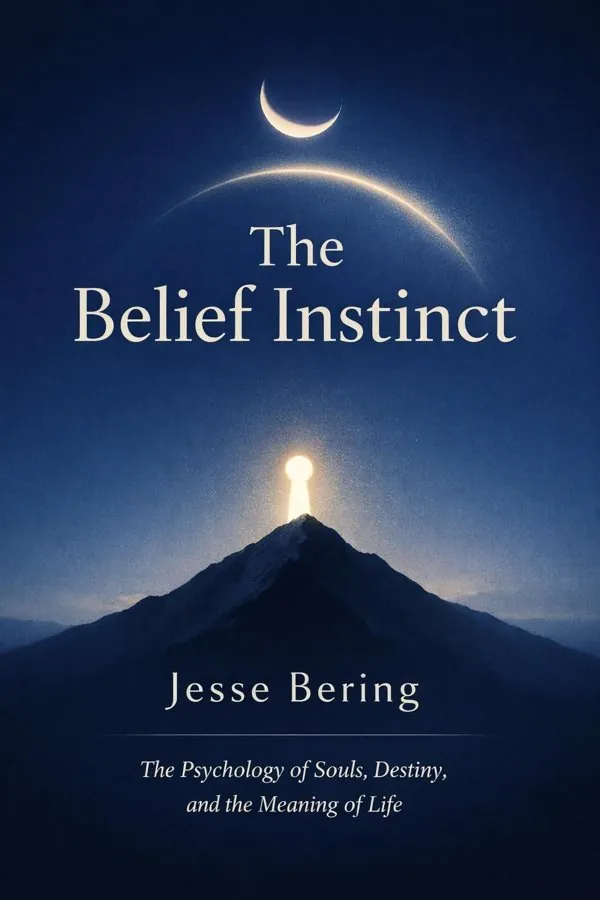
The Belief Instinct: The Psychology of Souls, Destiny, and the Meaning of Life: Summary & Key Insights
by Jesse Bering
 10 min9 chaptersAudio available
What Is The Belief Instinct: The Psychology of Souls, Destiny, and the Meaning of Life About?
The Belief Instinct: The Psychology of Souls, Destiny, and the Meaning of Life by Jesse Bering is a psychology book spanning 9 pages. In this thought-provoking work, evolutionary psychologist Jesse Bering explores the origins of human belief in gods, souls, and destiny. He argues that these beliefs are not arbitrary but evolved as adaptive illusions that helped our ancestors navigate complex social environments. Drawing on psychology, philosophy, and evolutionary theory, Bering examines how our minds are predisposed to see purpose and intention in the world around us.
This FizzRead summary covers all 9 key chapters of The Belief Instinct: The Psychology of Souls, Destiny, and the Meaning of Life in approximately 10 minutes, distilling the most important ideas, arguments, and takeaways from Jesse Bering's work. Also available as an audio summary and Key Quotes Podcast.
The Belief Instinct: The Psychology of Souls, Destiny, and the Meaning of Life
In this thought-provoking work, evolutionary psychologist Jesse Bering explores the origins of human belief in gods, souls, and destiny. He argues that these beliefs are not arbitrary but evolved as adaptive illusions that helped our ancestors navigate complex social environments. Drawing on psychology, philosophy, and evolutionary theory, Bering examines how our minds are predisposed to see purpose and intention in the world around us.
Who Should Read The Belief Instinct: The Psychology of Souls, Destiny, and the Meaning of Life?
This book is perfect for anyone interested in psychology and looking to gain actionable insights in a short read. Whether you're a student, professional, or lifelong learner, the key ideas from The Belief Instinct: The Psychology of Souls, Destiny, and the Meaning of Life by Jesse Bering will help you think differently.
- ✓Readers who enjoy psychology and want practical takeaways
- ✓Professionals looking to apply new ideas to their work and life
- ✓Anyone who wants the core insights of The Belief Instinct: The Psychology of Souls, Destiny, and the Meaning of Life in just 10 minutes
Want the full summary?
Get instant access to this book summary and 100K+ more with Fizz Moment.
Get Free SummaryAvailable on App Store • Free to download
Key Chapters
Everything begins with our capacity to imagine what others think. This is the evolutionary triumph known as Theory of Mind. It allows us to infer that when our friend reaches for the apple, she wants to eat it; that when a rival stares across the fire, he harbors suspicion. This mental modeling evolved to solve social problems in small, interdependent groups. But it also endowed us with a peculiar byproduct: we became experts at seeing agency everywhere.
When something rustled in the grass, the safer bet was to assume a predator lurked there. When the river flooded or thunder cracked, our minds, tuned to detect intentional agents, constructed invisible actors behind the events. Even in solitude, the brain’s machinery for tracking minds did not turn off—it simply filled in the blanks. We became haunted by unseen watchers. Gradually, those watchers acquired names, motives, and personalities, forming the early template for the divine.
The strength of this explanation lies in its cognitive grounding. Belief in gods, spirits, or destiny is not an irrational anomaly in the human record; it is the natural extension of a mental system that otherwise serves us well. Our ancestors didn’t invent the supernatural—they inferred it, because their minds were built to infer mental causes even when none were there.
From an evolutionary perspective, this over-interpretation of agency had clear survival benefits. False positives—assuming there is an agent when there isn’t—are much less costly than false negatives—failing to recognize a real threat. The cognitive architecture that made us jump at shadows also made us see spirits in the storm. Those who were more cautious, more attuned to signs of intent, had a better chance of surviving in a socially and biologically uncertain world.
But there is more to it than self-protection. Humans thrive on social cohesion. Seeing events as guided by shared supernatural forces, by a moral cosmos, binds people together. The illusion of divine oversight turns chaos into meaning. Collective myth-making thus became an adaptive social glue, reducing conflict and giving narrative coherence to existence. The gods were, in effect, the invisible members of the tribe—projected minds who helped regulate the behavior of real ones.
+ 7 more chapters — available in the FizzRead app
All Chapters in The Belief Instinct: The Psychology of Souls, Destiny, and the Meaning of Life
About the Author
Jesse Bering is an American psychologist and science writer known for his work on the cognitive science of religion and human behavior. He has written extensively on the psychology of belief, morality, and sexuality, and his research has been featured in major scientific and popular publications.
Get This Summary in Your Preferred Format
Read or listen to the The Belief Instinct: The Psychology of Souls, Destiny, and the Meaning of Life summary by Jesse Bering anytime, anywhere. FizzRead offers multiple formats so you can learn on your terms — all free.
Available formats: App · Audio · PDF · EPUB — All included free with FizzRead
Download The Belief Instinct: The Psychology of Souls, Destiny, and the Meaning of Life PDF and EPUB Summary
Key Quotes from The Belief Instinct: The Psychology of Souls, Destiny, and the Meaning of Life
“Everything begins with our capacity to imagine what others think.”
“From an evolutionary perspective, this over-interpretation of agency had clear survival benefits.”
Frequently Asked Questions about The Belief Instinct: The Psychology of Souls, Destiny, and the Meaning of Life
The Belief Instinct: The Psychology of Souls, Destiny, and the Meaning of Life by Jesse Bering is a psychology book that explores key ideas across 9 chapters. In this thought-provoking work, evolutionary psychologist Jesse Bering explores the origins of human belief in gods, souls, and destiny. He argues that these beliefs are not arbitrary but evolved as adaptive illusions that helped our ancestors navigate complex social environments. Drawing on psychology, philosophy, and evolutionary theory, Bering examines how our minds are predisposed to see purpose and intention in the world around us.
You Might Also Like

The Body Keeps the Score
Bessel van der Kolk
10 min
Surrounded by Idiots
Thomas Erikson
10 min
Emotional Intelligence
Daniel Goleman
10 min
Attached
Amir Levine
10 min
Why Does He Do That
Lundy Bancroft
10 min
Women Who Run with the Wolves
Clarissa Pinkola Estés
10 minBrowse by Category
Ready to read The Belief Instinct: The Psychology of Souls, Destiny, and the Meaning of Life?
Get the full summary and 100K+ more books with Fizz Moment.