
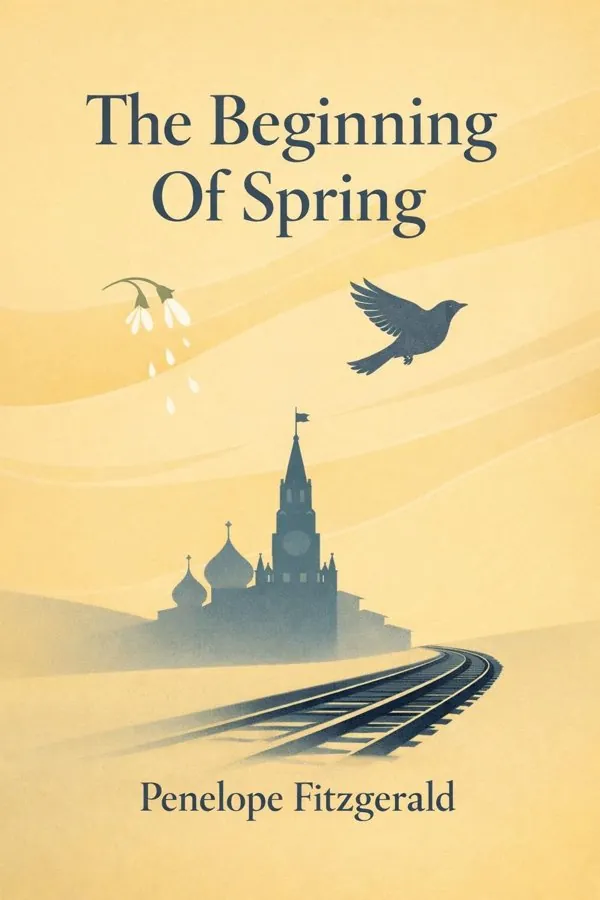
The Beginning Of Spring: Summary & Key Insights
 10 min8 chaptersAudio available
Key Takeaways from The Beginning Of Spring
A life can fracture not with drama, but with an empty room.
Sometimes renewal enters a broken home quietly, almost invisibly.
Belonging can be most painful when it is divided.
Renewal is rarely clean, and return does not erase what has happened.
The most remarkable events in Fitzgerald’s fiction often happen beneath the surface of ordinary life.
What Is The Beginning Of Spring About?
The Beginning Of Spring by Penelope Fitzgerald is a classics book spanning 4 pages. Set in Moscow in 1913, The Beginning Of Spring is a quietly luminous novel about abandonment, uncertainty, and the fragile hope that arrives with change. Penelope Fitzgerald follows Frank Reid, an English printer who has spent most of his life in Russia, as he wakes one morning to discover that his wife, Nellie, has left him and their three children. What follows is not a melodrama but something subtler and more penetrating: a study of how people go on living when the shape of ordinary life suddenly collapses. As Frank struggles to care for his children, manage his printing business, and make sense of his wife’s absence, the city around him trembles with signs of a world nearing transformation. What makes the novel matter is Fitzgerald’s extraordinary restraint. She captures emotional upheaval through small gestures, social misunderstandings, and fleeting moments of tenderness. Beneath its calm surface lies a rich meditation on family, identity, class, nationality, and the mystery of other people. Fitzgerald, one of the great stylists of 20th-century fiction, brings historical fiction and psychological insight together with rare precision, making this novel both intimate and quietly profound.
This FizzRead summary covers all 8 key chapters of The Beginning Of Spring in approximately 10 minutes, distilling the most important ideas, arguments, and takeaways from Penelope Fitzgerald's work. Also available as an audio summary and Key Quotes Podcast.
The Beginning Of Spring
Set in Moscow in 1913, The Beginning Of Spring is a quietly luminous novel about abandonment, uncertainty, and the fragile hope that arrives with change. Penelope Fitzgerald follows Frank Reid, an English printer who has spent most of his life in Russia, as he wakes one morning to discover that his wife, Nellie, has left him and their three children. What follows is not a melodrama but something subtler and more penetrating: a study of how people go on living when the shape of ordinary life suddenly collapses. As Frank struggles to care for his children, manage his printing business, and make sense of his wife’s absence, the city around him trembles with signs of a world nearing transformation.
What makes the novel matter is Fitzgerald’s extraordinary restraint. She captures emotional upheaval through small gestures, social misunderstandings, and fleeting moments of tenderness. Beneath its calm surface lies a rich meditation on family, identity, class, nationality, and the mystery of other people. Fitzgerald, one of the great stylists of 20th-century fiction, brings historical fiction and psychological insight together with rare precision, making this novel both intimate and quietly profound.
Who Should Read The Beginning Of Spring?
This book is perfect for anyone interested in classics and looking to gain actionable insights in a short read. Whether you're a student, professional, or lifelong learner, the key ideas from The Beginning Of Spring by Penelope Fitzgerald will help you think differently.
- ✓Readers who enjoy classics and want practical takeaways
- ✓Professionals looking to apply new ideas to their work and life
- ✓Anyone who wants the core insights of The Beginning Of Spring in just 10 minutes
Want the full summary?
Get instant access to this book summary and 100K+ more with Fizz Moment.
Get Free SummaryAvailable on App Store • Free to download
Key Chapters
A life can fracture not with drama, but with an empty room. That is the startling emotional premise of The Beginning Of Spring. Frank Reid’s story begins when he wakes to discover that his wife Nellie has vanished, leaving behind no real explanation and abandoning not only him but also their three children. Fitzgerald does not turn this moment into a theatrical crisis. Instead, she reveals how devastating loss often feels in real life: confused, awkward, practical, and strangely quiet. Frank must immediately confront school routines, meals, childcare, household order, and the reactions of friends and colleagues, all while trying to understand what has happened.
This first phase of the novel shows how abandonment unsettles identity as much as domestic structure. Frank is not simply missing his wife; he is forced to question the story he believed about his marriage, his home, and himself. Because he is an Englishman deeply rooted in Moscow, his dislocation is doubled. He belongs everywhere and nowhere. Even grief becomes difficult to name when social expectations require composure.
In practical terms, Fitzgerald captures a truth that applies far beyond the novel: in moments of sudden upheaval, people often survive first by attending to ordinary duties. Frank keeps the press running. He gets through the day. He responds to what must be done before he can fully understand what has been lost. Readers can recognize this pattern in divorce, bereavement, job loss, or any abrupt break in life.
Actionable takeaway: when life changes without warning, begin by stabilizing the essentials. Small routines do not solve grief, but they create the ground on which understanding and recovery can begin.
Sometimes renewal enters a broken home quietly, almost invisibly. After Nellie’s departure, the Reid household is marked by uncertainty and emotional vacancy. Into that emptiness comes Lisa Ivanovna, a young woman recommended to help care for the children. Her arrival alters the atmosphere of the novel. She does not impose order loudly or sentimentally. Instead, she brings a calm, capable presence that allows the household to breathe again.
Lisa’s role is far more complex than that of a simple caretaker. She becomes a figure of possibility, mystery, and transformation. The children respond to her, the domestic space becomes livable again, and Frank, who has been operating in a state of emotional suspension, begins to sense that life may continue in forms he had not expected. Fitzgerald is careful, however, not to reduce Lisa to a symbol of rescue. She remains enigmatic, self-contained, and not fully knowable. That unknowability is important: the novel insists that even those who seem central to our recovery are never ours to define.
There is also a practical social insight here. In times of crisis, healing often depends on someone who restores rhythm rather than offering grand speeches. A good teacher, caregiver, colleague, or friend may change a life simply by creating steadiness. Lisa helps not through emotional declarations but through presence, competence, and attention.
The household’s awakening is therefore not just romantic or narrative; it is structural. Children need care. Homes need patterns. Adults in pain need spaces where feeling can return indirectly. Fitzgerald shows how tenderness often arrives through usefulness and restraint.
Actionable takeaway: when supporting others in difficult times, focus less on dramatic reassurance and more on creating calm, reliable conditions in which trust and recovery can gradually emerge.
Belonging can be most painful when it is divided. One of the novel’s deepest themes is Frank Reid’s position between England and Russia. Though British by ancestry, he has spent most of his life in Moscow and runs a printing business there with familiarity and competence. Yet he is never entirely Russian, and in moments of crisis his foreignness becomes more visible to himself and to others. This in-between state shapes his emotional life, his marriage, and his understanding of the city around him.
Fitzgerald uses Frank’s divided identity to explore what it means to live inside more than one cultural system without being fully claimed by either. His household reflects this complexity. His children are being formed by Russia, his business depends on Russian society, and his social network includes both locals and expatriates. But when his marriage breaks down, he cannot rely on any simple script of belonging. The question is not just where he lives, but who he is when familiar roles fall away.
This tension has enduring relevance. Many readers know what it feels like to move between nations, classes, languages, or communities. Even without migration, people often occupy multiple identities at once: professional and private, traditional and modern, insider and outsider. Frank’s uncertainty reminds us that identity is rarely fixed. It is negotiated through work, family, place, and history.
The setting intensifies this theme. Russia in 1913 is itself between worlds, with old structures still standing but no longer secure. Frank’s personal instability mirrors the social instability around him. His divided life is not an exception; it is the novel’s way of describing modern existence.
Actionable takeaway: instead of forcing yourself into a single, simplified identity, learn to notice how your different affiliations shape you. Clarity often comes not from choosing one world over another, but from understanding how to live honestly between them.
Renewal is rarely clean, and return does not erase what has happened. The novel’s later movement, including questions around absence, reappearance, and changed relationships, gives its title a fuller meaning. Spring in Fitzgerald’s world is not merely a pleasant season; it is an uncertain threshold. Snow melts, but mud remains. Light increases, but nothing is fully settled. In this atmosphere, disappearance and return become charged with ambiguity.
Nellie’s absence cannot simply be undone, even if she reenters the story. Once trust has been broken, everyone has changed. Frank has been forced into new responsibilities. The children have adapted in their own ways. Lisa’s presence has reshaped the emotional life of the household. The possibility of restoration therefore raises difficult questions: can a family resume its old form, or must it become something different? Fitzgerald resists easy answers. She is interested in the reality that people often return to one another altered by what has happened in between.
The seasonal symbolism strengthens this point. Spring is not stability; it is transition. It promises growth while exposing vulnerability. In life, a new beginning often contains remnants of old pain, unfinished explanation, and unresolved feeling. That does not make renewal false. It makes it human.
Readers can apply this insight to reconciliation, career changes, recovery after illness, or any experience of starting over. We often imagine renewal as a complete reset. Fitzgerald suggests instead that healthy renewal accepts complexity. What returns may be love, order, or hope, but it returns in a changed landscape.
Actionable takeaway: when entering a new phase after loss or disruption, do not expect life to go back to what it was. Build the future by acknowledging what has changed and letting renewal take a new form.
Children do not experience family crisis as miniature adults. One of the novel’s quiet strengths is its portrayal of how Frank and Nellie’s children move through upheaval with a mixture of vulnerability, adaptability, and partial understanding. Fitzgerald does not sentimentalize them, but neither does she treat them as background. Their presence changes the moral and emotional stakes of everything that happens.
When a parent leaves, children often grasp more than adults assume, yet in forms that are fragmentary and indirect. They respond through mood, habit, attachment, fantasy, or sudden resilience. In the novel, the children continue to need food, play, sleep, care, and affection. Their world cannot pause simply because the adults are confused. This demand for continuity is one reason Lisa’s arrival matters so much. She helps restore not just order, but a feeling of safety.
Fitzgerald also suggests that children can absorb atmosphere long before they understand explanation. Tension, uncertainty, and emotional vacancy shape them even when no one speaks plainly. This insight remains highly relevant. In any household under stress, adults may focus on solving the visible problem while overlooking the emotional climate children are living inside.
The novel therefore models an important principle: protecting children does not mean pretending nothing is wrong. It means preserving dependable rhythms and relationships while recognizing that they are sensitive participants in family life. Their needs are concrete, immediate, and ongoing.
For readers, this can translate into practical attention to routine and emotional steadiness during periods of transition. Even small consistencies can matter deeply: regular meals, bedtime rituals, honest but measured communication, and the presence of trusted caregivers.
Actionable takeaway: during family disruption, prioritize stability for children through routine, trustworthy care, and calm honesty. They may not need every detail, but they do need to feel that life still has dependable structure.
When personal life collapses, work can become more than employment; it can become a form of orientation. Frank’s printing business is central to the novel not only as setting but as psychological anchor. Amid marital confusion and domestic instability, the press offers a world of tasks, relationships, craftsmanship, and continuity. It does not remove pain, but it gives shape to time and keeps Frank connected to others.
Fitzgerald treats work with unusual seriousness. Printing is not merely background detail. It represents a human effort to create order, transmit meaning, and make something durable in a shifting world. There is a subtle irony here, too: Frank produces printed materials in a society on the edge of historical upheaval. The tools of permanence exist inside a moment of impermanence.
This theme speaks strongly to modern readers. During grief, divorce, uncertainty, or social turbulence, meaningful work can offer stability. Not all work is fulfilling, of course, but purposeful activity often protects people from drifting into paralysis. The key is not overwork as avoidance; it is work as structure. Frank’s press keeps him engaged with material reality. Paper must be set. People must be paid. Machines must run.
The novel also implies that workplaces are communities, not just systems. Colleagues witness us, interpret us, and sometimes sustain us. Frank’s professional world becomes part of his emotional survival, even when it cannot solve his domestic problems.
Readers can take from this a balanced lesson. In hard periods, practical commitments can be life-preserving. The discipline of showing up, completing tasks, and making oneself useful can create momentum when feelings lag behind.
Actionable takeaway: if your personal life feels unstable, identify one meaningful area of work or responsibility you can tend consistently. Purposeful structure can help carry you through emotional uncertainty.
Some novels about history describe revolutions directly; Fitzgerald does something more subtle. The Beginning Of Spring is set in Moscow in 1913, just before Russia’s old order will be shaken beyond recovery. Yet the novel does not focus on major political events. Instead, it reveals how history can be felt as atmosphere: in uncertainty, in social tension, in the sense that ordinary arrangements may not endure. This gives the novel its distinctive power. Private lives unfold on the edge of public transformation.
Frank’s domestic crisis mirrors the wider instability of the society around him. His household has lost its expected form. His cultural identity is unsettled. His future feels unreadable. Likewise, Moscow itself is poised between old patterns and coming rupture. Fitzgerald never forces this parallel, but it quietly deepens every scene. The personal is historical not because characters discuss ideology constantly, but because their vulnerabilities exist inside a changing world.
This has lasting significance for readers living through uncertain times. We often separate personal problems from social context, as though relationships and workplaces exist apart from larger historical pressures. Fitzgerald shows the opposite. Economic conditions, political moods, cultural expectations, and impending change shape the emotional texture of daily life even when they remain in the background.
Her approach also reminds us that history is experienced unevenly. Most people do not know they are standing at the edge of an era until later. They simply sense strain, restlessness, or fragility. That is exactly the sensation the novel captures.
Actionable takeaway: when reflecting on your own life, consider the wider historical and social pressures around you. Personal confusion may not be only personal; understanding the larger context can bring perspective, patience, and better judgment.
All Chapters in The Beginning Of Spring
About the Author
Penelope Fitzgerald (1916–2000) was an English novelist, biographer, and essayist celebrated for her elegant, compressed prose and sharp moral intelligence. She came to fiction later in life after working as a teacher and writing biography, yet quickly established herself as one of Britain’s most distinguished novelists. Her breakthrough came with Offshore, which won the Booker Prize in 1979, and she went on to write acclaimed novels including The Bookshop, Human Voices, The Beginning Of Spring, and The Blue Flower. Fitzgerald’s fiction often focuses on people living at the edges of stability, exploring displacement, class, ambiguity, and endurance with wit and remarkable subtlety. Though her novels are often brief, they carry unusual depth, earning her a lasting reputation as one of the finest literary stylists of the 20th century.
Get This Summary in Your Preferred Format
Read or listen to the The Beginning Of Spring summary by Penelope Fitzgerald anytime, anywhere. FizzRead offers multiple formats so you can learn on your terms — all free.
Available formats: App · Audio · PDF · EPUB — All included free with FizzRead
Download The Beginning Of Spring PDF and EPUB Summary
Key Quotes from The Beginning Of Spring
“A life can fracture not with drama, but with an empty room.”
“Sometimes renewal enters a broken home quietly, almost invisibly.”
“Belonging can be most painful when it is divided.”
“Renewal is rarely clean, and return does not erase what has happened.”
“The most remarkable events in Fitzgerald’s fiction often happen beneath the surface of ordinary life.”
Frequently Asked Questions about The Beginning Of Spring
The Beginning Of Spring by Penelope Fitzgerald is a classics book that explores key ideas across 8 chapters. Set in Moscow in 1913, The Beginning Of Spring is a quietly luminous novel about abandonment, uncertainty, and the fragile hope that arrives with change. Penelope Fitzgerald follows Frank Reid, an English printer who has spent most of his life in Russia, as he wakes one morning to discover that his wife, Nellie, has left him and their three children. What follows is not a melodrama but something subtler and more penetrating: a study of how people go on living when the shape of ordinary life suddenly collapses. As Frank struggles to care for his children, manage his printing business, and make sense of his wife’s absence, the city around him trembles with signs of a world nearing transformation. What makes the novel matter is Fitzgerald’s extraordinary restraint. She captures emotional upheaval through small gestures, social misunderstandings, and fleeting moments of tenderness. Beneath its calm surface lies a rich meditation on family, identity, class, nationality, and the mystery of other people. Fitzgerald, one of the great stylists of 20th-century fiction, brings historical fiction and psychological insight together with rare precision, making this novel both intimate and quietly profound.
More by Penelope Fitzgerald


You Might Also Like




Browse by Category
Ready to read The Beginning Of Spring?
Get the full summary and 100K+ more books with Fizz Moment.