
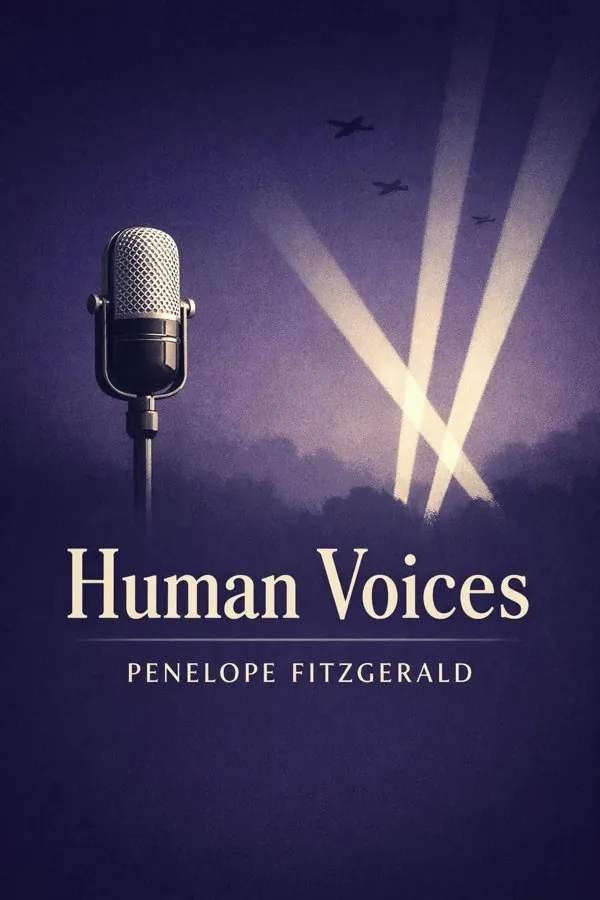
Human Voices: Summary & Key Insights
 10 min10 chaptersAudio available
Key Takeaways from Human Voices
A building can become a moral weather system, and in Human Voices Broadcasting House is exactly that.
Institutions run on ideals, but they survive on improvised competence.
What people are told in a crisis matters, but how they are told may matter even more.
Large institutions are often best understood from their margins, not their executive offices.
In Human Voices, wartime broadcasting is shown as a constant process of selection, omission, revision, and control.
What Is Human Voices About?
Human Voices by Penelope Fitzgerald is a classics book spanning 10 pages. Set in London during the Second World War, Human Voices follows the employees of the BBC’s Features Department as they work inside Broadcasting House while bombs fall, buildings burn, and certainty disappears. Penelope Fitzgerald turns what might seem a narrow institutional setting into a vivid portrait of a society under pressure. The novel is about broadcasting, but more deeply it is about how people try to preserve meaning, dignity, and connection when public language is strained by fear, bureaucracy, and propaganda. Through producers, announcers, typists, and administrators, Fitzgerald shows the strange mixture of comedy and danger that defined wartime daily life: missed messages can be fatal, yet absurd office routines continue. What makes the book matter is its refusal to turn heroism into spectacle. Instead, it finds courage in small acts of competence, kindness, and endurance. Fitzgerald, one of Britain’s finest stylists, writes with extraordinary economy, wit, and moral precision. Her authority comes not from grand declarations but from her ability to reveal how institutions sound, how people speak around the truth, and how fragile every “human voice” becomes in times of crisis.
This FizzRead summary covers all 10 key chapters of Human Voices in approximately 10 minutes, distilling the most important ideas, arguments, and takeaways from Penelope Fitzgerald's work. Also available as an audio summary and Key Quotes Podcast.
Human Voices
Set in London during the Second World War, Human Voices follows the employees of the BBC’s Features Department as they work inside Broadcasting House while bombs fall, buildings burn, and certainty disappears. Penelope Fitzgerald turns what might seem a narrow institutional setting into a vivid portrait of a society under pressure. The novel is about broadcasting, but more deeply it is about how people try to preserve meaning, dignity, and connection when public language is strained by fear, bureaucracy, and propaganda. Through producers, announcers, typists, and administrators, Fitzgerald shows the strange mixture of comedy and danger that defined wartime daily life: missed messages can be fatal, yet absurd office routines continue. What makes the book matter is its refusal to turn heroism into spectacle. Instead, it finds courage in small acts of competence, kindness, and endurance. Fitzgerald, one of Britain’s finest stylists, writes with extraordinary economy, wit, and moral precision. Her authority comes not from grand declarations but from her ability to reveal how institutions sound, how people speak around the truth, and how fragile every “human voice” becomes in times of crisis.
Who Should Read Human Voices?
This book is perfect for anyone interested in classics and looking to gain actionable insights in a short read. Whether you're a student, professional, or lifelong learner, the key ideas from Human Voices by Penelope Fitzgerald will help you think differently.
- ✓Readers who enjoy classics and want practical takeaways
- ✓Professionals looking to apply new ideas to their work and life
- ✓Anyone who wants the core insights of Human Voices in just 10 minutes
Want the full summary?
Get instant access to this book summary and 100K+ more with Fizz Moment.
Get Free SummaryAvailable on App Store • Free to download
Key Chapters
A building can become a moral weather system, and in Human Voices Broadcasting House is exactly that. Fitzgerald presents the BBC headquarters as both fortress and illusion: a place built to transmit order, authority, and continuity, even while the city around it is being torn open by air raids. Corridors, studios, control rooms, and offices form a miniature society where ordinary habits persist under extraordinary strain. The novel’s setting matters because it shows how institutions create emotional shelter. Inside the BBC, schedules still matter, memos still circulate, voices still go on air. Yet this routine is constantly interrupted by the knowledge that no wall is fully safe and no message fully secure.
Fitzgerald uses the building almost like a character. Its labyrinthine layout mirrors the confusion of wartime communication, while its polished professionalism contrasts with the chaos outside. This creates the novel’s distinctive tension: the BBC must sound calm because panic itself can become a weapon. In modern terms, Broadcasting House resembles any organization trying to project confidence during crisis—a hospital during a pandemic, a newsroom during political upheaval, or a company facing public disaster. The lesson is not that appearances are fake, but that appearances can help people function when they most need structure.
Readers can apply this insight by noticing how environments shape behavior. In moments of stress, routines, spaces, and shared procedures help people keep thinking clearly. Fitzgerald reminds us that stability is often staged before it is felt. Actionable takeaway: when life feels chaotic, create a reliable structure—physical or procedural—that gives people a place from which to speak and act calmly.
What people are told in a crisis matters, but how they are told may matter even more. One of the novel’s most searching themes is the tension between maintaining morale and telling the whole truth. The BBC is expected to reassure the nation, uphold public confidence, and avoid helping the enemy. Yet reassurance can slide into distortion, and careful language can become a mask. Fitzgerald is fascinated by this narrow, morally dangerous strip between necessary restraint and dishonest comfort.
The staff members are not cartoon propagandists. Most are trying to do decent work under impossible circumstances. They know that words can steady listeners, and they also know that words can conceal suffering. This conflict gives the novel its ethical depth. A broadcast that sounds composed may be an act of service, preventing fear from spreading. But it may also flatten experience, excluding grief, confusion, or anger. Fitzgerald shows that wartime communication is never merely informational. It is emotional management, social choreography, and political responsibility all at once.
This dilemma remains familiar today. Public officials, journalists, educators, and managers often struggle to communicate difficult truths without causing paralysis. During emergencies, organizations must decide how much uncertainty to admit, how much confidence to project, and when blunt honesty becomes essential. Human Voices suggests that tone is not cosmetic. Tone can preserve trust or erode it. Listeners often recognize when language has become too polished to be believed.
The novel’s practical lesson is to communicate with measured candor. People can accept hard realities more readily than manipulative optimism. Actionable takeaway: when speaking under pressure, aim for clarity that steadies rather than slogans that merely soothe.
Large institutions are often best understood from their margins, not their executive offices. Annie Asra, the young typist at the center of Human Voices, offers exactly this angle. She is not one of the BBC’s stars or senior strategists. She occupies a lower rung in the hierarchy, moving through spaces where information passes quickly but authority does not fully settle. Through Annie, Fitzgerald captures the vulnerability, alertness, and emotional sensitivity of someone who sees systems from below and still has to survive within them.
Annie’s perspective is crucial because it humanizes the BBC. The novel’s grand themes—war, communication, duty, censorship—are filtered through the daily life of a woman doing practical office work while absorbing the tensions around her. She notices moods, slights, loyalties, and absurdities that more powerful figures overlook. Her position also exposes the gendered and class-coded structure of the workplace. Annie must navigate expectations, dependence, and forms of condescension while maintaining competence. Fitzgerald gives her neither sentimental innocence nor melodramatic victimhood. Instead, Annie embodies ordinary intelligence under pressure.
For readers, Annie’s role has a clear application: the health of any institution is often most visible to those with the least formal power. Administrative staff, junior employees, assistants, and support workers frequently understand culture better than official leaders do because they see how instructions are actually received and enacted. Listening downward is therefore not charity; it is realism.
Fitzgerald’s achievement lies in making Annie both particular and representative. She reminds us that history is lived not only by decision-makers but by those who carry out the paperwork, absorb the anxiety, and keep the machine moving. Actionable takeaway: if you want to understand a system honestly, pay close attention to the people who do its quietest and least celebrated work.
Every crisis edits language. In Human Voices, wartime broadcasting is shown as a constant process of selection, omission, revision, and control. Messages are shaped not only by what can be verified, but by what ought to be said, what must not be said, and what can safely be heard. Fitzgerald treats this not as an abstract political debate but as a lived professional reality. Scripts must be altered, phrasing softened, implications considered, and timing judged. The result is a world in which speech is never simply speech; it is managed risk.
What makes the novel so subtle is that censorship appears in many forms. There is official censorship tied to national security. There is institutional censorship driven by reputation and policy. And there is personal self-censorship, the quiet internal process by which people decide what cannot be spoken because it would expose fear, desire, resentment, or helplessness. Fitzgerald suggests that wartime compresses all three into everyday habit. People begin to speak around things as much as they speak about them.
This idea extends easily into contemporary life. Social media, corporate communication, politics, and even family dynamics all involve strategic editing. We choose words to manage consequences, protect identities, or avoid escalation. The challenge is knowing when prudence becomes evasion. Human Voices does not argue for reckless transparency. Instead, it asks readers to notice the hidden costs of overmanaged speech: confusion, alienation, and the erosion of trust.
A practical way to use this insight is to distinguish between necessary discretion and fear-based vagueness. Not everything should be said immediately, but some things must be said plainly if relationships or institutions are to remain credible. Actionable takeaway: examine where your communication is wisely careful and where it has become so controlled that truth can no longer breathe.
War does not suspend personal feeling; it intensifies and distorts it. One of Fitzgerald’s quiet strengths is her ability to show how affection, longing, loyalty, and dependency unfold inside professional spaces. Human Voices is not only about broadcasting under bombardment. It is also about how people become attached to one another when danger collapses ordinary boundaries. In the BBC offices, emotional life is rarely declared directly. It emerges through gestures, misunderstandings, acts of protection, awkward silences, and the unequal power relations that shape intimacy.
Fitzgerald resists romantic simplification. Relationships in the novel are touched by uncertainty, class, hierarchy, and fatigue. People need one another, but not always in the same way. Care may be mixed with authority; admiration with vulnerability; desire with practical necessity. This makes the emotional world of the book feel unusually truthful. Under wartime conditions, relationships often become more urgent precisely because the future is unstable. Yet urgency does not guarantee clarity. People can be drawn together by fear, routine, loneliness, or shared work without fully understanding what binds them.
This remains highly recognizable. Intense workplaces, crisis situations, and periods of social upheaval often create accelerated bonds. Colleagues may become confidants, protectors, or substitutes for family. The novel invites readers to ask whether such closeness is sustaining, exploitative, or both. Fitzgerald’s answer is not cynical, but cautious. Human need is real, and so is the risk of confusion when emotional dependency grows in unequal settings.
The practical value here is emotional self-awareness. Strong feeling under pressure should be examined, not automatically trusted or dismissed. Actionable takeaway: in difficult periods, honor the relationships that sustain you, but also ask what fear, power, or circumstance may be adding to the intensity.
Human beings can adapt to almost anything, and that capacity is both admirable and unsettling. In Human Voices, the Blitz is not presented only as spectacular destruction. Fitzgerald shows how bombing becomes part of the texture of daily life—anticipated, endured, discussed, and folded into work routines. Sirens, damage, fatigue, and loss coexist with paperwork, tea, schedules, and office banter. This normalization of danger is one of the novel’s most powerful insights because it captures how societies continue under threat without ever becoming fully comfortable with it.
The effect is deeply humane. Fitzgerald does not diminish suffering by making danger familiar. Instead, she demonstrates the strange elasticity of ordinary life. People still notice small annoyances, professional rivalries, and moments of comic absurdity even when death is nearby. This is not moral failure. It is part of survival. Catastrophe rarely feels like a continuous climax. More often, it arrives in shocks and intervals, forcing people to alternate between alarm and routine.
Modern readers can recognize this pattern in many contexts: prolonged illness, economic instability, political conflict, or communities living with recurring disaster. People do not live permanently at the pitch of emergency. They create modified normality. The risk, of course, is that adaptation can dull perception. What once felt intolerable may begin to seem standard.
Fitzgerald’s novel helps readers see both sides of resilience: its necessity and its danger. Continuing to work and joke under bombardment is brave, but it can also hide accumulated strain. Actionable takeaway: when you adapt to ongoing pressure, pause regularly to assess what it is costing you emotionally rather than assuming endurance alone means you are fine.
Moral life is often less dramatic than we imagine, yet no less demanding. Human Voices is full of ethical choices that do not look heroic from the outside: whether to speak honestly, protect a colleague, follow a dubious instruction, share scarce kindness, or preserve standards when exhaustion invites indifference. Fitzgerald’s genius is to show that wartime virtue often appears in modest, almost invisible forms. The novel does not celebrate flashy bravery as much as consistency, decency, and moral tact.
This approach sharpens the book’s realism. Institutions under pressure are sustained not only by leaders but by people who continue doing difficult tasks conscientiously. A person who corrects a script carefully, keeps a frightened coworker steady, or refuses to exploit confusion may contribute more to collective survival than someone making dramatic declarations. Fitzgerald understands that ethics within bureaucracy are especially challenging because responsibility is dispersed. People can always tell themselves they are merely following procedure. Human Voices pushes against that evasion by making individual judgment matter.
The idea applies powerfully today. In many professional environments, moral compromise rarely arrives as a single catastrophic choice. It appears in small accommodations: softening facts, ignoring mistreatment, deferring responsibility, accepting a harmful norm because everyone else does. Fitzgerald suggests that character is built precisely in these minor decisions. Courage may consist in remaining humane when systems encourage impersonality.
Readers can take from this a more practical model of integrity. You do not need to be spectacularly brave to act ethically; you need to be attentive and willing to accept inconvenience. Actionable takeaway: treat small decisions as morally real, because in pressured institutions they are often where conscience survives or disappears.
Organizations like to imagine they run on policy, but in a crisis they often survive through kindness. One of the warmest threads in Human Voices is Fitzgerald’s attention to acts of care within the BBC: people covering for one another, noticing distress, sharing information, making room for weakness, or preserving another person’s dignity. These moments are not sentimental decoration. They are part of the machinery of survival. Without them, the institution’s formal mission would collapse under the weight of fear and fatigue.
Fitzgerald is careful not to idealize the workplace. The BBC is full of vanity, hierarchy, confusion, and irritation. Yet compassion persists within that imperfect system. This is one reason the novel feels so emotionally mature. It recognizes that institutions are never purely efficient structures; they are assemblies of vulnerable people. During wartime, that vulnerability becomes impossible to ignore. A colleague is not merely a function but a body that can be exhausted, a mind that can falter, a heart that can break.
In modern workplaces, this lesson is invaluable. Teams under stress often focus exclusively on output, deadlines, and procedural correctness. But trust, grace, and attention to individual strain are not distractions from performance. They are often what make sustained performance possible. Leaders who understand this create resilient cultures; those who do not produce brittle systems.
Fitzgerald also implies that compassion need not be dramatic. It can be tact, patience, silence, practical help, or a refusal to humiliate. Such gestures become forms of resistance against dehumanization. Actionable takeaway: strengthen any group you belong to by practicing concrete, unspectacular care—especially when pressure makes people most likely to forget one another’s humanity.
Destruction tests not only buildings but meaning itself. As Human Voices moves toward loss and damage, Fitzgerald asks what remains when systems fail, places are shattered, and plans are rendered temporary. The answer is not triumph in any simple sense. Her vision is quieter and more exacting. What persists is voice: not merely broadcasting as a technical operation, but the human capacity to address others, to witness, to remember, and to continue speaking despite fragility.
This closing movement gives the novel its lasting resonance. The war exposes how precarious institutions are, how vulnerable bodies are, and how limited language can be. Yet Fitzgerald does not conclude that words are useless. Instead, she shows that communication is precious precisely because it is fragile. A voice on air, a private exchange, a remembered phrase, or a carefully delivered announcement can all become acts of continuity in a broken world. The title itself points to plurality: many voices, imperfectly coordinated, making social life possible.
Readers can carry this insight beyond the novel. In times of grief, upheaval, or transition, people often wait for certainty before speaking honestly. Fitzgerald suggests the opposite. Speech matters most when certainty is unavailable. The point is not to control outcomes through language, but to preserve relationship and recognition through it.
This final idea also helps explain the book’s emotional aftereffect. Human Voices leaves readers with a sharpened awareness of what words can and cannot do. Actionable takeaway: when faced with loss or instability, do not underestimate the sustaining power of clear, humane speech—even when it cannot repair what has been broken.
All Chapters in Human Voices
About the Author
Penelope Fitzgerald (1916–2000) was one of the most admired English novelists of the late twentieth century, celebrated for her precision, wit, and remarkable economy of style. Born into a distinguished literary family, she worked as a teacher, journalist, and bookseller before publishing fiction later in life. Despite that late start, she produced a series of highly regarded novels, including Offshore, which won the Booker Prize in 1979, as well as The Bookshop, Human Voices, Innocence, and The Blue Flower. Fitzgerald also wrote biographies and literary criticism. Her fiction is known for its historical depth, moral subtlety, and ability to illuminate ordinary lives under pressure. She remains a writer prized for saying more in a few pages than many novelists manage in hundreds.
Get This Summary in Your Preferred Format
Read or listen to the Human Voices summary by Penelope Fitzgerald anytime, anywhere. FizzRead offers multiple formats so you can learn on your terms — all free.
Available formats: App · Audio · PDF · EPUB — All included free with FizzRead
Download Human Voices PDF and EPUB Summary
Key Quotes from Human Voices
“A building can become a moral weather system, and in Human Voices Broadcasting House is exactly that.”
“Institutions run on ideals, but they survive on improvised competence.”
“What people are told in a crisis matters, but how they are told may matter even more.”
“Large institutions are often best understood from their margins, not their executive offices.”
“In Human Voices, wartime broadcasting is shown as a constant process of selection, omission, revision, and control.”
Frequently Asked Questions about Human Voices
Human Voices by Penelope Fitzgerald is a classics book that explores key ideas across 10 chapters. Set in London during the Second World War, Human Voices follows the employees of the BBC’s Features Department as they work inside Broadcasting House while bombs fall, buildings burn, and certainty disappears. Penelope Fitzgerald turns what might seem a narrow institutional setting into a vivid portrait of a society under pressure. The novel is about broadcasting, but more deeply it is about how people try to preserve meaning, dignity, and connection when public language is strained by fear, bureaucracy, and propaganda. Through producers, announcers, typists, and administrators, Fitzgerald shows the strange mixture of comedy and danger that defined wartime daily life: missed messages can be fatal, yet absurd office routines continue. What makes the book matter is its refusal to turn heroism into spectacle. Instead, it finds courage in small acts of competence, kindness, and endurance. Fitzgerald, one of Britain’s finest stylists, writes with extraordinary economy, wit, and moral precision. Her authority comes not from grand declarations but from her ability to reveal how institutions sound, how people speak around the truth, and how fragile every “human voice” becomes in times of crisis.
More by Penelope Fitzgerald

You Might Also Like






Browse by Category
Ready to read Human Voices?
Get the full summary and 100K+ more books with Fizz Moment.