
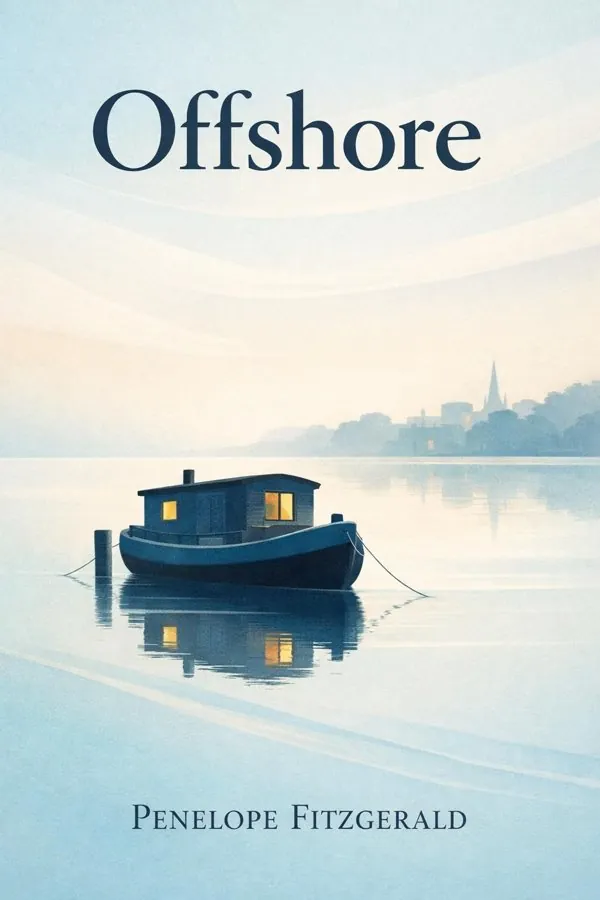
Offshore: A Novel: Summary & Key Insights
 10 min9 chaptersAudio available
Key Takeaways from Offshore: A Novel
Some people live in places that express exactly who they are, and in Offshore the houseboats on Battersea Reach do precisely that.
Hope can become most dangerous when it keeps us attached to what no longer exists.
Belonging often happens not among the well-adjusted, but among the mutually incomplete.
Home is usually imagined as the place where life becomes stable, but Offshore asks what happens when home itself is floating.
Humor in serious fiction is rarely about lightness alone; often it is a way of telling the truth without cruelty.
What Is Offshore: A Novel About?
Offshore: A Novel by Penelope Fitzgerald is a classics book spanning 4 pages. Penelope Fitzgerald’s Offshore is a small novel with unusual depth: a Booker Prize–winning portrait of people living on houseboats along Battersea Reach in early 1960s London, suspended between security and collapse, intimacy and solitude, hope and resignation. At its center is Nenna James, a young mother estranged from her husband and trying to make a life for herself and her daughters on the Thames among an eccentric, precarious community of fellow boat-dwellers. Around her, Fitzgerald assembles a cast of damaged, funny, stubborn, and vividly human figures whose lives seem makeshift yet emotionally exact. What makes Offshore matter is not plot alone, but perspective. Fitzgerald turns a marginal setting into a profound meditation on belonging, class, domestic instability, and the quiet heroism of carrying on when nothing is firmly anchored. Her prose is famously concise, witty, and precise, but beneath its lightness lies deep feeling. Fitzgerald herself knew hardship and impermanence, and she writes this floating world with authority, tenderness, and ironic intelligence. The result is a classic novel about people living just outside ordinary structures, and about the fragile ways they continue to love, endure, and hope.
This FizzRead summary covers all 9 key chapters of Offshore: A Novel in approximately 10 minutes, distilling the most important ideas, arguments, and takeaways from Penelope Fitzgerald's work. Also available as an audio summary and Key Quotes Podcast.
Offshore: A Novel
Penelope Fitzgerald’s Offshore is a small novel with unusual depth: a Booker Prize–winning portrait of people living on houseboats along Battersea Reach in early 1960s London, suspended between security and collapse, intimacy and solitude, hope and resignation. At its center is Nenna James, a young mother estranged from her husband and trying to make a life for herself and her daughters on the Thames among an eccentric, precarious community of fellow boat-dwellers. Around her, Fitzgerald assembles a cast of damaged, funny, stubborn, and vividly human figures whose lives seem makeshift yet emotionally exact.
What makes Offshore matter is not plot alone, but perspective. Fitzgerald turns a marginal setting into a profound meditation on belonging, class, domestic instability, and the quiet heroism of carrying on when nothing is firmly anchored. Her prose is famously concise, witty, and precise, but beneath its lightness lies deep feeling. Fitzgerald herself knew hardship and impermanence, and she writes this floating world with authority, tenderness, and ironic intelligence. The result is a classic novel about people living just outside ordinary structures, and about the fragile ways they continue to love, endure, and hope.
Who Should Read Offshore: A Novel?
This book is perfect for anyone interested in classics and looking to gain actionable insights in a short read. Whether you're a student, professional, or lifelong learner, the key ideas from Offshore: A Novel by Penelope Fitzgerald will help you think differently.
- ✓Readers who enjoy classics and want practical takeaways
- ✓Professionals looking to apply new ideas to their work and life
- ✓Anyone who wants the core insights of Offshore: A Novel in just 10 minutes
Want the full summary?
Get instant access to this book summary and 100K+ more with Fizz Moment.
Get Free SummaryAvailable on App Store • Free to download
Key Chapters
Some people live in places that express exactly who they are, and in Offshore the houseboats on Battersea Reach do precisely that. Fitzgerald’s river setting is not decorative background; it is the novel’s central condition. The residents live between two states, neither fully at home in respectable London life nor entirely outside it. Their boats are tied to shore but still subject to tide, weather, decay, and accident. That in-between existence becomes a powerful image of emotional and social uncertainty.
The Thames community is made up of people who have, for one reason or another, slipped from stable arrangements. They are not dramatic outcasts in the conventional sense. Rather, they are those for whom ordinary life has become difficult to maintain: marriages fray, finances wobble, social expectations feel unreachable. On land, these failures might look embarrassing or final. On the river, they become part of a shared condition. The boats offer refuge, but only a temporary one. Their physical instability mirrors the residents’ inner lives.
This idea has practical resonance well beyond the novel. Many people know what it means to occupy a transitional space: after a divorce, between careers, during illness, after moving cities, or while waiting for life to become recognizable again. Fitzgerald suggests that such thresholds are not empty pauses. They shape character, relationships, and perception. The instability of the setting forces attentiveness, improvisation, and humility.
The takeaway is simple: when life feels unsettled, do not dismiss the in-between as meaningless. Transitional spaces may feel precarious, but they often reveal who we are and what kind of belonging we truly need.
Hope can become most dangerous when it keeps us attached to what no longer exists. Nenna James stands at the quiet heart of Offshore, living on a boat with her daughters while separated from her husband Edward. She is not grandly tragic, nor is she clearly deluded. Instead, Fitzgerald presents her as painfully recognizable: a person trying to preserve dignity and emotional possibility in circumstances that are steadily eroding both.
Nenna’s life is shaped by suspension. She is not fully married, not fully independent, not fully defeated. Edward remains nearby in the larger geography of London, but emotionally he is distant and withholding. Nenna continues to imagine some form of return, reconciliation, or restoration, even as reality gives her little reason to believe in it. This tension gives the novel much of its ache. Her hope sustains her, yet it also traps her. She lives not only on the river but in a psychological middle ground, unable to move back and unable to move on.
Fitzgerald treats Nenna with extraordinary restraint. She does not sentimentalize her suffering or punish her indecision. Instead, she shows how ordinary endurance can itself become a form of courage. Nenna cares for her children, manages practical difficulties, and keeps living through uncertainty without the reward of clarity. That makes her one of literature’s most convincing portraits of a person surviving emotional limbo.
In everyday life, many readers will recognize this pattern: waiting for a relationship to improve, a family conflict to resolve, or a former version of life to return. Fitzgerald’s insight is that hope should be examined, not merely admired. Some hopes sustain life; others prevent renewal.
Actionable takeaway: ask yourself whether the future you are waiting for is truly possible, or whether your energy would be better spent building a life in the present.
Belonging often happens not among the well-adjusted, but among the mutually incomplete. One of Offshore’s great pleasures is Fitzgerald’s portrait of the houseboat community itself: eccentric, shabby, comic, vulnerable, and deeply revealing. These residents are linked less by ideology than by shared precariousness. They are not a utopian collective, yet they form a real social world with its own rhythms of assistance, gossip, misunderstanding, and loyalty.
Fitzgerald excels at showing how communities are built from partial connections rather than perfect understanding. The river people are often distracted, flawed, self-protective, or absurd. They may fail one another in crucial moments. But they also recognize one another in ways more stable societies often do not. Because they all live close to material insecurity, they understand the improvisational labor of daily survival. Because they are themselves somewhat displaced, they make room for oddity.
This gives the novel its tonal complexity. The community is funny without being mocking, affectionate without becoming sentimental. A broken-down boat, an awkward conversation, a half-reliable neighbor, a small practical kindness: Fitzgerald uses such details to show that human interdependence is usually messy, not noble. Yet the mess does not cancel the value of connection. On the contrary, it proves it.
Modern readers can apply this insight easily. Many people search for ideal communities—workplaces, friendships, neighborhoods, online circles—that will provide complete support and clarity. Fitzgerald suggests that real belonging rarely looks polished. It often emerges among people who are themselves uncertain, overburdened, and imperfect.
Actionable takeaway: stop measuring relationships against an ideal of flawless support. Invest instead in the modest, recurring acts of recognition and help that make imperfect communities livable.
Home is usually imagined as the place where life becomes stable, but Offshore asks what happens when home itself is floating. The novel takes the ordinary materials of domestic fiction—children, marriage, money, meals, arguments, routines—and relocates them to a setting where basic security is never guaranteed. In doing so, Fitzgerald reveals how fragile domestic order always is, even on dry land.
Nenna’s household is especially important here. She is raising children in a space that is physically constrained and emotionally unstable. Yet the novel does not portray motherhood as either pure fulfillment or pure burden. Instead, it shows domestic life as improvisation. Parenting, in Fitzgerald’s world, means making meaning amid clutter, uncertainty, and exhaustion. The boat is not a romantic refuge from family life; it intensifies every pressure. But it also strips away illusions and exposes what care really consists of: repetition, patience, sacrifice, and small acts of continuity.
This vision broadens the novel’s relevance. Many readers experience home not as serenity but as a site of strain: unstable finances, unresolved partnerships, cramped spaces, emotional ambivalence. Fitzgerald does not deny the hardship. She simply refuses to equate instability with lovelessness or inadequacy. A home can be improvised and still be real. It can be fragile and still contain devotion.
There is practical wisdom here for anyone dealing with imperfect circumstances. We often postpone dignity until life looks orderly. Offshore argues the opposite. Dignity emerges in how we inhabit disorder—how we care for others, maintain routines, and keep tenderness alive when control is limited.
Actionable takeaway: if your life feels chaotic, focus on one repeatable act that creates steadiness—a meal, a bedtime ritual, a weekly call. Stability is often built from small domestic habits, not ideal conditions.
Humor in serious fiction is rarely about lightness alone; often it is a way of telling the truth without cruelty. Fitzgerald’s wit is one of Offshore’s defining achievements. She writes about loneliness, marital disappointment, financial precarity, and emotional confusion, yet the novel remains animated by dry comedy and exquisite understatement. This tonal balance is not ornamental. It is part of her moral vision.
The characters are frequently absurd, but never merely ridiculous. Fitzgerald notices their vanity, evasions, fantasies, and poor decisions with unsparing clarity, then grants them a tenderness that prevents satire from hardening into contempt. In this way, comedy becomes a form of mercy. It allows readers to see folly honestly while remembering that folly is part of being human.
This matters because Offshore is a novel about people who might easily be dismissed by a harsher writer. The houseboat residents are not successful by ordinary social standards. Their lives are disordered; their judgment can be unreliable. Yet Fitzgerald’s humor preserves their dignity. She neither idealizes them nor reduces them to failures. The result is a rare emotional texture: amused sympathy.
In practical terms, this offers a useful lesson in how to understand ourselves and others. Many of life’s painful situations include elements of absurdity: bureaucratic disasters, family misunderstandings, romantic reversals, social embarrassment. To recognize the comedy is not to trivialize the pain. It is to create enough distance to endure it without bitterness.
Actionable takeaway: when facing a difficult situation, ask not only what hurts, but what is oddly human or even faintly comic in it. A gentler perspective can make hardship more bearable without denying its seriousness.
What seems loosely held together can survive for a long time—until one shock reveals how fragile it always was. In Offshore, physical instability is never far from emotional instability, and the novel’s movement toward storm and dispersal gives that truth dramatic shape. The river community cannot remain suspended forever. Weather, accident, money, and human limitation all press toward change.
The significance of this development lies in what it exposes. The boats, like the lives aboard them, appear habitable through habit and determination. But they are vulnerable to forces larger than personal intention. Fitzgerald shows how people maintain fragile arrangements by ignoring, minimizing, or postponing the reckoning they sense is coming. When disruption arrives, it does not create vulnerability so much as reveal it.
This applies directly to ordinary life. Individuals and families often live inside provisional systems—financially, emotionally, professionally—because those systems function well enough day to day. Then a crisis comes: illness, job loss, betrayal, relocation, death. The event feels abrupt, but it often reveals structural weaknesses that were already present. Fitzgerald does not present this as a moral failure. It is simply part of human life that much of what sustains us is less durable than we imagine.
Yet the novel is not nihilistic. Dispersal is painful, but it can also bring honesty. When unstable arrangements break, people may finally confront what they have been avoiding: dependency, loneliness, impossible hope, or the need for change.
Actionable takeaway: pay attention to the structures supporting your life. If a relationship, routine, or financial arrangement depends entirely on denial or luck, strengthen it now rather than waiting for a storm to make the hidden weakness undeniable.
Landscape in great fiction does more than surround characters; it interprets them. In Offshore, the Thames is a living presence—tidal, indifferent, reflective, carrying both waste and beauty. Fitzgerald uses the river as a mirror for emotional experience. It suggests drift, recurrence, uncertainty, and the impossibility of complete control. To live on it is to surrender certain illusions about permanence.
The river’s symbolism works because it remains concrete. It is not an abstract emblem floating above the story. It rises, falls, smells, shifts, threatens, and sustains. The residents must respond to its practical realities. At the same time, the river reflects their emotional states: their attachments are moored but not settled; their identities are shaped by movement; their hopes are carried along by forces they do not command.
This gives the novel a contemplative dimension. Offshore asks whether freedom and displacement are sometimes difficult to distinguish. The boat-dwellers possess a kind of liberty from conventional social structures, but that freedom comes with exposure, uncertainty, and social marginality. Likewise, many forms of modern independence—freelance work, urban mobility, unconventional family structures—can feel both liberating and destabilizing.
Fitzgerald’s deeper suggestion is that grace may exist even in this instability. One may never master the tides of life, but one can learn attentiveness, humility, and responsiveness. The river resists possession, yet it offers perspective.
Actionable takeaway: when circumstances feel fluid or uncontrollable, stop demanding total certainty. Instead, identify what you can realistically tend—your habits, your care for others, your honesty with yourself. Stability often begins with adaptation, not control.
Not all courage looks dramatic; sometimes it looks like getting through another day without surrendering tenderness. One of Offshore’s most lasting achievements is its attention to quiet resilience. Fitzgerald does not build her novel around triumph, revelation, or heroic transformation. Instead, she honors smaller forms of endurance: continuing to care, continuing to improvise, continuing to notice beauty and absurdity in diminished circumstances.
This restraint is what gives the book its emotional authority. The characters are not redeemed by a neat resolution. Their problems are not solved by insight alone. Yet the novel does not leave us in despair. It offers a subtler consolation: human beings can remain recognizably alive, funny, loving, and morally significant even when life is precarious and unresolved.
That idea has practical force because modern readers are often trained to expect visible outcomes. We want breakthroughs, closure, and measurable progress. Fitzgerald proposes a more patient metric. Sometimes the most meaningful achievement is not transformation but persistence without hardening. To remain openhearted in uncertain conditions is itself a kind of grace.
This is especially visible in the novel’s style. Fitzgerald’s compressed prose enacts the value it describes. She wastes nothing, exaggerates nothing, and still creates a world full of feeling. The effect is to remind us that significance need not be loud. The smallest gesture—an act of care, a moment of recognition, a refusal to become cruel—may carry the greatest moral weight.
Actionable takeaway: redefine resilience in your own life. Instead of asking only whether you are winning or fixing everything, ask whether you are staying humane, attentive, and capable of care under strain.
All Chapters in Offshore: A Novel
About the Author
Penelope Fitzgerald (1916–2000) was an English novelist, biographer, and essayist celebrated for her elegant brevity, dry humor, and profound psychological insight. Although she began publishing fiction later in life, she became one of the most respected literary voices of the twentieth century. Her novel Offshore won the Booker Prize in 1979, and she later earned further acclaim for works including The Bookshop, The Beginning of Spring, and The Gate of Angels. Fitzgerald’s writing often draws on lives shaped by constraint, social awkwardness, and instability, yet she treats her characters with remarkable intelligence and compassion. She also wrote acclaimed biographies and nonfiction. Today, she is admired for transforming small, ordinary worlds into fiction of lasting emotional and moral depth.
Get This Summary in Your Preferred Format
Read or listen to the Offshore: A Novel summary by Penelope Fitzgerald anytime, anywhere. FizzRead offers multiple formats so you can learn on your terms — all free.
Available formats: App · Audio · PDF · EPUB — All included free with FizzRead
Download Offshore: A Novel PDF and EPUB Summary
Key Quotes from Offshore: A Novel
“Some people live in places that express exactly who they are, and in Offshore the houseboats on Battersea Reach do precisely that.”
“Hope can become most dangerous when it keeps us attached to what no longer exists.”
“Belonging often happens not among the well-adjusted, but among the mutually incomplete.”
“Home is usually imagined as the place where life becomes stable, but Offshore asks what happens when home itself is floating.”
“Humor in serious fiction is rarely about lightness alone; often it is a way of telling the truth without cruelty.”
Frequently Asked Questions about Offshore: A Novel
Offshore: A Novel by Penelope Fitzgerald is a classics book that explores key ideas across 9 chapters. Penelope Fitzgerald’s Offshore is a small novel with unusual depth: a Booker Prize–winning portrait of people living on houseboats along Battersea Reach in early 1960s London, suspended between security and collapse, intimacy and solitude, hope and resignation. At its center is Nenna James, a young mother estranged from her husband and trying to make a life for herself and her daughters on the Thames among an eccentric, precarious community of fellow boat-dwellers. Around her, Fitzgerald assembles a cast of damaged, funny, stubborn, and vividly human figures whose lives seem makeshift yet emotionally exact. What makes Offshore matter is not plot alone, but perspective. Fitzgerald turns a marginal setting into a profound meditation on belonging, class, domestic instability, and the quiet heroism of carrying on when nothing is firmly anchored. Her prose is famously concise, witty, and precise, but beneath its lightness lies deep feeling. Fitzgerald herself knew hardship and impermanence, and she writes this floating world with authority, tenderness, and ironic intelligence. The result is a classic novel about people living just outside ordinary structures, and about the fragile ways they continue to love, endure, and hope.
More by Penelope Fitzgerald


You Might Also Like






Browse by Category
Ready to read Offshore: A Novel?
Get the full summary and 100K+ more books with Fizz Moment.