
Penelope Fitzgerald Books
Penelope Fitzgerald (1916–2000) was an English novelist, biographer, and essayist known for her concise, intelligent prose and subtle humor. She won the Booker Prize for Offshore in 1979 and was later shortlisted for several major literary awards, including the Booker Prize for The Bookshop, The Beginning of Spring, and The Gate of Angels.
Known for: Human Voices, Offshore: A Novel, The Beginning Of Spring
Books by Penelope Fitzgerald
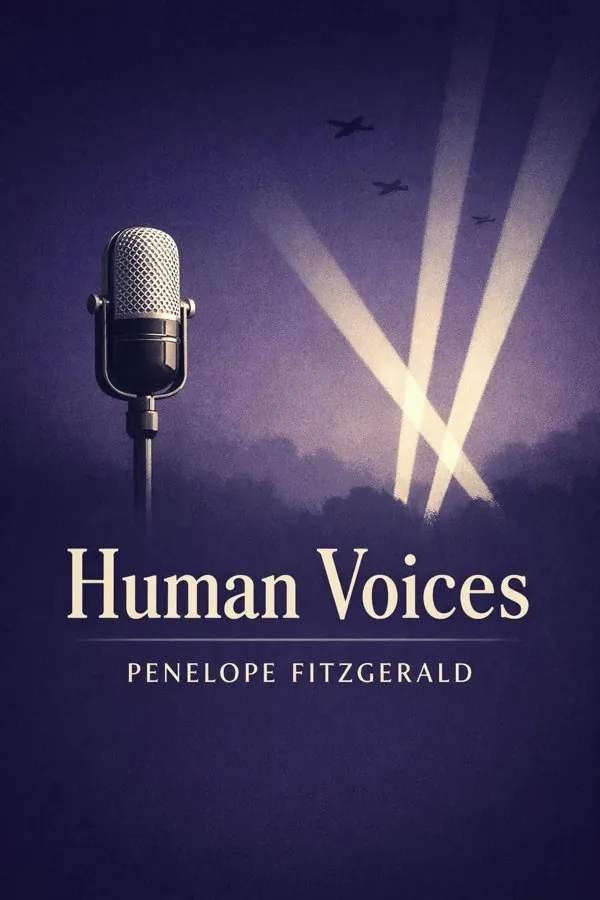
Human Voices
Set in London during the Second World War, Human Voices follows the employees of the BBC’s Features Department as they work inside Broadcasting House while bombs fall, buildings burn, and certainty di...

Offshore: A Novel
Penelope Fitzgerald’s Offshore is a small novel with unusual depth: a Booker Prize–winning portrait of people living on houseboats along Battersea Reach in early 1960s London, suspended between securi...

The Beginning Of Spring
Set in Moscow in 1913, The Beginning Of Spring is a quietly luminous novel about abandonment, uncertainty, and the fragile hope that arrives with change. Penelope Fitzgerald follows Frank Reid, an Eng...
Key Insights from Penelope Fitzgerald
Broadcasting House as Wartime Microcosm
A building can become a moral weather system, and in Human Voices Broadcasting House is exactly that. Fitzgerald presents the BBC headquarters as both fortress and illusion: a place built to transmit order, authority, and continuity, even while the city around it is being torn open by air raids. Cor...
From Human Voices
The Features Department’s Fragile Authority
Institutions run on ideals, but they survive on improvised competence. Nowhere is this clearer than in the Features Department, where Sam Brooks and Jeff Haggard embody different kinds of authority. Sam is principled, formal, and attached to the BBC’s mission. He believes broadcasting can sustain mo...
From Human Voices
Morale, Truth, and the Cost of Tone
What people are told in a crisis matters, but how they are told may matter even more. One of the novel’s most searching themes is the tension between maintaining morale and telling the whole truth. The BBC is expected to reassure the nation, uphold public confidence, and avoid helping the enemy. Yet...
From Human Voices
Annie Asra and the View Below
Large institutions are often best understood from their margins, not their executive offices. Annie Asra, the young typist at the center of Human Voices, offers exactly this angle. She is not one of the BBC’s stars or senior strategists. She occupies a lower rung in the hierarchy, moving through spa...
From Human Voices
Communication Shaped by Pressure and Censorship
Every crisis edits language. In Human Voices, wartime broadcasting is shown as a constant process of selection, omission, revision, and control. Messages are shaped not only by what can be verified, but by what ought to be said, what must not be said, and what can safely be heard. Fitzgerald treats ...
From Human Voices
Love, Dependency, and Emotional Entanglement
War does not suspend personal feeling; it intensifies and distorts it. One of Fitzgerald’s quiet strengths is her ability to show how affection, longing, loyalty, and dependency unfold inside professional spaces. Human Voices is not only about broadcasting under bombardment. It is also about how peo...
From Human Voices
About Penelope Fitzgerald
Penelope Fitzgerald (1916–2000) was an English novelist, biographer, and essayist known for her concise, intelligent prose and subtle humor. She won the Booker Prize for Offshore in 1979 and was later shortlisted for several major literary awards, including the Booker Prize for The Bookshop, The Beg...
Read more
Penelope Fitzgerald (1916–2000) was an English novelist, biographer, and essayist known for her concise, intelligent prose and subtle humor. She won the Booker Prize for Offshore in 1979 and was later shortlisted for several major literary awards, including the Booker Prize for The Bookshop, The Beg...
Penelope Fitzgerald (1916–2000) was an English novelist, biographer, and essayist known for her concise, intelligent prose and subtle humor. She won the Booker Prize for Offshore in 1979 and was later shortlisted for several major literary awards, including the Booker Prize for The Bookshop, The Beginning of Spring, and The Gate of Angels.





Frequently Asked Questions
Penelope Fitzgerald (1916–2000) was an English novelist, biographer, and essayist known for her concise, intelligent prose and subtle humor. She won the Booker Prize for Offshore in 1979 and was later shortlisted for several major literary awards, including the Booker Prize for The Bookshop, The Beginning of Spring, and The Gate of Angels.
Read Penelope Fitzgerald's books in 15 minutes
Get AI-powered summaries with key insights from 3 books by Penelope Fitzgerald.