
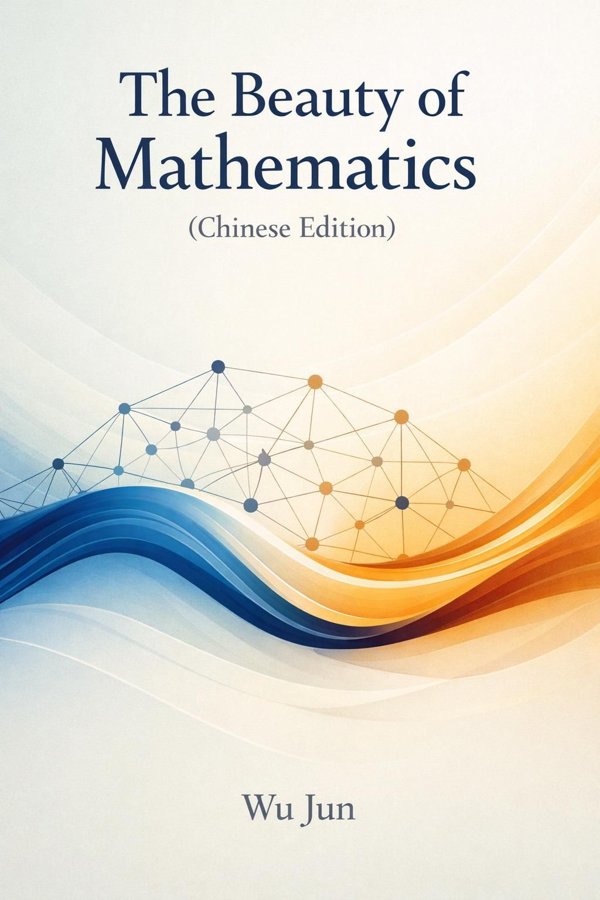
The Beauty of Mathematics (Chinese Edition): Summary & Key Insights
by Wu Jun
 10 min12 chaptersAudio available
What Is The Beauty of Mathematics (Chinese Edition) About?
The Beauty of Mathematics (Chinese Edition) by Wu Jun is a popular_sci book spanning 12 pages. The Beauty of Mathematics (Chinese Edition) is a popular science book written by Dr. Wu Jun. It systematically introduces how mathematics underpins modern technologies such as natural language processing, search engines, and artificial intelligence. Using accessible language, the author explains how mathematical principles like probability theory, information theory, and graph theory support the development of computer science, aiming to help readers appreciate the practical value and elegance of mathematics.
This FizzRead summary covers all 12 key chapters of The Beauty of Mathematics (Chinese Edition) in approximately 10 minutes, distilling the most important ideas, arguments, and takeaways from Wu Jun's work. Also available as an audio summary and Key Quotes Podcast.
The Beauty of Mathematics (Chinese Edition)
The Beauty of Mathematics (Chinese Edition) is a popular science book written by Dr. Wu Jun. It systematically introduces how mathematics underpins modern technologies such as natural language processing, search engines, and artificial intelligence. Using accessible language, the author explains how mathematical principles like probability theory, information theory, and graph theory support the development of computer science, aiming to help readers appreciate the practical value and elegance of mathematics.
Who Should Read The Beauty of Mathematics (Chinese Edition)?
This book is perfect for anyone interested in popular_sci and looking to gain actionable insights in a short read. Whether you're a student, professional, or lifelong learner, the key ideas from The Beauty of Mathematics (Chinese Edition) by Wu Jun will help you think differently.
- ✓Readers who enjoy popular_sci and want practical takeaways
- ✓Professionals looking to apply new ideas to their work and life
- ✓Anyone who wants the core insights of The Beauty of Mathematics (Chinese Edition) in just 10 minutes
Want the full summary?
Get instant access to this book summary and 100K+ more with Fizz Moment.
Get Free SummaryAvailable on App Store • Free to download
Key Chapters
When we look at a search engine today, we rarely imagine the immense mathematics humming beneath its surface. To make Google or Baidu instantly produce the most relevant results for billions of queries, the system must translate web structure into numbers, evaluate importance, and rank pages. This translation is mathematical at its core. The famous PageRank algorithm — developed by Sergey Brin and Larry Page — rests upon the concept of matrix computation and eigenvectors. Each webpage is a node in a gigantic graph, and each link a directional edge. The entire web becomes a matrix, with probabilities representing the likelihood of moving from one page to another. Through iterative computation, mathematics gives weight to connections, distinguishing quality from popularity.
I remember countless discussions within Google about refining relevance: adding parameters, adjusting damping factors, rebalancing matrices. Every adjustment was grounded in pure mathematics, not anecdote. What this reveals is that mathematics allows technology to scale. Without these linear algebraic models, the web would remain an unsearchable chaos. Mathematics brings order through structure. To me, this is beauty — millions of equations silently calculating what content best matches human intent. It’s the meeting point of logic and meaning.
Understanding this process also changes how we see our own knowledge systems. When we rank or assess, consciously or not, we’re applying principles similar to PageRank: evaluating connectivity, filtering noise, balancing influence. Mathematics helps us formalize what we intuitively do, making things transparent and repeatable. The web stands as the grand illustration of how mathematical abstraction becomes practical power.
The web, languages, and even human thought are full of uncertainty. Probability theory exists precisely to describe and manage this uncertainty. In information retrieval, when a user types a keyword, we do not know with certainty what the user truly seeks. Instead, we model likelihood: given this query, what documents are most probable to satisfy it? Mathematics turns vagueness into computable expectations.
Consider the Bayes formula, the heart of probabilistic inference. It allows systems to update beliefs based on new evidence. In search engines, it evaluates the chance that a page is relevant given observed features — words, links, historical patterns. Probability is the way we make sense of incomplete data. When I worked on statistical language models, the elegance of these principles often took my breath away. Behind every instant of algorithmic efficiency, there is deep statistical thought — deciding what matters, predicting with limited knowledge.
Probability doesn’t just run machines; it educates our thinking. It tells us to replace certainty with reasoned expectation. It teaches patience with complexity. In technology, this mindset creates smarter systems; in life, it nurtures wisdom. The same mathematics enabling search engines to retrieve precise results also guides us to think critically about evidence and bias. That is the subtle beauty I hoped readers would perceive — mathematics as a discipline of humility before truth.
+ 10 more chapters — available in the FizzRead app
All Chapters in The Beauty of Mathematics (Chinese Edition)
About the Author
Wu Jun is a computer scientist and author who has worked at Google and Tencent, contributing to search engine and natural language processing technologies. He holds a Ph.D. from Johns Hopkins University and a degree from Tsinghua University. His other well-known works include 'The Waves of the Future' and 'The Light of Civilization.'
Get This Summary in Your Preferred Format
Read or listen to the The Beauty of Mathematics (Chinese Edition) summary by Wu Jun anytime, anywhere. FizzRead offers multiple formats so you can learn on your terms — all free.
Available formats: App · Audio · PDF · EPUB — All included free with FizzRead
Download The Beauty of Mathematics (Chinese Edition) PDF and EPUB Summary
Key Quotes from The Beauty of Mathematics (Chinese Edition)
“When we look at a search engine today, we rarely imagine the immense mathematics humming beneath its surface.”
“The web, languages, and even human thought are full of uncertainty.”
Frequently Asked Questions about The Beauty of Mathematics (Chinese Edition)
The Beauty of Mathematics (Chinese Edition) by Wu Jun is a popular_sci book that explores key ideas across 12 chapters. The Beauty of Mathematics (Chinese Edition) is a popular science book written by Dr. Wu Jun. It systematically introduces how mathematics underpins modern technologies such as natural language processing, search engines, and artificial intelligence. Using accessible language, the author explains how mathematical principles like probability theory, information theory, and graph theory support the development of computer science, aiming to help readers appreciate the practical value and elegance of mathematics.
You Might Also Like

Structures: Or Why Things Don"t Fall Down
J.E. Gordon
10 min
The Road to Wigan Pier
George Orwell
10 min
Bonk: The Curious Coupling of Science and Sex
Mary Roach
10 min
First Bite: How We Learn to Eat
Bee Wilson
10 min
In Pursuit Of The Unknown: 17 Equations That Changed The World
Ian Stewart
10 min
Napoleon's Buttons: 17 Molecules That Changed History
Penny Le Couteur and Jay Burreson
10 minBrowse by Category
Ready to read The Beauty of Mathematics (Chinese Edition)?
Get the full summary and 100K+ more books with Fizz Moment.