
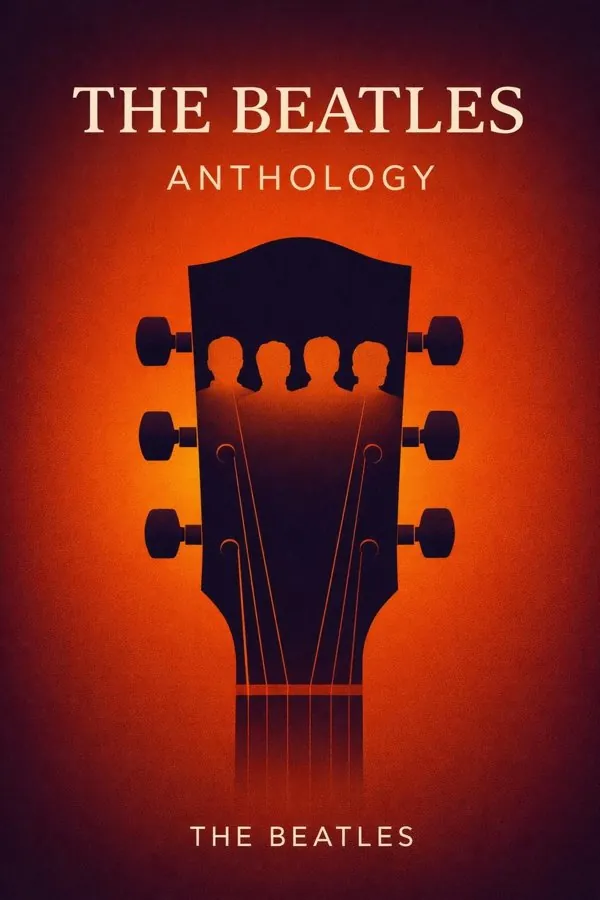
The Beatles Anthology: Summary & Key Insights
by The Beatles
 10 min9 chaptersAudio available
Key Takeaways from The Beatles Anthology
Great artists rarely emerge from nowhere; they are built from the sounds, streets, and tensions around them.
Talent becomes identity only when it survives pressure.
Breakthroughs are rarely accidents; they happen when preparation meets the right opportunity.
Mass adoration can look like triumph from the outside and feel like captivity from within.
Innovation often begins when creators stop asking what a tool was designed for and start asking what else it can do.
What Is The Beatles Anthology About?
The Beatles Anthology by The Beatles is a music_film book spanning 8 pages. The Beatles Anthology is more than a band memoir—it is a first-person history of modern popular culture told by the people who helped invent it. Drawn from the voices of John Lennon, Paul McCartney, George Harrison, and Ringo Starr, the book traces the Beatles’ path from working-class Liverpool childhoods to the clubs of Hamburg, the frenzy of Beatlemania, the artistic breakthroughs of the studio years, and the emotional unravelling that led to the group’s end. What makes this book so compelling is its perspective: rather than presenting the Beatles as untouchable icons, it reveals them as ambitious, funny, competitive, vulnerable young men learning in public while changing music forever. Alongside rare photographs and archival material, their recollections illuminate how songs were shaped, how friendships were tested, and how extraordinary fame altered every part of life. The book matters because the Beatles were not simply successful entertainers—they transformed songwriting, recording, image, and global youth culture. As an autobiographical account told in their own words, The Beatles Anthology carries unmatched authority and intimacy, offering readers both a cultural landmark and a deeply human story.
This FizzRead summary covers all 9 key chapters of The Beatles Anthology in approximately 10 minutes, distilling the most important ideas, arguments, and takeaways from The Beatles's work. Also available as an audio summary and Key Quotes Podcast.
The Beatles Anthology
The Beatles Anthology is more than a band memoir—it is a first-person history of modern popular culture told by the people who helped invent it. Drawn from the voices of John Lennon, Paul McCartney, George Harrison, and Ringo Starr, the book traces the Beatles’ path from working-class Liverpool childhoods to the clubs of Hamburg, the frenzy of Beatlemania, the artistic breakthroughs of the studio years, and the emotional unravelling that led to the group’s end. What makes this book so compelling is its perspective: rather than presenting the Beatles as untouchable icons, it reveals them as ambitious, funny, competitive, vulnerable young men learning in public while changing music forever. Alongside rare photographs and archival material, their recollections illuminate how songs were shaped, how friendships were tested, and how extraordinary fame altered every part of life. The book matters because the Beatles were not simply successful entertainers—they transformed songwriting, recording, image, and global youth culture. As an autobiographical account told in their own words, The Beatles Anthology carries unmatched authority and intimacy, offering readers both a cultural landmark and a deeply human story.
Who Should Read The Beatles Anthology?
This book is perfect for anyone interested in music_film and looking to gain actionable insights in a short read. Whether you're a student, professional, or lifelong learner, the key ideas from The Beatles Anthology by The Beatles will help you think differently.
- ✓Readers who enjoy music_film and want practical takeaways
- ✓Professionals looking to apply new ideas to their work and life
- ✓Anyone who wants the core insights of The Beatles Anthology in just 10 minutes
Want the full summary?
Get instant access to this book summary and 100K+ more with Fizz Moment.
Get Free SummaryAvailable on App Store • Free to download
Key Chapters
Great artists rarely emerge from nowhere; they are built from the sounds, streets, and tensions around them. The Beatles’ story begins in Liverpool, a tough postwar port city where American records arrived like messages from another world. For John, Paul, George, and later Ringo, music was not an abstract ambition but an escape route, a language of possibility, and a way to form identity. Skiffle, rock ’n’ roll, rhythm and blues, and early pop all mixed with local wit and working-class resilience. That environment gave the future Beatles their ear for melody, their appetite for experimentation, and their instinct to connect with ordinary people.
The book shows that their early influences were not polished or academic. They learned by listening obsessively, copying heroes, and trying to recreate what they loved with limited means. Elvis Presley suggested charisma, Chuck Berry offered rhythmic drive and wordplay, Buddy Holly modeled self-contained songwriting, and Little Richard delivered vocal intensity and showmanship. Equally important were family circumstances, friendships, and personal losses, which shaped the emotional texture later heard in their songs.
For readers, this is a reminder that creativity often begins through imitation and immersion. A writer may absorb the cadences of favorite authors; a filmmaker may begin by recreating scenes they admire; a startup founder may learn by studying products that changed user behavior. What matters is not pretending to be original from the start, but building taste through exposure and practice.
Actionable takeaway: map your own creative Liverpool—identify the people, places, and influences that formed your instincts, then deliberately revisit them to understand what your work is really rooted in.
Talent becomes identity only when it survives pressure. Before they were global stars, the Beatles were a rough, hungry live band playing punishing sets in Hamburg’s clubs. The Anthology makes clear that Hamburg was not glamorous training—it was exhausting, chaotic, and often uncomfortable. They played for hours each night, sharpened their timing, learned how to command distracted crowds, and discovered that performance is as much stamina and chemistry as raw ability.
Those nights mattered because they transformed a promising group into a formidable one. Constant playing improved their musicianship at a speed that no rehearsal room could match. They learned how to stretch songs, read audiences, recover from mistakes, and create a shared stage personality. The camaraderie of surviving poor conditions together also deepened their bond. Even their image evolved there, as they became bolder, tighter, and more distinct from other bands.
This chapter carries a lesson far beyond music. Many breakthrough teams are shaped in low-status, high-pressure environments before the world notices them. A chef develops under relentless service, a salesperson improves through repeated rejection, and a founder learns by shipping imperfect products under real-world constraints. Difficult environments can reveal weak points quickly and build confidence honestly.
The Beatles’ Hamburg years also caution against romanticizing overnight success. By the time audiences called them “new,” they were already deeply seasoned. Mastery often looks sudden only to those who did not see the apprenticeship.
Actionable takeaway: create your own Hamburg by choosing one demanding environment where repetition, feedback, and pressure will force your skills to mature faster than comfort ever could.
Breakthroughs are rarely accidents; they happen when preparation meets the right opportunity. The Beatles’ rise through Liverpool and then into EMI under producer George Martin shows how local momentum, professional polish, and strategic support can combine to change everything. By the time they reached a recording contract, they already had an unusually strong live act, a growing fan base, and a developing songwriting identity. What the right collaborators did was help translate that energy into records the wider world could hear.
The Anthology underscores the importance of Brian Epstein’s management and George Martin’s production judgment. Epstein recognized that presentation mattered—how the band dressed, behaved, and was positioned. Martin recognized musical intelligence and potential, even when the group was still raw. Neither man “created” the Beatles, but both amplified what was already there. This is a crucial distinction. The best mentors and gatekeepers do not invent talent; they refine and direct it.
There is a practical lesson here for anyone trying to grow a project or career. Skill alone is not enough. You also need translation: the ability to present your work in a form others can understand and champion. A designer may need a strong portfolio, a researcher may need a clear abstract, and an entrepreneur may need a compelling pitch deck. Often, success depends on finding people who can help bridge craft and audience.
The Beatles’ early recording years also show that first opportunities are rarely perfect. Songs were adjusted, lineups changed, and expectations evolved. Progress came from staying adaptable without losing core identity.
Actionable takeaway: prepare your work as if an opportunity could arrive tomorrow, and seek collaborators who can help convert your raw strengths into something visible, credible, and memorable.
Mass adoration can look like triumph from the outside and feel like captivity from within. The Beatles’ explosion into Beatlemania marked one of the most intense episodes of celebrity in modern history. Crowds screamed so loudly they could barely hear themselves perform. Airports, hotels, press conferences, and concerts became scenes of frenzy. The Anthology captures both the exhilaration and the absurdity of becoming symbols before fully becoming adults.
This period matters because it shows how public success can distort private life. On one hand, the Beatles experienced extraordinary validation: sold-out tours, global recognition, and a level of cultural impact almost impossible to overstate. On the other hand, the speed and scale of fame created exhaustion, isolation, and a growing sense that the machinery around them was becoming larger than the music itself. Their humor helped them survive, but it also often functioned as armor against scrutiny and pressure.
The broader lesson is that growth always changes the conditions of work. As an organization scales, a founder may lose the intimacy of early collaboration. As an artist gains followers, audience expectations can harden into a cage. Visibility creates leverage, but it also creates noise. Without boundaries, what once felt like achievement can become performance without meaning.
The Beatles’ experience encourages readers to think carefully about what kind of success they actually want. Recognition is useful, but if it erodes the conditions that made great work possible, it becomes self-defeating.
Actionable takeaway: define in advance which parts of your life, process, and values must remain protected as success grows, so expansion does not quietly strip away the freedom that made your work worth doing.
Innovation often begins when creators stop asking what a tool was designed for and start asking what else it can do. As touring became limiting, the Beatles turned inward to the recording studio and transformed popular music in the process. The Anthology shows how the group evolved from recording songs as performances to treating the studio itself as a creative space—one where sounds could be layered, altered, reversed, expanded, and reimagined.
This shift was not just technical; it was conceptual. Albums such as Revolver and Sgt. Pepper’s Lonely Hearts Club Band emerged from a willingness to break habits. Tape loops, orchestral arrangements, unusual instrumentation, close-miked textures, and structural experimentation allowed the Beatles to move beyond the constraints of live replication. Supported by producers and engineers willing to explore with them, they proved that pop music could be playful, ambitious, and artistically cohesive without losing mass appeal.
For readers in any field, this is a model of creative reinvention. A teacher might turn a classroom into a lab for active learning rather than passive instruction. A software team might use data not only to optimize existing features but to imagine entirely new user behaviors. A writer might stop seeing form as fixed and start using structure as part of the meaning.
The deeper insight is that innovation requires both curiosity and permission. The Beatles succeeded because they trusted experimentation enough to risk confusion, failure, and criticism. They treated constraints not as walls but as prompts.
Actionable takeaway: choose one tool, process, or medium you use routinely and ask how it might become more than a delivery mechanism—how it could itself become a source of invention.
The stronger a group becomes, the harder it can be to ignore the fact that its members are growing in different directions. The Beatles were united by shared history and talent, but The Anthology makes clear that success gradually magnified differences in temperament, ambition, and spiritual outlook. John became increasingly restless and confrontational, Paul more driven and exacting, George more assertive in seeking artistic space, and Ringo often the stabilizing presence amid tensions.
These differences were not necessarily signs of failure. In many great teams, individual maturation eventually makes the original structure feel too small. What had once been a natural hierarchy can begin to feel restrictive; what once looked like healthy drive can start to resemble control. The Beatles’ internal strain was shaped by business disputes, new relationships, grief after the death of Brian Epstein, and the practical difficulty of maintaining a collective identity when each member was changing rapidly.
This idea has broad application in partnerships, families, and organizations. Conflict is often interpreted as proof that something has gone wrong, but sometimes it signals that people’s needs and identities are no longer aligned with old systems. A cofounding team may need new decision rules. A department may need clearer ownership. A marriage or friendship may require a different kind of honesty than before.
The Beatles’ story suggests that unresolved tension becomes more damaging when brilliance allows people to avoid difficult conversations. Talent can postpone reckoning, but it cannot replace trust.
Actionable takeaway: when collaboration starts feeling strained, don’t ask only who is right—ask what has changed in each person, and what structures now need to change with them.
When public achievement stops answering private questions, people often begin searching elsewhere. In the later Beatles years, spirituality, meditation, philosophy, and altered consciousness became part of the band’s evolving inner life. The Anthology presents this not as a superficial fashion but as a serious attempt—especially for George, though not only him—to find meaning beyond money, fame, and endless public demand. Their interest in Indian music, meditation, and Eastern thought opened not only musical possibilities but new ways of understanding identity and purpose.
This period is significant because it shows that reinvention is often driven by existential need, not just artistic ambition. The Beatles had already achieved what most performers dream of, yet they still felt incomplete, curious, and at times deeply unsettled. Their spiritual explorations reflected a broader 1960s cultural shift, but in their case it also marked a personal attempt to reclaim interior life from the machinery of celebrity.
Readers can apply this insight in a grounded way. Periods of outward success often expose inner neglect. A professional may realize that career momentum has left no room for reflection. A parent may discover they have become efficient but emotionally disconnected. A creator may need silence as much as stimulation. Spirituality need not mean religion; it can mean any serious practice that restores perspective—meditation, journaling, prayer, walking, study, or service.
The Beatles’ search was imperfect and sometimes contradictory, but that is part of the lesson. Growth rarely arrives cleanly. It unfolds through experiments, enthusiasms, mistakes, and sincere attempts to live more consciously.
Actionable takeaway: establish one regular reflective practice that is not tied to productivity, so your inner life develops alongside your outer achievements.
Some of the most meaningful endings are not sudden collapses but prolonged attempts to keep something alive after trust has frayed. The Beatles’ final phase, including the making of the White Album, Let It Be, and Abbey Road, shows a group still capable of brilliance even as their unity weakened. The Anthology does not reduce the breakup to a single cause. Instead, it reveals a web of pressures: artistic divergence, business problems, interpersonal resentment, outside influences, and the sheer difficulty of sustaining a once-intimate partnership under historic levels of strain.
What makes this stage compelling is the coexistence of fragmentation and excellence. Even when working separately or uneasily, the Beatles continued to produce songs of extraordinary depth and range. That paradox matters. Teams do not cease creating the moment they begin to fracture; sometimes their final works are sharpened by urgency, distance, and a clearer sense of individuality.
There is a practical lesson here about endings in general. Projects, companies, and relationships often persist beyond the point of ease because people still care, still hope, or still cannot imagine life after separation. The challenge is to recognize when preserving the form of a collaboration is no longer the same as preserving its spirit. Graceful closure requires honesty, not just endurance.
The Beatles’ story also reminds readers that endings should not erase what was built. The breakup was painful, but it did not cancel the years of invention, friendship, and cultural transformation that came before.
Actionable takeaway: when something important is ending, focus on two tasks at once—tell the truth about why it cannot continue as before, and protect what deserves to be honored from the journey you shared.
The true measure of cultural impact is not only what a work achieves in its own time but how deeply it reshapes what later generations think is possible. The Beatles’ legacy extends far beyond chart records or nostalgia. The Anthology frames their story as one of continuing influence: on songwriting craft, album-making, recording technology, visual identity, global fandom, and the idea that popular music can be both commercially enormous and artistically adventurous.
Their legacy also lives in memory—personal, collective, and contested. Each Beatle remembers events with a distinct tone, and that multiplicity is part of the value of the book. History is not a single clean narrative; it is a chorus of perspectives shaped by personality, time, hurt, affection, and hindsight. By presenting the band’s story through their own voices, The Beatles Anthology becomes not just a record of facts but a study in how people remember shared lives differently.
For modern readers, this final idea is powerful. Influence is often more durable than ownership. You may not control how your work is interpreted, but you can shape the standards it leaves behind. A teacher’s legacy may be students who think more boldly. A manager’s legacy may be teams that build healthier cultures. An artist’s legacy may be permission granted to others.
The Beatles endure because they opened doors—in melody, production, image, and ambition—that countless others walked through. They remain alive wherever people take creative risks that once seemed impossible in popular form.
Actionable takeaway: think about your legacy not as reputation alone, but as the possibilities your work creates for others after you are no longer in the room.
All Chapters in The Beatles Anthology
About the Author
The Beatles were an English rock band formed in Liverpool in 1960 and composed of John Lennon, Paul McCartney, George Harrison, and Ringo Starr. Emerging from the city’s vibrant postwar music scene, they developed their craft in Liverpool and Hamburg before becoming the most influential group in popular music history. Their work transformed not only songwriting and studio production but also fashion, youth culture, and the global reach of recorded music. Across a remarkably short span, they evolved from energetic rock ’n’ roll performers into bold artistic innovators responsible for landmark albums and enduring songs. Though the band officially broke up in 1970, their cultural and musical influence remains unparalleled. As the collective “author” of The Beatles Anthology, they offer an unmatched firsthand account of their own extraordinary journey.
Get This Summary in Your Preferred Format
Read or listen to the The Beatles Anthology summary by The Beatles anytime, anywhere. FizzRead offers multiple formats so you can learn on your terms — all free.
Available formats: App · Audio · PDF · EPUB — All included free with FizzRead
Download The Beatles Anthology PDF and EPUB Summary
Key Quotes from The Beatles Anthology
“Great artists rarely emerge from nowhere; they are built from the sounds, streets, and tensions around them.”
“Talent becomes identity only when it survives pressure.”
“Breakthroughs are rarely accidents; they happen when preparation meets the right opportunity.”
“Mass adoration can look like triumph from the outside and feel like captivity from within.”
“Innovation often begins when creators stop asking what a tool was designed for and start asking what else it can do.”
Frequently Asked Questions about The Beatles Anthology
The Beatles Anthology by The Beatles is a music_film book that explores key ideas across 9 chapters. The Beatles Anthology is more than a band memoir—it is a first-person history of modern popular culture told by the people who helped invent it. Drawn from the voices of John Lennon, Paul McCartney, George Harrison, and Ringo Starr, the book traces the Beatles’ path from working-class Liverpool childhoods to the clubs of Hamburg, the frenzy of Beatlemania, the artistic breakthroughs of the studio years, and the emotional unravelling that led to the group’s end. What makes this book so compelling is its perspective: rather than presenting the Beatles as untouchable icons, it reveals them as ambitious, funny, competitive, vulnerable young men learning in public while changing music forever. Alongside rare photographs and archival material, their recollections illuminate how songs were shaped, how friendships were tested, and how extraordinary fame altered every part of life. The book matters because the Beatles were not simply successful entertainers—they transformed songwriting, recording, image, and global youth culture. As an autobiographical account told in their own words, The Beatles Anthology carries unmatched authority and intimacy, offering readers both a cultural landmark and a deeply human story.
You Might Also Like
Beethoven: A Documentary Study
H. C. Robbins Landon
10 min
Cinema Speculation
Quentin Tarantino
10 min
Deep Listening: A Composer's Sound Practice
Pauline Oliveros
10 min
Dylan Goes Electric!: Newport, Seeger, Dylan, and the Night That Split the Sixties
Elijah Wald
10 min
Future Frames
Maria Walsh
10 min
Hamilton: The Revolution: Being the Complete Libretto of the Broadway Musical, with a True Account of Its Creation, and Concise Remarks on Hip-Hop, the Power of Stories, and the New America
Lin-Manuel Miranda, Jeremy McCarter
10 minBrowse by Category
Ready to read The Beatles Anthology?
Get the full summary and 100K+ more books with Fizz Moment.