
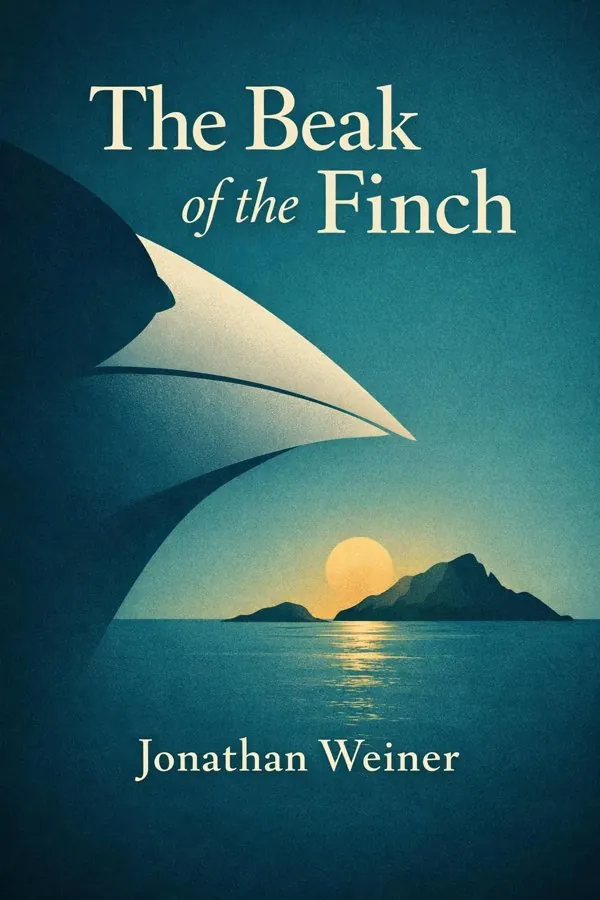
The Beak of the Finch: A Story of Evolution in Our Time: Summary & Key Insights
 10 min9 chaptersAudio available
Key Takeaways from The Beak of the Finch: A Story of Evolution in Our Time
A remote island can sometimes reveal more about life than a library full of theories.
Evolution feels abstract only until you measure it carefully enough.
Big scientific revolutions often depend on humble routines.
No population can evolve if its members are all effectively identical.
Nature is messier than our categories, and that messiness can be creative.
What Is The Beak of the Finch: A Story of Evolution in Our Time About?
The Beak of the Finch: A Story of Evolution in Our Time by Jonathan Weiner is a life_science book spanning 4 pages. Jonathan Weiner’s The Beak of the Finch brings one of science’s biggest ideas down from the realm of theory and into the dust, heat, and unpredictability of real life. The book follows the landmark fieldwork of biologists Peter and Rosemary Grant, who spent decades studying Darwin’s finches on the Galápagos Islands. By measuring birds year after year—tracking their beaks, bodies, breeding, and survival—the Grants showed that natural selection is not merely a process buried in the fossil record. It happens now, sometimes in just a few generations, and can be seen with remarkable clarity when conditions change. What makes this book so powerful is its blend of rigorous science and vivid storytelling. Weiner, a Pulitzer Prize–winning science writer, turns careful observation into an intellectual adventure, connecting Darwin’s original insights to modern genetics, ecology, and evolutionary theory. The result is both a scientific revelation and a philosophical challenge: life is not fixed, stable, or finished. It is constantly improvising. For anyone interested in biology, adaptation, climate, or how living systems respond to pressure, this book offers one of the clearest and most memorable portraits of evolution in action.
This FizzRead summary covers all 9 key chapters of The Beak of the Finch: A Story of Evolution in Our Time in approximately 10 minutes, distilling the most important ideas, arguments, and takeaways from Jonathan Weiner's work. Also available as an audio summary and Key Quotes Podcast.
The Beak of the Finch: A Story of Evolution in Our Time
Jonathan Weiner’s The Beak of the Finch brings one of science’s biggest ideas down from the realm of theory and into the dust, heat, and unpredictability of real life. The book follows the landmark fieldwork of biologists Peter and Rosemary Grant, who spent decades studying Darwin’s finches on the Galápagos Islands. By measuring birds year after year—tracking their beaks, bodies, breeding, and survival—the Grants showed that natural selection is not merely a process buried in the fossil record. It happens now, sometimes in just a few generations, and can be seen with remarkable clarity when conditions change.
What makes this book so powerful is its blend of rigorous science and vivid storytelling. Weiner, a Pulitzer Prize–winning science writer, turns careful observation into an intellectual adventure, connecting Darwin’s original insights to modern genetics, ecology, and evolutionary theory. The result is both a scientific revelation and a philosophical challenge: life is not fixed, stable, or finished. It is constantly improvising. For anyone interested in biology, adaptation, climate, or how living systems respond to pressure, this book offers one of the clearest and most memorable portraits of evolution in action.
Who Should Read The Beak of the Finch: A Story of Evolution in Our Time?
This book is perfect for anyone interested in life_science and looking to gain actionable insights in a short read. Whether you're a student, professional, or lifelong learner, the key ideas from The Beak of the Finch: A Story of Evolution in Our Time by Jonathan Weiner will help you think differently.
- ✓Readers who enjoy life_science and want practical takeaways
- ✓Professionals looking to apply new ideas to their work and life
- ✓Anyone who wants the core insights of The Beak of the Finch: A Story of Evolution in Our Time in just 10 minutes
Want the full summary?
Get instant access to this book summary and 100K+ more with Fizz Moment.
Get Free SummaryAvailable on App Store • Free to download
Key Chapters
A remote island can sometimes reveal more about life than a library full of theories. That is the enduring power of the Galápagos in The Beak of the Finch. When Charles Darwin visited the islands in 1835, he encountered birds and other animals that were similar across islands yet distinct in small, meaningful ways. Those differences helped spark one of the most important scientific insights in history: species are not fixed. They can diverge over time as they adapt to local conditions.
Weiner shows that the Galápagos are not just a historical backdrop to Darwin’s breakthrough. They remain a living laboratory where the processes Darwin inferred can be observed directly. The islands are isolated enough to make patterns visible, but dynamic enough to show that nature is always changing. Different islands create different ecological pressures. Food supplies shift with rainfall, drought, competition, and chance. Under such conditions, even small variations in traits such as beak size can matter enormously.
This idea has practical value far beyond birds. In medicine, agriculture, and conservation, scientists often learn most from simplified systems where change can be tracked clearly. The Galápagos serve that role for evolution. They let researchers see how environment, variation, and survival interact.
The larger lesson is that understanding any system begins with looking closely at differences that seem minor at first. Actionable takeaway: when studying change—whether in nature, organizations, or your own habits—start by identifying the small variations and local pressures that shape outcomes over time.
Evolution feels abstract only until you measure it carefully enough. The central achievement of Peter and Rosemary Grant was to show that natural selection can be observed in real time. On the island of Daphne Major, they trapped finches, banded them, weighed them, measured their beaks, tracked parentage, and followed survival across years of changing weather. Their work transformed evolution from a distant historical narrative into an active, measurable process.
The book’s most famous episodes involve drought and rain. In drought years, small soft seeds became scarce, leaving behind harder and tougher seeds. Finches with larger, deeper beaks were better able to crack them and were therefore more likely to survive and reproduce. In wetter periods, different food conditions favored other traits. The average beak size in the population shifted accordingly. In other words, the environment did not merely influence individual birds; it changed the direction of the population.
This matters because it demonstrates a key principle: selection is not a vague force but a statistical sorting process. Traits linked to survival and reproduction become more common when circumstances reward them. Weiner makes clear that this is not a rare or dramatic exception. It is the ordinary logic of life under pressure.
You can apply this thinking broadly. Businesses adapt to markets, pathogens adapt to drugs, and habits adapt to routines through repeated selection pressures. Actionable takeaway: if you want change, do not focus only on intentions—change the environment that rewards some behaviors and penalizes others.
Big scientific revolutions often depend on humble routines. One of the most striking elements in The Beak of the Finch is the sheer discipline of the Grants’ fieldwork. Their breakthroughs did not arise from a single dramatic moment but from years of repeated measurements under difficult conditions. They caught birds in mist nets, identified individuals by bands, recorded tiny differences in beak depth and wing length, documented which birds bred with which, and returned season after season.
That level of precision was essential because evolution often works through small shifts rather than obvious transformations. A difference of a millimeter in beak depth can affect what a bird can eat, which can affect whether it survives a drought, which in turn can shape the next generation. Without careful data, such patterns would be invisible or dismissed as anecdotal.
Weiner uses this to show how science really works. Discovery is not just brilliance. It is patience, consistency, and the willingness to endure uncertainty until patterns emerge. This is why long-term studies are so valuable in ecology and biology. Short snapshots can miss the very fluctuations that drive adaptation.
The same principle applies in everyday decision-making. If you want to understand your health, finances, or performance, occasional impressions are less useful than reliable longitudinal data. Trends reveal what moments conceal. Actionable takeaway: measure consistently over time. Whether you are studying birds or improving your own life, disciplined tracking often uncovers the forces that truly drive change.
No population can evolve if its members are all effectively identical. One of the book’s recurring insights is that variation within a species is not noise around a standard model; it is the essential material on which natural selection acts. The finches on Daphne Major differed in beak size, shape, body dimensions, feeding behavior, and song. Those differences, some subtle and some more visible, created the possibility for selection when conditions shifted.
Weiner emphasizes that variation is not a side note to evolution. It is the reason adaptation is possible at all. When drought hits, individuals are not equally equipped to cope. Some happen to possess traits better suited to the new conditions. If those traits are heritable, they can become more common in later generations. Evolution therefore depends on two linked facts: populations vary, and some of that variation gets passed on.
This has major implications in fields such as crop science, epidemiology, and conservation biology. A genetically uniform crop may look efficient, but it can be fragile in the face of disease or climate stress. Diverse populations, whether biological or institutional, often possess greater adaptive potential because they contain more possible responses to change.
The human lesson is equally important. Systems built for total uniformity may appear orderly but can become brittle. Actionable takeaway: preserve and value variation. In teams, ecosystems, or strategies, diversity is not just a moral or aesthetic good—it is often the basis of resilience and future adaptation.
Nature is messier than our categories, and that messiness can be creative. In the finches’ world, species are not always neatly sealed units. Weiner explores how hybridization—interbreeding between closely related forms—complicates the classic picture of evolution as a simple branching tree. On the Galápagos, finch lineages can occasionally cross, introducing new combinations of genes and traits into populations.
Rather than undermining evolution, this finding enriches it. Hybridization can supply fresh variation that natural selection may later test. In some cases, it may even help generate new ecological opportunities or accelerate divergence under changing conditions. The Grants’ work showed that species boundaries can be porous, especially when ecological pressures shift or when individuals disperse between islands.
This matters because many people imagine species as fixed boxes. The book argues for a more dynamic understanding: species are real, but they are historical populations in motion, not eternal Platonic forms. Modern genetics has reinforced this view across many organisms, from plants to fish to human ancestors. Evolution includes not only separation but occasional mixing.
In practical terms, this idea shapes conservation, where managers must decide how to treat hybrid populations, and agriculture, where breeders intentionally combine lineages to produce useful traits. It also encourages intellectual humility. Our labels can be useful without being absolute. Actionable takeaway: when facing complex systems, resist rigid categories. Look instead for exchange, overlap, and the unexpected combinations that can generate novelty.
Adaptation is lawful, but it is not orderly in the way people often imagine. The Beak of the Finch repeatedly shows that evolution is shaped by both selection and contingency. Droughts, storms, seed availability, migration events, and random survival can alter the direction of change. The environment imposes pressures, but those pressures arrive unevenly and unpredictably. As a result, evolution is responsive and opportunistic rather than preplanned.
This is one of the book’s most sobering insights. There is no final destination toward which finches are progressing. A trait that helps in one year may become less useful in the next if rains return or competitors arrive. The Grants found that selection could reverse direction as conditions changed. Evolution is therefore not a ladder of improvement. It is an ongoing adjustment to local circumstances.
The practical implications are broad. Climate change, emerging disease, and habitat fragmentation are not static challenges. They create moving targets. Organisms, institutions, and individuals must adapt under uncertainty. Planning remains essential, but so does flexibility. A strategy optimized for one set of conditions may fail under another.
This perspective also helps correct a common misunderstanding in personal development: success does not come only from having good traits or good plans. It also depends on fit between those traits and the current environment. Actionable takeaway: build adaptability, not just optimization. Prepare for changing conditions by keeping options open, reviewing assumptions often, and avoiding dependence on a single favorable circumstance.
One of the book’s great achievements is to break the illusion that evolution is always too slow to notice. Popular imagination often places evolutionary change on a timescale so vast that it seems irrelevant to human observation. Weiner shows the opposite. Under strong selection, measurable change can occur over just a few generations. In the finches, shifts in beak dimensions happened quickly enough for researchers to document them from year to year.
This does not mean that all evolution is rapid or that new species appear overnight. Rather, it means that evolutionary change operates across a range of tempos. Some patterns unfold slowly in deep time; others happen with surprising speed when ecological pressure is intense and suitable variation already exists. That realization changes how we think about everything from antibiotic resistance to pesticide resistance to urban wildlife adapting to human-made environments.
The modern world makes this lesson especially urgent. Humans are constantly altering habitats, climates, and food webs. Organisms respond. Some adapt, some move, and some disappear. Understanding rapid evolution is therefore not just academically interesting. It is necessary for public health, conservation, and environmental policy.
At a personal level, the idea is encouraging and cautionary at once. Systems can change faster than expected, for better or worse, when feedback is strong. Actionable takeaway: do not assume gradual change means slow change. Watch for pressures that can accelerate adaptation, and respond early before new patterns become difficult to reverse.
A beak is a tiny thing to build a grand theory on, yet that is precisely the point. The book shows how minute physical differences can have enormous consequences when they affect access to food, mate choice, or reproductive success. Beak depth, for example, is not merely a descriptive feature. It changes what seeds a finch can crack, how efficiently it can feed during scarcity, and therefore whether it survives long enough to breed.
Weiner uses these details to reveal a broader truth: in evolution, significance is contextual. A trait matters not because it is large or dramatic, but because it interacts with the environment in consequential ways. This is why the Grants paid attention to such fine-grained measurements. A slight average shift in a population can indicate substantial selective pressure at work.
This principle translates well beyond biology. In engineering, a small design change can alter performance under stress. In communication, a subtle shift in wording can change trust or understanding. In health, minor repeated behaviors can transform long-term outcomes. Complex systems are often sensitive to variables that look trivial in isolation.
The lesson is to avoid being blinded by scale. Not every important cause is obvious. Sometimes the most consequential factors are the ones most easily overlooked because they seem too small to matter. Actionable takeaway: examine fine details where performance meets pressure. Small, measurable traits often drive big outcomes when conditions become demanding.
A story about birds on volcanic islands becomes, in Weiner’s hands, a story about all life under pressure. The finches matter not just because they illuminate Darwin’s ideas, but because they offer a model for understanding how living systems respond to change everywhere. Evolution is not confined to remote ecosystems. It is present in hospitals where microbes evolve resistance, in farms where pests adapt to chemicals, and in cities where animals learn new ways to survive.
The book’s wider message is that humans are participants in evolution, not observers standing outside it. By changing climates, landscapes, species interactions, and selective environments, we are influencing the evolutionary trajectories of countless organisms, including ourselves indirectly through health and ecology. This makes the study of evolution a practical necessity, not a philosophical luxury.
Weiner also invites readers to see humility in this perspective. Human plans often assume stability, yet life operates through constant revision. The world is less like a finished machine than a restless experiment. That view can sharpen both scientific curiosity and ethical responsibility.
For readers, the finches become a lens through which to think about resilience, unintended consequences, and the long-term effects of present choices. Actionable takeaway: use an evolutionary lens when evaluating modern problems. Ask how incentives, pressures, and inherited variation may shape future responses, especially in health, environmental policy, and systems design.
All Chapters in The Beak of the Finch: A Story of Evolution in Our Time
About the Author
Jonathan Weiner is an American science writer celebrated for making complex biological ideas vivid and accessible to a broad audience. He is best known for The Beak of the Finch, which won the Pulitzer Prize for General Nonfiction and became a landmark work in popular science writing. Weiner’s reporting often focuses on evolution, genetics, heredity, and the changing scientific understanding of life. His style combines careful research, narrative momentum, and a strong ability to translate fieldwork and theory into stories that general readers can follow with ease. In addition to his writing, he has taught and lectured on science and journalism, helping bridge the gap between researchers and the public. His work remains influential for readers seeking scientifically rigorous but deeply readable accounts of modern biology.
Get This Summary in Your Preferred Format
Read or listen to the The Beak of the Finch: A Story of Evolution in Our Time summary by Jonathan Weiner anytime, anywhere. FizzRead offers multiple formats so you can learn on your terms — all free.
Available formats: App · Audio · PDF · EPUB — All included free with FizzRead
Download The Beak of the Finch: A Story of Evolution in Our Time PDF and EPUB Summary
Key Quotes from The Beak of the Finch: A Story of Evolution in Our Time
“A remote island can sometimes reveal more about life than a library full of theories.”
“Evolution feels abstract only until you measure it carefully enough.”
“Big scientific revolutions often depend on humble routines.”
“No population can evolve if its members are all effectively identical.”
“Nature is messier than our categories, and that messiness can be creative.”
Frequently Asked Questions about The Beak of the Finch: A Story of Evolution in Our Time
The Beak of the Finch: A Story of Evolution in Our Time by Jonathan Weiner is a life_science book that explores key ideas across 9 chapters. Jonathan Weiner’s The Beak of the Finch brings one of science’s biggest ideas down from the realm of theory and into the dust, heat, and unpredictability of real life. The book follows the landmark fieldwork of biologists Peter and Rosemary Grant, who spent decades studying Darwin’s finches on the Galápagos Islands. By measuring birds year after year—tracking their beaks, bodies, breeding, and survival—the Grants showed that natural selection is not merely a process buried in the fossil record. It happens now, sometimes in just a few generations, and can be seen with remarkable clarity when conditions change. What makes this book so powerful is its blend of rigorous science and vivid storytelling. Weiner, a Pulitzer Prize–winning science writer, turns careful observation into an intellectual adventure, connecting Darwin’s original insights to modern genetics, ecology, and evolutionary theory. The result is both a scientific revelation and a philosophical challenge: life is not fixed, stable, or finished. It is constantly improvising. For anyone interested in biology, adaptation, climate, or how living systems respond to pressure, this book offers one of the clearest and most memorable portraits of evolution in action.
You Might Also Like
The Selfish Gene
Richard Dawkins
10 min
Awakenings
Oliver Sacks
10 min
Parasite Rex: Inside the Bizarre World of Nature's Most Dangerous Creatures
Carl Zimmer
10 min
The Atlas of Life on Earth
Various
10 min
The Book of Humans: The Story of How We Became Us
Adam Rutherford
10 min
The Horse
Wendy Williams
10 minBrowse by Category
Ready to read The Beak of the Finch: A Story of Evolution in Our Time?
Get the full summary and 100K+ more books with Fizz Moment.