
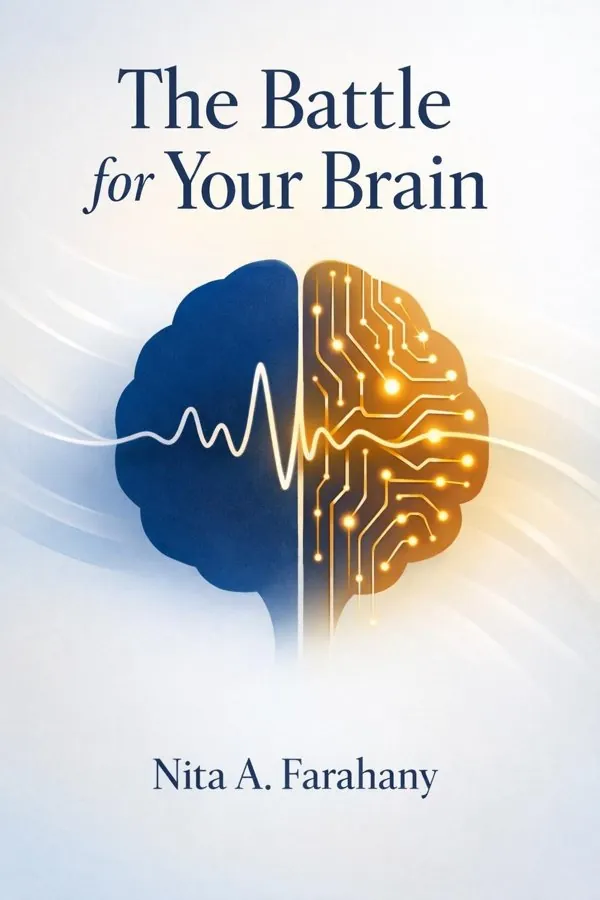
The Battle for Your Brain: Defending the Right to Think Freely in the Age of Neurotechnology: Summary & Key Insights
 10 min5 chaptersAudio available
What Is The Battle for Your Brain: Defending the Right to Think Freely in the Age of Neurotechnology About?
The Battle for Your Brain: Defending the Right to Think Freely in the Age of Neurotechnology by Nita A. Farahany is a ethics book spanning 5 pages. In this groundbreaking work, Nita A. Farahany explores the emerging field of neurotechnology and its profound implications for privacy, autonomy, and human rights. She examines how brain-monitoring devices and neurodata could transform workplaces, law enforcement, and personal life, urging society to safeguard cognitive liberty—the right to think freely and privately—in the face of rapid technological advances.
This FizzRead summary covers all 5 key chapters of The Battle for Your Brain: Defending the Right to Think Freely in the Age of Neurotechnology in approximately 10 minutes, distilling the most important ideas, arguments, and takeaways from Nita A. Farahany's work. Also available as an audio summary and Key Quotes Podcast.
The Battle for Your Brain: Defending the Right to Think Freely in the Age of Neurotechnology
In this groundbreaking work, Nita A. Farahany explores the emerging field of neurotechnology and its profound implications for privacy, autonomy, and human rights. She examines how brain-monitoring devices and neurodata could transform workplaces, law enforcement, and personal life, urging society to safeguard cognitive liberty—the right to think freely and privately—in the face of rapid technological advances.
Who Should Read The Battle for Your Brain: Defending the Right to Think Freely in the Age of Neurotechnology?
This book is perfect for anyone interested in ethics and looking to gain actionable insights in a short read. Whether you're a student, professional, or lifelong learner, the key ideas from The Battle for Your Brain: Defending the Right to Think Freely in the Age of Neurotechnology by Nita A. Farahany will help you think differently.
- ✓Readers who enjoy ethics and want practical takeaways
- ✓Professionals looking to apply new ideas to their work and life
- ✓Anyone who wants the core insights of The Battle for Your Brain: Defending the Right to Think Freely in the Age of Neurotechnology in just 10 minutes
Want the full summary?
Get instant access to this book summary and 100K+ more with Fizz Moment.
Get Free SummaryAvailable on App Store • Free to download
Key Chapters
In exploring cognitive liberty, I argue that the ability to think privately and independently must be considered a fundamental human right. Cognitive liberty means having the freedom to determine what enters our minds, what remains private, and how our mental processes are shaped. It is the right to use neurotechnology to enhance ourselves if we choose—but also the right to refuse its use when imposed by others. As brain-computer interfaces blur the line between thought and data, we need new frameworks to preserve mental autonomy.
Throughout history, rights have evolved in response to shifts in technology. The printing press expanded freedom of expression; the internet transformed access to information. Now, neurotechnology challenges the very boundary between self and system. When sensors can decode emotion, concentration, or even moral judgment, our internal world becomes potentially transparent to entities beyond ourselves. Without protection, “mental privacy” risks becoming an obsolete concept.
I emphasize that cognitive liberty must rest on three pillars: freedom of thought, mental privacy, and self-determination. Freedom of thought prevents coercion or manipulation at the cognitive level. Mental privacy guards against unauthorized access to neural data. Self-determination ensures individuals retain authority over how their mental lives are enhanced or modified. To defend these principles, law and ethics must expand beyond traditional privacy and bodily autonomy—into the realm of mental autonomy.
This idea is not abstract philosophy. Already, employers use wearable neurotech to monitor attention and productivity. Policymakers consider its application in criminal justice. Tech companies integrate it into consumer devices. Cognitive liberty thus becomes the frontier of all liberties, for when thought itself is constrained, every other freedom falters.
Neurotechnology operates by capturing electrical signals generated by the brain—commonly through EEG, fNIRS, and other methods—and translating them into data streams that reflect mental states. These readings can indicate focus, fatigue, mood, and even subconscious reactions. At first glance, such capabilities promise immense value: detecting diseases earlier, improving learning environments, reducing accidents caused by fatigue. But behind the allure of these benefits lies the danger of misuse.
I illustrate how companies have already begun piloting programs that monitor workers’ neural activity to gauge productivity. When a factory headset detects distraction, a notification is sent to the supervisor. What begins as safety oversight easily mutates into surveillance. In classrooms, devices meant to measure engagement can condition how students are perceived or rewarded—not for thinking well, but for appearing attentive. The line between help and coercion becomes exceedingly thin.
Moreover, brain data is not ordinary data. It is the most intimate form of human information—revealing characteristics we may not even consciously know about ourselves. Neurodata can expose patterns linked to political belief, personality traits, or implicit bias. If misused, it could become the ultimate instrument of control. The ethics of informed consent, data ownership, and psychological autonomy must therefore be reconsidered.
I argue that existing privacy laws fail to address neurodata’s unique sensitivity. Standard data protection frameworks treat brain recordings as if they were another biometric identifier. But neural activity captures what we feel, imagine, and desire. Its collection and analysis open direct doors into the mind. Thus, regulations must treat brain information as inviolable—accessible only under conditions that ensure mental sovereignty. Without such norms, brain-monitoring technologies may normalize thought surveillance in every sphere of life.
+ 3 more chapters — available in the FizzRead app
All Chapters in The Battle for Your Brain: Defending the Right to Think Freely in the Age of Neurotechnology
About the Author
Nita A. Farahany is a professor of law and philosophy at Duke University and a leading scholar on the ethical, legal, and social implications of emerging technologies. She has served on national advisory committees and is recognized for her work on neuroscience and law.
Get This Summary in Your Preferred Format
Read or listen to the The Battle for Your Brain: Defending the Right to Think Freely in the Age of Neurotechnology summary by Nita A. Farahany anytime, anywhere. FizzRead offers multiple formats so you can learn on your terms — all free.
Available formats: App · Audio · PDF · EPUB — All included free with FizzRead
Download The Battle for Your Brain: Defending the Right to Think Freely in the Age of Neurotechnology PDF and EPUB Summary
Key Quotes from The Battle for Your Brain: Defending the Right to Think Freely in the Age of Neurotechnology
“In exploring cognitive liberty, I argue that the ability to think privately and independently must be considered a fundamental human right.”
“Neurotechnology operates by capturing electrical signals generated by the brain—commonly through EEG, fNIRS, and other methods—and translating them into data streams that reflect mental states.”
Frequently Asked Questions about The Battle for Your Brain: Defending the Right to Think Freely in the Age of Neurotechnology
The Battle for Your Brain: Defending the Right to Think Freely in the Age of Neurotechnology by Nita A. Farahany is a ethics book that explores key ideas across 5 chapters. In this groundbreaking work, Nita A. Farahany explores the emerging field of neurotechnology and its profound implications for privacy, autonomy, and human rights. She examines how brain-monitoring devices and neurodata could transform workplaces, law enforcement, and personal life, urging society to safeguard cognitive liberty—the right to think freely and privately—in the face of rapid technological advances.
You Might Also Like

What We Owe the Future
William MacAskill
10 min
Abortion
David Boonin
10 min
Blind Spots: Why We Fail to Do What's Right and What to Do About It
Max H. Bazerman, Ann E. Tenbrunsel
10 min
Digital Ethics: Research and Practice
Christopher Burr, Luciano Floridi (Editors)
10 min
Doing Good Better: Effective Altruism and a Radical New Way to Make a Difference
William MacAskill
10 min
Eating Animals
Jonathan Safran Foer
10 minBrowse by Category
Ready to read The Battle for Your Brain: Defending the Right to Think Freely in the Age of Neurotechnology?
Get the full summary and 100K+ more books with Fizz Moment.