
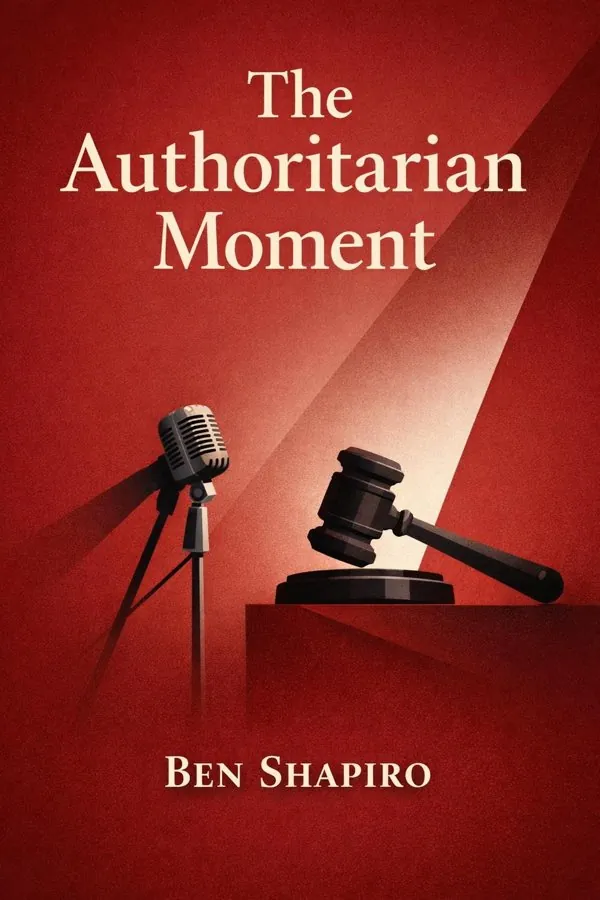
The Authoritarian Moment: How the Left Weaponized America's Institutions Against Dissent: Summary & Key Insights
by Ben Shapiro
 10 min6 chaptersAudio available
What Is The Authoritarian Moment: How the Left Weaponized America's Institutions Against Dissent About?
The Authoritarian Moment: How the Left Weaponized America's Institutions Against Dissent by Ben Shapiro is a politics book spanning 6 pages. In this book, conservative commentator Ben Shapiro argues that American cultural and political institutions have been overtaken by an authoritarian left that suppresses dissenting viewpoints. He examines how media, academia, corporate America, and government have aligned to enforce ideological conformity, and he calls for renewed commitment to free speech and open debate.
This FizzRead summary covers all 6 key chapters of The Authoritarian Moment: How the Left Weaponized America's Institutions Against Dissent in approximately 10 minutes, distilling the most important ideas, arguments, and takeaways from Ben Shapiro's work. Also available as an audio summary and Key Quotes Podcast.
The Authoritarian Moment: How the Left Weaponized America's Institutions Against Dissent
In this book, conservative commentator Ben Shapiro argues that American cultural and political institutions have been overtaken by an authoritarian left that suppresses dissenting viewpoints. He examines how media, academia, corporate America, and government have aligned to enforce ideological conformity, and he calls for renewed commitment to free speech and open debate.
Who Should Read The Authoritarian Moment: How the Left Weaponized America's Institutions Against Dissent?
This book is perfect for anyone interested in politics and looking to gain actionable insights in a short read. Whether you're a student, professional, or lifelong learner, the key ideas from The Authoritarian Moment: How the Left Weaponized America's Institutions Against Dissent by Ben Shapiro will help you think differently.
- ✓Readers who enjoy politics and want practical takeaways
- ✓Professionals looking to apply new ideas to their work and life
- ✓Anyone who wants the core insights of The Authoritarian Moment: How the Left Weaponized America's Institutions Against Dissent in just 10 minutes
Want the full summary?
Get instant access to this book summary and 100K+ more with Fizz Moment.
Get Free SummaryAvailable on App Store • Free to download
Key Chapters
The media, once considered the watchdogs of power, have become enforcers of ideological boundaries. When I began my career, journalism still retained a measure of pluralism — outlets competed for credibility through diversity of opinion. But over the past decade, many mainstream networks and publications have embraced activism disguised as reporting. Their mission is no longer to inform citizens but to sculpt the moral narrative of society. This evolution did not happen overnight; it followed a long cultural transformation inside newsrooms, where professional ethics gave way to political purpose.
In the traditional liberal model, truth emerged through open contestation. Today, truth is treated as something to be protected from contamination by dissent. Reporters now speak openly of ‘platforming’ or ‘deplatforming’ viewpoints, as if journalistic exposure itself were an ethical risk. The language has changed — objectivity has been rebranded as complicity, balance as irresponsibility. By declaring neutrality immoral, media institutions have placed themselves in direct opposition to free discourse.
You can see this authoritarian instinct at work in how stories are framed. Whether dealing with science, race, gender, or politics, the dominant aim is to enforce a single approved interpretation. Those who question it are not simply wrong — they are dangerous. Coverage decisions follow this logic, amplifying voices that reinforce the moral orthodoxy while stigmatizing or excluding those who challenge it. The result is a feedback loop: audiences receive information tightly filtered through ideological conviction, while journalists gain social prestige by reinforcing moral consensus.
I argue that this system erodes civic trust. When the public senses that reality is being selectively edited, skepticism grows, and with it, polarization. But beneath that division lies something deeper — a climate where fear of misrepresentation silences debate before it begins. I’ve experienced this phenomenon personally, as have countless others who diverge from progressive assumptions. The answer, however, is not to reject media entirely, but to demand its renewal through openness. Restoring journalism to its proper role means celebrating disagreement, not suppressing it.
+ 4 more chapters — available in the FizzRead app
All Chapters in The Authoritarian Moment: How the Left Weaponized America's Institutions Against Dissent
About the Author
Ben Shapiro is an American conservative political commentator, author, lawyer, and public speaker. He is the founder and editor emeritus of The Daily Wire and host of The Ben Shapiro Show, a popular political podcast and radio program.
Get This Summary in Your Preferred Format
Read or listen to the The Authoritarian Moment: How the Left Weaponized America's Institutions Against Dissent summary by Ben Shapiro anytime, anywhere. FizzRead offers multiple formats so you can learn on your terms — all free.
Available formats: App · Audio · PDF · EPUB — All included free with FizzRead
Download The Authoritarian Moment: How the Left Weaponized America's Institutions Against Dissent PDF and EPUB Summary
Key Quotes from The Authoritarian Moment: How the Left Weaponized America's Institutions Against Dissent
“To understand the force shaping our present institutions, we must first remember what authoritarianism has traditionally meant.”
“The media, once considered the watchdogs of power, have become enforcers of ideological boundaries.”
Frequently Asked Questions about The Authoritarian Moment: How the Left Weaponized America's Institutions Against Dissent
The Authoritarian Moment: How the Left Weaponized America's Institutions Against Dissent by Ben Shapiro is a politics book that explores key ideas across 6 chapters. In this book, conservative commentator Ben Shapiro argues that American cultural and political institutions have been overtaken by an authoritarian left that suppresses dissenting viewpoints. He examines how media, academia, corporate America, and government have aligned to enforce ideological conformity, and he calls for renewed commitment to free speech and open debate.
More by Ben Shapiro


You Might Also Like

Antifa: The Anti-Fascist Handbook
Mark Bray
10 min
Attack from Within: How Disinformation Is Sabotaging America
Barbara McQuade
10 min
Coercion, Capital, and European States, AD 990–1992
Charles Tilly
10 min
Digital Democracy: Concepts, Methodologies, Tools, and Applications
Various Authors
10 min
Fascism
Stanley G. Payne
10 min
Fire And Fury: Inside The Trump White House
Michael Wolff
10 minBrowse by Category
Ready to read The Authoritarian Moment: How the Left Weaponized America's Institutions Against Dissent?
Get the full summary and 100K+ more books with Fizz Moment.