
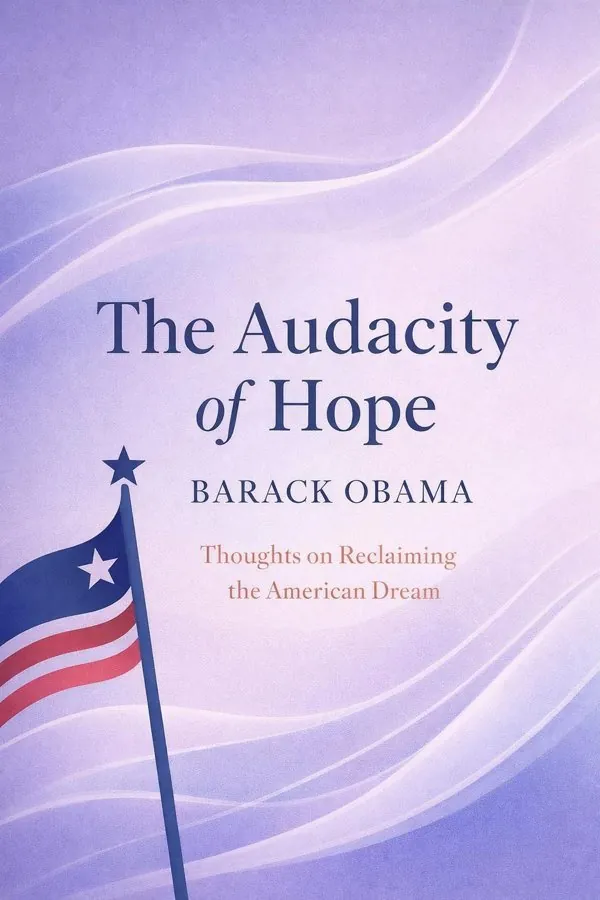
The Audacity of Hope: Summary & Key Insights
by Barack Obama
 10 min9 chaptersAudio available
Key Takeaways from The Audacity of Hope
A democracy can survive disagreement, but it struggles when disagreement hardens into contempt.
Every political argument hides a moral argument underneath.
A constitutional system is designed not only to empower government, but to limit it.
Many people enter politics wanting transformation and leave disillusioned by procedure.
A society that praises hard work but ignores unequal starting points confuses myth with justice.
What Is The Audacity of Hope About?
The Audacity of Hope by Barack Obama is a memoir book published in 2006 spanning 9 pages. The Audacity of Hope is Barack Obama’s meditation on American politics, public morality, and the fragile promise of democracy. Written before his presidency, the book blends memoir, political reflection, and civic argument to explore what had gone wrong in the nation’s public life—and what might still be repaired. Obama examines the forces pulling Americans apart: partisanship, economic inequality, racial tension, cultural mistrust, and a growing cynicism about government. Yet he refuses to settle for despair. Instead, he argues that democracy works only when citizens believe their common life is worth renewing. What makes the book matter is its combination of idealism and practicality. Obama does not present politics as a realm of pure principle or easy answers. He writes as a senator who has seen compromise, ambition, lobbying, and polarization up close, but who still believes public service can be honorable. His authority comes from that rare position: part insider, part critic, and part bridge-builder. Drawing on his upbringing, legal training, community organizing, faith journey, and Senate experience, Obama offers a thoughtful and accessible vision of citizenship rooted in empathy, responsibility, and hope.
This FizzRead summary covers all 9 key chapters of The Audacity of Hope in approximately 10 minutes, distilling the most important ideas, arguments, and takeaways from Barack Obama's work. Also available as an audio summary and Key Quotes Podcast.
The Audacity of Hope
The Audacity of Hope is Barack Obama’s meditation on American politics, public morality, and the fragile promise of democracy. Written before his presidency, the book blends memoir, political reflection, and civic argument to explore what had gone wrong in the nation’s public life—and what might still be repaired. Obama examines the forces pulling Americans apart: partisanship, economic inequality, racial tension, cultural mistrust, and a growing cynicism about government. Yet he refuses to settle for despair. Instead, he argues that democracy works only when citizens believe their common life is worth renewing.
What makes the book matter is its combination of idealism and practicality. Obama does not present politics as a realm of pure principle or easy answers. He writes as a senator who has seen compromise, ambition, lobbying, and polarization up close, but who still believes public service can be honorable. His authority comes from that rare position: part insider, part critic, and part bridge-builder. Drawing on his upbringing, legal training, community organizing, faith journey, and Senate experience, Obama offers a thoughtful and accessible vision of citizenship rooted in empathy, responsibility, and hope.
Who Should Read The Audacity of Hope?
This book is perfect for anyone interested in memoir and looking to gain actionable insights in a short read. Whether you're a student, professional, or lifelong learner, the key ideas from The Audacity of Hope by Barack Obama will help you think differently.
- ✓Readers who enjoy memoir and want practical takeaways
- ✓Professionals looking to apply new ideas to their work and life
- ✓Anyone who wants the core insights of The Audacity of Hope in just 10 minutes
Want the full summary?
Get instant access to this book summary and 100K+ more with Fizz Moment.
Get Free SummaryAvailable on App Store • Free to download
Key Chapters
A democracy can survive disagreement, but it struggles when disagreement hardens into contempt. In The Audacity of Hope, Obama argues that the deepest crisis in American politics is not simply that Republicans and Democrats hold different views. It is that the opposing sides have come to see one another as morally suspect, intellectually dishonest, and fundamentally un-American. Once that happens, compromise starts to look like betrayal, and every issue becomes a test of loyalty rather than a problem to solve.
Obama’s reflections on entering the Senate show how institutional polarization becomes personal. Legislators often arrive with sincere convictions, yet they operate inside a culture shaped by party discipline, media narratives, donor pressure, and constant campaigning. The result is a politics that rewards outrage more than deliberation. Opponents stop being fellow citizens with alternative ideas and become enemies to defeat.
The book does not deny real ideological differences. Instead, it asks whether democratic life requires a deeper commitment than winning. Obama suggests that mature politics depends on recognizing that most citizens are guided by some mixture of principle, interest, fear, and hope. That recognition creates space for negotiation without surrendering values.
In ordinary life, this insight applies far beyond Washington. Families, workplaces, and communities often fall into the same trap: assuming bad faith before listening carefully. Productive conversation starts when people describe problems honestly, acknowledge complexity, and avoid reducing others to caricatures.
The practical lesson is simple but demanding: argue with conviction, but refuse to dehumanize. Before dismissing a political opponent, ask what concern or value may be driving their view. The actionable takeaway is to practice one act of democratic discipline this week: have a conversation about a divisive issue in which your goal is not to win, but to understand and clarify.
Every political argument hides a moral argument underneath. Obama insists that debates about taxes, schools, healthcare, and war are never merely technical. They are also about what kind of people we believe ourselves to be, what responsibilities we owe one another, and how we define fairness. Policy matters, but policy grows out of values.
In this chapter, Obama reflects on the sources of his own moral outlook: his mother’s empathy, his grandparents’ decency, the civil rights tradition, and his exposure to people living very different lives. These influences taught him that good politics cannot rest on abstract ideology alone. It must begin with human dignity. At the same time, he resists the idea that values belong to one party or one region. Conservatives may emphasize family, order, and self-reliance; liberals may stress equality, inclusion, and shared obligation. In a healthy democracy, these values should be in conversation, not at war.
Obama also challenges progressives to speak more openly about morality. When political leaders discuss only programs and statistics, they often lose people who are asking deeper questions about meaning, responsibility, and character. Facts persuade best when linked to a moral framework people can recognize.
This has practical relevance in daily decision-making. Whether leading a team, raising children, or participating in civic life, people are more credible when they can explain not just what they want, but why it matters. Values create coherence between words and actions.
The takeaway is to identify the core values behind your strongest opinions. The next time you advocate for a cause, name the principle at stake—fairness, security, compassion, freedom, accountability—and connect your argument to lived experience. Clear moral language invites deeper trust and better dialogue.
A constitutional system is designed not only to empower government, but to limit it. Obama treats the U.S. Constitution with respect, yet he resists worshipping it as a static relic. Its genius, he argues, lies in balancing enduring principles with democratic adaptation. Liberty survives because power is divided, rights are protected, and no leader stands above the law. But the Constitution also leaves room for each generation to interpret justice more fully.
Obama, trained as a constitutional lawyer, presents the document as both safeguard and challenge. It restrains impulsive government action, protects minority rights, and creates procedures that force competing interests into dialogue. At the same time, it reflects historical limitations. The original constitutional order coexisted with slavery, exclusion, and unequal citizenship. Progress came not from abandoning the Constitution, but from struggling within its framework to expand its promise.
This point matters because constitutional debates are often framed too narrowly. One side invokes original meaning to prevent overreach; the other calls for living interpretation to meet contemporary realities. Obama’s approach suggests that both instincts matter. Fidelity requires humility before the text and seriousness about its democratic purpose.
In practical terms, this means citizens should care about institutions, not just outcomes. Courts, elections, legislatures, and checks and balances may seem frustratingly slow, but they prevent politics from becoming pure force. In workplaces and communities, the parallel is clear: fair rules and transparent processes are part of justice, even when they slow decisions down.
The actionable takeaway is to engage one issue through an institutional lens. Instead of asking only, “What result do I want?” ask, “What process protects fairness, accountability, and legitimacy?” Democracies endure when citizens value both just ends and constitutional means.
Many people enter politics wanting transformation and leave disillusioned by procedure. Obama confronts that tension directly. He argues that politics is an imperfect craft, shaped by compromise, competing interests, public pressure, and the stubborn constraints of reality. If you expect purity, you will call every deal corruption. If you expect nothing, you will accept cynicism as wisdom. The challenge is to work in the middle ground without losing your ethical center.
Obama describes how legislation is actually made: through committee negotiations, strategic concessions, coalition building, and trade-offs. That process can appear messy, but messiness is often the price of democratic inclusion. In a pluralistic society, people do not start from the same assumptions. Progress often happens incrementally because agreement itself is hard-won.
Yet Obama does not romanticize the system. He acknowledges the role of money, ambition, media theater, and partisan gamesmanship. His insight is that compromise becomes unhealthy only when leaders stop distinguishing between essential principles and negotiable details. A person who cannot compromise will achieve little; a person who compromises on everything stands for nothing.
This lesson applies to any collaborative setting. In teams, marriages, and community projects, success often requires knowing when to insist, when to adapt, and when to delay. Effective leadership is not rigid consistency; it is disciplined judgment.
Obama’s broader point is that democratic change demands stamina. Citizens should not confuse slow progress with failure, nor should they let procedural frustrations become excuses for withdrawal. The actionable takeaway is to define your non-negotiables. On one issue that matters to you, write down which principles are essential and which tactics are flexible. That clarity helps you negotiate without becoming cynical or unmoored.
A society that praises hard work but ignores unequal starting points confuses myth with justice. Obama’s discussion of opportunity challenges the comforting idea that success is simply the reward for discipline and talent. Individual responsibility matters deeply, he argues, but it operates within structures—schools, wages, neighborhoods, healthcare systems, labor markets, and family stability—that either widen or narrow real possibility.
Obama’s central claim is not that government should guarantee equal outcomes. Rather, government should help create fair conditions in which effort has a meaningful chance to pay off. That includes quality education, access to healthcare, economic mobility, dignified work, and a safety net that protects people from catastrophe without undermining initiative. He places opportunity at the heart of the American story, but insists that rhetoric about opportunity becomes hollow if millions are blocked by circumstances they did not choose.
The strength of this argument is its refusal of false choices. Obama does not romanticize bureaucracy, nor does he idolize markets. He sees the economy as a tool that should serve broad human flourishing. Public investment, private innovation, family stability, and civic responsibility all matter. A functioning society asks individuals to strive, but it also refuses to abandon those trapped by structural disadvantage.
In practical life, this invites a more serious understanding of merit. Whether hiring, mentoring, teaching, or leading, people should ask not only who performs best now, but who has had the support necessary to develop. Fairness includes access, not just evaluation.
The actionable takeaway is to examine one institution you influence—your workplace, school, community group, or family—and identify one barrier that limits opportunity for others. Then act to reduce it, whether through mentoring, sharing resources, or advocating for better systems.
People do not leave their deepest convictions at the door when they enter public life. Obama’s chapter on faith explores how religious belief can shape moral seriousness, humility, and service without becoming a weapon in politics. He rejects two extremes: the view that faith should dominate public policy, and the view that religious language has no legitimate place in democratic debate. For him, faith can nourish civic life when it inspires compassion and accountability rather than superiority.
Obama writes candidly about his own Christian journey, including the search for belonging and meaning that led him to church life in Chicago. That experience gave him a language for suffering, solidarity, forgiveness, and hope. At the same time, he is careful to defend pluralism. In a nation composed of many faiths and also of nonbelievers, public arguments must be translated into reasons others can engage, regardless of creed.
This is one of the book’s most valuable contributions. It suggests that secular and religious citizens need not fear one another if both accept democratic humility. Believers should not assume divine certainty about public policy; secular citizens should not dismiss religious motivations as irrational by definition. Shared life becomes possible when each side recognizes the other’s moral seriousness.
The practical application is broad. In organizations and communities, people often hold strong convictions rooted in culture, faith, or philosophy. Respectful collaboration requires translating those convictions into common language while preserving authenticity.
The actionable takeaway is to practice principled translation. When a belief matters deeply to you, ask how to express its public meaning in terms others can understand. That habit protects both conscience and coexistence, allowing faith to inform responsibility without undermining democratic equality.
Nations often prefer sentimental stories about race because honest stories require accountability. Obama approaches race in America with unusual balance: he refuses to deny the enduring power of historical injustice, but he also rejects the idea that racial division makes common citizenship impossible. His argument is that progress begins with truth-telling—not guilt performances or slogans, but a mature willingness to face how history still shapes opportunity, trust, and identity.
Drawing on his own mixed heritage and public experience, Obama explores the different narratives Americans bring to race. Black Americans may carry inherited memories of exclusion, humiliation, and resilience. White Americans may feel accused, misunderstood, or defensive, especially when they did not directly cause the injustices being discussed. Immigrants and other minority groups may enter the conversation with yet another set of hopes and tensions. These conflicting perspectives can produce silence, resentment, or simplistic blame.
Obama’s contribution is to insist that empathy and responsibility must operate together. Structural inequities in housing, education, criminal justice, and employment cannot be solved through individual goodwill alone. But neither can they be addressed if citizens retreat into racial camps and assume permanent bad faith. Honest democratic life requires acknowledging pain while still building shared purpose.
In everyday settings, this means creating room for complexity. Conversations about race become more productive when people distinguish between personal intent and systemic effect, between listening and defensiveness, and between accountability and shame.
The actionable takeaway is to replace avoidance with informed engagement. Read one serious account of racial inequality in an area that affects your community, then discuss it with curiosity rather than certainty. Progress begins when people are willing to learn, speak honestly, and remain at the table even when the conversation is uncomfortable.
A powerful nation can still be dangerously shortsighted. In discussing the world beyond America’s borders, Obama argues that foreign policy should combine realism, principle, and humility. Military power matters, but force alone cannot secure legitimacy, prevent extremism, or build stable alliances. A country’s influence depends not only on what it can compel, but on what it can persuade, model, and sustain.
Obama wrote at a time when debates over war, terrorism, and American leadership were intense. His position resists both naïve idealism and blunt unilateralism. He accepts that states must protect themselves and that threats are real. But he also insists that durable security comes from diplomacy, international cooperation, economic development, and respect for global norms. When a nation ignores how others perceive its actions, it weakens its own strategic position.
The deeper idea is that patriotism should not require arrogance. Love of country can coexist with self-criticism. In fact, self-criticism may be essential to responsible leadership. A nation that believes it is incapable of error becomes more dangerous to itself and others.
This has practical analogies in leadership generally. Whether running a company, school, or household, power works best when paired with listening. Decisions imposed without understanding often create resistance, even when intentions are good. Influence grows when others trust your judgment and motives.
The actionable takeaway is to apply strategic humility. Before making a major decision that affects others, ask three questions: What are my interests? How will others experience this choice? What long-term relationships will it strengthen or weaken? Strength is most effective when informed by perspective, restraint, and a willingness to learn.
Success in public life can become emptiness if it costs intimacy, presence, and love. Obama’s chapter on family reveals one of the book’s quietest but most important truths: political purpose must remain connected to personal responsibility. Ambition can be noble, but it becomes distorted when work, status, or mission consistently outrun the needs of the people closest to us.
Obama reflects on the strain politics places on marriage and parenthood—the travel, scrutiny, exhaustion, and emotional absence that public service can demand. These reflections humanize his larger argument by grounding it in ordinary moral conflict. The same person who speaks about justice and community may still fail to be fully present at home. Ideals are tested not only on the Senate floor, but at the dinner table.
What makes this insight powerful is that it broadens the meaning of citizenship. A healthy society depends not just on laws and institutions, but on relationships of care. Families, however they are formed, are where people learn patience, sacrifice, accountability, and love. Public leaders who ignore private responsibility risk speaking credibly about the nation while neglecting the first community they belong to.
This lesson extends to anyone balancing mission and attachment. Teachers, entrepreneurs, activists, executives, and caregivers all face the temptation to justify neglect in the name of larger goals. But no lasting contribution is made stronger by chronic emotional absence.
The actionable takeaway is to align your calendar with your professed priorities. Choose one recurring habit that protects your closest relationships—a dedicated meal, a no-phone evening, a weekly check-in, or time reserved for caregiving. Hope becomes credible when the values we champion publicly are practiced privately.
All Chapters in The Audacity of Hope
About the Author
Barack Obama is an American politician, lawyer, and author best known as the 44th President of the United States, serving from 2009 to 2017. Born in Honolulu, Hawaii, he graduated from Columbia University and Harvard Law School, where he became the first Black president of the Harvard Law Review. Before entering national politics, Obama worked as a community organizer in Chicago, practiced civil rights law, and taught constitutional law. He served in the Illinois State Senate and later as a U.S. senator from Illinois. Obama is also a celebrated writer whose books include Dreams from My Father, The Audacity of Hope, and A Promised Land. His work often explores identity, democracy, leadership, and the moral responsibilities of public life.
Get This Summary in Your Preferred Format
Read or listen to the The Audacity of Hope summary by Barack Obama anytime, anywhere. FizzRead offers multiple formats so you can learn on your terms — all free.
Available formats: App · Audio · PDF · EPUB — All included free with FizzRead
Download The Audacity of Hope PDF and EPUB Summary
Key Quotes from The Audacity of Hope
“A democracy can survive disagreement, but it struggles when disagreement hardens into contempt.”
“Every political argument hides a moral argument underneath.”
“A constitutional system is designed not only to empower government, but to limit it.”
“Many people enter politics wanting transformation and leave disillusioned by procedure.”
“A society that praises hard work but ignores unequal starting points confuses myth with justice.”
Frequently Asked Questions about The Audacity of Hope
The Audacity of Hope by Barack Obama is a memoir book that explores key ideas across 9 chapters. The Audacity of Hope is Barack Obama’s meditation on American politics, public morality, and the fragile promise of democracy. Written before his presidency, the book blends memoir, political reflection, and civic argument to explore what had gone wrong in the nation’s public life—and what might still be repaired. Obama examines the forces pulling Americans apart: partisanship, economic inequality, racial tension, cultural mistrust, and a growing cynicism about government. Yet he refuses to settle for despair. Instead, he argues that democracy works only when citizens believe their common life is worth renewing. What makes the book matter is its combination of idealism and practicality. Obama does not present politics as a realm of pure principle or easy answers. He writes as a senator who has seen compromise, ambition, lobbying, and polarization up close, but who still believes public service can be honorable. His authority comes from that rare position: part insider, part critic, and part bridge-builder. Drawing on his upbringing, legal training, community organizing, faith journey, and Senate experience, Obama offers a thoughtful and accessible vision of citizenship rooted in empathy, responsibility, and hope.
More by Barack Obama


You Might Also Like




Featured In
Browse by Category
Ready to read The Audacity of Hope?
Get the full summary and 100K+ more books with Fizz Moment.