
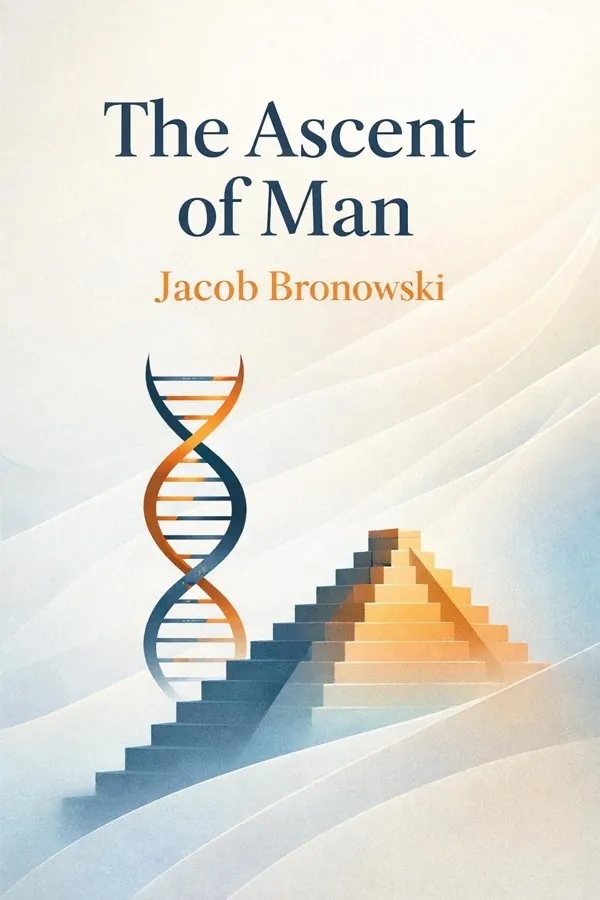
The Ascent of Man: Summary & Key Insights
 10 min9 chaptersAudio available
Key Takeaways from The Ascent of Man
To understand human greatness, Bronowski insists, we must begin with human fragility.
Civilization, Bronowski shows, began not with conquest but with observation.
A civilization can be read in the materials it learns to master.
The most powerful discoveries often begin with a suspicion that what we see is only the surface.
Human beings began to think scientifically when they discovered that the universe could be described with number.
What Is The Ascent of Man About?
The Ascent of Man by Jacob Bronowski is a popular_sci book spanning 7 pages. The Ascent of Man is Jacob Bronowski’s sweeping account of how human beings rose from vulnerable primates to makers of science, art, language, and civilization. Drawn from his celebrated BBC series, the book is not simply a history of discoveries. It is a meditation on the human mind itself: our ability to imagine what does not yet exist, test ideas against reality, and reshape the world through knowledge. Bronowski argues that science is not cold or mechanical. It is one of humanity’s most creative and humane achievements, deeply connected to poetry, craftsmanship, moral responsibility, and freedom. What makes the book endure is its refusal to separate scientific progress from human values. Bronowski moves from early toolmaking and agriculture to mathematics, astronomy, evolution, and modern physics, showing that every advance begins in curiosity and carries ethical consequences. His authority comes from unusual breadth: trained in mathematics, engaged with biology and history, and gifted as a public intellectual, he wrote with both precision and warmth. The result is a classic of popular science that helps readers see civilization not as a chain of accidents, but as the story of human imagination learning how to know.
This FizzRead summary covers all 9 key chapters of The Ascent of Man in approximately 10 minutes, distilling the most important ideas, arguments, and takeaways from Jacob Bronowski's work. Also available as an audio summary and Key Quotes Podcast.
The Ascent of Man
The Ascent of Man is Jacob Bronowski’s sweeping account of how human beings rose from vulnerable primates to makers of science, art, language, and civilization. Drawn from his celebrated BBC series, the book is not simply a history of discoveries. It is a meditation on the human mind itself: our ability to imagine what does not yet exist, test ideas against reality, and reshape the world through knowledge. Bronowski argues that science is not cold or mechanical. It is one of humanity’s most creative and humane achievements, deeply connected to poetry, craftsmanship, moral responsibility, and freedom.
What makes the book endure is its refusal to separate scientific progress from human values. Bronowski moves from early toolmaking and agriculture to mathematics, astronomy, evolution, and modern physics, showing that every advance begins in curiosity and carries ethical consequences. His authority comes from unusual breadth: trained in mathematics, engaged with biology and history, and gifted as a public intellectual, he wrote with both precision and warmth. The result is a classic of popular science that helps readers see civilization not as a chain of accidents, but as the story of human imagination learning how to know.
Who Should Read The Ascent of Man?
This book is perfect for anyone interested in popular_sci and looking to gain actionable insights in a short read. Whether you're a student, professional, or lifelong learner, the key ideas from The Ascent of Man by Jacob Bronowski will help you think differently.
- ✓Readers who enjoy popular_sci and want practical takeaways
- ✓Professionals looking to apply new ideas to their work and life
- ✓Anyone who wants the core insights of The Ascent of Man in just 10 minutes
Want the full summary?
Get instant access to this book summary and 100K+ more with Fizz Moment.
Get Free SummaryAvailable on App Store • Free to download
Key Chapters
To understand human greatness, Bronowski insists, we must begin with human fragility. We are not separate from nature, and our achievements become more impressive, not less, when we remember that they arose from ordinary animal beginnings. Humanity did not descend ready-made into wisdom. We emerged through evolution, through adaptation, and through a long struggle in uncertain environments. What distinguishes us is not physical strength or instinctive perfection, but flexibility of mind.
Bronowski treats early humanity as a turning point in nature: a species able to imagine alternatives. Our ancestors learned not just to react but to anticipate. The hand and the brain evolved together. A shaped stone is more than a tool; it is evidence that someone pictured a form before it existed. This capacity for mental rehearsal is the seed of science, technology, and art alike.
That insight changes how we think about progress. Human advancement is not proof that we escaped nature. It is proof that nature produced a creature capable of self-reflection and invention. In modern life, this matters because many people still imagine intelligence as a fixed trait or civilization as the possession of a few superior groups. Bronowski rejects that completely. The power to create, compare, and learn belongs to the species as a whole.
A practical example is education. If human success comes from adaptability rather than rigid programming, then schools, workplaces, and societies should reward curiosity, experimentation, and revision instead of rote conformity. We thrive when we are allowed to explore possibilities.
Actionable takeaway: Treat human potential as something developed through imagination and practice, not something predetermined by status, origin, or talent alone.
Civilization, Bronowski shows, began not with conquest but with observation. The agricultural revolution was a triumph of patience: watching seasons, soils, rainfall, seeds, and animal behavior closely enough to build a stable life around recurring patterns. Farming did not merely provide food. It changed the human relationship to time, risk, memory, and cooperation.
Once people settled, they began to plan for futures beyond the next hunt. They stored grain, developed calendars, divided labor, and built institutions. Villages became cities because agriculture made surplus possible, and surplus made specialization possible. Priests, potters, builders, scribes, and rulers all emerged from the simple but profound insight that nature contains rhythms that can be understood and worked with.
Bronowski’s deeper point is that knowledge often grows from practical attention rather than abstract theory. A farmer noticing when floods arrive is already doing early science. The line between survival skill and scientific reasoning is not as sharp as modern people often assume. This is useful today because we sometimes dismiss firsthand knowledge in favor of formal expertise alone. Yet innovation still depends on close contact with reality: gardeners understand climate shifts, mechanics hear patterns in machines, nurses detect changes before charts do.
Agriculture also teaches a moral lesson. Settled life required trust, shared systems, and long-term thinking. Societies that live only for immediate gain eventually exhaust their future. In business, health, and environmental policy, the agricultural mindset remains essential: observe carefully, invest patiently, and think in seasons rather than impulses.
Actionable takeaway: Build your plans around real patterns, not wishful thinking—watch what repeats, learn from cycles, and make decisions with the long term in mind.
A civilization can be read in the materials it learns to master. In Bronowski’s telling, the story of stone, metal, and craft is not merely technological; it is intellectual. When humans learned to split flint, polish axes, smelt copper, and alloy bronze, they were doing more than improving tools. They were discovering that matter has structure and that hidden properties reveal themselves to careful hands.
The phrase “the grain in the stone” captures a central scientific truth: nature is not chaos. Materials behave according to patterns, and human skill grows by attending to those patterns instead of imposing brute force. A stone breaks differently depending on how it is struck. Metal changes when heated, cooled, or mixed. Craftsmanship becomes a dialogue with reality.
Bronowski uses these developments to show that science and art were never separate domains. The ancient smith and sculptor were experimenters. They relied on touch, timing, proportion, and accumulated knowledge. In modern terms, this is prototyping and iteration. A ceramicist adjusting kiln temperatures, an engineer refining a composite material, or a chef learning how ingredients transform under heat all participate in the same logic: knowledge is embodied in repeated, attentive practice.
This idea matters because contemporary culture often overvalues abstract intelligence while undervaluing skilled making. Yet many breakthroughs come from people who know materials intimately. Designers who understand physical constraints create better products. Surgeons refine technique through tactile precision. Builders learn what plans on paper can miss.
Bronowski reminds us that the hand is not a servant of the mind; it is one of its partners. To make is to think in action. Human culture advanced because we learned to trust disciplined craft as a path to understanding.
Actionable takeaway: Learn something hands-on—build, repair, cook, draw, or craft—because working directly with materials sharpens perception and deepens real understanding.
Human beings began to think scientifically when they discovered that the universe could be described with number. Bronowski uses astronomy and mathematics to show how one of civilization’s greatest leaps came from recognizing order in the heavens. The motions of stars and planets were once wrapped in myth, but observers gradually found repeatable patterns, and those patterns could be expressed mathematically.
This was revolutionary because mathematics offered something unique: a language for relationships that remained true regardless of local custom or political power. A geometric proof in Greece, a calculation in Baghdad, and an astronomical table in India all participated in a universal form of thought. Bronowski treats this as one of humanity’s deepest achievements—a shared rational structure that links cultures across time.
The “music” in the title is important. Number is not just utility; it has beauty. The same mind that delights in harmony in music can delight in elegant equations. Bronowski repeatedly rejects the false division between quantitative understanding and aesthetic experience. Precision can be beautiful, and beauty can guide inquiry. Scientists often pursue theories because they feel coherent or graceful before they are fully confirmed.
For modern readers, the lesson is broad. Numerical literacy is not a narrow technical skill but a way of seeing. Statistics can reveal trends hidden in anecdote. Budgeting can turn vague anxiety into clear choices. Data analysis can expose whether an intervention is working. At the same time, Bronowski warns against worshipping numbers without judgment. Mathematics is a tool of insight, not a substitute for wisdom.
To think mathematically is to ask: what is the pattern, what is the relation, what can be measured, and what remains uncertain? That habit strengthens decisions in science, policy, and everyday life.
Actionable takeaway: Use numbers to clarify reality, but always pair calculation with interpretation, context, and human judgment.
One of Bronowski’s most urgent arguments is that knowledge is not certainty. Science does not progress by claiming final truth; it progresses by forming the best explanations available and then exposing them to criticism, testing, and revision. This is not a weakness of science but its moral and intellectual strength.
Bronowski wrote in the shadow of the twentieth century, when ideological certainty had justified immense cruelty. He contrasts the openness of scientific inquiry with the rigidity of dogma. A scientist must be prepared to say, “I may be wrong.” That admission creates room for evidence, dialogue, and correction. In contrast, systems that claim unquestionable truth often become oppressive because they no longer tolerate doubt or dissent.
This idea has immediate relevance today. In public debate, people often confuse confidence with accuracy. They seek simple certainties about health, politics, identity, or technology. Bronowski asks us to resist that temptation. A mature mind can act decisively while still acknowledging uncertainty. Doctors work with probabilities. Investors manage risk, not guarantees. Teachers revise methods when students do not learn. Good judgment depends on calibrated confidence, not absolute assurance.
The practical application is especially important in the age of misinformation. Skepticism should not mean cynicism or paralysis. It means weighing evidence, comparing sources, and remaining open to revision. Scientific thinking is not believing nothing. It is believing responsibly.
Bronowski’s message is also personal. Relationships, careers, and self-understanding improve when we loosen our grip on the need to be unquestionably right. Curiosity fosters growth; certainty often freezes it.
Actionable takeaway: Replace the question “How can I prove I’m right?” with “What evidence would change my mind?” and let that guide your decisions.
Humans, Bronowski observes, are unusual because we mature slowly. Our long childhood is not an inconvenience to be overcome; it is one of the foundations of our success. Because we spend so much time dependent on others, we gain extended periods for learning, imitation, play, experimentation, and social bonding. Evolution gave us less finished instinct and more open possibility.
Bronowski extends this biological fact into a cultural insight. Human civilization itself has a kind of long childhood. Each generation inherits language, techniques, stories, and institutions, but must also reinterpret them. We are never complete. We remain learners, individually and collectively. That is why education is not merely preparation for life; it is one of the central processes by which life continues.
This view challenges modern impatience. We often want quick mastery, immediate expertise, and instant productivity. But many of the most important human capacities—judgment, creativity, emotional intelligence, scientific reasoning—develop slowly. They require environments where mistakes are tolerated and exploration is encouraged. Children learn through trial, adults also do, and innovative cultures preserve room for both.
The idea has direct practical force in parenting, management, and self-development. A child who asks endless questions is not being inefficient; curiosity is how intelligence grows. A new employee needs structured support before autonomy. A person changing careers should expect a period of awkwardness. Progress is often the byproduct of prolonged apprenticeship.
Bronowski also suggests a moral lesson: our dependence on one another is not a defect but part of our humanity. Because we learn socially, knowledge carries obligations of care, teaching, and stewardship.
Actionable takeaway: Give growth the time it requires—create conditions for sustained learning, and do not mistake early uncertainty for lack of potential.
The modern age gave humanity unprecedented power, but Bronowski insists that power alone is not progress. Scientific knowledge can illuminate the world, heal disease, and reduce suffering; it can also be turned toward destruction when severed from humility and moral concern. One of the book’s most memorable themes is that the crisis of modern civilization is not scientific knowledge itself, but the use of knowledge without humanity.
Bronowski, writing after war and genocide, knew that technical sophistication does not guarantee wisdom. Bureaucracies can become efficient at cruelty. Engineers can build machines for murder. Political regimes can exploit the authority of science while betraying its spirit of openness and doubt. This is why he distinguishes science as a method of honest inquiry from scientism as a mask for power.
The lesson remains urgent in an era of artificial intelligence, biotechnology, surveillance, and ecological strain. The question is not only what we can do, but what we should do, under what safeguards, and with what respect for human dignity. Data can optimize systems while invading privacy. Genetic tools can cure disease while tempting coercive control. Efficiency can become an idol if no one asks who bears the cost.
For organizations and citizens, Bronowski’s warning translates into ethical design. Build accountability into innovation. Invite critique early. Consider unintended consequences. Protect dissent. Reward responsibility, not just speed. Human progress requires institutions that pair expertise with conscience.
Scientific literacy, then, is not just understanding facts. It includes understanding limits, uncertainty, and the moral weight of application.
Actionable takeaway: Whenever you evaluate a new technology or system, ask not only “Does it work?” but also “Whom does it help, whom might it harm, and who gets to decide?”
All Chapters in The Ascent of Man
About the Author
Jacob Bronowski (1908–1974) was a British mathematician, biologist, historian of science, and one of the twentieth century’s great interpreters of knowledge for general readers. Born in Poland and raised in Britain, he was educated at Cambridge and built a career that crossed disciplinary boundaries with unusual ease. Bronowski worked in mathematics and wartime operational research, but he became best known for his writing and broadcasting on science, culture, and human values. He believed that science was not a narrow technical pursuit but a creative, ethical, and deeply human endeavor. That vision reached its fullest expression in The Ascent of Man, adapted from his acclaimed 1973 BBC series. His work continues to resonate for its clarity, breadth, and passionate defense of curiosity, imagination, and intellectual humility.
Get This Summary in Your Preferred Format
Read or listen to the The Ascent of Man summary by Jacob Bronowski anytime, anywhere. FizzRead offers multiple formats so you can learn on your terms — all free.
Available formats: App · Audio · PDF · EPUB — All included free with FizzRead
Download The Ascent of Man PDF and EPUB Summary
Key Quotes from The Ascent of Man
“To understand human greatness, Bronowski insists, we must begin with human fragility.”
“Civilization, Bronowski shows, began not with conquest but with observation.”
“A civilization can be read in the materials it learns to master.”
“The most powerful discoveries often begin with a suspicion that what we see is only the surface.”
“Human beings began to think scientifically when they discovered that the universe could be described with number.”
Frequently Asked Questions about The Ascent of Man
The Ascent of Man by Jacob Bronowski is a popular_sci book that explores key ideas across 9 chapters. The Ascent of Man is Jacob Bronowski’s sweeping account of how human beings rose from vulnerable primates to makers of science, art, language, and civilization. Drawn from his celebrated BBC series, the book is not simply a history of discoveries. It is a meditation on the human mind itself: our ability to imagine what does not yet exist, test ideas against reality, and reshape the world through knowledge. Bronowski argues that science is not cold or mechanical. It is one of humanity’s most creative and humane achievements, deeply connected to poetry, craftsmanship, moral responsibility, and freedom. What makes the book endure is its refusal to separate scientific progress from human values. Bronowski moves from early toolmaking and agriculture to mathematics, astronomy, evolution, and modern physics, showing that every advance begins in curiosity and carries ethical consequences. His authority comes from unusual breadth: trained in mathematics, engaged with biology and history, and gifted as a public intellectual, he wrote with both precision and warmth. The result is a classic of popular science that helps readers see civilization not as a chain of accidents, but as the story of human imagination learning how to know.
You Might Also Like

Structures: Or Why Things Don"t Fall Down
J.E. Gordon
10 min
The Road to Wigan Pier
George Orwell
10 min
Bonk: The Curious Coupling of Science and Sex
Mary Roach
10 min
First Bite: How We Learn to Eat
Bee Wilson
10 min
In Pursuit Of The Unknown: 17 Equations That Changed The World
Ian Stewart
10 min
Napoleon's Buttons: 17 Molecules That Changed History
Penny Le Couteur and Jay Burreson
10 minBrowse by Category
Ready to read The Ascent of Man?
Get the full summary and 100K+ more books with Fizz Moment.