
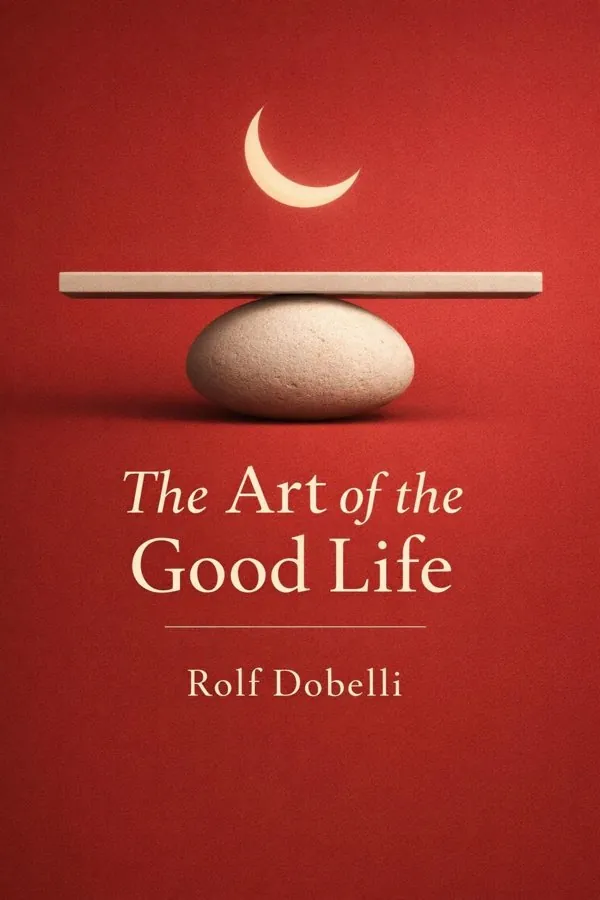
The Art of the Good Life: Clear Thinking for Business and a Better Life: Summary & Key Insights
by Rolf Dobelli
 10 min9 chaptersAudio available
Key Takeaways from The Art of the Good Life: Clear Thinking for Business and a Better Life
A good life is shaped less by what you add and more by what you refuse to let in.
Success often comes not from being exceptionally smart, but from consistently avoiding avoidable mistakes.
Few forces influence your future more than the people you spend time with.
Much of disappointment is not caused by reality itself, but by the gap between reality and what we expected.
Freedom is often misunderstood as the ability to do whatever you want.
What Is The Art of the Good Life: Clear Thinking for Business and a Better Life About?
The Art of the Good Life: Clear Thinking for Business and a Better Life by Rolf Dobelli is a mindset book. What does it really mean to live well? In The Art of the Good Life, Rolf Dobelli argues that a better life is not built through grand theories, constant self-optimization, or endless busyness. Instead, it comes from clearer thinking, better decisions, emotional discipline, and the ability to ignore what does not matter. Drawing on philosophy, psychology, behavioral economics, and practical experience, Dobelli offers a series of short mental models designed to help readers avoid common mistakes and focus on what truly improves life. This book matters because modern life overwhelms us with options, opinions, distractions, and pressure. We are told to chase success, consume more information, and compare ourselves constantly. Dobelli challenges that pattern. He shows that wisdom often lies not in doing more, but in removing noise, reducing error, and choosing deliberately. Dobelli is well known for translating complex ideas about human behavior and decision-making into accessible, useful insights. As the author of The Art of Thinking Clearly, he brings credibility, intellectual range, and a practical style to this book. The result is a thoughtful guide for anyone who wants more clarity, calm, and control in business and everyday life.
This FizzRead summary covers all 9 key chapters of The Art of the Good Life: Clear Thinking for Business and a Better Life in approximately 10 minutes, distilling the most important ideas, arguments, and takeaways from Rolf Dobelli's work. Also available as an audio summary and Key Quotes Podcast.
The Art of the Good Life: Clear Thinking for Business and a Better Life
What does it really mean to live well? In The Art of the Good Life, Rolf Dobelli argues that a better life is not built through grand theories, constant self-optimization, or endless busyness. Instead, it comes from clearer thinking, better decisions, emotional discipline, and the ability to ignore what does not matter. Drawing on philosophy, psychology, behavioral economics, and practical experience, Dobelli offers a series of short mental models designed to help readers avoid common mistakes and focus on what truly improves life.
This book matters because modern life overwhelms us with options, opinions, distractions, and pressure. We are told to chase success, consume more information, and compare ourselves constantly. Dobelli challenges that pattern. He shows that wisdom often lies not in doing more, but in removing noise, reducing error, and choosing deliberately.
Dobelli is well known for translating complex ideas about human behavior and decision-making into accessible, useful insights. As the author of The Art of Thinking Clearly, he brings credibility, intellectual range, and a practical style to this book. The result is a thoughtful guide for anyone who wants more clarity, calm, and control in business and everyday life.
Who Should Read The Art of the Good Life: Clear Thinking for Business and a Better Life?
This book is perfect for anyone interested in mindset and looking to gain actionable insights in a short read. Whether you're a student, professional, or lifelong learner, the key ideas from The Art of the Good Life: Clear Thinking for Business and a Better Life by Rolf Dobelli will help you think differently.
- ✓Readers who enjoy mindset and want practical takeaways
- ✓Professionals looking to apply new ideas to their work and life
- ✓Anyone who wants the core insights of The Art of the Good Life: Clear Thinking for Business and a Better Life in just 10 minutes
Want the full summary?
Get instant access to this book summary and 100K+ more with Fizz Moment.
Get Free SummaryAvailable on App Store • Free to download
Key Chapters
A good life is shaped less by what you add and more by what you refuse to let in. One of Dobelli’s central ideas is that modern people suffer not mainly from lack, but from overload. We absorb too much news, too many opinions, too many requests, and too many artificial desires. Without strong mental filters, life becomes reactive instead of intentional.
Dobelli argues that clear thinking starts with selection. You do not need to engage with every controversy, answer every message instantly, or stay informed about every global event. Much of what competes for your attention has little impact on your real responsibilities, relationships, or happiness. Yet it consumes emotional energy all the same. The result is a mind cluttered with urgency but disconnected from what matters.
In practical terms, this means deciding what deserves your time before the world decides for you. A professional, for example, may believe constant email checking makes them productive, when in reality it fragments concentration. A parent may spend hours scrolling through advice and comparisons instead of simply being present with their family. A business leader may chase trends rather than strengthen core operations.
Dobelli’s point is not to become ignorant or detached. It is to become deliberate. Attention is one of life’s most valuable assets, and wasting it is a hidden form of self-sabotage. The good life depends on building boundaries around your mind.
Actionable takeaway: Create a personal filter rule this week. Identify three recurring inputs—such as news, social media, or low-value meetings—and reduce or eliminate them to protect your attention for higher-value thinking and living.
Success often comes not from being exceptionally smart, but from consistently avoiding avoidable mistakes. Dobelli emphasizes a deeply practical truth: the path to a good life is less about heroic genius and more about error reduction. This perspective is liberating because it shifts the focus from perfection to prudence.
Many people imagine that happiness, wealth, or fulfillment comes from extraordinary moves—finding the perfect career, making a brilliant investment, or discovering a life-changing secret. Dobelli challenges this. He suggests that stable progress more often comes from not ruining things: not marrying the wrong person, not taking foolish risks, not overreacting emotionally, not following crowds, and not neglecting your health.
This way of thinking is especially useful in business. Investors who avoid catastrophic losses often outperform those chasing spectacular wins. Managers who prevent toxic hires protect culture more effectively than those who make flashy strategic announcements. Individuals who stay out of debt may gain more freedom than those obsessed with maximizing short-term gains.
The idea also applies personally. You do not need the ideal morning routine, perfect productivity system, or endless motivation. You may simply need to stop doing a few things that repeatedly damage your peace—doomscrolling before bed, saying yes when you mean no, or making decisions when angry.
Dobelli’s framework echoes the logic of negative knowledge: understanding what not to do is often more reliable than knowing exactly what to do. A good life is built through fewer self-inflicted wounds.
Actionable takeaway: Make a “stop-doing” list. Write down three repeated mistakes or habits that reliably create stress, conflict, or poor decisions, and focus on removing them before adding anything new.
Few forces influence your future more than the people you spend time with. Dobelli highlights the importance of social environment, arguing that much of what we become is quietly molded by the norms, expectations, and emotional tone of our relationships. If you want a good life, you must treat your social circle as a strategic decision, not an accident.
Humans are highly imitative. We adopt habits, ambitions, standards, and emotional responses from those around us. Spend time with people who are cynical, distracted, and perpetually dissatisfied, and those traits begin to feel normal. Spend time with people who are grounded, thoughtful, responsible, and kind, and your own behavior rises to meet that standard.
This is not simply about networking or surrounding yourself with “successful” people. Dobelli’s deeper point is about atmosphere. Good relationships protect mental health, improve judgment, and increase resilience. In contrast, corrosive relationships drain energy, distort priorities, and create confusion. A toxic colleague, manipulative partner, or chronically negative friend can undermine your quality of life more than many external setbacks.
The business application is obvious. Teams tend to absorb the behavior they tolerate. If gossip, blame, and ego dominate, performance suffers. If trust, accountability, and calm competence prevail, better decisions follow. Personally, the lesson is to invest in people who bring stability rather than drama.
Choosing your circle may involve difficult acts of honesty. Some relationships need firmer boundaries. Others deserve more attention. The good life is relational, and your companions matter.
Actionable takeaway: Audit your inner circle. Identify which relationships consistently leave you clearer, calmer, and stronger—and which leave you depleted. Invest more in the first group and reduce exposure to the second.
Much of disappointment is not caused by reality itself, but by the gap between reality and what we expected. Dobelli repeatedly returns to the power of expectations, showing that they shape satisfaction more than many objective conditions do. A good life therefore requires not only good circumstances, but disciplined expectations.
People often assume that higher expectations lead to better outcomes because they encourage ambition. Sometimes that is true. But unmanaged expectations can also become a trap. We expect careers to be constantly meaningful, relationships to feel effortless, vacations to be transformative, and success to bring lasting contentment. When life turns out to be ordinary, imperfect, or slow-moving, we feel cheated.
Dobelli advocates a more mature approach: hope for good outcomes, but anchor yourself in realism. For example, a new job may improve your income and learning opportunities, but it will still involve boring tasks and frustrating people. A marriage may be loving and fulfilling, but it will also require compromise and patience. Starting a business may be exciting, but uncertainty and setbacks are part of the package.
This mindset reduces emotional volatility. Instead of swinging between excitement and resentment, you become steadier. In business, realistic expectations improve planning, hiring, and negotiations. In personal life, they make gratitude easier because you stop measuring every experience against fantasy.
Managing expectations does not mean becoming pessimistic. It means aligning your inner script with how life actually works. This protects you from unnecessary suffering and helps you appreciate what is already good.
Actionable takeaway: Before your next major decision, write down both the upside and the likely frustrations. Read the list later when disappointment appears, so you can respond with perspective rather than surprise.
Freedom is often misunderstood as the ability to do whatever you want. Dobelli offers a more demanding and more useful view: real freedom comes from self-command. If your impulses, moods, cravings, or social pressures control you, then your choices are not truly your own. The good life requires discipline because discipline protects autonomy.
This idea applies across money, work, health, and relationships. A person who cannot delay gratification may earn well but remain trapped in debt. A leader who cannot regulate anger may damage trust and lose influence. Someone who cannot say no may appear generous while quietly surrendering their time and priorities to others.
Dobelli’s point is not moralistic. It is deeply practical. Self-control compounds. A small act of restraint today often creates options tomorrow. Saving instead of spending creates flexibility. Exercising instead of indulging every comfort protects vitality. Thinking before speaking preserves relationships. Conversely, repeated surrender to impulse narrows life over time.
In a world engineered to exploit attention and desire, self-control becomes even more valuable. Digital platforms, advertising, and social validation systems are built to weaken deliberate choice. Without conscious resistance, people drift into habits that feel easy now but costly later.
The good life is not joyless. Dobelli is not arguing for rigid denial. He is arguing that lasting enjoyment comes when pleasures are chosen wisely rather than consumed compulsively. Discipline is not the enemy of happiness; it is one of its conditions.
Actionable takeaway: Pick one area where impulse regularly overrides judgment—spending, phone use, snacking, or emotional reactions—and install one friction point, such as a waiting rule, app limit, or pause before response.
Peace increases when you stop fighting battles you were never meant to win. Dobelli draws from a Stoic insight that remains profoundly relevant: much suffering comes from investing emotional energy in things outside our control. Markets fluctuate, people misunderstand us, luck intervenes, and events unfold without our permission. A good life depends on separating what we can influence from what we cannot.
This distinction sounds simple, but living it is difficult. People obsess over reputation, other people’s opinions, political turmoil, timing, and outcomes that depend on many variables. They replay conversations, imagine alternate histories, and agonize over circumstances no amount of worry can change. The cost is mental exhaustion.
Dobelli recommends redirecting attention toward your own actions, preparation, character, and response. In business, you cannot control whether every proposal is accepted, but you can control the quality of your work and follow-through. In relationships, you cannot force appreciation, but you can communicate honestly and behave with integrity. In health, you cannot guarantee perfect outcomes, but you can influence sleep, movement, and habits.
This mindset is not passive. It is highly effective because it channels effort into domains where effort can matter. It also builds resilience. When setbacks happen, instead of collapsing into complaint, you ask: What is still within my power? That question restores agency.
The good life is calmer when you stop trying to dominate uncertainty. Control is always partial, and wisdom begins when you stop demanding more than reality offers.
Actionable takeaway: The next time you feel anxious, divide the problem into two lists: what you control and what you do not. Take one concrete step on the first list and consciously release the second.
A fulfilling life is rarely built on constant pleasure or stimulation. Dobelli challenges the modern obsession with excitement by suggesting that meaning more often emerges from responsibility, contribution, and commitment. People tend to overvalue intensity and undervalue steadiness. Yet many of life’s deepest satisfactions come from showing up repeatedly for something that matters.
This is visible in family life, craftsmanship, leadership, and long-term projects. Raising children is not always exciting, but it is often meaningful. Building a business may involve repetitive effort, setbacks, and unglamorous tasks, yet it can become a source of pride and purpose. Caring for aging parents, mentoring others, or mastering a skill may not produce constant thrills, but they enrich life in a way novelty cannot.
Dobelli’s argument helps correct a common misunderstanding: if something is difficult, routine, or occasionally boring, it must be wrong for you. In reality, worthwhile pursuits often contain friction. Meaning is not the absence of burden. It is the presence of a burden you willingly carry.
This insight is especially important in a culture that promotes instant gratification and endless choice. If you are always searching for the next emotional high, you may miss the durable fulfillment that comes from loyalty, service, and disciplined effort. Happiness may fluctuate, but meaning can anchor you.
A good life, then, is not simply a pleasurable one. It is a life aligned with values and responsibilities you can respect. Meaning grows when your days are tied to purposes larger than your momentary mood.
Actionable takeaway: Identify one responsibility in your life that feels heavy but meaningful. Reframe it not as a burden to escape, but as a chosen commitment that gives your life depth and direction.
Complexity often looks impressive, but simplicity is usually more effective. Dobelli shows that in both life and business, simple systems tend to be more robust, more understandable, and easier to sustain. People frequently overcomplicate decisions, schedules, goals, and explanations because complexity gives the illusion of sophistication. In reality, unnecessary complexity creates friction and failure points.
Consider personal finance. A simple habit of living below your means and investing steadily often beats complicated schemes. In health, regular sleep, movement, and basic nutrition outperform elaborate hacks for most people. In work, a clear strategy executed consistently is stronger than a long list of shifting priorities.
Simplicity also supports peace of mind. The more obligations, possessions, subscriptions, meetings, and parallel goals you accumulate, the more mental overhead you carry. Every extra commitment consumes attention. Dobelli’s broader philosophy suggests that a good life is not crowded. It has room to breathe.
This principle matters in leadership as well. Teams perform better when expectations are clear, communication is direct, and processes are streamlined. Customers trust businesses that make decisions and offerings easy to understand. Simplicity is not laziness; it is disciplined design.
The challenge is that simplicity often requires courage. It means saying no, removing features, declining opportunities, and accepting that not everything can be optimized at once. But what remains becomes stronger. A simpler life is easier to maintain and harder to derail.
Actionable takeaway: Simplify one domain this week—calendar, finances, workspace, or goals—by removing one recurring source of clutter, confusion, or overcommitment and replacing it with a single clear rule.
All Chapters in The Art of the Good Life: Clear Thinking for Business and a Better Life
About the Author
Rolf Dobelli is a Swiss author, entrepreneur, and public thinker best known for his work on decision-making, rationality, and practical wisdom. He gained international recognition with The Art of Thinking Clearly, a bestselling book that introduced a wide audience to cognitive biases and errors in judgment. Dobelli studied philosophy and business administration, and his writing reflects a blend of intellectual rigor and real-world practicality. He is known for distilling ideas from psychology, economics, literature, and classical philosophy into short, memorable lessons that readers can apply in everyday life. In The Art of the Good Life, Dobelli expands beyond clear thinking to explore how better judgment, emotional discipline, and deliberate choices can lead to a more meaningful and satisfying life.
Get This Summary in Your Preferred Format
Read or listen to the The Art of the Good Life: Clear Thinking for Business and a Better Life summary by Rolf Dobelli anytime, anywhere. FizzRead offers multiple formats so you can learn on your terms — all free.
Available formats: App · Audio · PDF · EPUB — All included free with FizzRead
Download The Art of the Good Life: Clear Thinking for Business and a Better Life PDF and EPUB Summary
Key Quotes from The Art of the Good Life: Clear Thinking for Business and a Better Life
“A good life is shaped less by what you add and more by what you refuse to let in.”
“Success often comes not from being exceptionally smart, but from consistently avoiding avoidable mistakes.”
“Few forces influence your future more than the people you spend time with.”
“Much of disappointment is not caused by reality itself, but by the gap between reality and what we expected.”
“Freedom is often misunderstood as the ability to do whatever you want.”
Frequently Asked Questions about The Art of the Good Life: Clear Thinking for Business and a Better Life
The Art of the Good Life: Clear Thinking for Business and a Better Life by Rolf Dobelli is a mindset book that explores key ideas across 9 chapters. What does it really mean to live well? In The Art of the Good Life, Rolf Dobelli argues that a better life is not built through grand theories, constant self-optimization, or endless busyness. Instead, it comes from clearer thinking, better decisions, emotional discipline, and the ability to ignore what does not matter. Drawing on philosophy, psychology, behavioral economics, and practical experience, Dobelli offers a series of short mental models designed to help readers avoid common mistakes and focus on what truly improves life. This book matters because modern life overwhelms us with options, opinions, distractions, and pressure. We are told to chase success, consume more information, and compare ourselves constantly. Dobelli challenges that pattern. He shows that wisdom often lies not in doing more, but in removing noise, reducing error, and choosing deliberately. Dobelli is well known for translating complex ideas about human behavior and decision-making into accessible, useful insights. As the author of The Art of Thinking Clearly, he brings credibility, intellectual range, and a practical style to this book. The result is a thoughtful guide for anyone who wants more clarity, calm, and control in business and everyday life.
More by Rolf Dobelli

You Might Also Like


Browse by Category
Ready to read The Art of the Good Life: Clear Thinking for Business and a Better Life?
Get the full summary and 100K+ more books with Fizz Moment.