
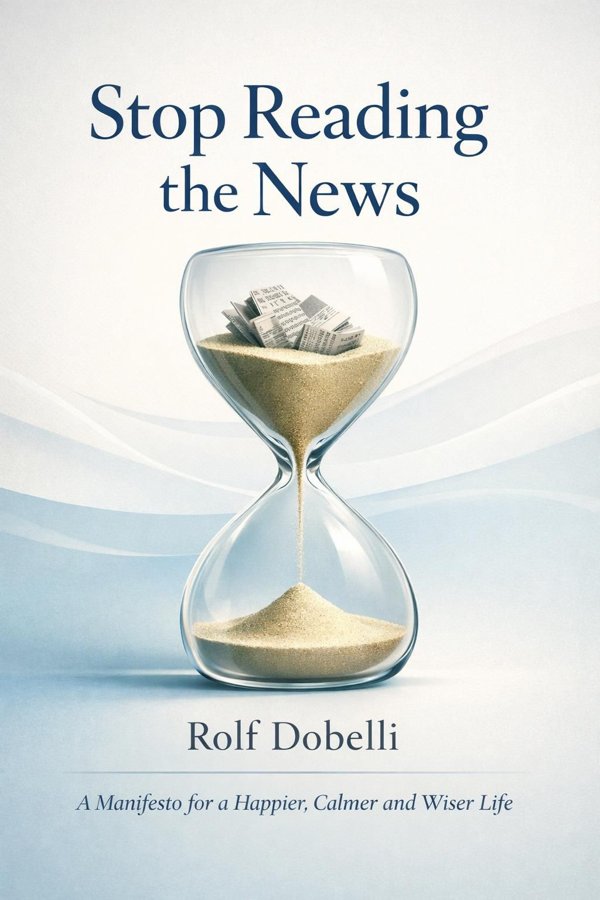
Stop Reading the News: A Manifesto for a Happier, Calmer and Wiser Life: Summary & Key Insights
by Rolf Dobelli
 10 min6 chaptersAudio available
What Is Stop Reading the News: A Manifesto for a Happier, Calmer and Wiser Life About?
Stop Reading the News: A Manifesto for a Happier, Calmer and Wiser Life by Rolf Dobelli is a mindset book spanning 6 pages. In this thought-provoking book, Swiss author Rolf Dobelli argues that consuming news daily harms our mental clarity, productivity, and happiness. Drawing on research from psychology, economics, and media studies, he explains how news distorts our perception of the world, triggers anxiety, and distracts us from meaningful work. Dobelli advocates for a 'news diet'—a deliberate withdrawal from the constant stream of headlines—to regain focus, peace of mind, and a deeper understanding of reality.
This FizzRead summary covers all 6 key chapters of Stop Reading the News: A Manifesto for a Happier, Calmer and Wiser Life in approximately 10 minutes, distilling the most important ideas, arguments, and takeaways from Rolf Dobelli's work. Also available as an audio summary and Key Quotes Podcast.
Stop Reading the News: A Manifesto for a Happier, Calmer and Wiser Life
In this thought-provoking book, Swiss author Rolf Dobelli argues that consuming news daily harms our mental clarity, productivity, and happiness. Drawing on research from psychology, economics, and media studies, he explains how news distorts our perception of the world, triggers anxiety, and distracts us from meaningful work. Dobelli advocates for a 'news diet'—a deliberate withdrawal from the constant stream of headlines—to regain focus, peace of mind, and a deeper understanding of reality.
Who Should Read Stop Reading the News: A Manifesto for a Happier, Calmer and Wiser Life?
This book is perfect for anyone interested in mindset and looking to gain actionable insights in a short read. Whether you're a student, professional, or lifelong learner, the key ideas from Stop Reading the News: A Manifesto for a Happier, Calmer and Wiser Life by Rolf Dobelli will help you think differently.
- ✓Readers who enjoy mindset and want practical takeaways
- ✓Professionals looking to apply new ideas to their work and life
- ✓Anyone who wants the core insights of Stop Reading the News: A Manifesto for a Happier, Calmer and Wiser Life in just 10 minutes
Want the full summary?
Get instant access to this book summary and 100K+ more with Fizz Moment.
Get Free SummaryAvailable on App Store • Free to download
Key Chapters
When I observe the modern news landscape, I see an ecosystem optimized for emotion, not insight. The structure of news has evolved to satisfy our deepest psychological cravings for novelty, conflict, and significance. Each headline invites you to feel — usually alarm or outrage — but seldom invites you to think.
News as an industry is not a neutral transmitter of facts. It is a commercial enterprise competing for attention. This competition drives a ruthless selection principle: only stories that trigger strong reactions survive. Sensation beats significance; immediacy trumps accuracy. The result is a continuous feedback loop — the more we click, the more shock-driven content we get.
In the past, news required effort. You read a newspaper, reflecting on carefully crafted essays. Today, the news chases you. It seeps into every waking moment through notifications, social media, and 24-hour cycles. This ubiquity creates a false sense of relevance. When you read about distant disasters or fleeting scandals, your brain processes them as personal alerts — but in reality, their impact on your life is negligible. The attention they steal, however, is not.
Once we accept that news is designed to entertain, not enlighten, we can approach it with greater clarity. You cannot derive wisdom from fragments. Wisdom demands context, reflection, and time — the very qualities modern news consumption systematically erodes.
The human brain has not evolved to handle a constant firehose of information. News does not just inform; it manipulates how you perceive the world. Our minds rely on heuristics — mental shortcuts — to make sense of complexity. The news exploits these shortcuts, amplifying our biases.
Take the availability bias: we estimate the frequency or importance of an event by how easily it comes to mind. Because the news focuses disproportionately on dramatic, rare events — airplane crashes, terrorist attacks, celebrity scandals — our perception of reality skews toward fear and rarity. We begin to worry about improbable threats while ignoring real, slow-moving dangers, such as climate change or erosion of civic trust.
Then there is confirmation bias. If you have a worldview, the news can supply endless ammunition to reinforce it. In the digital age, algorithmic feeds personalize your information environment so that you only encounter opinions that echo your own. This insulates you inside a cognitive bubble where disagreement feels threatening.
And perhaps most pervasive of all — negativity bias. Bad news grabs attention because our ancestors survived by responding to threats. Modern editors understand this instinct perfectly. The result is a psychological diet heavy on negativity, training your mind to see catastrophe everywhere. Once you realize that your fears are not your own but engineered responses to stimuli carefully selected by editors and algorithms, you begin to reclaim mental sovereignty.
+ 4 more chapters — available in the FizzRead app
All Chapters in Stop Reading the News: A Manifesto for a Happier, Calmer and Wiser Life
About the Author
Rolf Dobelli is a Swiss author and entrepreneur best known for his works on clear thinking and decision-making, including 'The Art of Thinking Clearly'. He holds a PhD in economic philosophy and is the founder of the Zurich Minds network, which connects leading thinkers from science, culture, and business.
Get This Summary in Your Preferred Format
Read or listen to the Stop Reading the News: A Manifesto for a Happier, Calmer and Wiser Life summary by Rolf Dobelli anytime, anywhere. FizzRead offers multiple formats so you can learn on your terms — all free.
Available formats: App · Audio · PDF · EPUB — All included free with FizzRead
Download Stop Reading the News: A Manifesto for a Happier, Calmer and Wiser Life PDF and EPUB Summary
Key Quotes from Stop Reading the News: A Manifesto for a Happier, Calmer and Wiser Life
“When I observe the modern news landscape, I see an ecosystem optimized for emotion, not insight.”
“The human brain has not evolved to handle a constant firehose of information.”
Frequently Asked Questions about Stop Reading the News: A Manifesto for a Happier, Calmer and Wiser Life
Stop Reading the News: A Manifesto for a Happier, Calmer and Wiser Life by Rolf Dobelli is a mindset book that explores key ideas across 6 chapters. In this thought-provoking book, Swiss author Rolf Dobelli argues that consuming news daily harms our mental clarity, productivity, and happiness. Drawing on research from psychology, economics, and media studies, he explains how news distorts our perception of the world, triggers anxiety, and distracts us from meaningful work. Dobelli advocates for a 'news diet'—a deliberate withdrawal from the constant stream of headlines—to regain focus, peace of mind, and a deeper understanding of reality.
More by Rolf Dobelli
You Might Also Like

Browse by Category
Ready to read Stop Reading the News: A Manifesto for a Happier, Calmer and Wiser Life?
Get the full summary and 100K+ more books with Fizz Moment.