
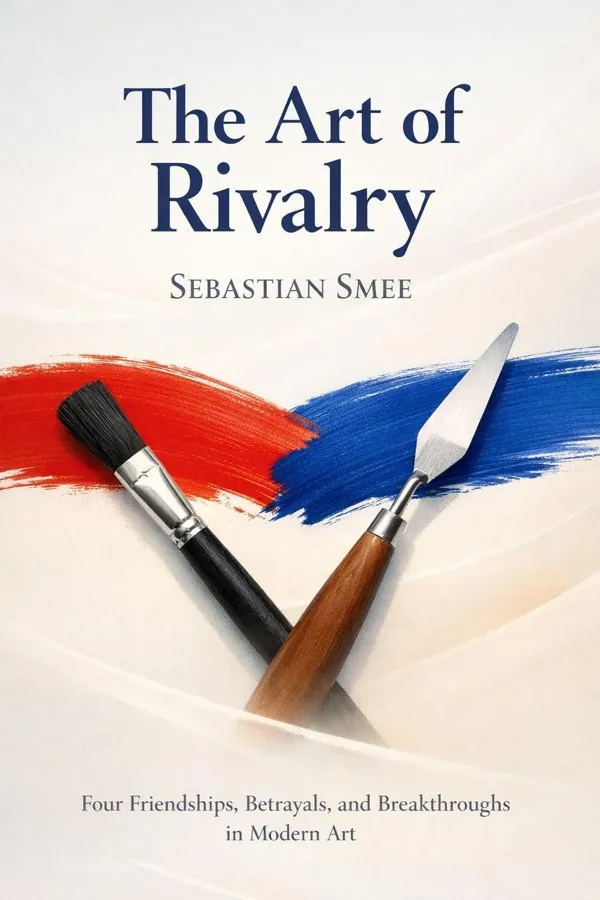
The Art of Rivalry: Four Friendships, Betrayals, and Breakthroughs in Modern Art: Summary & Key Insights
 10 min5 chaptersAudio available
What Is The Art of Rivalry: Four Friendships, Betrayals, and Breakthroughs in Modern Art About?
The Art of Rivalry: Four Friendships, Betrayals, and Breakthroughs in Modern Art by Sebastian Smee is a art_history book spanning 5 pages. The Art of Rivalry explores the complex relationships between pairs of modern artists—Lucian Freud and Francis Bacon, Pablo Picasso and Henri Matisse, Jackson Pollock and Willem de Kooning, and Edgar Degas and Édouard Manet. Through these intertwined stories, Sebastian Smee reveals how friendship and competition fueled their creativity and shaped the course of modern art.
This FizzRead summary covers all 5 key chapters of The Art of Rivalry: Four Friendships, Betrayals, and Breakthroughs in Modern Art in approximately 10 minutes, distilling the most important ideas, arguments, and takeaways from Sebastian Smee's work. Also available as an audio summary and Key Quotes Podcast.
The Art of Rivalry: Four Friendships, Betrayals, and Breakthroughs in Modern Art
The Art of Rivalry explores the complex relationships between pairs of modern artists—Lucian Freud and Francis Bacon, Pablo Picasso and Henri Matisse, Jackson Pollock and Willem de Kooning, and Edgar Degas and Édouard Manet. Through these intertwined stories, Sebastian Smee reveals how friendship and competition fueled their creativity and shaped the course of modern art.
Who Should Read The Art of Rivalry: Four Friendships, Betrayals, and Breakthroughs in Modern Art?
This book is perfect for anyone interested in art_history and looking to gain actionable insights in a short read. Whether you're a student, professional, or lifelong learner, the key ideas from The Art of Rivalry: Four Friendships, Betrayals, and Breakthroughs in Modern Art by Sebastian Smee will help you think differently.
- ✓Readers who enjoy art_history and want practical takeaways
- ✓Professionals looking to apply new ideas to their work and life
- ✓Anyone who wants the core insights of The Art of Rivalry: Four Friendships, Betrayals, and Breakthroughs in Modern Art in just 10 minutes
Want the full summary?
Get instant access to this book summary and 100K+ more with Fizz Moment.
Get Free SummaryAvailable on App Store • Free to download
Key Chapters
In Paris of the late 19th century, the friendship between Edgar Degas and Édouard Manet represented a turning point in the story of realism. Both sought truth in everyday life, yet they approached that truth through different temperaments. I aimed to show how Degas, the meticulous observer of movement and structure, admired Manet’s spontaneous brushwork and his ease in social and intellectual circles. Manet embodied the adventurer, bold and public; Degas, the introspective craftsman, was drawn to private moments of form and poise.
They crossed paths amid the ferment of Paris’s newly forming modern sensibility—the rise of impressionism, the shifting role of the salon, the debates over what constituted a modern subject. Degas sketched Manet painting, admired his daring, and at times recoiled from his impulsiveness. Then came the incident that shaped their estrangement: Degas’s gift of a portrait of Manet and his wife, which Manet mutilated, cutting out a section that offended him. The breach was more than personal; it symbolized a rupture between two ways of seeing the world.
Through their tension, both refined their art. Degas developed his concept of discipline—his ballet scenes, his controlled anatomy—out of a desire to resist Manet’s looseness while absorbing his truthfulness. Manet, in turn, learned from Degas’s perfectionism, even as he insisted on spontaneity and speed. They taught each other that artistic honesty requires risk, and that friendship among artists is never safe—it’s charged with the unspoken demand to evolve.
When Matisse and Picasso entered each other’s orbit in the early 20th century, modern art was still finding its vocabulary. Their meeting in Paris initiated one of the greatest rivalries—yet also collaborations—in art history. Matisse was calm, deliberate, a master of color as a vehicle for serenity. Picasso was restless, analytical, the architect of form as transformation. In my telling, their dynamic symbolized how contradiction can yield mutual growth.
Matisse’s paintings of supple figures and luminous interiors captivated Picasso, who studied them with both admiration and anxiety. He once said that whenever he saw a Matisse, he wanted to smash something. That frustration became his fuel. His pursuit of Cubism, his fragmented perspectives, were in part a dialogue—a riposte—to Matisse’s harmonies. Picasso’s drive to surpass him wasn’t about imitation; it was about invention born from comparison.
Matisse understood rivalry differently. His response was not defensive but expansive—he deepened his color, simplified his forms, and created a space where stillness could hold energy. Even when critics compared the two relentlessly, Matisse retained respect. He knew that without Picasso’s challenge, his own art might have settled into comfort. Their correspondence and exchanges, often edged with irony, show an enduring recognition: they needed each other’s opposition.
Through their rivalry, modern art absorbed a new logic—color and form became conversations rather than hierarchies. Matisse and Picasso pushed perception to its boundaries, teaching future generations that difference, when treated as dialogue, breeds freedom. If there was tension, it was creative tension—the magnetism of two minds seeing the same world through utterly distinct prisms.
+ 3 more chapters — available in the FizzRead app
All Chapters in The Art of Rivalry: Four Friendships, Betrayals, and Breakthroughs in Modern Art
About the Author
Sebastian Smee is an Australian-born art critic and author. He won the Pulitzer Prize for Criticism in 2011 for his work at The Boston Globe and has written extensively on modern and contemporary art. Smee is known for his insightful and accessible writing that bridges the gap between artists and audiences.
Get This Summary in Your Preferred Format
Read or listen to the The Art of Rivalry: Four Friendships, Betrayals, and Breakthroughs in Modern Art summary by Sebastian Smee anytime, anywhere. FizzRead offers multiple formats so you can learn on your terms — all free.
Available formats: App · Audio · PDF · EPUB — All included free with FizzRead
Download The Art of Rivalry: Four Friendships, Betrayals, and Breakthroughs in Modern Art PDF and EPUB Summary
Key Quotes from The Art of Rivalry: Four Friendships, Betrayals, and Breakthroughs in Modern Art
“In Paris of the late 19th century, the friendship between Edgar Degas and Édouard Manet represented a turning point in the story of realism.”
“When Matisse and Picasso entered each other’s orbit in the early 20th century, modern art was still finding its vocabulary.”
Frequently Asked Questions about The Art of Rivalry: Four Friendships, Betrayals, and Breakthroughs in Modern Art
The Art of Rivalry: Four Friendships, Betrayals, and Breakthroughs in Modern Art by Sebastian Smee is a art_history book that explores key ideas across 5 chapters. The Art of Rivalry explores the complex relationships between pairs of modern artists—Lucian Freud and Francis Bacon, Pablo Picasso and Henri Matisse, Jackson Pollock and Willem de Kooning, and Edgar Degas and Édouard Manet. Through these intertwined stories, Sebastian Smee reveals how friendship and competition fueled their creativity and shaped the course of modern art.
You Might Also Like
Studies In Impressionism
John Rewald
10 min
Art Since 1900: Modernism, Antimodernism, Postmodernism
Hal Foster, Rosalind E. Krauss, Yve-Alain Bois, Benjamin H. D. Buchloh
10 min
Art Since 1940: Strategies of Being
Jonathan Fineberg
10 min
Color and Meaning: Art, Science, and Symbolism
John Gage
10 min
Color: Travels Through the Paintbox
Victoria Finlay
10 min
Curatorial Activism: Towards an Ethics of Curating
Maura Reilly
10 minBrowse by Category
Ready to read The Art of Rivalry: Four Friendships, Betrayals, and Breakthroughs in Modern Art?
Get the full summary and 100K+ more books with Fizz Moment.