
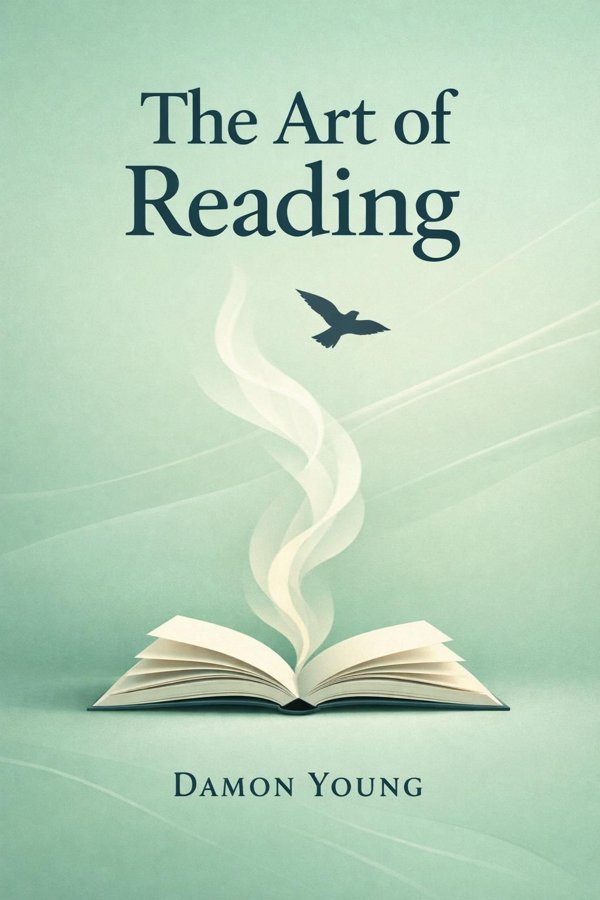
The Art of Reading: Summary & Key Insights
by Damon Young
 10 min9 chaptersAudio available
Key Takeaways from The Art of Reading
One of the book’s central insights is that reading is not passive reception but trained attention.
Every meaningful reading experience leaves a trace on identity.
A great book does more than inform us about other lives; it lets us imaginatively inhabit them.
Reading teaches us that being alone need not mean being empty.
Although reading often happens in private, Young emphasizes that it is never purely solitary.
What Is The Art of Reading About?
The Art of Reading by Damon Young is a western_phil book spanning 9 pages. In The Art of Reading, Australian philosopher Damon Young makes a powerful case that reading is far more than a pastime, academic skill, or escape from daily life. It is a disciplined, imaginative, and ethical practice that changes how we pay attention, who we become, and how we relate to others. Drawing on philosophy, memoir, and literary criticism, Young reflects on the pleasures and demands of reading through writers such as Virginia Woolf, Marcel Proust, George Eliot, and others who understood books as instruments of self-formation. What makes this work especially compelling is Young’s ability to connect large philosophical questions to ordinary experience: why some books unsettle us, why solitude can feel nourishing on the page, and why reading asks something serious of our character. He writes not as a distant theorist but as a thoughtful companion, someone who understands both the difficulty and the joy of sustained attention in a distracted age. For anyone who has ever wondered why reading matters, or how to read more deeply, this book offers a rich and humane answer.
This FizzRead summary covers all 9 key chapters of The Art of Reading in approximately 10 minutes, distilling the most important ideas, arguments, and takeaways from Damon Young's work. Also available as an audio summary and Key Quotes Podcast.
The Art of Reading
In The Art of Reading, Australian philosopher Damon Young makes a powerful case that reading is far more than a pastime, academic skill, or escape from daily life. It is a disciplined, imaginative, and ethical practice that changes how we pay attention, who we become, and how we relate to others. Drawing on philosophy, memoir, and literary criticism, Young reflects on the pleasures and demands of reading through writers such as Virginia Woolf, Marcel Proust, George Eliot, and others who understood books as instruments of self-formation. What makes this work especially compelling is Young’s ability to connect large philosophical questions to ordinary experience: why some books unsettle us, why solitude can feel nourishing on the page, and why reading asks something serious of our character. He writes not as a distant theorist but as a thoughtful companion, someone who understands both the difficulty and the joy of sustained attention in a distracted age. For anyone who has ever wondered why reading matters, or how to read more deeply, this book offers a rich and humane answer.
Who Should Read The Art of Reading?
This book is perfect for anyone interested in western_phil and looking to gain actionable insights in a short read. Whether you're a student, professional, or lifelong learner, the key ideas from The Art of Reading by Damon Young will help you think differently.
- ✓Readers who enjoy western_phil and want practical takeaways
- ✓Professionals looking to apply new ideas to their work and life
- ✓Anyone who wants the core insights of The Art of Reading in just 10 minutes
Want the full summary?
Get instant access to this book summary and 100K+ more with Fizz Moment.
Get Free SummaryAvailable on App Store • Free to download
Key Chapters
One of the book’s central insights is that reading is not passive reception but trained attention. In a culture shaped by speed, interruption, and constant stimulation, the ability to sit with a difficult sentence, follow a long argument, or enter a subtle fictional world has become a rare achievement. Young argues that reading well depends on virtues such as patience, humility, concentration, and openness. These are not merely academic traits; they are habits of mind that influence how we live.
To read seriously is to resist the urge for instant clarity and quick reward. A demanding novel, philosophical essay, or poem often withholds its meaning at first. Instead of offering immediate satisfaction, it asks the reader to slow down, reread, question assumptions, and remain alert to nuance. That process can feel effortful, but it is precisely where the value lies. Reading becomes a discipline because it trains us to stay present, even when understanding comes gradually.
This idea has practical consequences. A reader who turns off notifications, reads for thirty uninterrupted minutes, and keeps a pencil nearby is not just improving comprehension; they are cultivating a steadier form of attention. The same discipline can carry into conversation, work, and reflection. Young suggests that the art of reading begins with honoring the conditions that deep reading requires.
Actionable takeaway: Create a simple reading ritual—set aside distraction-free time, read slowly, and pause to note what confuses or moves you rather than rushing toward completion.
Every meaningful reading experience leaves a trace on identity. Young suggests that reading does not simply add information to the mind; it reorganizes the self. A powerful book can alter the language we use, the emotions we recognize, and the possibilities we imagine for our own lives. In this sense, reading is a form of self-composition. We do not remain exactly the same after inhabiting the consciousness of another person, whether real or fictional.
This transformation happens in several ways. Sometimes a book names an experience we have felt but could not articulate. Sometimes it introduces a way of thinking that unsettles our familiar certainties. At other times, it opens a door to values, ambitions, or forms of courage we had not considered. Reading George Eliot or Proust, for example, is not just absorbing style or plot; it is entering a different framework for interpreting memory, desire, and moral choice.
Young’s point is not that books dictate who we become, but that they furnish inner life. They create mental rooms we can revisit. A teenager who discovers Woolf may gain a new sense of inwardness; a weary adult reading philosophy may recover seriousness or wonder. Over time, our library becomes part of our biography.
This idea also invites selectivity. If reading shapes the self, then our choices matter. We should ask not only what is entertaining or useful, but what kind of person a book helps us become.
Actionable takeaway: After finishing a book, write down one way it changed your thinking, language, or sense of self, and revisit that note later.
A great book does more than inform us about other lives; it lets us imaginatively inhabit them. Young treats reading as a training ground for empathy, not in a sentimental sense, but as an expansion of moral perception. Through literature especially, we enter minds unlike our own, encounter motives we might otherwise dismiss, and feel the texture of lives shaped by different histories, classes, temperaments, or desires. Reading teaches us that other people are more complex than our judgments allow.
This imaginative movement matters because moral failure often begins in simplification. We reduce others to labels, roles, or isolated acts. Fiction resists that reduction. A novelist can reveal hesitation, contradiction, shame, tenderness, vanity, and longing all at once. That layered understanding does not excuse harmful behavior, but it deepens our capacity for humane judgment. We become slower to caricature and quicker to ask what hidden pressures shape a person’s actions.
Young also implies that empathy through reading has limits. It is not a substitute for justice, lived experience, or direct encounter. Still, it is valuable preparation for them. A reader of serious literature may become better equipped to listen, less eager to flatten disagreement, and more aware that every visible life contains an invisible interior.
In practice, this can influence everything from parenting to political discussion. Reading a novel about migration, illness, or loneliness may not make us experts, but it can make us less careless. It enlarges the imagination required for ethical life.
Actionable takeaway: Alternate between books that reflect your experience and books that challenge it, and ask what each one reveals about lives you might otherwise overlook.
Reading teaches us that being alone need not mean being empty. Young presents reading as one of the richest forms of solitude because it combines privacy with companionship, silence with dialogue, and withdrawal with expansion. When we read, we step away from immediate social demands, yet we enter the company of minds that can provoke, console, instruct, or unsettle us. Solitude becomes not deprivation but a condition for inward depth.
This matters in a time when solitude is often confused with loneliness or constantly interrupted by digital noise. Many people find it difficult to be alone without seeking stimulation. Reading offers another possibility: sustained private attention that feels alive rather than isolating. A book can sharpen self-awareness, restore emotional balance, or create a space where difficult thoughts can emerge safely. It can help us endure grief, uncertainty, boredom, or transition.
Young’s account also suggests that reading in solitude is a way of recovering autonomy. In the reading life, we are not merely reacting to events, feeds, or demands. We choose our pace, our company, and our questions. That freedom helps build an interior life that is less dependent on approval or distraction.
Practically, this may mean reclaiming quiet moments that would otherwise be filled automatically—early mornings, commutes, or the last half hour before sleep. Over time, those small pockets of reading can become a structure of refuge and renewal.
Actionable takeaway: Protect one regular period each day for solitary reading, treating it not as leftover leisure but as necessary time for mental and emotional restoration.
People rarely read for one reason alone. Young explores how reading is driven by desire: the desire for pleasure, understanding, beauty, escape, status, intimacy, mastery, consolation, or transformation. A book attracts us because we hope it will satisfy some need, even when that need is only dimly understood. Reading is therefore not just intellectual but emotional and aspirational. We choose books partly according to what we long for.
Recognizing this clarifies why reading habits are so personal. One reader turns to detective fiction for order and suspense; another returns to poetry for intensity; another seeks philosophy during periods of confusion. Even ambitious reading lists often conceal deeper desires: to become more cultivated, more articulate, more serious, more free. Young invites readers to become more conscious of these motives, not to judge them too harshly but to understand them better.
This awareness can improve reading choices. If we know we are only reading for social prestige, we may feel secretly bored and detached. If we notice that we read solely for comfort, we may miss books that challenge and enlarge us. The art lies in balancing appetite with aspiration—letting pleasure draw us in while allowing difficulty and surprise to stretch us.
A practical reader might build a varied reading life: one book for delight, one for challenge, one for companionship in a current life problem. That approach treats desire as informative rather than embarrassing.
Actionable takeaway: Before starting a book, ask yourself what you want from it—escape, clarity, beauty, challenge, comfort—and use the answer to read more deliberately.
Young argues that reading is not morally neutral. The way we read reflects and shapes our character. Ethical reading involves honesty, attentiveness, fairness, and a willingness to encounter a text without immediately bending it to our prejudices. It asks us to listen before judging, to interpret carefully, and to acknowledge complexity. These habits are ethical because they mirror the kind of respect we owe other people.
This does not mean every book is morally improving, nor that readers must become solemn or censorious. Rather, it means that reading can train us in virtues relevant beyond literature. A careful reader resists distortion. A generous reader tries to understand an author’s intention before dismissing it. A courageous reader stays with disturbing material long enough to think seriously about it. These habits can influence how we evaluate news, political claims, and interpersonal conflict.
Young also hints at a further ethical question: what should we do about troubling books or flawed authors? His framework suggests neither blind reverence nor instant rejection. Instead, readers should practice critical engagement—acknowledging a work’s insight, limitation, historical context, and harm where relevant. Ethical reading means being awake rather than obedient.
In everyday life, this might involve slowing down before reacting to a provocative passage, asking what a text really says, and considering whose perspective is centered or excluded. Reading then becomes rehearsal for more responsible citizenship and conversation.
Actionable takeaway: When a book frustrates or offends you, pause before dismissing it and write down the strongest version of its perspective before offering your critique.
To read well is also to learn how language works. Young explores the intimate bond between reading and writing, showing that attentive readers become more sensitive to tone, rhythm, structure, argument, and style. Every strong sentence teaches something about precision and music; every weak one reveals what fails to persuade. Writers are formed not only by practice but by the books they absorb.
This relationship goes beyond imitation. Reading teaches choices. A memoir may reveal how honesty can coexist with elegance. A philosophical essay may show how clarity emerges from order. A novel may demonstrate how withholding information creates tension. Even if a reader never publishes anything, these lessons matter because writing is part of ordinary life: emails, reports, personal reflection, teaching, persuasion, and conversation all depend on language.
Young’s larger point is that reading refines expression by refining perception. The more alertly we read, the better we notice distinctions, and the more exact our own words can become. A person who has spent time with careful prose often develops a stronger ear for cliché, vagueness, and exaggeration. Reading makes us less satisfied with empty language.
Practically, this can be cultivated through annotation. Notice how an author begins a chapter, pivots in an argument, or describes an emotion without sentimentality. Borrow techniques, not just opinions. Over time, reading becomes an apprenticeship in style and thought.
Actionable takeaway: Keep a small notebook of passages you admire and briefly note what each one teaches you about clarity, rhythm, argument, or emotional force.
One of Young’s most subtle claims is that reading does not end when the book closes. It alters perception. After a powerful work, the world itself can seem newly legible: memory appears differently after Proust, urban life after Woolf, moral complexity after Eliot. Books furnish not only ideas but lenses. They help us notice patterns, moods, and meanings that were previously hidden in plain sight.
This is why reading matters beyond literary culture. It influences how we interpret our own experiences. A philosophical text may make a reader more attentive to vanity, freedom, mortality, or attention. A novel may reveal that a family conflict contains competing loyalties rather than a simple villain. Poetry may make ordinary scenes feel denser and more alive. Reading can heighten the world rather than distract from it.
Young portrays the accomplished reader as someone whose reality has been enriched by many voices. This does not mean replacing life with books. On the contrary, books become valuable when they return us to life with sharpened perception. We notice more, judge less crudely, and feel more fully the strangeness or beauty of ordinary existence.
This idea also explains why rereading is powerful. We return to a book changed, and it sends us back to the world changed again. Reading and living become reciprocal acts, each illuminating the other.
Actionable takeaway: After finishing a meaningful book, take a walk or sit quietly and ask what in your daily world now looks different because of what you have read.
All Chapters in The Art of Reading
About the Author
Damon Young is an Australian philosopher, writer, and public intellectual known for bringing philosophical reflection into conversation with literature, art, and everyday life. He studied philosophy academically but has built a wider readership through essays and books that combine intellectual seriousness with an approachable style. Young often writes about character, emotion, ethics, culture, and the habits that shape human flourishing. His work has appeared in major newspapers and magazines, and he is widely admired for making complex ideas feel vivid, practical, and humane. In The Art of Reading, these strengths are especially clear: he blends literary sensitivity, philosophical insight, and personal reflection to show how reading can deepen attention, enlarge the self, and enrich ordinary experience.
Get This Summary in Your Preferred Format
Read or listen to the The Art of Reading summary by Damon Young anytime, anywhere. FizzRead offers multiple formats so you can learn on your terms — all free.
Available formats: App · Audio · PDF · EPUB — All included free with FizzRead
Download The Art of Reading PDF and EPUB Summary
Key Quotes from The Art of Reading
“One of the book’s central insights is that reading is not passive reception but trained attention.”
“Every meaningful reading experience leaves a trace on identity.”
“A great book does more than inform us about other lives; it lets us imaginatively inhabit them.”
“Reading teaches us that being alone need not mean being empty.”
“Although reading often happens in private, Young emphasizes that it is never purely solitary.”
Frequently Asked Questions about The Art of Reading
The Art of Reading by Damon Young is a western_phil book that explores key ideas across 9 chapters. In The Art of Reading, Australian philosopher Damon Young makes a powerful case that reading is far more than a pastime, academic skill, or escape from daily life. It is a disciplined, imaginative, and ethical practice that changes how we pay attention, who we become, and how we relate to others. Drawing on philosophy, memoir, and literary criticism, Young reflects on the pleasures and demands of reading through writers such as Virginia Woolf, Marcel Proust, George Eliot, and others who understood books as instruments of self-formation. What makes this work especially compelling is Young’s ability to connect large philosophical questions to ordinary experience: why some books unsettle us, why solitude can feel nourishing on the page, and why reading asks something serious of our character. He writes not as a distant theorist but as a thoughtful companion, someone who understands both the difficulty and the joy of sustained attention in a distracted age. For anyone who has ever wondered why reading matters, or how to read more deeply, this book offers a rich and humane answer.
You Might Also Like
A Little History of Philosophy
Nigel Warburton
10 min
Areopagitica
John Milton
10 min
How To Think Like A Philosopher: Essential Principles For Clear Thinking
Peter Cave
10 min
Language, Truth and Logic
A. J. Ayer
10 min
The Age of Reason
Thomas Paine
10 min
The Essays
Michel De Montaigne
10 minBrowse by Category
Ready to read The Art of Reading?
Get the full summary and 100K+ more books with Fizz Moment.