
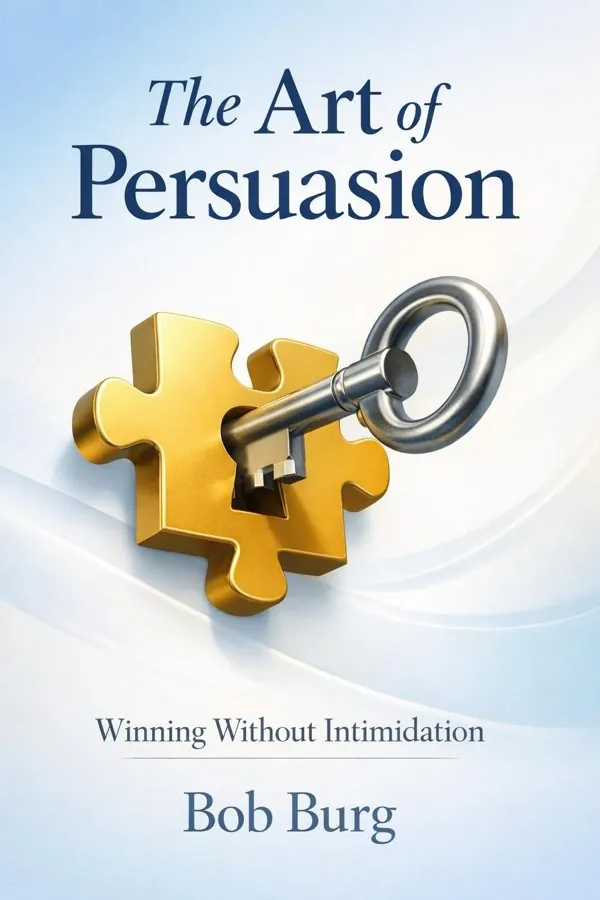
The Art of Persuasion: Winning Without Intimidation: Summary & Key Insights
by Bob Burg
 10 min8 chaptersAudio available
Key Takeaways from The Art of Persuasion: Winning Without Intimidation
The most misunderstood truth about persuasion is that it only works well when the other person remains free.
People rarely resist because they are stubborn for no reason; they resist because they see the situation differently than you do.
No technique can compensate for a lack of trust.
Many people think persuasion is mostly about speaking well, but Burg shows that the strongest persuaders are often the best listeners.
Resistance is not always rejection.
What Is The Art of Persuasion: Winning Without Intimidation About?
The Art of Persuasion: Winning Without Intimidation by Bob Burg is a communication book spanning 7 pages. In The Art of Persuasion: Winning Without Intimidation, Bob Burg argues that the most powerful form of influence does not rely on force, pressure, or clever manipulation. Instead, it grows out of trust, empathy, clarity, and genuine respect for the other person’s freedom to choose. This book is a practical guide to persuading ethically in sales, leadership, negotiations, and everyday relationships. Burg shows that people are far more likely to say yes when they feel understood, safe, and valued rather than cornered. What makes the book especially useful is its combination of principle and application. Burg does not present persuasion as a mysterious talent reserved for charismatic personalities. He breaks it down into learnable habits: listening more carefully, asking better questions, framing ideas around shared benefits, and responding to resistance without becoming defensive. The result is a model of influence that is both effective and honorable. Burg is a respected author and speaker best known for his work on relationship-based success and value-centered communication. His authority comes from years of teaching professionals how to build influence by serving others first, making this book highly relevant in an age weary of hype and hard sell tactics.
This FizzRead summary covers all 8 key chapters of The Art of Persuasion: Winning Without Intimidation in approximately 10 minutes, distilling the most important ideas, arguments, and takeaways from Bob Burg's work. Also available as an audio summary and Key Quotes Podcast.
The Art of Persuasion: Winning Without Intimidation
In The Art of Persuasion: Winning Without Intimidation, Bob Burg argues that the most powerful form of influence does not rely on force, pressure, or clever manipulation. Instead, it grows out of trust, empathy, clarity, and genuine respect for the other person’s freedom to choose. This book is a practical guide to persuading ethically in sales, leadership, negotiations, and everyday relationships. Burg shows that people are far more likely to say yes when they feel understood, safe, and valued rather than cornered.
What makes the book especially useful is its combination of principle and application. Burg does not present persuasion as a mysterious talent reserved for charismatic personalities. He breaks it down into learnable habits: listening more carefully, asking better questions, framing ideas around shared benefits, and responding to resistance without becoming defensive. The result is a model of influence that is both effective and honorable.
Burg is a respected author and speaker best known for his work on relationship-based success and value-centered communication. His authority comes from years of teaching professionals how to build influence by serving others first, making this book highly relevant in an age weary of hype and hard sell tactics.
Who Should Read The Art of Persuasion: Winning Without Intimidation?
This book is perfect for anyone interested in communication and looking to gain actionable insights in a short read. Whether you're a student, professional, or lifelong learner, the key ideas from The Art of Persuasion: Winning Without Intimidation by Bob Burg will help you think differently.
- ✓Readers who enjoy communication and want practical takeaways
- ✓Professionals looking to apply new ideas to their work and life
- ✓Anyone who wants the core insights of The Art of Persuasion: Winning Without Intimidation in just 10 minutes
Want the full summary?
Get instant access to this book summary and 100K+ more with Fizz Moment.
Get Free SummaryAvailable on App Store • Free to download
Key Chapters
The most misunderstood truth about persuasion is that it only works well when the other person remains free. Bob Burg draws a sharp line between persuasion, manipulation, and coercion. Manipulation hides motives, distorts facts, or exploits emotion to get compliance. Coercion uses pressure, fear, or power to remove choice. Persuasion, by contrast, is an ethical process of helping someone see value clearly enough to make a willing decision.
This distinction matters because many people resist learning persuasion skills precisely because they do not want to be pushy. Burg reframes influence as a service. If you have an idea, product, proposal, or solution that can genuinely help someone, then presenting it clearly and compellingly is not selfish. It is responsible. Ethical persuasion does not trick people into saying yes. It reveals why saying yes may serve their own goals.
Imagine a manager asking a team member to adopt a new process. A manipulative approach might exaggerate benefits and hide likely challenges. A coercive approach might threaten consequences for noncompliance. A persuasive approach would explain the purpose, acknowledge concerns, connect the change to the employee’s priorities, and invite honest dialogue. The employee may still disagree, but trust remains intact.
This idea also applies in personal life. Parents, partners, and friends often try to influence one another. The question is whether they seek mutual understanding or mere control. Burg’s standard is simple: if your approach depends on removing someone’s dignity or freedom, it is not persuasion.
Actionable takeaway: Before any important conversation, ask yourself, “Am I trying to help this person make a good decision, or am I trying to overpower them?” Let the answer guide your tone and strategy.
People rarely resist because they are stubborn for no reason; they resist because they see the situation differently than you do. One of Burg’s central lessons is that empathy is not a soft extra in persuasion but its emotional foundation. If you do not understand what matters to the other person, your message will miss its mark no matter how polished it sounds.
Empathy in this context means more than being nice. It means entering the other person’s perspective with discipline and curiosity. What pressures are they facing? What are they afraid of losing? What do they hope to gain? What would make your proposal feel risky, annoying, or unnecessary from their point of view? Persuasion improves dramatically when you stop asking, “How can I get them to agree?” and start asking, “How do they see this?”
Consider a salesperson speaking with a small business owner. If the salesperson talks only about features, price, and market comparisons, the conversation may feel generic. But if they learn that the owner is overwhelmed, short on staff, and worried about wasted time, then they can position the solution around simplicity, reliability, and reduced stress. The product has not changed, but the relevance has.
Empathy also lowers defensiveness. People become more open when they sense that you are trying to understand rather than outmaneuver them. In difficult conversations, simply acknowledging concerns can transform the interaction. Phrases like “I can see why that would worry you” or “That makes sense from where you sit” create space for trust.
Actionable takeaway: In your next persuasive conversation, spend the first part discovering the other person’s priorities, concerns, and desired outcomes before presenting your own case.
No technique can compensate for a lack of trust. Burg emphasizes that persuasion rests on credibility, and credibility is built over time through consistency, honesty, and congruence between words and actions. People may comply briefly with someone they distrust, but they rarely commit wholeheartedly. Sustainable influence belongs to those whose character makes their message believable.
Trust has several dimensions. First, people must believe you are competent. If you cannot demonstrate knowledge, judgment, or reliability, they will hesitate to follow your lead. Second, they must believe you are honest. If they suspect exaggeration or hidden agendas, resistance rises immediately. Third, they must believe you care about more than your own gain. This is where many persuasive efforts fail. Even strong facts lose power when people think you are only trying to win.
For example, a consultant who openly admits the limits of a recommendation often becomes more persuasive, not less. By acknowledging trade-offs and possible drawbacks, they show that they value truth over closing the deal. Likewise, a leader who follows through on small promises earns the right to be believed on larger ones. Credibility accumulates through these repeated moments.
Burg’s approach reminds us that trust is not built in the final pitch. It is built in every interaction before the pitch appears. Your punctuality, preparation, responsiveness, and willingness to listen all influence how your message will be received. Persuasion often begins long before persuasion is attempted.
Actionable takeaway: Strengthen influence by auditing your credibility. Ask whether your behavior consistently signals competence, honesty, and concern for the other person’s best interest.
Many people think persuasion is mostly about speaking well, but Burg shows that the strongest persuaders are often the best listeners. Talking gives you a chance to deliver your message; listening gives you the information needed to make that message matter. When you listen closely and ask thoughtful questions, you uncover the motives, assumptions, and objections that actually drive decisions.
Questions are powerful because they invite ownership. A direct argument can trigger resistance, especially if the other person feels cornered or judged. But a well-placed question encourages them to think for themselves. Instead of saying, “This is obviously the best choice,” a persuasive communicator might ask, “What would matter most to you in choosing a solution?” or “What would make this feel worthwhile?” Such questions shift the conversation from persuasion as pressure to persuasion as discovery.
Listening also reveals hidden objections. A client may say price is the issue when the real concern is implementation risk. An employee may appear resistant to change when they are actually afraid of losing competence or status. If you rush to answer surface objections, you may never address the deeper issue. Burg’s method requires patience: hear not only the words but also the meaning behind them.
In everyday life, this is equally useful. During family disagreements, people often speak past each other because each person is preparing a rebuttal instead of listening. Asking, “Can you help me understand what matters most to you here?” can produce more movement than ten minutes of defensiveness.
Actionable takeaway: In your next important conversation, aim to ask at least three sincere questions before making your case, and listen for the real issue beneath the first answer.
Resistance is not always rejection. One of Burg’s most practical insights is that objections should not be treated as enemies to crush but as signals to understand. When people hesitate, question, or push back, they are often telling you where uncertainty lives. If you respond with pressure, you increase fear. If you respond with curiosity and calm, you turn resistance into dialogue.
This approach requires emotional discipline. The moment someone objects, many persuaders become defensive, argumentative, or overly eager. They interrupt, over-explain, or pile on more reasons. Burg suggests doing the opposite. Slow down. Acknowledge the concern. Clarify what it really means. Then address it specifically rather than dumping more information on the person.
For example, if a prospect says, “I need to think about it,” an aggressive persuader might launch into urgency tactics. Burg’s approach would be to ask gently, “Of course. When you think about it, what are the main things you’ll be weighing?” That question respects autonomy while surfacing the actual barrier. Maybe they are uncertain about budget, timing, spouse approval, or trust. Once the real issue is known, the conversation becomes constructive.
This principle is vital in leadership too. If employees resist a change initiative, labeling them negative usually makes matters worse. A better response is to invite specifics: “What concerns you most about this shift?” Often, people become far more cooperative once they feel heard and included.
Actionable takeaway: Treat objections as information, not opposition. When you encounter resistance, pause and ask a clarifying question before offering any response.
People are far more willing to cooperate when they can see how your desired outcome also serves theirs. Burg repeatedly emphasizes the importance of win-win thinking in persuasion. Ethical influence does not ask others to sacrifice their interests so you can satisfy yours. It looks for overlap, alignment, and shared value.
Framing is the skill that makes this visible. The same idea can feel self-serving or compelling depending on how it is presented. If you focus only on what you want, listeners naturally become cautious. But if you connect your proposal to what they care about, it becomes relevant. This is not manipulation through clever wording. It is the disciplined act of translating your idea into the other person’s language of value.
A team leader, for instance, may want employees to adopt a new reporting system. If the message is framed as “I need this for better oversight,” it may feel bureaucratic. If it is framed as “This will reduce duplicate work, make handoffs smoother, and help us solve issues faster,” adoption becomes more likely because the benefit is shared. Likewise, in negotiation, focusing on mutual gains can preserve relationships while still producing strong outcomes.
Positive language matters here too. People respond better to what they can gain than to vague pressure or implied threats. Clear, constructive framing lowers anxiety and improves receptivity. It helps others imagine success instead of loss.
Actionable takeaway: Before presenting any request or proposal, rewrite it from the listener’s point of view. Identify at least three concrete ways your desired outcome benefits them, not just you.
Short-term wins can be costly if they damage reputation, relationships, or self-respect. Burg’s larger argument is that persuasion only becomes truly powerful when it is anchored in integrity. Ethical influence is not just morally preferable; it is strategically superior over time. People remember how you made them feel, whether you were transparent, and whether your promises matched reality.
Integrity in persuasion means telling the truth without distortion, honoring the other person’s right to say no, and recommending only what you genuinely believe is in their best interest. It also means being willing to walk away when the fit is wrong. This is difficult in high-pressure environments, but Burg suggests that the courage to lose a sale or argument can preserve the trust that opens future opportunities.
Consider a financial advisor who discourages a client from making an unsuitable investment even though it would generate fees. That act of restraint may reduce immediate revenue, but it deepens credibility and loyalty. In personal relationships, integrity appears when you speak honestly rather than using guilt, flattery, or emotional leverage to get your way. The relationship becomes safer because the other person knows your influence will not be predatory.
Burg’s philosophy is especially relevant in a world where audiences are highly alert to hype and insincerity. Influence based on pressure may still produce transactions, but influence based on integrity produces advocacy, referrals, and long-term trust.
Actionable takeaway: Define your non-negotiables before you persuade. Decide what you will not exaggerate, conceal, or pressure, even if doing so might help you win in the moment.
People often focus on external techniques while ignoring the mindset that makes those techniques believable. Burg suggests that effective persuasion begins internally, with how you regard yourself, your message, and the person you hope to influence. If your posture is needy, combative, or approval-seeking, others will sense it. If your posture is calm, respectful, and service-oriented, your communication gains quiet power.
Inner posture shapes tone, timing, and emotional presence. Someone who is desperate for agreement tends to overtalk, interrupt, or push too hard. Someone who sees persuasion as a chance to serve remains more composed. They can state their case confidently without clinging to the outcome. This detachment does not make them passive. It makes them credible, because they are not trying to force momentum that the conversation has not earned.
This principle is especially useful in high-stakes settings such as interviews, sales meetings, salary negotiations, and difficult personal conversations. If you enter the exchange thinking, “I must make them say yes,” anxiety rises and subtle pressure leaks into your words. But if you enter thinking, “My job is to understand, communicate value clearly, and seek the right fit,” you become more persuasive precisely because you are less controlling.
Inner posture also affects respect. When you genuinely believe the other person has the right to choose, you stop treating disagreement as an insult. That makes you harder to rattle and easier to trust.
Actionable takeaway: Before a persuasive conversation, reset your mindset by asking, “How can I serve this person with clarity and honesty, regardless of whether they agree with me?”
All Chapters in The Art of Persuasion: Winning Without Intimidation
About the Author
Bob Burg is an American author, speaker, and business educator best known for his work on ethical influence, relationship-based success, and communication. He has written and co-authored several influential books, including the bestselling The Go-Giver, which helped popularize the idea that lasting success comes from creating value for others. Burg’s teachings often focus on trust, authenticity, service, and the power of genuine human connection in business and life. Over the years, he has spoken to audiences ranging from entrepreneurs and sales teams to corporate leaders and professional organizations. His approach stands out for combining practical persuasion strategies with a strong moral foundation. In The Art of Persuasion: Winning Without Intimidation, he applies that philosophy directly to influence, showing readers how to persuade effectively while preserving integrity and respect.
Get This Summary in Your Preferred Format
Read or listen to the The Art of Persuasion: Winning Without Intimidation summary by Bob Burg anytime, anywhere. FizzRead offers multiple formats so you can learn on your terms — all free.
Available formats: App · Audio · PDF · EPUB — All included free with FizzRead
Download The Art of Persuasion: Winning Without Intimidation PDF and EPUB Summary
Key Quotes from The Art of Persuasion: Winning Without Intimidation
“The most misunderstood truth about persuasion is that it only works well when the other person remains free.”
“People rarely resist because they are stubborn for no reason; they resist because they see the situation differently than you do.”
“No technique can compensate for a lack of trust.”
“Many people think persuasion is mostly about speaking well, but Burg shows that the strongest persuaders are often the best listeners.”
“One of Burg’s most practical insights is that objections should not be treated as enemies to crush but as signals to understand.”
Frequently Asked Questions about The Art of Persuasion: Winning Without Intimidation
The Art of Persuasion: Winning Without Intimidation by Bob Burg is a communication book that explores key ideas across 8 chapters. In The Art of Persuasion: Winning Without Intimidation, Bob Burg argues that the most powerful form of influence does not rely on force, pressure, or clever manipulation. Instead, it grows out of trust, empathy, clarity, and genuine respect for the other person’s freedom to choose. This book is a practical guide to persuading ethically in sales, leadership, negotiations, and everyday relationships. Burg shows that people are far more likely to say yes when they feel understood, safe, and valued rather than cornered. What makes the book especially useful is its combination of principle and application. Burg does not present persuasion as a mysterious talent reserved for charismatic personalities. He breaks it down into learnable habits: listening more carefully, asking better questions, framing ideas around shared benefits, and responding to resistance without becoming defensive. The result is a model of influence that is both effective and honorable. Burg is a respected author and speaker best known for his work on relationship-based success and value-centered communication. His authority comes from years of teaching professionals how to build influence by serving others first, making this book highly relevant in an age weary of hype and hard sell tactics.
You Might Also Like

Magic Words: The Science and Secrets Behind Seven Words That Motivate, Engage, and Influence
Tim David
10 min
Talking Across The Divide: How to Communicate with People You Disagree with and Maybe Even Change the World
Justin Lee
10 min
The Exceptional Presenter: A Proven Formula to Open Up! and Own the Room
Timothy J. Koegel
10 min
4 Essential Keys to Effective Communication in Love, Life, Work--Anywhere!: Including the 12-Day Communication Challenge!
Bento C. Leal III
10 min
Active Listening Techniques: 30 Practical Tools to Hone Your Communication Skills
Nisha Gupta
10 min
Bargaining for Advantage: Negotiation Strategies for Reasonable People
G. Richard Shell
10 minBrowse by Category
Ready to read The Art of Persuasion: Winning Without Intimidation?
Get the full summary and 100K+ more books with Fizz Moment.