
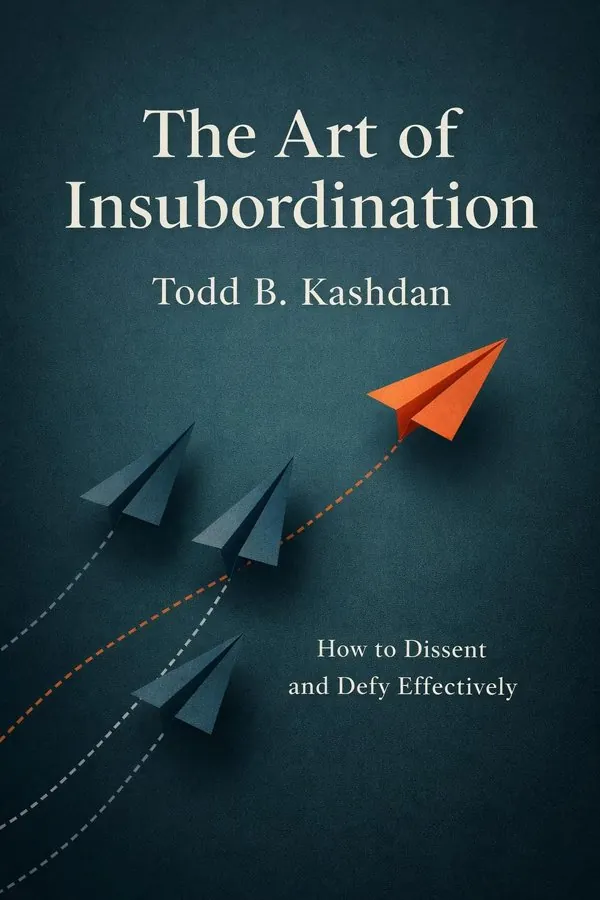
The Art of Insubordination: How to Dissent and Defy Effectively: Summary & Key Insights
 10 min9 chaptersAudio available
Key Takeaways from The Art of Insubordination: How to Dissent and Defy Effectively
Kashdan begins by examining the psychological forces that make dissent so difficult.
Courage is often romanticized as fearlessness, but Kashdan makes a more useful point: moral courage is acting in alignment with your values while fear is fully present.
Kashdan argues that effective dissent is a discipline, not an emotional outburst.
People are more willing to hear a hard truth from someone they trust.
One of the smartest ways to lower defensiveness is to replace immediate accusation with genuine curiosity.
What Is The Art of Insubordination: How to Dissent and Defy Effectively About?
The Art of Insubordination: How to Dissent and Defy Effectively by Todd B. Kashdan is a psychology book spanning 9 pages. Most people like to think they would speak up when it matters. In reality, conformity is powerful, silence is often rewarded, and dissent can feel socially dangerous. In The Art of Insubordination, psychologist Todd B. Kashdan argues that principled defiance is not reckless behavior but a vital human skill. The book examines how individuals can challenge bad norms, resist unhealthy authority, and question groupthink without becoming destructive, self-righteous, or ineffective. At its core, it is a guide to disagreeing with purpose. What makes this book especially valuable is Kashdan’s combination of psychological research and practical wisdom. Drawing on studies of conformity, courage, curiosity, identity, and resilience, he shows why people stay quiet even when they know something is wrong, and what separates impulsive rebellion from effective insubordination. He also explores how organizations and communities can benefit when dissent is welcomed rather than punished. For anyone who has ever hesitated to voice an unpopular truth, challenge a broken system, or defend a principle under pressure, this book offers both a framework and a set of tools for doing so with intelligence, influence, and courage.
This FizzRead summary covers all 9 key chapters of The Art of Insubordination: How to Dissent and Defy Effectively in approximately 10 minutes, distilling the most important ideas, arguments, and takeaways from Todd B. Kashdan's work. Also available as an audio summary and Key Quotes Podcast.
The Art of Insubordination: How to Dissent and Defy Effectively
Most people like to think they would speak up when it matters. In reality, conformity is powerful, silence is often rewarded, and dissent can feel socially dangerous. In The Art of Insubordination, psychologist Todd B. Kashdan argues that principled defiance is not reckless behavior but a vital human skill. The book examines how individuals can challenge bad norms, resist unhealthy authority, and question groupthink without becoming destructive, self-righteous, or ineffective. At its core, it is a guide to disagreeing with purpose.
What makes this book especially valuable is Kashdan’s combination of psychological research and practical wisdom. Drawing on studies of conformity, courage, curiosity, identity, and resilience, he shows why people stay quiet even when they know something is wrong, and what separates impulsive rebellion from effective insubordination. He also explores how organizations and communities can benefit when dissent is welcomed rather than punished. For anyone who has ever hesitated to voice an unpopular truth, challenge a broken system, or defend a principle under pressure, this book offers both a framework and a set of tools for doing so with intelligence, influence, and courage.
Who Should Read The Art of Insubordination: How to Dissent and Defy Effectively?
This book is perfect for anyone interested in psychology and looking to gain actionable insights in a short read. Whether you're a student, professional, or lifelong learner, the key ideas from The Art of Insubordination: How to Dissent and Defy Effectively by Todd B. Kashdan will help you think differently.
- ✓Readers who enjoy psychology and want practical takeaways
- ✓Professionals looking to apply new ideas to their work and life
- ✓Anyone who wants the core insights of The Art of Insubordination: How to Dissent and Defy Effectively in just 10 minutes
Want the full summary?
Get instant access to this book summary and 100K+ more with Fizz Moment.
Get Free SummaryAvailable on App Store • Free to download
Key Chapters
One of the most unsettling truths about human behavior is that people do not need to be forced into conformity; often, they drift into it because belonging feels safer than standing apart. Kashdan begins by examining the psychological forces that make dissent so difficult. Human beings are deeply social creatures, and our desire for approval, status, and connection shapes far more of our behavior than we typically admit. From classrooms to corporations to political movements, people routinely suppress doubts in order to avoid conflict, embarrassment, or exclusion.
This tendency is not simply weakness. It is built into how social life works. We use other people as cues for what is acceptable, intelligent, and safe. When everyone around us appears to agree, we infer that disagreement must be risky or foolish. In hierarchical settings, this effect becomes even stronger. If a leader expresses confidence, others may silence their own concerns, even when the evidence points elsewhere. That is how bad ideas survive, unethical practices spread, and preventable failures multiply.
Kashdan shows that conformity can be useful when it promotes coordination or trust, but it becomes dangerous when it numbs moral judgment and curiosity. Effective dissent begins with recognizing that the pressure to fit in is not a personal defect; it is a predictable social force. Once you understand that, you can prepare for it rather than be unconsciously ruled by it.
A practical example is the employee who notices a flawed proposal in a meeting but assumes others must know better. Instead of staying silent, the person can ask a clarifying question that surfaces uncertainty without triggering immediate defensiveness. Actionable takeaway: before entering any high-stakes group setting, identify one belief, concern, or question you are willing to voice so conformity does not make the decision for you.
Courage is often romanticized as fearlessness, but Kashdan makes a more useful point: moral courage is acting in alignment with your values while fear is fully present. The people who challenge injustice, resist corruption, or confront harmful norms are rarely calm or comfortable. What separates them is not the absence of anxiety but the willingness to move through it in service of something larger than self-protection.
Moral courage emerges from the combination of conviction and compassion. Conviction gives dissent direction. It answers the question, What principle am I standing for? Compassion ensures that dissent does not become ego-driven aggression. It asks, How can I challenge this problem without losing sight of the humanity of the people involved? Without conviction, people rationalize silence. Without compassion, they may become combative and ineffective.
Kashdan also emphasizes that courage is rarely a one-time grand gesture. More often, it is expressed in small acts: asking a difficult question, refusing to go along with an unethical shortcut, defending someone who is being marginalized, or naming what others are trying not to see. These moments accumulate, shaping identity over time. The more often people act in accordance with values under pressure, the more they come to see themselves as capable dissenters.
Consider a manager who notices bias in hiring discussions. Moral courage may not require a dramatic confrontation. It may begin with saying, “I want to make sure we are evaluating candidates by consistent criteria.” That statement anchors the conversation in fairness rather than accusation.
Actionable takeaway: define in writing the two or three values you would be willing to experience discomfort for. When a difficult moment arrives, let those values guide your response instead of waiting to feel brave.
Not all rebellion is useful. Kashdan argues that effective dissent is a discipline, not an emotional outburst. Many people assume that if they are morally right, their challenge will naturally be persuasive. In practice, dissent succeeds only when it is timed well, aimed clearly, and delivered strategically. Effective insubordination requires understanding not just what is wrong, but what kind of intervention will create the best chance of change.
The anatomy of effective dissent includes several elements. First, identify the target precisely. Are you resisting a policy, a behavior, a decision-making process, or a broader culture? Vague opposition creates confusion and invites dismissal. Second, distinguish between inconvenience and genuine principle. If every frustration becomes a moral emergency, your credibility erodes. Third, calibrate the form of dissent to the context. A private conversation, a public objection, a written record, or coordinated group action each sends a different signal and carries different risks.
Kashdan also highlights the difference between reactive defiance and constructive challenge. Reactive defiance is fueled by anger alone and often hardens opposition. Constructive challenge combines truth-telling with problem-solving. It is more likely to invite engagement because it exposes what is broken while pointing toward an alternative. In this way, dissent becomes a form of leadership rather than mere resistance.
For example, a teacher who objects to a harmful school rule will be more effective by documenting its effects on students, proposing a replacement, and recruiting allies than by simply denouncing administrators as uncaring. The substance may be the same, but the structure changes the outcome.
Actionable takeaway: before dissenting, answer three questions: What exactly am I challenging, what outcome do I want, and what method gives me the highest chance of being heard?
People are more willing to hear a hard truth from someone they trust. Kashdan stresses that dissent is not only about bravery; it is also about influence. A person may be completely justified and still fail if others perceive them as careless, hostile, uninformed, or self-serving. That is why credibility is one of the most important assets a dissenter can build before conflict ever arises.
Credibility grows from a pattern of competence, fairness, and restraint. When you are known for doing your work well, listening carefully, and choosing your battles thoughtfully, your objections carry more weight. Others infer that if you are speaking up now, something important must be at stake. In contrast, people who reflexively oppose everything often become easy to ignore, even when they are right.
Kashdan suggests that influence is strengthened when dissenters show they understand the larger goals of the group. Instead of positioning themselves as outsiders attacking the system, they can frame their concerns as efforts to protect the group’s mission, integrity, or long-term success. This does not mean becoming agreeable for appearance’s sake. It means demonstrating that your challenge emerges from investment rather than contempt.
An employee raising safety concerns, for instance, is more persuasive when they connect the issue to team performance, reputation, and human well-being rather than simply venting frustration. Likewise, a student questioning a rule will gain more support by showing respect for shared educational goals.
Credibility also depends on evidence. Stories matter, but facts, examples, and patterns make dissent harder to dismiss as personal emotion.
Actionable takeaway: strengthen your influence before you need it by becoming known as informed, fair, and mission-driven. Then, when you dissent, connect your objection to shared values and support it with concrete evidence.
One of the smartest ways to lower defensiveness is to replace immediate accusation with genuine curiosity. Kashdan, whose broader work often emphasizes curiosity as a psychological strength, shows how it can transform dissent from a threatening attack into an opening for reflection. This matters because people resist challenges not only because they disagree, but because they feel judged, cornered, or humiliated.
Curiosity-based dissent begins by asking questions that reveal assumptions, gaps, and unintended consequences. Questions such as “What evidence supports this approach?” or “How might this affect the people with the least power?” invite examination without requiring instant surrender. They also help the dissenter gather information. Sometimes what looks like negligence is actually a misunderstanding; other times, inquiry uncovers deeper problems than expected. Curiosity protects against simplistic narratives and increases the quality of the challenge.
This approach is especially effective in workplaces, families, and communities where relationships matter. Instead of saying, “This plan is irresponsible,” a leader might say, “Help me understand how we are accounting for these risks.” Instead of, “You are ignoring this problem,” a colleague could ask, “What concerns did we decide were acceptable here, and why?” These formulations preserve tension but make dialogue more possible.
Curiosity does not mean passivity. Kashdan is not suggesting that all conflict can be solved by asking polite questions. Rather, curiosity is a tactical and ethical choice: it improves the odds that others will stay engaged long enough to confront reality. When the facts are clear, stronger language may be necessary. But curiosity often gets you to that point more effectively.
Actionable takeaway: in your next disagreement, lead with two sincere questions before making your argument. Use inquiry to surface assumptions, clarify stakes, and create room for a more productive challenge.
A culture that punishes disagreement does not create harmony; it creates hidden errors, fake consensus, and quiet resentment. Kashdan argues that while individual courage matters, sustainable dissent depends on environments that make truth-telling safer and more normal. In healthy groups, disagreement is not treated as betrayal but as a necessary part of learning, accountability, and adaptation.
Leaders play an outsized role here. If managers, teachers, parents, or political figures react defensively whenever challenged, people quickly learn that silence is the wiser strategy. Over time, this creates brittle systems where only flattering information reaches the top. By contrast, leaders who reward candor, admit uncertainty, and invite challenge increase the group’s intelligence. Psychological safety does not mean everyone feels comfortable all the time; it means people believe they can raise concerns without being humiliated or punished unfairly.
Kashdan suggests practical ways to build such environments. Teams can create explicit norms for disagreement, assign someone to test assumptions, and debrief decisions by asking what was not said. Organizations can provide channels for confidential reporting while also encouraging open dialogue where possible. Families can normalize respectful disagreement by allowing children to question rules and explain their reasoning.
Importantly, a pro-dissent culture still requires standards. Not every objection is wise, informed, or constructive. The goal is not endless contrarianism but a system in which challenges are evaluated on their merits rather than suppressed for convenience.
A company launching a new product, for example, might designate a meeting segment specifically for identifying failure points. That simple ritual can prevent groupthink and elevate hidden concerns before they become public disasters.
Actionable takeaway: if you lead others, establish one recurring practice that legitimizes disagreement, such as a red-team review, anonymous feedback channel, or standing invitation for counterarguments.
Speaking up has consequences, and Kashdan does not romanticize them. Effective dissent often brings social friction, career risk, emotional exhaustion, and moments of self-doubt. Even when people admire courage in theory, they may react negatively when a dissenter disrupts comfort, threatens status, or exposes shared complicity. That is why resilience is not optional; it is part of the craft of insubordination.
Backlash can take many forms: being ignored, subtly excluded, publicly criticized, or privately labeled difficult. Sometimes the response is overt punishment; other times it is a gradual withdrawal of opportunities and support. Kashdan encourages readers to prepare psychologically for these reactions so they are not blindsided or demoralized by them. Expecting friction reduces the temptation to interpret resistance as proof that you were wrong to speak.
Resilience, however, is not stoic isolation. People sustain principled dissent by building support networks, documenting key interactions, recovering physically and emotionally, and separating identity from immediate outcomes. A setback does not always mean failure. Many important challenges succeed only after repeated attempts, shifting coalitions, and delayed recognition.
Kashdan also advises people to regulate their energy. Constant outrage leads to burnout and impulsive decisions. Sustainable dissent involves knowing when to push, when to pause, and when to find allies who can share the burden. A whistleblower, activist, or reform-minded employee is far more effective when they have strategic patience and emotional grounding.
For example, someone challenging a toxic policy at work may need to keep records, consult trusted colleagues, seek outside guidance, and set boundaries around stress rather than trying to fight alone on every front.
Actionable takeaway: create a resilience plan before taking a stand. Identify your allies, your recovery practices, your documentation strategy, and the signs that tell you it is time to rest or escalate.
The hardest part of dissent is often not the first act of defiance but the sustained commitment that follows. Kashdan closes the arc of his argument by treating courage as a practice that can be cultivated over time. People do not become effective dissenters through inspiration alone. They build the necessary muscles through repeated choices, reflection, and deliberate exposure to manageable risks.
This long-haul perspective matters because principled insubordination is emotionally and morally demanding. If your identity depends on always winning, always being praised, or always feeling certain, you will struggle to endure the ambiguity and resistance that dissent brings. Kashdan encourages readers to develop a more flexible inner posture: one that tolerates discomfort, learns from mistakes, and remains open to revision. Good dissenters are not merely stubborn; they are committed truth-seekers who can update their views without surrendering their integrity.
Practicing courage may include speaking earlier in meetings, having difficult one-on-one conversations, testing small acts of noncompliance with low stakes, and reflecting after each experience. What triggered fear? What worked? What would you do differently next time? Over time, these actions create a repertoire of skills and a stronger sense of agency.
Kashdan also connects this to meaning. People sustain difficult action when they see themselves as contributors to something larger than comfort or careerism. Dissent becomes less about dramatic rebellion and more about living coherently.
A practical example is someone who commits to voicing one honest concern each week in situations where they would normally stay quiet. That modest experiment can gradually reshape identity and confidence.
Actionable takeaway: treat courage like training. Start with small acts of principled honesty, review the results, and progressively increase the stakes so dissent becomes a habit rather than a rare emergency response.
All Chapters in The Art of Insubordination: How to Dissent and Defy Effectively
About the Author
Todd B. Kashdan is a psychologist, professor at George Mason University, and one of the leading public voices in contemporary positive psychology. His research focuses on curiosity, courage, well-being, meaning, and the ways people grow through uncertainty and challenge. Known for bridging rigorous science with practical insight, Kashdan has written widely for both academic and general audiences. He is the author of several books that explore human potential, emotional complexity, and purposeful living. In The Art of Insubordination, he brings together his expertise in psychology and behavior change to examine how people can resist conformity and challenge harmful systems effectively. His work is especially valued for showing that personal growth is not just about feeling good, but about acting with honesty, resilience, and conviction when it matters most.
Get This Summary in Your Preferred Format
Read or listen to the The Art of Insubordination: How to Dissent and Defy Effectively summary by Todd B. Kashdan anytime, anywhere. FizzRead offers multiple formats so you can learn on your terms — all free.
Available formats: App · Audio · PDF · EPUB — All included free with FizzRead
Download The Art of Insubordination: How to Dissent and Defy Effectively PDF and EPUB Summary
Key Quotes from The Art of Insubordination: How to Dissent and Defy Effectively
“One of the most unsettling truths about human behavior is that people do not need to be forced into conformity; often, they drift into it because belonging feels safer than standing apart.”
“Courage is often romanticized as fearlessness, but Kashdan makes a more useful point: moral courage is acting in alignment with your values while fear is fully present.”
“Kashdan argues that effective dissent is a discipline, not an emotional outburst.”
“People are more willing to hear a hard truth from someone they trust.”
“One of the smartest ways to lower defensiveness is to replace immediate accusation with genuine curiosity.”
Frequently Asked Questions about The Art of Insubordination: How to Dissent and Defy Effectively
The Art of Insubordination: How to Dissent and Defy Effectively by Todd B. Kashdan is a psychology book that explores key ideas across 9 chapters. Most people like to think they would speak up when it matters. In reality, conformity is powerful, silence is often rewarded, and dissent can feel socially dangerous. In The Art of Insubordination, psychologist Todd B. Kashdan argues that principled defiance is not reckless behavior but a vital human skill. The book examines how individuals can challenge bad norms, resist unhealthy authority, and question groupthink without becoming destructive, self-righteous, or ineffective. At its core, it is a guide to disagreeing with purpose. What makes this book especially valuable is Kashdan’s combination of psychological research and practical wisdom. Drawing on studies of conformity, courage, curiosity, identity, and resilience, he shows why people stay quiet even when they know something is wrong, and what separates impulsive rebellion from effective insubordination. He also explores how organizations and communities can benefit when dissent is welcomed rather than punished. For anyone who has ever hesitated to voice an unpopular truth, challenge a broken system, or defend a principle under pressure, this book offers both a framework and a set of tools for doing so with intelligence, influence, and courage.
More by Todd B. Kashdan

You Might Also Like

The Body Keeps the Score
Bessel van der Kolk
10 min
Surrounded by Idiots
Thomas Erikson
10 min
Emotional Intelligence
Daniel Goleman
10 min
Attached
Amir Levine
10 min
Why Does He Do That
Lundy Bancroft
10 min
Women Who Run with the Wolves
Clarissa Pinkola Estés
10 minBrowse by Category
Ready to read The Art of Insubordination: How to Dissent and Defy Effectively?
Get the full summary and 100K+ more books with Fizz Moment.