
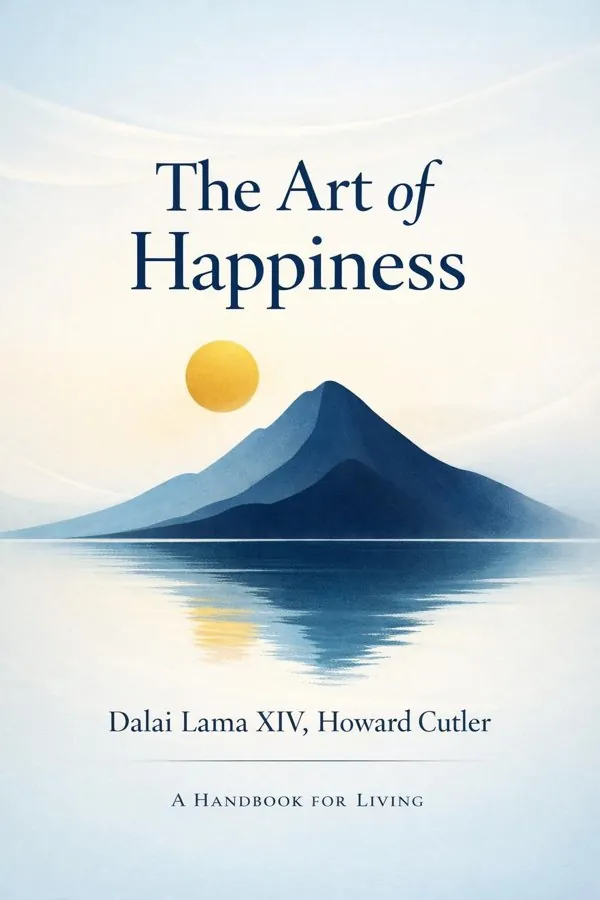
The Art of Happiness: A Handbook for Living: Summary & Key Insights
by Dalai Lama XIV, Howard Cutler
 10 min10 chaptersAudio available
What Is The Art of Happiness: A Handbook for Living About?
The Art of Happiness: A Handbook for Living by Dalai Lama XIV, Howard Cutler is a positive_psych book spanning 10 pages. The Art of Happiness es una guía práctica que combina las enseñanzas del Dalai Lama con la perspectiva psicológica del Dr. Howard Cutler. A través de conversaciones y reflexiones, el libro explora cómo alcanzar una vida más plena y feliz mediante la compasión, la paz interior y la comprensión de la mente humana.
This FizzRead summary covers all 10 key chapters of The Art of Happiness: A Handbook for Living in approximately 10 minutes, distilling the most important ideas, arguments, and takeaways from Dalai Lama XIV, Howard Cutler's work. Also available as an audio summary and Key Quotes Podcast.
The Art of Happiness: A Handbook for Living
The Art of Happiness es una guía práctica que combina las enseñanzas del Dalai Lama con la perspectiva psicológica del Dr. Howard Cutler. A través de conversaciones y reflexiones, el libro explora cómo alcanzar una vida más plena y feliz mediante la compasión, la paz interior y la comprensión de la mente humana.
Who Should Read The Art of Happiness: A Handbook for Living?
This book is perfect for anyone interested in positive_psych and looking to gain actionable insights in a short read. Whether you're a student, professional, or lifelong learner, the key ideas from The Art of Happiness: A Handbook for Living by Dalai Lama XIV, Howard Cutler will help you think differently.
- ✓Readers who enjoy positive_psych and want practical takeaways
- ✓Professionals looking to apply new ideas to their work and life
- ✓Anyone who wants the core insights of The Art of Happiness: A Handbook for Living in just 10 minutes
Want the full summary?
Get instant access to this book summary and 100K+ more with Fizz Moment.
Get Free SummaryAvailable on App Store • Free to download
Key Chapters
When people think of happiness, they often imagine success, wealth, or comfort. Yet, from my understanding, happiness begins with the mind. It is a mental state—a sense of inner balance and peace that does not rely on circumstances. Too often, we confuse pleasure for happiness. Pleasure is temporary and dependent on external conditions. Genuine happiness is enduring and arises when we train our mind to remain warm and open even amidst difficulty.
The key insight I wish to share is that our emotions shape our experience more than our surroundings. A person living modestly but with compassion may feel more fulfilled than someone surrounded by luxury but driven by greed or comparison. Happiness thus cannot be bought or granted; it must be cultivated through understanding and practice.
Through my discussions with Dr. Cutler, I emphasized how Western thought often associates happiness with emotional highs, while Buddhist thinking sees it as the stable calm that comes from inner equanimity. Inner peace is achieved when we restrain destructive emotions—anger, jealousy, fear—and nurture empathy and patience. The mind’s training is central because, without discipline, we become slaves to transient feelings.
Let us think of happiness as a skill. Like a musician mastering an instrument, we must practice each day, noticing how we react to life’s challenges and gently guiding ourselves toward compassion and reason. This kind of happiness is sustainable because it is not tied to the fleeting ups and downs of life—it is rooted in awareness and kindness.
What is the purpose of life? When asked this question, my answer has always been simple: the purpose of life is to seek happiness. Regardless of religion, culture, or background, all humans share this same aspiration. Every choice we make, ultimately, seeks to reduce suffering and bring joy.
But this happiness must be truly understood. To seek happiness is not to pursue selfish pleasure or escape from difficulty. It is to cultivate a mind that radiates well-being, a mind that finds joy in compassion and service. When we help others, when we offer understanding, we touch the deeper level of happiness that unites all beings.
Our purpose is therefore not to separate ourselves from others but to connect. True happiness is interdependent—it blossoms when we see our own well-being as bound to the well-being of those around us. When we recognize this mutual connection, life gains meaning beyond the pursuit of comfort or success.
I often tell people that spiritual development is not a luxury; it is a necessity. Without understanding our deeper purpose, we drift through life endlessly chasing goals that never satisfy. But when we realize that happiness itself is our purpose—and that compassion is its essence—we can structure our lives around what truly matters: inner peace, kindness, and wisdom.
+ 8 more chapters — available in the FizzRead app
All Chapters in The Art of Happiness: A Handbook for Living
About the Authors
El Dalai Lama XIV, líder espiritual del Tíbet, es reconocido mundialmente por su mensaje de paz, compasión y sabiduría. Howard Cutler es psiquiatra estadounidense y autor, conocido por su colaboración con el Dalai Lama en obras sobre la felicidad y la psicología.
Get This Summary in Your Preferred Format
Read or listen to the The Art of Happiness: A Handbook for Living summary by Dalai Lama XIV, Howard Cutler anytime, anywhere. FizzRead offers multiple formats so you can learn on your terms — all free.
Available formats: App · Audio · PDF · EPUB — All included free with FizzRead
Download The Art of Happiness: A Handbook for Living PDF and EPUB Summary
Key Quotes from The Art of Happiness: A Handbook for Living
“When people think of happiness, they often imagine success, wealth, or comfort.”
“When asked this question, my answer has always been simple: the purpose of life is to seek happiness.”
Frequently Asked Questions about The Art of Happiness: A Handbook for Living
The Art of Happiness: A Handbook for Living by Dalai Lama XIV, Howard Cutler is a positive_psych book that explores key ideas across 10 chapters. The Art of Happiness es una guía práctica que combina las enseñanzas del Dalai Lama con la perspectiva psicológica del Dr. Howard Cutler. A través de conversaciones y reflexiones, el libro explora cómo alcanzar una vida más plena y feliz mediante la compasión, la paz interior y la comprensión de la mente humana.
You Might Also Like
Don't Sweat the Small Stuff... and It's All Small Stuff
Richard Carlson
10 min
Option B
Sheryl Sandberg & Adam Grant
10 min
Hallelujah Anyway: Rediscovering Mercy
Anne Lamott
10 min
I Can Do It: How to Use Affirmations to Change Your Life
Louise Hay
10 min
The Coffee Bean: A Simple Lesson to Create Positive Change
Jon Gordon, Damon West
10 min
The Happiness Hypothesis: Finding Modern Truth in Ancient Wisdom
Jonathan Haidt
10 minBrowse by Category
Ready to read The Art of Happiness: A Handbook for Living?
Get the full summary and 100K+ more books with Fizz Moment.