
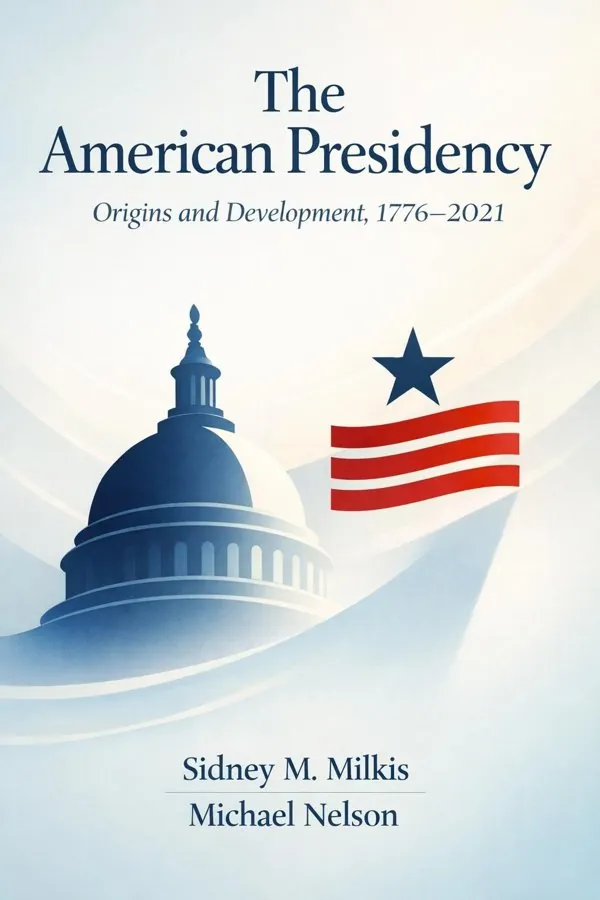
The American Presidency: Origins and Development, 1776–2021: Summary & Key Insights
by Sidney M. Milkis, Michael Nelson
 10 min13 chaptersAudio available
What Is The American Presidency: Origins and Development, 1776–2021 About?
The American Presidency: Origins and Development, 1776–2021 by Sidney M. Milkis, Michael Nelson is a politics book spanning 13 pages. This comprehensive study traces the evolution of the U.S. presidency from its constitutional origins to the modern era. It examines how historical, political, and institutional developments have shaped the office, exploring the balance between executive power and democratic accountability. The authors analyze key presidencies, policy transformations, and the changing relationship between the president, Congress, and the public.
This FizzRead summary covers all 13 key chapters of The American Presidency: Origins and Development, 1776–2021 in approximately 10 minutes, distilling the most important ideas, arguments, and takeaways from Sidney M. Milkis, Michael Nelson's work. Also available as an audio summary and Key Quotes Podcast.
The American Presidency: Origins and Development, 1776–2021
This comprehensive study traces the evolution of the U.S. presidency from its constitutional origins to the modern era. It examines how historical, political, and institutional developments have shaped the office, exploring the balance between executive power and democratic accountability. The authors analyze key presidencies, policy transformations, and the changing relationship between the president, Congress, and the public.
Who Should Read The American Presidency: Origins and Development, 1776–2021?
This book is perfect for anyone interested in politics and looking to gain actionable insights in a short read. Whether you're a student, professional, or lifelong learner, the key ideas from The American Presidency: Origins and Development, 1776–2021 by Sidney M. Milkis, Michael Nelson will help you think differently.
- ✓Readers who enjoy politics and want practical takeaways
- ✓Professionals looking to apply new ideas to their work and life
- ✓Anyone who wants the core insights of The American Presidency: Origins and Development, 1776–2021 in just 10 minutes
Want the full summary?
Get instant access to this book summary and 100K+ more with Fizz Moment.
Get Free SummaryAvailable on App Store • Free to download
Key Chapters
When George Washington took the oath of office in 1789, there was no blueprint for presidential behavior. Every decision—from how to address Congress to whether to dismiss cabinet officers—set a precedent. Washington’s greatest achievement was establishing the legitimacy of the presidency itself in a republic wary of concentrated power. He balanced authority with restraint, rejecting the trappings of monarchy while ensuring executive independence. His choice to retire voluntarily after two terms symbolized this balance, creating a tradition that would stand until Franklin Roosevelt’s time.
Washington understood that public trust was the true foundation of executive authority. His deliberate neutrality in foreign affairs and measured use of the veto demonstrated that the president could lead without dominating. Under him, the presidency acquired moral stature—an office representing civic virtue. His administration also revealed early tensions between executive and legislative prerogatives, setting the stage for ongoing debates about constitutional interpretation and political accountability.
John Adams and Thomas Jefferson followed Washington’s example while testing its boundaries. Adams’s struggle with factionalism and Jefferson’s triumph in the peaceful transfer of power in 1800 confirmed that the presidency could endure partisan change without collapsing. The era established essential norms of legitimacy: the president as guardian of the national interest and symbol of institutional continuity.
Jefferson’s vision of the presidency marked a profound shift toward democratic responsiveness. He saw himself as a servant of public will rather than a monarch above it. His informal style, preference for limited government, and commitment to republican simplicity contrasted sharply with Federalist elitism. Yet Jefferson’s purchase of Louisiana and his confrontations over judicial independence revealed the elastic boundaries of executive power—how even limited government required decisive leadership.
Andrew Jackson transformed this relationship further. Jackson embodied the rising democratic spirit of the 1820s, portraying himself as the champion of the common man against entrenched political elites. He asserted a direct link between the president and the people, redefining legitimacy in popular—not institutional—terms. His assertive use of the veto and defiance of judicial authority during the Bank War reconfigured executive politics. The presidency, in Jackson’s hands, became an office of opinion leadership and national representation, not mere administration.
With Jackson, democracy widened and politics roughened. His brand of leadership laid the groundwork for the mass party system and introduced the idea that presidents must speak for the nation even against established institutions. It also raised enduring questions about populism’s limits—where democratic responsiveness becomes authoritarian impulse. Jefferson and Jackson thus stand as architects of the people’s presidency, opening the path to modern political mobilization.
+ 11 more chapters — available in the FizzRead app
All Chapters in The American Presidency: Origins and Development, 1776–2021
About the Authors
Sidney M. Milkis is a professor of politics at the University of Virginia, specializing in American political development and the presidency. Michael Nelson is a professor of political science at Rhodes College and a senior fellow at the University of Virginia’s Miller Center, known for his extensive scholarship on the American presidency and political institutions.
Get This Summary in Your Preferred Format
Read or listen to the The American Presidency: Origins and Development, 1776–2021 summary by Sidney M. Milkis, Michael Nelson anytime, anywhere. FizzRead offers multiple formats so you can learn on your terms — all free.
Available formats: App · Audio · PDF · EPUB — All included free with FizzRead
Download The American Presidency: Origins and Development, 1776–2021 PDF and EPUB Summary
Key Quotes from The American Presidency: Origins and Development, 1776–2021
“When George Washington took the oath of office in 1789, there was no blueprint for presidential behavior.”
“Jefferson’s vision of the presidency marked a profound shift toward democratic responsiveness.”
Frequently Asked Questions about The American Presidency: Origins and Development, 1776–2021
The American Presidency: Origins and Development, 1776–2021 by Sidney M. Milkis, Michael Nelson is a politics book that explores key ideas across 13 chapters. This comprehensive study traces the evolution of the U.S. presidency from its constitutional origins to the modern era. It examines how historical, political, and institutional developments have shaped the office, exploring the balance between executive power and democratic accountability. The authors analyze key presidencies, policy transformations, and the changing relationship between the president, Congress, and the public.
You Might Also Like

Antifa: The Anti-Fascist Handbook
Mark Bray
10 min
Attack from Within: How Disinformation Is Sabotaging America
Barbara McQuade
10 min
Coercion, Capital, and European States, AD 990–1992
Charles Tilly
10 min
Digital Democracy: Concepts, Methodologies, Tools, and Applications
Various Authors
10 min
Fascism
Stanley G. Payne
10 min
Fire And Fury: Inside The Trump White House
Michael Wolff
10 minBrowse by Category
Ready to read The American Presidency: Origins and Development, 1776–2021?
Get the full summary and 100K+ more books with Fizz Moment.