
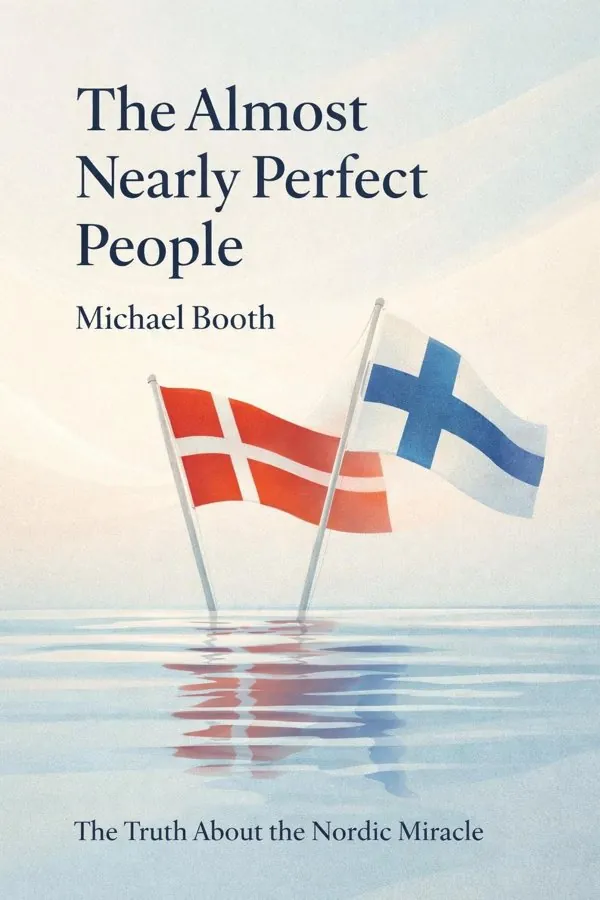
The Almost Nearly Perfect People: The Truth About the Nordic Miracle: Summary & Key Insights
 10 min9 chaptersAudio available
What Is The Almost Nearly Perfect People: The Truth About the Nordic Miracle About?
The Almost Nearly Perfect People: The Truth About the Nordic Miracle by Michael Booth is a sociology book spanning 9 pages. A witty and insightful travelogue by British journalist Michael Booth that explores the myths and realities behind the Nordic countries’ reputation for happiness, equality, and social perfection. Booth travels through Denmark, Norway, Sweden, Finland, and Iceland, uncovering cultural quirks, political contradictions, and human stories that challenge the idea of a flawless Scandinavian utopia.
This FizzRead summary covers all 9 key chapters of The Almost Nearly Perfect People: The Truth About the Nordic Miracle in approximately 10 minutes, distilling the most important ideas, arguments, and takeaways from Michael Booth's work. Also available as an audio summary and Key Quotes Podcast.
The Almost Nearly Perfect People: The Truth About the Nordic Miracle
A witty and insightful travelogue by British journalist Michael Booth that explores the myths and realities behind the Nordic countries’ reputation for happiness, equality, and social perfection. Booth travels through Denmark, Norway, Sweden, Finland, and Iceland, uncovering cultural quirks, political contradictions, and human stories that challenge the idea of a flawless Scandinavian utopia.
Who Should Read The Almost Nearly Perfect People: The Truth About the Nordic Miracle?
This book is perfect for anyone interested in sociology and looking to gain actionable insights in a short read. Whether you're a student, professional, or lifelong learner, the key ideas from The Almost Nearly Perfect People: The Truth About the Nordic Miracle by Michael Booth will help you think differently.
- ✓Readers who enjoy sociology and want practical takeaways
- ✓Professionals looking to apply new ideas to their work and life
- ✓Anyone who wants the core insights of The Almost Nearly Perfect People: The Truth About the Nordic Miracle in just 10 minutes
Want the full summary?
Get instant access to this book summary and 100K+ more with Fizz Moment.
Get Free SummaryAvailable on App Store • Free to download
Key Chapters
My exploration began at home, in Denmark, where the world’s “happiest people” live—at least according to countless surveys. The Danish model is indeed enviable: universal education and healthcare, a robust safety net, and an instinctive sense of equity that underpins public life. Yet when one scratches the surface of this serenity, paradoxes emerge. Denmark’s famed hygge, that cozy state of contentment achieved through soft lighting and companionship, symbolizes the national commitment to comfort and belonging. But it also cloaks a certain social rigidity, an unspoken rule that one must not stand out or disturb the collective calm.
Living here, I often sensed a stifling complacency—a pride so internalized that it bordered on self-congratulation. Danes trust their government almost unconditionally, confident that their system reflects moral virtue. But trust can breed laziness of thought. When equality is achieved mainly through taxation and social policy, personal initiative can sometimes feel subdued. Moreover, the social cohesion that binds the Danes can also exclude. Immigrants and outsiders often find it difficult to penetrate the cultural wall of informality and insider humor. The famed Jante Law, an unwritten code discouraging boastfulness or ambition, keeps everyone humble—but perhaps too humble.
The paradox of Denmark, I concluded, is this: its citizens’ happiness is genuine, but fragile. It thrives on smallness—on the sense that everyone knows, and more importantly, behaves like, everyone else. That intimacy is beautiful, but it demands conformity. Denmark’s lesson is not that utopia has been achieved, but that comfort, once institutionalized, becomes its own constraint.
Crossing into Norway, I encountered a different kind of perfection—the perfection of prosperity. The discovery of oil transformed Norway from an austere Nordic sibling into an energy superpower. Yet what impressed me most was not the wealth itself but how cautiously and conscientiously it is managed. The Norwegian oil fund, designed to prevent the country from succumbing to ‘Dutch disease,’ stands as a moral as well as economic achievement—a disciplined attempt to preserve fairness across generations.
But wealth changes psychology, even when handled responsibly. Norwegians, descendants of fishermen and farmers who once scraped survival from mountain and sea, now live in a society so successful it struggles to define ambition anew. A deep cultural modesty persists, a Lutheran echo that discourages display and excess. Yet behind this modesty lies unease: what happens when a people who pride themselves on industriousness no longer need to work as hard? In outlying regions, I found loneliness and disconnection, a lingering sense that prosperity had thinned communal bonds.
Norway’s restraint is admirable, but it carries its own social toll. Norwegians, perhaps more than any of their Nordic neighbors, guard their privacy fiercely. Their landscape reflects their character—majestic but aloof. Conversations are deliberate, formality veiling a warm, if sparing, generosity. My time there reminded me that independence, even amid abundance, can be a kind of isolation. Norway’s miracle, then, is not wealth itself, but its persistent questioning of what wealth is for.
+ 7 more chapters — available in the FizzRead app
All Chapters in The Almost Nearly Perfect People: The Truth About the Nordic Miracle
About the Author
Michael Booth is a British journalist, travel writer, and author known for his humorous and critical takes on European culture. He has written for major publications such as The Guardian and The Independent, and his books often blend reportage with cultural analysis.
Get This Summary in Your Preferred Format
Read or listen to the The Almost Nearly Perfect People: The Truth About the Nordic Miracle summary by Michael Booth anytime, anywhere. FizzRead offers multiple formats so you can learn on your terms — all free.
Available formats: App · Audio · PDF · EPUB — All included free with FizzRead
Download The Almost Nearly Perfect People: The Truth About the Nordic Miracle PDF and EPUB Summary
Key Quotes from The Almost Nearly Perfect People: The Truth About the Nordic Miracle
“My exploration began at home, in Denmark, where the world’s “happiest people” live—at least according to countless surveys.”
“Crossing into Norway, I encountered a different kind of perfection—the perfection of prosperity.”
Frequently Asked Questions about The Almost Nearly Perfect People: The Truth About the Nordic Miracle
The Almost Nearly Perfect People: The Truth About the Nordic Miracle by Michael Booth is a sociology book that explores key ideas across 9 chapters. A witty and insightful travelogue by British journalist Michael Booth that explores the myths and realities behind the Nordic countries’ reputation for happiness, equality, and social perfection. Booth travels through Denmark, Norway, Sweden, Finland, and Iceland, uncovering cultural quirks, political contradictions, and human stories that challenge the idea of a flawless Scandinavian utopia.
You Might Also Like

Between the World and Me
Ta-Nehisi Coates
10 min
Half the Sky
Nicholas D. Kristof, Sheryl WuDunn
10 min
Men Explain Things To Me
Rebecca Solnit
10 min
Rational Ritual
Michael Suk-Young Chwe
10 min
The New Jim Crow
Michelle Alexander
10 min
Beyond Culture
Edward T. Hall
10 minBrowse by Category
Ready to read The Almost Nearly Perfect People: The Truth About the Nordic Miracle?
Get the full summary and 100K+ more books with Fizz Moment.