
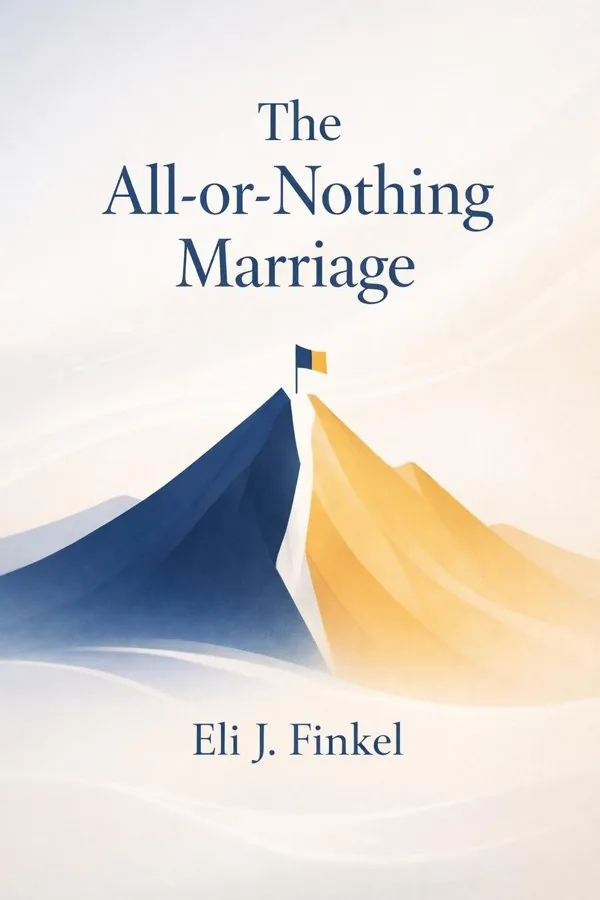
The All-or-Nothing Marriage: How the Best Marriages Work: Summary & Key Insights
 10 min10 chaptersAudio available
Key Takeaways from The All-or-Nothing Marriage: How the Best Marriages Work
One of the most revealing truths about marriage is that what we expect from it today would have seemed astonishing to people in earlier centuries.
A modern marriage often succeeds or fails not because couples lack love, but because they expect love to do more than it was ever designed to do.
The cruel irony of modern marriage is that the more we ask of it, the more likely we are to starve it of the conditions it needs to succeed.
A marriage cannot consistently deliver transcendence when it is failing at the basics.
Sometimes the healthiest move in marriage is not to ask for more, but to ask for less in the right way.
What Is The All-or-Nothing Marriage: How the Best Marriages Work About?
The All-or-Nothing Marriage: How the Best Marriages Work by Eli J. Finkel is a relationships book spanning 10 pages. In The All-or-Nothing Marriage, psychologist Eli J. Finkel argues that modern marriage has become both more demanding and more rewarding than at any point in history. Where marriage once centered on economic survival, social order, or basic companionship, many couples today expect their partner to help them feel understood, fulfilled, and fully realized. That shift has created extraordinary possibilities for intimacy, but it has also placed enormous pressure on relationships that are often under-resourced and overstretched. Finkel’s core insight is not that marriage is failing, but that expectations have risen faster than the time, energy, and psychological skills couples bring to it. Drawing on decades of social science, historical analysis, and relationship research, he explains why some marriages thrive under these conditions while others feel chronically disappointing. The book matters because it replaces vague romantic advice with a clear framework: lower your expectations in the right areas, invest deeply in the right moments, and build a marriage that supports growth without collapsing under impossible demands. For anyone trying to create a more resilient, meaningful partnership, Finkel offers both realism and hope.
This FizzRead summary covers all 10 key chapters of The All-or-Nothing Marriage: How the Best Marriages Work in approximately 10 minutes, distilling the most important ideas, arguments, and takeaways from Eli J. Finkel's work. Also available as an audio summary and Key Quotes Podcast.
The All-or-Nothing Marriage: How the Best Marriages Work
In The All-or-Nothing Marriage, psychologist Eli J. Finkel argues that modern marriage has become both more demanding and more rewarding than at any point in history. Where marriage once centered on economic survival, social order, or basic companionship, many couples today expect their partner to help them feel understood, fulfilled, and fully realized. That shift has created extraordinary possibilities for intimacy, but it has also placed enormous pressure on relationships that are often under-resourced and overstretched. Finkel’s core insight is not that marriage is failing, but that expectations have risen faster than the time, energy, and psychological skills couples bring to it. Drawing on decades of social science, historical analysis, and relationship research, he explains why some marriages thrive under these conditions while others feel chronically disappointing. The book matters because it replaces vague romantic advice with a clear framework: lower your expectations in the right areas, invest deeply in the right moments, and build a marriage that supports growth without collapsing under impossible demands. For anyone trying to create a more resilient, meaningful partnership, Finkel offers both realism and hope.
Who Should Read The All-or-Nothing Marriage: How the Best Marriages Work?
This book is perfect for anyone interested in relationships and looking to gain actionable insights in a short read. Whether you're a student, professional, or lifelong learner, the key ideas from The All-or-Nothing Marriage: How the Best Marriages Work by Eli J. Finkel will help you think differently.
- ✓Readers who enjoy relationships and want practical takeaways
- ✓Professionals looking to apply new ideas to their work and life
- ✓Anyone who wants the core insights of The All-or-Nothing Marriage: How the Best Marriages Work in just 10 minutes
Want the full summary?
Get instant access to this book summary and 100K+ more with Fizz Moment.
Get Free SummaryAvailable on App Store • Free to download
Key Chapters
One of the most revealing truths about marriage is that what we expect from it today would have seemed astonishing to people in earlier centuries. For most of human history, marriage was not primarily about romance, deep friendship, or self-discovery. It was a practical institution shaped by survival, property, labor, kinship, and social stability. Spouses often depended on one another to run a household, raise children, manage land, or preserve family alliances. Love could exist, but it was not the institution’s central purpose.
Finkel traces a broad evolution in marriage. In preindustrial societies, marriage helped people meet basic needs such as food, shelter, protection, and reproduction. As economic and social structures changed, especially during industrialization, marriage gradually became more companionate. People began to value emotional closeness, affection, and mutual support more explicitly. In the modern era, however, marriage has gone a step further. It has become what Finkel calls self-expressive: a relationship expected to help us become our best selves.
This historical lens matters because it explains a common modern confusion. Many people judge their marriages harshly without recognizing that they are asking one relationship to perform functions once distributed across family, community, religion, and work. We want our spouse to be co-parent, confidant, lover, therapist, cheerleader, adventure partner, and witness to our growth. That is an extraordinary burden for any institution.
A practical application is simple but powerful: discuss with your partner how your expectations compare to those of earlier generations and to your own family background. Often, conflict softens when couples realize they are not merely clashing over chores or affection, but over competing models of what marriage is for.
Actionable takeaway: Stop treating your expectations as timeless facts; examine them as historical products and decide together which ones truly belong in your marriage.
A modern marriage often succeeds or fails not because couples lack love, but because they expect love to do more than it was ever designed to do. Finkel’s concept of the self-expressive marriage captures a defining feature of contemporary relationships: we no longer want marriage merely to provide stability or companionship. We want it to foster authenticity, self-esteem, purpose, and personal transformation.
This shift is not entirely misguided. At its best, marriage can indeed become a powerful context for growth. A supportive spouse can encourage courage during career transitions, emotional healing after loss, or moral development through honest feedback and deep trust. Great marriages do not just comfort us; they can elevate us. In this sense, modern marriage offers possibilities that earlier eras rarely imagined.
But the self-expressive model contains a hidden risk. When a marriage becomes the primary site of self-actualization, normal disappointments feel existential. A missed conversation is no longer just a missed conversation; it feels like evidence that the relationship is failing its deepest purpose. Partners may also place unrealistic pressure on each other to be constantly insightful, emotionally available, and inspiring.
Consider a couple in which one partner wants ambitious discussions about dreams, meaning, and personal growth every evening, while the other is mentally depleted from work and parenting. The issue is not simply neglect. It may reflect a mismatch between aspiration and available resources. Finkel’s point is that self-expressive marriage can be extraordinary, but only if couples understand its costs.
Actionable takeaway: Identify one area where you hope your marriage helps you grow, and one area where you may be overloading it with expectations. Protect the first and lighten the second.
The cruel irony of modern marriage is that the more we ask of it, the more likely we are to starve it of the conditions it needs to succeed. Finkel calls this dynamic the suffocation model. The idea is straightforward: contemporary couples place historically high expectations on marriage while often devoting historically low amounts of time, focus, and psychological energy to nurturing it. The relationship then struggles not because the goals are inherently wrong, but because the support system is too weak.
In earlier eras, spouses may have expected less emotional fulfillment from marriage. Today, by contrast, people hope marriage will deliver intimacy, excitement, affirmation, sexual satisfaction, parenting coordination, and personal growth. Yet many couples are overworked, digitally distracted, financially stressed, and socially fragmented. They want a high-performance relationship while operating under chronic depletion.
This mismatch can suffocate connection. Partners become more likely to misread each other, to default to impatience, and to reserve only leftovers for the relationship. A couple may say they value emotional intimacy, yet spend evenings multitasking through screens, logistics, and fatigue. Over time, their marriage carries more pressure and receives less oxygen.
The suffocation model is useful because it reframes blame. Instead of asking, “Why are we failing at marriage?” couples can ask, “What are we demanding from our marriage, and what resources are we actually providing?” This creates a more compassionate and practical conversation.
A concrete example is scheduling energy, not just time. A Friday-night date after an exhausting week may produce conflict, while a Saturday morning walk may produce warmth and reflection. The same couple, the same love, but different conditions.
Actionable takeaway: Make a list of your top three expectations for your marriage, then match each one with a real investment of time, attention, or ritual. If the investment is missing, the expectation may be suffocating the bond.
A marriage cannot consistently deliver transcendence when it is failing at the basics. Finkel applies Maslow’s hierarchy of needs to intimate relationships, showing that marriages, like individuals, function best when lower-level needs are met before higher-level aspirations can flourish. This is one of the book’s most practical frameworks because it helps couples understand why inspirational goals often collapse under ordinary strain.
At the base of the hierarchy are survival-oriented concerns: safety, stability, and predictable cooperation. In marital terms, this can include financial reliability, respectful behavior, physical safety, shared responsibility, and basic trust. Above that are needs for love and belonging: affection, companionship, responsiveness, and emotional support. Only when these levels are reasonably secure can couples effectively pursue higher aims such as esteem, growth, self-expression, and mutual self-actualization.
The mistake many modern couples make is aiming immediately for the top. They want profound conversations about purpose and identity while struggling with unresolved resentment about chores, childcare, debt, or dismissive communication. Finkel does not argue that couples should abandon lofty ambitions. He argues that they must build a sturdy platform for them.
Imagine a couple frustrated that their relationship no longer feels inspiring. They may sign up for a retreat or read books about deeper intimacy, yet continue interrupting each other, avoiding practical planning, and leaving everyday burdens unevenly distributed. The problem is not a lack of spiritual depth. It is instability lower in the hierarchy.
This framework also helps partners avoid contempt. If one spouse is focused on practical order while the other craves emotional or existential depth, neither is necessarily shallow. They may simply be responding to different levels of unmet need.
Actionable takeaway: Ask together, “What level of the marriage hierarchy most needs attention right now: stability, connection, or growth?” Strengthen the lowest shaky layer before demanding the highest one.
Sometimes the healthiest move in marriage is not to ask for more, but to ask for less in the right way. Finkel’s recalibration strategy does not mean lowering standards or settling for mediocrity. It means adjusting expectations so that they align with reality, context, and the true purpose of the relationship. Many marriages improve not through dramatic interventions, but through the relief that comes when partners stop demanding perfection from each other.
Recalibration is especially important during seasons of scarcity. New parenthood, job loss, illness, caregiving, relocation, and chronic stress can sharply reduce what a couple can offer. If partners continue measuring the relationship against a fantasy standard, frustration grows. But if they consciously redefine success for that season, they protect goodwill and reduce avoidable disappointment.
For example, a couple who once enjoyed long reflective dinners may now be juggling toddlers and sleep deprivation. Recalibration might mean accepting that intimacy currently looks like ten minutes of genuine conversation, a shared laugh in the kitchen, or a weekly check-in rather than constant emotional depth. This is not failure. It is strategic adaptation.
Finkel’s argument is liberating because unrealistic expectations often masquerade as devotion. We think asking more proves that the relationship matters. In reality, wisdom sometimes means discerning which desires are essential and which are burdensome. Recalibration also helps spouses distinguish character issues from capacity limits. A partner may not be uncaring; they may be overwhelmed.
This strategy requires communication. Couples need explicit conversations about what they can reasonably expect from each other in a given chapter of life. Without that clarity, people silently accumulate resentment over promises no one actually made.
Actionable takeaway: Define one “good enough for now” standard in your marriage this month. Choose a realistic version of connection, support, or romance that protects the relationship instead of punishing it.
You do not need to transform every minute of married life to transform the marriage. One of Finkel’s most encouraging ideas is the optimization strategy: because time and energy are limited, couples should invest intentionally in the moments that yield the greatest relational return. Rather than trying to be ideal partners at all times, they can become better at key interactions that shape trust, closeness, and resilience.
Optimization recognizes a basic reality. Most couples cannot sustain peak emotional engagement constantly, nor do they need to. What matters is identifying the situations where care, responsiveness, and generosity have outsize effects. These might include how partners greet each other after work, how they handle conflict escalation, how they respond to bids for attention, or how they mark important transitions and achievements.
Research supports the idea that small moments matter enormously. A warm response to a partner’s good news can deepen intimacy. A brief ritual of reunion can reduce accumulated distance. A skillful repair attempt during an argument can prevent hours of emotional fallout. In other words, targeted effort often beats vague good intentions.
Imagine a couple who feel disconnected. They may not be able to schedule elaborate date nights each week, but they can create a non-negotiable ten-minute evening ritual with no phones, ask one meaningful question, and end with physical affection. Or they can commit to pausing conflicts before contempt appears. These interventions are modest yet potent.
Optimization is also about timing. The best moment to invest may be when your partner is vulnerable, proud, discouraged, or reaching toward you in a subtle way. Missing those moments repeatedly creates distance; meeting them builds security.
Actionable takeaway: Choose two recurring moments in your week that matter disproportionately, and upgrade them deliberately with full attention, warmth, and consistency.
Good marriages are not built only on feeling; they are built on habits of interpretation, communication, and response. Finkel integrates decades of relationship science to show that thriving couples often use practical psychological tools, whether consciously or not. These tools do not eliminate conflict, but they reduce unnecessary damage and make intimacy more sustainable.
One important tool is charitable interpretation. In strained relationships, people often assign the harshest motive to their partner’s behavior: “You ignored me because you do not care,” or “You forgot because I am not important.” Happier couples are more likely to pause and consider benign explanations, especially when the offense is minor. This does not mean excusing serious problems. It means not turning every disappointment into a moral verdict.
Another tool is active responsiveness. People feel loved when their partner seems to understand, validate, and care about their inner experience. That can happen in conflict, but also in ordinary conversation. Listening carefully, asking follow-up questions, and reflecting emotion are simple behaviors with profound effects.
Finkel also highlights the value of perspective-taking and strategic self-control. Many regrettable marital moments occur not because people lack love, but because they react from ego threat, stress, or fatigue. Taking a pause, lowering physiological arousal, or revisiting a conversation later can preserve dignity and clarity.
A useful application is creating a repair script. For instance: “I think I’m getting defensive. Let me slow down. I want to understand what hurt you.” Such language interrupts escalation and invites collaboration.
Science-based tools matter because they convert abstract commitment into repeatable behavior. Love becomes visible in how couples explain each other, soothe tension, and respond to emotional bids.
Actionable takeaway: This week, practice one skill consistently: assume a kinder explanation, respond more actively to good news, or use a pause-and-repair script during tension.
A marriage becomes fragile when it is expected to provide everything. One of Finkel’s most sensible insights is that healthy relationships are strengthened, not threatened, by robust external networks. Friends, relatives, mentors, coworkers, communities, and meaningful institutions all help carry emotional, practical, and identity-related burdens that modern couples often place solely on each other.
This matters because the self-expressive marriage can become isolating. If your spouse is your only confidant, your sole emotional refuge, your primary social life, and your exclusive source of affirmation, the relationship may become overloaded. Even a loving partner can feel trapped under that weight. External support systems distribute pressure and enrich the marriage indirectly.
A friend may provide perspective your spouse cannot offer. A sibling may share family responsibilities. A therapist may help with wounds too sensitive or entrenched to resolve alone. A faith community, neighborhood circle, or parenting network may provide belonging and practical help. These connections do not compete with marriage; they create the conditions under which marriage can breathe.
Consider a couple under chronic childcare stress. If they rely only on each other, resentment may build quickly. But if grandparents help occasionally, friends provide emotional companionship, and each partner has at least one trusted person outside the marriage, the relationship gains resilience. The spouse no longer has to be the entire village.
There is also an identity benefit. People who maintain meaningful lives beyond marriage often bring more vitality back into it. They are less likely to treat every unmet need as marital failure and more likely to approach the relationship with generosity.
Actionable takeaway: Strengthen one support channel outside your marriage this month, whether through friendship, family, community, counseling, or shared networks that reduce pressure on the partnership.
What works in one season of marriage may fail in the next. Finkel emphasizes that successful couples are not those who discover a perfect formula and repeat it forever, but those who remain flexible as circumstances, identities, and needs evolve. Marriage is a moving target because life is a moving target.
Flexibility begins with accepting change as normal rather than threatening. Careers shift, bodies age, children arrive, parents decline, ambitions grow or shrink, and emotional capacities fluctuate. A rigid marriage script can turn these changes into crises. A flexible marriage treats them as invitations to renegotiate how love is expressed and how partnership is organized.
For example, a couple may begin marriage with abundant spontaneity, then later need more structure to protect connection amid parenting demands. Another couple may thrive on constant togetherness early on, then discover that individual space improves warmth and desire. Flexibility means noticing these developments without assuming that adaptation signals decline.
This principle is especially important in conflict. Partners often fight not because one is wrong and the other right, but because both are defending an outdated model of the relationship. One still expects the rhythms of pre-parenthood; the other has silently adjusted to survival mode. Flexibility allows couples to update agreements explicitly rather than punish each other for changing.
Finkel’s view is grounded in realism. Human beings are dynamic, and marriage must be dynamic too. The strongest unions combine commitment with revision. They preserve core values while altering habits, expectations, and structures to meet present realities.
Actionable takeaway: Schedule a seasonal marriage review. Ask: What has changed in our lives, what no longer works, and what new arrangement would better fit who we are now?
The central paradox of modern marriage is that it can become one of the richest sources of human flourishing precisely when couples stop expecting it to do everything all the time. Finkel’s broader contribution is not simply a set of tips, but a balanced philosophy. He rejects both cynicism and romantic excess. Marriage should not be reduced to a mere contract for logistics, but neither should it be idealized into an all-purpose engine of permanent fulfillment.
The best marriages, in Finkel’s account, are ambitious but grounded. They aim for deep friendship, emotional responsiveness, erotic vitality, and mutual growth. Yet they also respect human limits. They recognize that stress narrows capacity, that no partner can perfectly mirror every need, and that sustainable intimacy requires prioritization. This is where many couples go wrong: they either give up on higher possibilities or pursue them so relentlessly that the relationship collapses under pressure.
A balanced marriage asks discerning questions. When should we stretch toward growth, and when should we simplify? Which desires are central to our shared life, and which can be met elsewhere or later? How do we protect tenderness when resources are low? This orientation allows couples to pursue excellence selectively and mercifully.
In practical terms, balance may mean preserving one sacred ritual, letting go of performative relationship standards, seeking outside help when necessary, and revisiting expectations as life changes. It also means viewing marriage as a collaborative project rather than a passive source of happiness.
Finkel ultimately shows that extraordinary marriages are possible, but not by accident. They emerge when couples understand the historical burden placed on modern marriage and respond with skill, intentionality, and compassion.
Actionable takeaway: Build a marriage philosophy together in one sentence, combining aspiration and realism, such as: “We want a growth-oriented marriage that stays kind, flexible, and realistic under pressure.”
All Chapters in The All-or-Nothing Marriage: How the Best Marriages Work
About the Author
Eli J. Finkel is an American psychologist, professor at Northwestern University, and director of the Relationships and Motivation Lab. His research focuses on romantic relationships, close relationships, self-control, and the ways people pursue connection and personal growth through intimacy. Known for combining rigorous academic work with accessible writing, Finkel has published extensively in leading psychology journals and has become a respected voice in relationship science. In The All-or-Nothing Marriage, he draws on years of empirical research to explain how marriage has changed across history and why modern couples often place unprecedented demands on the institution. His work stands out for its balance of scientific credibility, cultural insight, and practical usefulness for people seeking stronger, more realistic, and more fulfilling relationships.
Get This Summary in Your Preferred Format
Read or listen to the The All-or-Nothing Marriage: How the Best Marriages Work summary by Eli J. Finkel anytime, anywhere. FizzRead offers multiple formats so you can learn on your terms — all free.
Available formats: App · Audio · PDF · EPUB — All included free with FizzRead
Download The All-or-Nothing Marriage: How the Best Marriages Work PDF and EPUB Summary
Key Quotes from The All-or-Nothing Marriage: How the Best Marriages Work
“One of the most revealing truths about marriage is that what we expect from it today would have seemed astonishing to people in earlier centuries.”
“A modern marriage often succeeds or fails not because couples lack love, but because they expect love to do more than it was ever designed to do.”
“The cruel irony of modern marriage is that the more we ask of it, the more likely we are to starve it of the conditions it needs to succeed.”
“A marriage cannot consistently deliver transcendence when it is failing at the basics.”
“Sometimes the healthiest move in marriage is not to ask for more, but to ask for less in the right way.”
Frequently Asked Questions about The All-or-Nothing Marriage: How the Best Marriages Work
The All-or-Nothing Marriage: How the Best Marriages Work by Eli J. Finkel is a relationships book that explores key ideas across 10 chapters. In The All-or-Nothing Marriage, psychologist Eli J. Finkel argues that modern marriage has become both more demanding and more rewarding than at any point in history. Where marriage once centered on economic survival, social order, or basic companionship, many couples today expect their partner to help them feel understood, fulfilled, and fully realized. That shift has created extraordinary possibilities for intimacy, but it has also placed enormous pressure on relationships that are often under-resourced and overstretched. Finkel’s core insight is not that marriage is failing, but that expectations have risen faster than the time, energy, and psychological skills couples bring to it. Drawing on decades of social science, historical analysis, and relationship research, he explains why some marriages thrive under these conditions while others feel chronically disappointing. The book matters because it replaces vague romantic advice with a clear framework: lower your expectations in the right areas, invest deeply in the right moments, and build a marriage that supports growth without collapsing under impossible demands. For anyone trying to create a more resilient, meaningful partnership, Finkel offers both realism and hope.
You Might Also Like
The 5 Love Languages
Gary Chapman
10 min
Men Are from Mars, Women Are from Venus
John Gray
10 min
She Comes First
Ian Kerner
10 min
No More Mr Nice Guy
Robert Glover
10 min
Hold Me Tight
Sue Johnson
10 min
Mating in Captivity
Esther Perel
10 minBrowse by Category
Ready to read The All-or-Nothing Marriage: How the Best Marriages Work?
Get the full summary and 100K+ more books with Fizz Moment.