
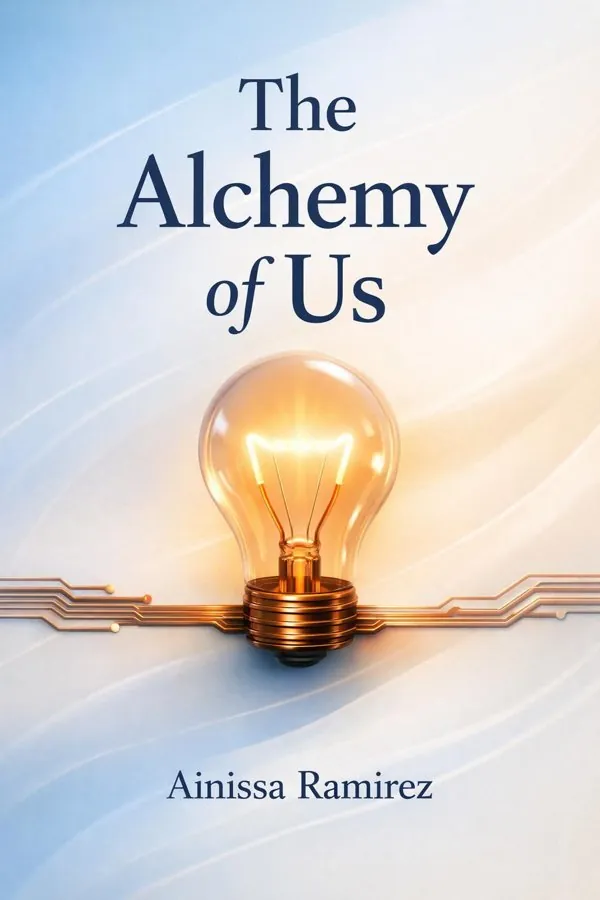
The Alchemy of Us: How Humans and Matter Transformed One Another: Summary & Key Insights
 10 min9 chaptersAudio available
Key Takeaways from The Alchemy of Us: How Humans and Matter Transformed One Another
One of Ramirez’s most striking insights is that clocks did not merely help people keep track of time—they changed what time was.
If clocks transformed time, steel rails transformed space.
Communication technologies do not simply carry messages; they redefine intimacy, urgency, and attention.
Memory feels personal and internal, but Ramirez shows that technologies of image-making reshape both what we remember and how we remember it.
The invention of artificial light did not just brighten darkness; it reorganized human life.
What Is The Alchemy of Us: How Humans and Matter Transformed One Another About?
The Alchemy of Us: How Humans and Matter Transformed One Another by Ainissa Ramirez is a popular_sci book spanning 9 pages. In The Alchemy of Us, materials scientist and science communicator Ainissa Ramirez tells a surprising story: technologies do not simply help humans do things more efficiently; they quietly reshape what it means to be human. Through eight material inventions—clocks, steel rails, copper wires, photographic film, electric light, magnetic storage, glass, and silicon chips—Ramirez shows how tools alter our habits, our bodies, our expectations, and even our emotional lives. A clock changes how we experience time. A railroad changes how we imagine distance. A light bulb changes when we sleep, work, and gather. What makes this book matter is its reversal of the usual innovation narrative. Rather than celebrating invention as a one-way triumph of human ingenuity over nature, Ramirez explores a two-way exchange: we transform matter, and matter transforms us. Drawing on her expertise as a former Yale materials science professor and acclaimed public communicator, she blends history, science, and cultural analysis into a vivid account of everyday objects with extraordinary consequences. The result is a deeply human popular science book that makes familiar technologies feel strange, powerful, and newly worth examining.
This FizzRead summary covers all 9 key chapters of The Alchemy of Us: How Humans and Matter Transformed One Another in approximately 10 minutes, distilling the most important ideas, arguments, and takeaways from Ainissa Ramirez's work. Also available as an audio summary and Key Quotes Podcast.
The Alchemy of Us: How Humans and Matter Transformed One Another
In The Alchemy of Us, materials scientist and science communicator Ainissa Ramirez tells a surprising story: technologies do not simply help humans do things more efficiently; they quietly reshape what it means to be human. Through eight material inventions—clocks, steel rails, copper wires, photographic film, electric light, magnetic storage, glass, and silicon chips—Ramirez shows how tools alter our habits, our bodies, our expectations, and even our emotional lives. A clock changes how we experience time. A railroad changes how we imagine distance. A light bulb changes when we sleep, work, and gather.
What makes this book matter is its reversal of the usual innovation narrative. Rather than celebrating invention as a one-way triumph of human ingenuity over nature, Ramirez explores a two-way exchange: we transform matter, and matter transforms us. Drawing on her expertise as a former Yale materials science professor and acclaimed public communicator, she blends history, science, and cultural analysis into a vivid account of everyday objects with extraordinary consequences. The result is a deeply human popular science book that makes familiar technologies feel strange, powerful, and newly worth examining.
Who Should Read The Alchemy of Us: How Humans and Matter Transformed One Another?
This book is perfect for anyone interested in popular_sci and looking to gain actionable insights in a short read. Whether you're a student, professional, or lifelong learner, the key ideas from The Alchemy of Us: How Humans and Matter Transformed One Another by Ainissa Ramirez will help you think differently.
- ✓Readers who enjoy popular_sci and want practical takeaways
- ✓Professionals looking to apply new ideas to their work and life
- ✓Anyone who wants the core insights of The Alchemy of Us: How Humans and Matter Transformed One Another in just 10 minutes
Want the full summary?
Get instant access to this book summary and 100K+ more with Fizz Moment.
Get Free SummaryAvailable on App Store • Free to download
Key Chapters
One of Ramirez’s most striking insights is that clocks did not merely help people keep track of time—they changed what time was. Before widespread mechanical timekeeping, most communities lived by natural rhythms: sunrise, seasons, weather, prayer, and agricultural cycles. Time was local, flexible, and tied to the body and the land. The arrival of mechanical clocks introduced something radically different: standardized, divided, and externally enforced time.
Once hours and minutes became visible and countable, societies reorganized themselves around precision. Factories could demand punctuality. Schools could run on bells. Trains could coordinate arrivals and departures. Workers no longer sold only effort; they sold hours. In this way, a device made of gears and metal altered economic systems, social discipline, and even moral values. Being “on time” became a sign of reliability and respectability.
Ramirez encourages us to see that time discipline is not natural; it is technological. The modern sensation of being rushed, scheduled, and accountable to the clock has a material history. Even today, our digital calendars, fitness trackers, and productivity apps extend the logic of the first mechanical clocks. We increasingly experience life not as a flow but as a sequence of measurable units to optimize.
In practical terms, this insight can change how we think about stress and busyness. If clock-based urgency is historically created, then some of our pressure is cultural rather than inevitable. We can choose when precision serves us and when it rules us. Actionable takeaway: audit one part of your day—meetings, exercise, meals, or family time—and ask whether strict timing improves the experience or merely reflects inherited clock discipline.
If clocks transformed time, steel rails transformed space. The railroad did more than move people and goods faster; it redrew mental maps. Places that once felt remote became reachable, markets widened, migration accelerated, and national identity strengthened as travel and trade connected previously separate regions.
Ramirez shows that the railroad was not just an engineering feat but a material revolution. Strong, durable steel rails allowed trains to carry heavier loads over longer distances with greater reliability than earlier transport systems. This material capability generated social consequences. Businesses could scale. Cities could grow around rail hubs. Families could relocate. Tourism became more practical. Newspapers, food, and manufactured goods circulated more widely, knitting together economies and cultures.
But the transformation was not purely positive. Railroads also accelerated extraction, territorial conquest, and inequality. They changed landscapes and often advanced the interests of industrial power at the expense of communities and ecosystems. Ramirez’s point is that materials have social consequences far beyond their technical function. Steel rails were not neutral tracks; they became pathways for new forms of power.
We still live with similar dynamics. High-speed internet, air travel networks, highways, and logistics systems continue to shrink perceived distance while reshaping labor, consumption, and settlement patterns. The railroad story reminds us that infrastructure changes imagination first and geography second.
Actionable takeaway: look at one infrastructure system you rely on—public transit, roads, shipping, broadband—and ask how it shapes your choices. Where you live, what you buy, and whom you meet may reflect material networks more than personal preference alone.
Communication technologies do not simply carry messages; they redefine intimacy, urgency, and attention. Ramirez uses copper, especially in telegraph and telephone wires, to show how a conductive metal helped create a new social world. Copper’s ability to transmit electrical signals efficiently made long-distance communication practical, turning messages that once took days or weeks into near-instant exchanges.
That speed changed expectations. News could travel quickly. Businesses could coordinate over long distances. Governments could administer more centrally. Families could hear the voices of loved ones far away. The emotional meaning of distance shifted. Absence no longer meant silence.
Yet copper communication also altered human behavior in subtler ways. When people become reachable, they become interruptible. Urgent communication starts to feel normal. Social bonds stretch across space, but so do obligations and anxieties. The telegraph compressed information into short bursts; the telephone made conversation immediate; later communication networks continued this trend toward constant contact. Ramirez’s larger point is that materials embedded in infrastructure shape the tempo and texture of relationships.
This idea remains highly relevant in the smartphone age. Fiber optics and wireless signals may dominate now, but the social logic that began with copper persists: faster contact increases both connection and pressure. We often celebrate communication tools for overcoming distance, while overlooking how they demand responsiveness and fragment attention.
A practical application is to distinguish between availability and closeness. The ability to send or receive messages at any moment is not the same as meaningful connection. Actionable takeaway: create one communication boundary—such as delayed replies, phone-free meals, or scheduled check-ins—to use technology more intentionally rather than letting its built-in urgency govern your relationships.
Memory feels personal and internal, but Ramirez shows that technologies of image-making reshape both what we remember and how we remember it. Photographic film did more than preserve faces and moments; it changed the human relationship to the past. Once images could be captured reliably and reproduced, memory became externalized, collectible, and increasingly visual.
Before photography, remembrance depended more heavily on stories, paintings, objects, and human recall. Film introduced a new authority: the camera seemed to offer proof. Family life, war, travel, science, and public history could all be documented in ways that felt immediate and factual. But Ramirez highlights the paradox here. Photography can preserve memory, yet it also edits it. The camera frames, excludes, stages, and selects. What gets photographed often becomes what matters most.
This had broad consequences. Families built identities through albums. Nations shaped narratives through images of conflict and progress. Scientific research gained new forms of evidence. At the same time, people began experiencing events partly for their recordability. The desire to capture a moment can alter the moment itself.
Today’s digital photo culture magnifies this effect. We document constantly, often producing more images than we can meaningfully revisit. Ramirez helps us see that this habit has roots in material innovations like film, which taught us to trust images and outsource memory to devices.
The practical lesson is not to reject photography, but to use it with awareness. Some moments benefit from capture; others deepen through presence. Actionable takeaway: the next time you encounter a meaningful event, decide consciously whether to photograph it, journal about it, or simply experience it without recording. That choice shapes the memory you will keep.
The invention of artificial light did not just brighten darkness; it reorganized human life. Ramirez explains that the light bulb extended the usable day, reducing dependence on sunset and fundamentally changing work, leisure, safety, and sleep. Once illumination became affordable and reliable, nighttime was no longer a natural stopping point.
That shift had enormous social consequences. Factories could run longer hours. Shops and streets stayed active after dark. Homes became more flexible spaces for reading, socializing, and domestic labor. Cities developed nightlife and a new sense of round-the-clock possibility. Electric light also carried symbolic meaning: modernity, progress, comfort, and control over nature.
But the material story has a biological side. Human bodies evolved with daily light-dark cycles, and artificial illumination can disrupt those rhythms. Ramirez points to the tradeoff embedded in technological progress: the same light that enabled productivity and pleasure also altered sleep patterns, hormonal cycles, and rest. In making life more convenient, we also made it less synchronized with natural cues.
The lesson is especially relevant in the era of LEDs, screens, and 24/7 work culture. We often treat artificial light as purely beneficial, yet it shapes mood, focus, and health. Night is no longer simply dark; it is engineered.
In practice, understanding this can improve energy and wellbeing. Lighting influences when we feel alert, relaxed, and ready to sleep. Actionable takeaway: design your light environment on purpose—seek bright natural or cool light in the morning for alertness, and reduce intense or blue-heavy light in the evening to protect sleep and restore a healthier rhythm.
Human beings have always stored information outside the brain—in books, archives, ledgers, and monuments—but hard disks changed the scale, speed, and accessibility of that storage. Ramirez uses magnetic storage to show how material innovations turned information into something vast, searchable, duplicable, and transportable. The result was not just better record-keeping but a new relationship to knowledge itself.
Hard disks made it possible to keep immense amounts of data in compact physical form. Businesses could analyze records more efficiently. Governments could maintain larger systems of administration. Scientists could process and revisit datasets at greater scale. Individuals could save documents, music, images, and eventually whole slices of personal life. Memory became less about scarcity and more about accumulation.
That abundance has consequences. When storage is limited, people curate; when storage becomes cheap, they save everything. This changes habits of attention and judgment. We may remember less internally because retrieval becomes external and easy. At the same time, the existence of permanent or semi-permanent records changes privacy, reputation, and accountability. A world that can remember more can also forgive less.
Ramirez’s broader argument is that matter shapes mind. A spinning disk coated with magnetic material affects not just computers, but culture: how institutions govern, how workers track performance, how families archive life, and how individuals understand personal history.
A practical application is to treat digital memory as a form of design, not passive accumulation. Actionable takeaway: review one category of stored information—photos, files, notes, emails—and decide what deserves preserving, what should be organized, and what should be deleted. The way you store information influences the way you think.
Glass seems ordinary because it is everywhere, but Ramirez reveals it as one of the most transformative materials in human history. Through lenses, windows, microscopes, telescopes, and screens, glass has expanded what humans can see—and therefore what humans can know and do. In this sense, glass did not merely improve vision; it altered the scope of reality available to us.
Corrective lenses changed individual lives by restoring function, productivity, and independence. Reading, craftwork, navigation, and scholarship all benefited when eyesight could be extended rather than simply endured. Telescopes opened the heavens, challenging old cosmologies and enlarging human imagination. Microscopes exposed hidden biological worlds, reshaping medicine and science. Windows and architectural glass transformed buildings and cities by changing the relationship between interior and exterior space.
Ramirez invites us to notice an important pattern: every extension of sight creates new forms of power. To see farther or smaller is to gain authority, whether in science, surveillance, warfare, or commerce. Materials that improve perception can also reshape hierarchies of knowledge. What becomes visible becomes thinkable.
In modern life, glass still mediates experience through phone screens, camera lenses, lab instruments, and display technologies. Much of what we call “information” reaches us through transparent materials. We do not merely look through glass; increasingly, we live through it.
The actionable lesson is to reflect on mediated seeing. Better visibility is not always the same as better understanding. Actionable takeaway: when using any visual technology—from charts to smartphone feeds to scientific images—pause to ask what it reveals, what it filters out, and how that frame influences your conclusions.
When computing becomes cheap, fast, and widely embedded, it does more than automate tasks—it changes how people think. Ramirez presents silicon chips as one of the clearest examples of matter remaking humanity. By allowing information processing to occur at extraordinary speed and scale, silicon transformed everything from science and business to communication, entertainment, and everyday judgment.
The chip’s significance lies in miniaturization and multiplication. Once computational power could fit into smaller devices at lower cost, calculation escaped specialized rooms and entered homes, schools, offices, cars, and pockets. Decisions once made slowly, through deliberation or experience, increasingly became data-driven, model-assisted, or algorithmically filtered. Search engines changed how we find knowledge. Navigation apps changed how we move through space. Recommendation systems shape what we watch, buy, and believe.
Ramirez’s insight is not that silicon made us less human, but that it redistributed cognitive labor. We outsource memory, navigation, estimation, and even social sorting to machines built from silicon. This creates convenience and capability, but also dependence. If a tool handles more thinking for us, we may lose some fluency in the skills it replaces.
The broader message is that intelligence is now partly infrastructural. We think with and through devices. The challenge is to remain aware of that partnership rather than treating outputs as neutral truth.
In daily life, this means balancing automation with active judgment. Actionable takeaway: identify one area where you rely heavily on digital guidance—directions, recommendations, scheduling, writing, or shopping—and occasionally perform the task with less assistance. Preserving human skill is a way of staying in relationship with technology rather than surrendering to it.
All Chapters in The Alchemy of Us: How Humans and Matter Transformed One Another
About the Author
Ainissa Ramirez is an award-winning materials scientist, author, and public science communicator whose work explores how science and technology shape everyday life. Trained as a scientist and formerly a professor at Yale University, she is known for translating complex technical ideas into clear, engaging stories for general audiences. Her writing and speaking often focus on the relationship between materials, invention, culture, and human behavior. Ramirez has contributed to major media outlets and built a reputation for making science both intellectually rich and accessible. In The Alchemy of Us, she draws on her deep expertise in materials science to illuminate the hidden influence of ordinary objects, showing how the stuff we make ultimately remakes us.
Get This Summary in Your Preferred Format
Read or listen to the The Alchemy of Us: How Humans and Matter Transformed One Another summary by Ainissa Ramirez anytime, anywhere. FizzRead offers multiple formats so you can learn on your terms — all free.
Available formats: App · Audio · PDF · EPUB — All included free with FizzRead
Download The Alchemy of Us: How Humans and Matter Transformed One Another PDF and EPUB Summary
Key Quotes from The Alchemy of Us: How Humans and Matter Transformed One Another
“One of Ramirez’s most striking insights is that clocks did not merely help people keep track of time—they changed what time was.”
“If clocks transformed time, steel rails transformed space.”
“Communication technologies do not simply carry messages; they redefine intimacy, urgency, and attention.”
“Memory feels personal and internal, but Ramirez shows that technologies of image-making reshape both what we remember and how we remember it.”
“The invention of artificial light did not just brighten darkness; it reorganized human life.”
Frequently Asked Questions about The Alchemy of Us: How Humans and Matter Transformed One Another
The Alchemy of Us: How Humans and Matter Transformed One Another by Ainissa Ramirez is a popular_sci book that explores key ideas across 9 chapters. In The Alchemy of Us, materials scientist and science communicator Ainissa Ramirez tells a surprising story: technologies do not simply help humans do things more efficiently; they quietly reshape what it means to be human. Through eight material inventions—clocks, steel rails, copper wires, photographic film, electric light, magnetic storage, glass, and silicon chips—Ramirez shows how tools alter our habits, our bodies, our expectations, and even our emotional lives. A clock changes how we experience time. A railroad changes how we imagine distance. A light bulb changes when we sleep, work, and gather. What makes this book matter is its reversal of the usual innovation narrative. Rather than celebrating invention as a one-way triumph of human ingenuity over nature, Ramirez explores a two-way exchange: we transform matter, and matter transforms us. Drawing on her expertise as a former Yale materials science professor and acclaimed public communicator, she blends history, science, and cultural analysis into a vivid account of everyday objects with extraordinary consequences. The result is a deeply human popular science book that makes familiar technologies feel strange, powerful, and newly worth examining.
You Might Also Like

Structures: Or Why Things Don"t Fall Down
J.E. Gordon
10 min
The Road to Wigan Pier
George Orwell
10 min
Bonk: The Curious Coupling of Science and Sex
Mary Roach
10 min
First Bite: How We Learn to Eat
Bee Wilson
10 min
In Pursuit Of The Unknown: 17 Equations That Changed The World
Ian Stewart
10 min
Napoleon's Buttons: 17 Molecules That Changed History
Penny Le Couteur and Jay Burreson
10 minBrowse by Category
Ready to read The Alchemy of Us: How Humans and Matter Transformed One Another?
Get the full summary and 100K+ more books with Fizz Moment.