
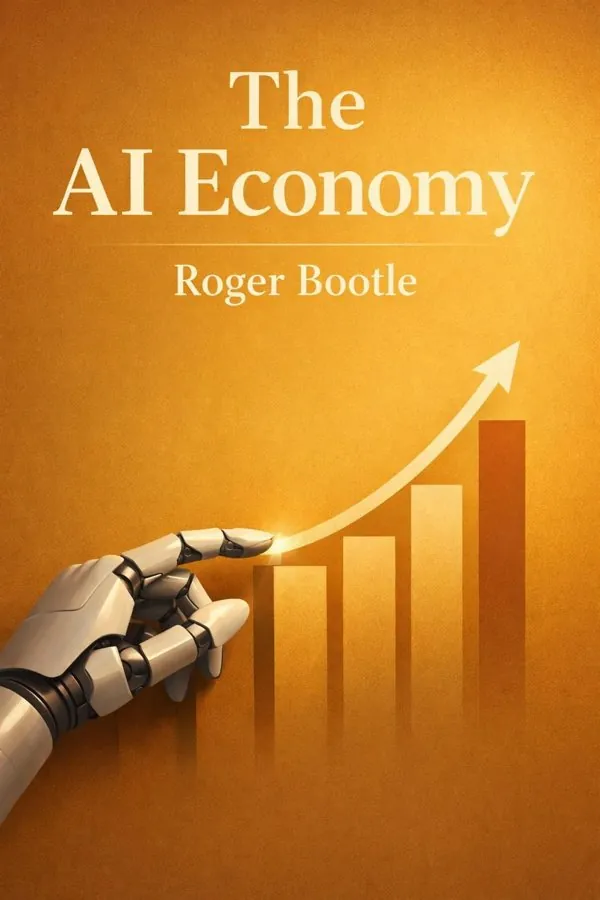
The AI Economy: Work, Wealth and Welfare in the Age of the Robot: Summary & Key Insights
by Roger Bootle
 10 min10 chaptersAudio available
Key Takeaways from The AI Economy: Work, Wealth and Welfare in the Age of the Robot
Technological revolutions rarely just improve existing systems; they reorder the foundations of economic life.
The deepest challenge of automation is not merely lost wages; it is the possible erosion of work as a source of identity and social belonging.
At its best, AI is a productivity machine.
When technology changes quickly, the labor market rarely adjusts smoothly.
One of Bootle’s most powerful arguments is that AI could increase the economic importance of capital relative to labor.
What Is The AI Economy: Work, Wealth and Welfare in the Age of the Robot About?
The AI Economy: Work, Wealth and Welfare in the Age of the Robot by Roger Bootle is a economics book spanning 10 pages. Artificial intelligence is often discussed as a technological marvel, but Roger Bootle asks a more consequential question: what will it do to the economy, to work, and to the social contract that holds modern societies together? In The AI Economy, he examines AI not as a gadget trend but as a force on the scale of the Industrial Revolution—one capable of transforming productivity, wages, inequality, business ownership, and public policy. The book explores whether intelligent machines will create broad prosperity, deepen insecurity, or produce both at once. What makes this book especially valuable is Bootle’s ability to combine economic history, macroeconomic analysis, and public-policy realism. He neither celebrates technology uncritically nor falls into apocalyptic pessimism. Instead, he offers a sober framework for thinking about how automation changes the balance between labor and capital, why traditional welfare systems may become inadequate, and which policy choices could help societies adapt. For readers trying to understand the future of jobs, growth, and fairness in an AI-driven world, this book provides a lucid and timely guide.
This FizzRead summary covers all 10 key chapters of The AI Economy: Work, Wealth and Welfare in the Age of the Robot in approximately 10 minutes, distilling the most important ideas, arguments, and takeaways from Roger Bootle's work. Also available as an audio summary and Key Quotes Podcast.
The AI Economy: Work, Wealth and Welfare in the Age of the Robot
Artificial intelligence is often discussed as a technological marvel, but Roger Bootle asks a more consequential question: what will it do to the economy, to work, and to the social contract that holds modern societies together? In The AI Economy, he examines AI not as a gadget trend but as a force on the scale of the Industrial Revolution—one capable of transforming productivity, wages, inequality, business ownership, and public policy. The book explores whether intelligent machines will create broad prosperity, deepen insecurity, or produce both at once.
What makes this book especially valuable is Bootle’s ability to combine economic history, macroeconomic analysis, and public-policy realism. He neither celebrates technology uncritically nor falls into apocalyptic pessimism. Instead, he offers a sober framework for thinking about how automation changes the balance between labor and capital, why traditional welfare systems may become inadequate, and which policy choices could help societies adapt. For readers trying to understand the future of jobs, growth, and fairness in an AI-driven world, this book provides a lucid and timely guide.
Who Should Read The AI Economy: Work, Wealth and Welfare in the Age of the Robot?
This book is perfect for anyone interested in economics and looking to gain actionable insights in a short read. Whether you're a student, professional, or lifelong learner, the key ideas from The AI Economy: Work, Wealth and Welfare in the Age of the Robot by Roger Bootle will help you think differently.
- ✓Readers who enjoy economics and want practical takeaways
- ✓Professionals looking to apply new ideas to their work and life
- ✓Anyone who wants the core insights of The AI Economy: Work, Wealth and Welfare in the Age of the Robot in just 10 minutes
Want the full summary?
Get instant access to this book summary and 100K+ more with Fizz Moment.
Get Free SummaryAvailable on App Store • Free to download
Key Chapters
Technological revolutions rarely just improve existing systems; they reorder the foundations of economic life. Bootle places artificial intelligence within a long lineage that includes mechanization, electrification, mass production, and computing. Each previous wave displaced some tasks, created new industries, and changed who held power in the economy. The important lesson is not that disruption is new, but that each revolution alters the relationship between labor, capital, and productivity in distinctive ways.
The Industrial Revolution replaced muscle with machines. Later revolutions reorganized communication, transport, and industrial scale. AI differs because it targets not only physical work but also cognitive tasks once considered uniquely human: pattern recognition, forecasting, writing, diagnosis, and decision support. That means the coming shift may touch lawyers, accountants, analysts, teachers, and managers as much as factory workers. History suggests economies eventually adapt, but it also shows that transitions can be long, uneven, and politically destabilizing.
A practical way to apply this insight is to avoid simplistic analogies. Businesses should not assume AI is just another software upgrade; it may restructure entire value chains. Workers should not assume their job title protects them; individual tasks are what matter. Policymakers should remember that past transitions required new institutions, from labor protections to public education.
Actionable takeaway: Study AI as an economic transformation, not a tech trend, and evaluate which tasks, industries, and institutions in your world are most vulnerable to structural change.
The deepest challenge of automation is not merely lost wages; it is the possible erosion of work as a source of identity and social belonging. Bootle emphasizes that employment does more than pay bills. It gives people structure, recognition, purpose, and a place in society. If AI steadily absorbs routine work and increasingly handles complex cognitive tasks, the question becomes not simply how people will earn, but how they will matter.
This matters because many optimistic accounts of automation assume that people can smoothly shift into more creative or interpersonal roles. In reality, not everyone can or wants to become a designer, therapist, entrepreneur, or strategist. Some jobs will survive precisely because they depend on trust, empathy, responsibility, and human presence: nursing, childcare, negotiation, skilled trades, and leadership in ambiguous settings. Yet even these may be reshaped by AI tools rather than left untouched.
Consider a medical setting. AI may interpret scans faster than radiologists, but patients may still want a doctor to explain risks, weigh trade-offs, and provide reassurance. In education, AI can generate personalized exercises, but students still need human motivation, discipline, and mentorship. The result is not a world without work, but a world in which human work shifts toward judgment, care, coordination, and accountability.
Actionable takeaway: Instead of defining your future by occupation alone, identify the human capabilities in your role—trust, empathy, creativity, moral judgment, and relationship-building—and strengthen them deliberately.
At its best, AI is a productivity machine. Bootle argues that the strongest economic case for AI lies in its potential to produce more output with fewer inputs, lowering costs, improving quality, and increasing overall prosperity. Productivity growth is the ultimate source of rising living standards over time. Without it, economies stagnate, wages struggle, and public finances become harder to sustain.
AI can raise productivity in obvious and subtle ways. It can automate repetitive office workflows, reduce error rates in logistics, accelerate drug discovery, improve factory maintenance, optimize energy use, and support faster customer service. A small firm using AI-assisted accounting and marketing may suddenly operate with the efficiency once available only to large corporations. A hospital may allocate staff more intelligently. A transport company may use predictive systems to reduce downtime and fuel costs.
But Bootle warns that higher productivity does not automatically translate into broadly shared gains. Economies can become more productive while many workers feel squeezed if benefits flow mainly to technology owners, dominant platforms, or highly skilled elites. Timing also matters: costs of adjustment often arrive before the benefits are widely distributed.
The practical implication is that productivity should be welcomed, but not romanticized. Firms need strategies for reinvesting gains in training, wage growth, service quality, or expansion. Governments need tax, competition, and welfare systems that help convert efficiency into social progress rather than concentrated wealth.
Actionable takeaway: Treat productivity gains as an opportunity to redesign how value is shared, not merely as a way to cut costs.
When technology changes quickly, the labor market rarely adjusts smoothly. Bootle explores how AI may hollow out some middle-skill occupations while expanding both high-value expert roles and lower-paid service work. This pattern, already visible in earlier digital transitions, can widen inequality even when unemployment does not explode. The real danger may be fragmentation: secure, well-paid workers on one side and precarious, displaced, or downgraded workers on the other.
AI is likely to affect tasks rather than erase professions in one stroke. A paralegal may lose document review work but remain valuable in client coordination. A financial analyst may rely on AI for modeling but still be needed for interpretation and communication. At the same time, some jobs may shrink dramatically where task automation is nearly complete. Workers with adaptable skills, credentials, and access to retraining will fare better than those in fragile sectors or regions.
Examples already exist. Retail workers face automated checkout and inventory systems. Call-center employees encounter conversational AI. Programmers may use coding assistants that make top performers more productive while reducing demand for routine junior work. This does not guarantee mass joblessness, but it does suggest more volatile careers and greater pressure on wages in certain segments.
Bootle’s broader point is that labor-market stress is not a side issue; it is central to whether AI becomes politically acceptable. If people experience only insecurity while hearing abstract promises of future gains, backlash is inevitable.
Actionable takeaway: Build career resilience by focusing on transferable skills, ongoing retraining, and sectors where human oversight and client trust remain essential.
One of Bootle’s most powerful arguments is that AI could increase the economic importance of capital relative to labor. If machines, software, data systems, and robotic platforms do a larger share of productive work, then returns may increasingly flow to those who own those assets rather than those who sell their time. This shift would have profound implications for wealth distribution, corporate power, and political stability.
In a traditional labor-intensive economy, wages are the main route through which prosperity reaches households. In an AI-intensive economy, profits, intellectual property rights, platform control, and data ownership could become more decisive. A company that develops a powerful model or controls a critical AI infrastructure layer may scale globally with relatively few employees. Investors, founders, and asset owners can then capture gains disproportionate to the workforce involved.
This is not just a theory. Technology sectors already exhibit winner-take-most dynamics, where network effects and low marginal costs create highly concentrated fortunes. If AI amplifies this pattern, societies may face a future in which economic growth is strong but broad participation is weak. That could undermine consumer demand, fuel resentment, and destabilize democratic politics.
Practical responses might include broader asset ownership through pension funds, employee share schemes, sovereign wealth structures, or policies that encourage diffusion of technology rather than monopolistic concentration. The key is not hostility to capital, but recognition that who owns productive assets shapes who benefits from innovation.
Actionable takeaway: Pay attention not only to jobs but to ownership—invest, participate in asset-building where possible, and support policies that widen access to productive capital.
Technology does not determine social outcomes on its own; policy channels its effects. Bootle rejects the idea that governments can simply stand aside and let markets sort everything out. If AI transforms employment patterns, inequality, tax bases, and bargaining power, then public institutions must adapt. The central challenge is not to stop innovation, but to govern its consequences intelligently.
This means rethinking education, taxation, regulation, competition policy, and social insurance. Education systems built around one early-life qualification may no longer suit a world of repeated career transitions. Tax systems heavily dependent on labor income may weaken if profits and capital income rise faster than wages. Competition authorities may need to scrutinize platform dominance, data concentration, and barriers to entry. Labor regulation may need updating for algorithmic management and more fluid forms of work.
Bootle also stresses that poor policy can worsen AI’s downsides. Overregulation may suppress innovation and push firms elsewhere. Underregulation may permit concentration, insecurity, and social fragmentation. The goal is balance: encourage experimentation and productivity while preserving fair competition, worker support, and social legitimacy.
For example, governments can subsidize retraining, modernize unemployment insurance, support regional adjustment where industries decline, and invest in digital infrastructure that allows smaller firms to adopt AI productively. Good policy broadens access to the benefits of technological change.
Actionable takeaway: Judge AI debates not by whether they are pro- or anti-technology, but by whether they create institutions that spread gains, ease transitions, and maintain public trust.
If work becomes less stable, less central, or less evenly rewarded, welfare states built around continuous full-time employment may stop functioning well. Bootle therefore examines whether societies need deeper reform, including versions of universal basic income or other mechanisms that decouple basic security from traditional jobs. The point is not that one single policy will solve everything, but that old assumptions about earnings, benefits, and eligibility may no longer hold.
A system designed for a stable industrial workforce can struggle when people move between freelance work, part-time roles, retraining periods, caregiving responsibilities, and technologically displaced spells of unemployment. Means-tested benefits may become too complex or punitive. Existing safety nets may also fail to address the psychological and civic effects of economic insecurity.
Universal basic income is one possible response because it offers simplicity and unconditional support. Its strengths include reducing bureaucracy and providing a floor beneath everyone in a volatile economy. Its weaknesses include cost, inflation concerns, and the possibility of weakening incentives or public support for targeted services. Alternatives include wage subsidies, negative income taxes, universal basic services, or stronger contributory insurance.
Bootle’s larger contribution is to frame welfare reform as part of economic modernization rather than charity. If AI increases aggregate wealth, societies will need institutions that convert that wealth into security and social cohesion.
Actionable takeaway: Evaluate welfare ideas by one practical standard: do they provide dignity and stability in a world where employment may no longer be the sole gateway to economic citizenship?
The AI revolution will not unfold in a single national economy; it will reorder international competitiveness. Bootle highlights how countries differ in capital markets, education systems, regulatory cultures, industrial structures, and state capacity. These differences will shape which nations lead in AI development, which become efficient adopters, and which fall behind. The result could be a significant redistribution of economic power across the globe.
Countries with strong research ecosystems, deep venture capital, flexible labor markets, and digital infrastructure may gain an early advantage. Others may benefit through adoption rather than invention, using AI to improve manufacturing, logistics, healthcare, and public administration. But nations with weak institutions, low skills, or poor connectivity risk being left further behind. This may widen existing global inequalities even as AI raises productivity in leading economies.
There is also a geopolitical dimension. Control over semiconductors, cloud infrastructure, data resources, and frontier models may become strategic assets, much like energy or industrial capacity in earlier eras. Governments may respond with industrial policy, export controls, domestic subsidy programs, and new alliances. Businesses operating globally will need to navigate fragmented regulatory regimes and divergent ethical standards.
For firms, this means competitiveness will increasingly depend on AI adoption speed, data strategy, and workforce adaptation. For countries, it means long-term prosperity may hinge on education reform, innovation policy, and openness to productive new technologies.
Actionable takeaway: Whether you are leading a business or evaluating a country’s prospects, treat AI capability and adoption as core determinants of future competitiveness, not optional add-ons.
An AI economy is not only about efficiency; it is also about what kind of society people wish to inhabit. Bootle insists that ethical and social questions cannot be separated from economic analysis. If AI enables enormous wealth creation while reducing human agency, intensifying surveillance, or marginalizing large groups, then economic success on paper may conceal social failure in reality.
Several concerns stand out. Algorithmic systems can encode bias, making access to credit, hiring, policing, or insurance less fair rather than more. Workplace monitoring can become more intrusive as employers use data to evaluate performance in granular, potentially dehumanizing ways. Decisions may become harder to contest if responsibility is diffused across automated systems. And even where AI performs well, people may still object to handing over inherently human domains—care, justice, education, or warfare—to machine-led processes.
A practical example is hiring software. It may reduce costs and process applications quickly, but if trained on biased historical data it can reproduce discrimination at scale. In healthcare, AI triage can improve efficiency, yet patients may want transparency and the ability to appeal. Ethical design therefore requires accountability, explainability where possible, and human oversight in high-stakes settings.
Bootle’s broader point is that a society organized solely around output may neglect dignity, autonomy, and trust. Economic policy must therefore include ethical guardrails, not as obstacles to progress but as conditions for legitimate progress.
Actionable takeaway: Whenever AI promises efficiency, ask a second question just as seriously: does this use preserve fairness, accountability, and human dignity?
Perhaps the most important message in Bootle’s book is that the AI age has multiple possible outcomes. There is no single predetermined future in which robots either save humanity or render it obsolete. Much depends on how businesses deploy technology, how governments redesign institutions, how ownership is distributed, and how societies define prosperity beyond GDP alone.
One plausible future is broadly optimistic: AI lifts productivity, reduces drudgery, improves healthcare and education, and generates enough wealth to support shorter working hours and stronger social protection. Another is darker: high profits, concentrated ownership, weak labor bargaining power, unstable employment, and a fraying social contract. A more likely scenario may combine elements of both, with some sectors and societies adapting better than others.
This framework matters because fatalism leads to passivity. If people assume technological change is unstoppable and socially neutral, they may ignore the need for reform until tensions become severe. By contrast, if leaders understand that institutions shape outcomes, they can design transitions rather than merely react to shocks.
For individuals, this means preparing for a fluid future rather than expecting permanence. For organizations, it means investing not only in AI tools but in people, trust, and governance. For governments, it means acting before dislocation becomes entrenched.
Actionable takeaway: Replace deterministic thinking with scenario thinking—plan for several AI futures and make decisions now that increase the odds of a prosperous, humane one.
All Chapters in The AI Economy: Work, Wealth and Welfare in the Age of the Robot
About the Author
Roger Bootle is a British economist, author, and founder of Capital Economics, an influential independent macroeconomic research consultancy. Known for his clear, accessible style, he has spent decades analyzing global economic trends, financial markets, monetary policy, and the future of capitalism. Bootle has advised governments, corporations, and investors, and he frequently contributes to public debate through articles, commentary, and speaking engagements. His work is valued for combining analytical rigor with practical relevance, making complex economic issues understandable to a broad audience. In The AI Economy, he brings that experience to one of the defining questions of our time: how artificial intelligence will reshape work, wealth, and welfare. His perspective is especially compelling because he approaches AI not as a technologist, but as an economist focused on long-term structural change.
Get This Summary in Your Preferred Format
Read or listen to the The AI Economy: Work, Wealth and Welfare in the Age of the Robot summary by Roger Bootle anytime, anywhere. FizzRead offers multiple formats so you can learn on your terms — all free.
Available formats: App · Audio · PDF · EPUB — All included free with FizzRead
Download The AI Economy: Work, Wealth and Welfare in the Age of the Robot PDF and EPUB Summary
Key Quotes from The AI Economy: Work, Wealth and Welfare in the Age of the Robot
“Technological revolutions rarely just improve existing systems; they reorder the foundations of economic life.”
“The deepest challenge of automation is not merely lost wages; it is the possible erosion of work as a source of identity and social belonging.”
“At its best, AI is a productivity machine.”
“When technology changes quickly, the labor market rarely adjusts smoothly.”
“One of Bootle’s most powerful arguments is that AI could increase the economic importance of capital relative to labor.”
Frequently Asked Questions about The AI Economy: Work, Wealth and Welfare in the Age of the Robot
The AI Economy: Work, Wealth and Welfare in the Age of the Robot by Roger Bootle is a economics book that explores key ideas across 10 chapters. Artificial intelligence is often discussed as a technological marvel, but Roger Bootle asks a more consequential question: what will it do to the economy, to work, and to the social contract that holds modern societies together? In The AI Economy, he examines AI not as a gadget trend but as a force on the scale of the Industrial Revolution—one capable of transforming productivity, wages, inequality, business ownership, and public policy. The book explores whether intelligent machines will create broad prosperity, deepen insecurity, or produce both at once. What makes this book especially valuable is Bootle’s ability to combine economic history, macroeconomic analysis, and public-policy realism. He neither celebrates technology uncritically nor falls into apocalyptic pessimism. Instead, he offers a sober framework for thinking about how automation changes the balance between labor and capital, why traditional welfare systems may become inadequate, and which policy choices could help societies adapt. For readers trying to understand the future of jobs, growth, and fairness in an AI-driven world, this book provides a lucid and timely guide.
You Might Also Like

Business Adventures
John Brooks
10 min
Nudge
Richard H. Thaler, Cass R. Sunstein
10 min
The Hitchhiker"s Guide to the Galaxy
Douglas Adams
10 minThe Muqaddimah
Ibn Khaldun
10 minThe Outsiders
William N. Thorndike
10 min
A Little History of Economics
Niall Kishtainy
10 minBrowse by Category
Ready to read The AI Economy: Work, Wealth and Welfare in the Age of the Robot?
Get the full summary and 100K+ more books with Fizz Moment.