
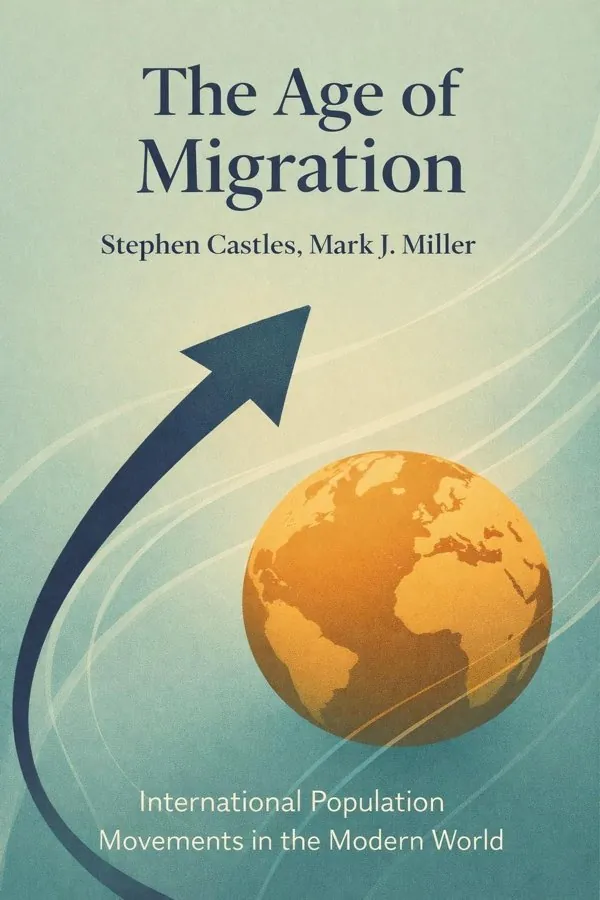
The Age of Migration: International Population Movements in the Modern World: Summary & Key Insights
by Stephen Castles, Mark J. Miller
 10 min9 chaptersAudio available
What Is The Age of Migration: International Population Movements in the Modern World About?
The Age of Migration: International Population Movements in the Modern World by Stephen Castles, Mark J. Miller is a sociology book spanning 9 pages. This book provides a comprehensive analysis of global migration patterns, exploring the economic, political, and social forces that drive population movements across borders. It examines the historical development of migration, the role of states and international institutions, and the impact of migration on societies worldwide.
This FizzRead summary covers all 9 key chapters of The Age of Migration: International Population Movements in the Modern World in approximately 10 minutes, distilling the most important ideas, arguments, and takeaways from Stephen Castles, Mark J. Miller's work. Also available as an audio summary and Key Quotes Podcast.
The Age of Migration: International Population Movements in the Modern World
This book provides a comprehensive analysis of global migration patterns, exploring the economic, political, and social forces that drive population movements across borders. It examines the historical development of migration, the role of states and international institutions, and the impact of migration on societies worldwide.
Who Should Read The Age of Migration: International Population Movements in the Modern World?
This book is perfect for anyone interested in sociology and looking to gain actionable insights in a short read. Whether you're a student, professional, or lifelong learner, the key ideas from The Age of Migration: International Population Movements in the Modern World by Stephen Castles, Mark J. Miller will help you think differently.
- ✓Readers who enjoy sociology and want practical takeaways
- ✓Professionals looking to apply new ideas to their work and life
- ✓Anyone who wants the core insights of The Age of Migration: International Population Movements in the Modern World in just 10 minutes
Want the full summary?
Get instant access to this book summary and 100K+ more with Fizz Moment.
Get Free SummaryAvailable on App Store • Free to download
Key Chapters
To grasp the present, we must travel back to the nineteenth century, the formative era of modern migration systems. Industrialization and colonialism were twin forces that rearranged global patterns of human movement. The rise of industrial economies in Europe generated immense demand for labor, while expanding empires opened channels of mobility across continents. Millions left rural communities for factories, mines, and cities. Others were displaced through conquest or incorporated into colonial economies as indentured or coerced workers.
I wanted readers to recognize that these migrations were not spontaneous flows but heavily structured movements shaped by states, markets, and imperial hierarchies. Migration was part of a global labor division — Europeans sought surplus labor abroad; colonial subjects were extracted from their homes to fuel production; and the political geography of nations began to crystallize through this interplay. The great transatlantic migrations to the Americas illustrate this point vividly: movements driven by both push factors (poverty, persecution) and pull factors (industrial opportunity, land) within an emerging capitalist world system.
When we describe the twentieth century, we see the end of colonial empires and the birth of new nation-states, yet migration did not slow. It diversified. Postcolonial movements, guest worker programs in Europe, and new transnational connections brought a mixture of economic and cultural exchange. Migration continually reflects shifts in global power, and each historical chapter leaves deep imprints on present policy debates. This long view helps us see migration not as a new disorder but as a recurring pattern—one that evolves alongside modernization itself.
Migration can never be fully explained by a single theory. That was one of our earliest clarifications. Economists sought to model movement as rational choice: individuals weighing benefits against costs. Sociologists, meanwhile, highlighted social networks, community structures, and cultural ties that sustain flows across generations. Political scientists examined how state institutions and international relations frame these movements in terms of sovereignty and control.
In this book, we bring these perspectives together to reveal migration as a multidimensional phenomenon. The neoclassical model of migration assumes wage differentials as primary motivators, yet we show that the decision to migrate is embedded in social relationships — families invest in mobility as a household strategy. The new economics of labor migration expands this view, stressing the collective management of risk in unstable economies.
We also stress the importance of world-systems theory, which situates migration within global capitalism. Development in one region often corresponds to underdevelopment elsewhere, producing the very inequalities that drive movement. Dependency and center-periphery relations explain why migrants often come from zones historically integrated into global markets as suppliers of labor and raw materials.
Equally crucial is the transnational approach. It shows how migrants maintain social, economic, and political ties across borders, reshaping the meaning of belonging. Migration, in this lens, is not a one-time relocation but an ongoing circulation of people, ideas, and resources, creating hybrid communities and fluid identities.
Through these theoretical dialogues, we sought to provide a framework that respects complexity. Migration is simultaneously economic strategy, social transformation, and political negotiation. To understand it, one must look beyond national boundaries toward the interdependence of global societies.
+ 7 more chapters — available in the FizzRead app
All Chapters in The Age of Migration: International Population Movements in the Modern World
About the Authors
Stephen Castles is a sociologist known for his research on international migration and multiculturalism. Mark J. Miller is a political scientist specializing in migration policy and international relations.
Get This Summary in Your Preferred Format
Read or listen to the The Age of Migration: International Population Movements in the Modern World summary by Stephen Castles, Mark J. Miller anytime, anywhere. FizzRead offers multiple formats so you can learn on your terms — all free.
Available formats: App · Audio · PDF · EPUB — All included free with FizzRead
Download The Age of Migration: International Population Movements in the Modern World PDF and EPUB Summary
Key Quotes from The Age of Migration: International Population Movements in the Modern World
“To grasp the present, we must travel back to the nineteenth century, the formative era of modern migration systems.”
“Migration can never be fully explained by a single theory.”
Frequently Asked Questions about The Age of Migration: International Population Movements in the Modern World
The Age of Migration: International Population Movements in the Modern World by Stephen Castles, Mark J. Miller is a sociology book that explores key ideas across 9 chapters. This book provides a comprehensive analysis of global migration patterns, exploring the economic, political, and social forces that drive population movements across borders. It examines the historical development of migration, the role of states and international institutions, and the impact of migration on societies worldwide.
You Might Also Like

Between the World and Me
Ta-Nehisi Coates
10 min
Half the Sky
Nicholas D. Kristof, Sheryl WuDunn
10 min
Men Explain Things To Me
Rebecca Solnit
10 min
Rational Ritual
Michael Suk-Young Chwe
10 min
The New Jim Crow
Michelle Alexander
10 min
Beyond Culture
Edward T. Hall
10 minBrowse by Category
Ready to read The Age of Migration: International Population Movements in the Modern World?
Get the full summary and 100K+ more books with Fizz Moment.