
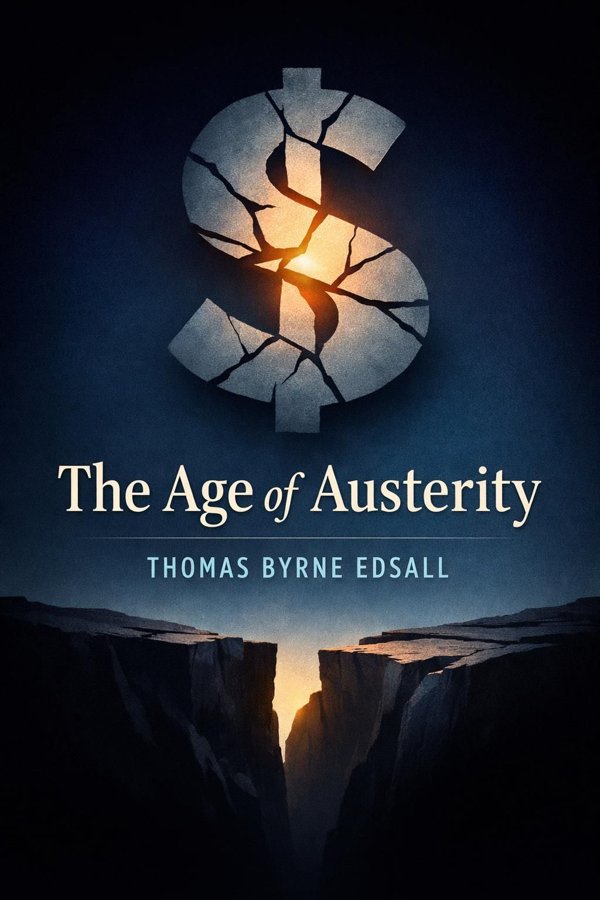
The Age of Austerity: How Scarcity Will Remake American Politics: Summary & Key Insights
 10 min9 chaptersAudio available
Key Takeaways from The Age of Austerity: How Scarcity Will Remake American Politics
A democracy is easier to govern when most people believe tomorrow will be better than today.
When abundance fades, politics stops feeling aspirational and starts feeling defensive.
Economic scarcity rarely stays economic for long; it often becomes cultural and racial.
A stable democracy depends heavily on a confident middle class.
In an age of austerity, the party most comfortable opposing government expansion gains structural advantages.
What Is The Age of Austerity: How Scarcity Will Remake American Politics About?
The Age of Austerity: How Scarcity Will Remake American Politics by Thomas Byrne Edsall is a politics book spanning 10 pages. What happens to a democracy when growth slows, public resources tighten, and politics becomes a struggle over who gets less rather than who gets more? In The Age of Austerity, Thomas Byrne Edsall argues that this shift defines modern American politics. The postwar era was built on expanding prosperity, which allowed leaders to compromise, broaden public programs, and ease social tensions. But as growth became weaker, inequality widened, wages stagnated, and fiscal pressures intensified, politics hardened into a fight over redistribution, identity, and power. Edsall shows that scarcity changes everything: it sharpens class conflict, inflames racial and demographic anxiety, empowers organized interests, and makes governing far more difficult. This is not just a book about budgets or deficits. It is a book about how economic limits reshape political behavior, party strategy, and social trust. Edsall writes with the authority of a veteran political journalist and scholar who has spent decades examining inequality, electoral coalitions, and public policy. His analysis remains deeply relevant for anyone trying to understand why American politics feels so polarized, zero-sum, and emotionally charged.
This FizzRead summary covers all 9 key chapters of The Age of Austerity: How Scarcity Will Remake American Politics in approximately 10 minutes, distilling the most important ideas, arguments, and takeaways from Thomas Byrne Edsall's work. Also available as an audio summary and Key Quotes Podcast.
The Age of Austerity: How Scarcity Will Remake American Politics
What happens to a democracy when growth slows, public resources tighten, and politics becomes a struggle over who gets less rather than who gets more? In The Age of Austerity, Thomas Byrne Edsall argues that this shift defines modern American politics. The postwar era was built on expanding prosperity, which allowed leaders to compromise, broaden public programs, and ease social tensions. But as growth became weaker, inequality widened, wages stagnated, and fiscal pressures intensified, politics hardened into a fight over redistribution, identity, and power. Edsall shows that scarcity changes everything: it sharpens class conflict, inflames racial and demographic anxiety, empowers organized interests, and makes governing far more difficult. This is not just a book about budgets or deficits. It is a book about how economic limits reshape political behavior, party strategy, and social trust. Edsall writes with the authority of a veteran political journalist and scholar who has spent decades examining inequality, electoral coalitions, and public policy. His analysis remains deeply relevant for anyone trying to understand why American politics feels so polarized, zero-sum, and emotionally charged.
Who Should Read The Age of Austerity: How Scarcity Will Remake American Politics?
This book is perfect for anyone interested in politics and looking to gain actionable insights in a short read. Whether you're a student, professional, or lifelong learner, the key ideas from The Age of Austerity: How Scarcity Will Remake American Politics by Thomas Byrne Edsall will help you think differently.
- ✓Readers who enjoy politics and want practical takeaways
- ✓Professionals looking to apply new ideas to their work and life
- ✓Anyone who wants the core insights of The Age of Austerity: How Scarcity Will Remake American Politics in just 10 minutes
Want the full summary?
Get instant access to this book summary and 100K+ more with Fizz Moment.
Get Free SummaryAvailable on App Store • Free to download
Key Chapters
When abundance fades, politics stops feeling aspirational and starts feeling defensive. One of Edsall’s central arguments is that slower growth transforms public life into a contest over redistribution. If the economic pie is no longer expanding fast enough, then any gain for one group is more likely to be experienced by another as a loss. That shift encourages zero-sum thinking, and zero-sum politics is much harsher than politics built on expectations of shared progress.
This helps explain why disputes over taxes, welfare, healthcare, pensions, and education become so emotionally charged. These are not merely technical policy disagreements. They are struggles over who deserves public support, who bears the burden of funding it, and whose needs count most in a constrained system. Under conditions of scarcity, language changes too. Terms like "makers and takers," "deserving and undeserving," and "entitlements" become politically potent because they frame redistribution as a moral conflict.
Edsall also shows that redistribution battles are rarely just about economics. They carry assumptions about work, family, race, immigration, age, and region. A policy designed to help one population can be portrayed as unfair to another, even when the actual fiscal impact is modest. This is one reason austerity politics often generates resentment beyond what numbers alone would predict.
A practical example is healthcare reform. Supporters may see coverage expansion as social protection in an unequal economy. Opponents may view it as a transfer they are being forced to finance. In a scarcity mindset, both sides interpret policy through loss aversion.
Actionable takeaway: whenever a policy debate seems unusually bitter, identify the underlying redistribution question. Ask who is perceived to gain, who is perceived to pay, and how that perception shapes political resistance.
Economic scarcity rarely stays economic for long; it often becomes cultural and racial. Edsall devotes significant attention to the way demographic change reshapes politics when resources feel limited. As the United States becomes more racially and ethnically diverse, debates over public spending, taxation, immigration, and social benefits become entangled with questions of identity and belonging. In times of growth, diversity may still provoke tension, but those tensions are easier to manage when opportunity appears widely available. In times of scarcity, demographic change can be framed as direct competition.
Edsall’s point is not simply that race matters in politics. It is that austerity magnifies racial conflict by making distributional choices feel more threatening. If voters believe government assistance disproportionately benefits groups unlike themselves, they may oppose programs they might otherwise support. This is especially true when political actors use coded rhetoric to connect fiscal policy with racial anxiety.
Examples are everywhere: opposition to urban spending framed as resistance to dependency, immigration debates cast as fights over jobs and services, or school funding disputes that mirror suburban and urban demographic divides. Political entrepreneurs often mobilize these fears strategically, linking cultural unease to tax and spending preferences.
This dynamic helps explain why broad social solidarity is difficult to sustain in a diverse democracy under fiscal strain. It also clarifies why policies with universal goals can be undermined when they are perceived through group competition rather than shared citizenship.
Actionable takeaway: to understand public resistance to redistributive policy, look beyond economics and examine how race, ethnicity, and demographic change shape perceptions of fairness, threat, and collective responsibility.
A stable democracy depends heavily on a confident middle class. Edsall argues that one of the most consequential developments in modern America is the erosion of middle-class security. This is not only about income levels. It is about the weakening of the institutions and expectations that once anchored ordinary life: stable employment, affordable education, rising home values, manageable healthcare costs, and the belief that hard work leads to advancement.
When the middle class loses confidence, politics becomes volatile. People who feel downward pressure are more likely to distrust elites, resent government, and respond to messages of betrayal or restoration. They may oppose aid to the poor because they fear slipping into dependency themselves, while also resisting policies seen as helping the wealthy. This creates a combustible politics of frustration, where many citizens feel squeezed from both above and below.
Edsall connects this middle-class strain to deindustrialization, wage stagnation, global competition, and the rising costs of key necessities. Families once able to absorb shocks now live closer to the edge. That insecurity changes voting behavior. It can fuel anti-tax sentiment, support for populist insurgencies, and hostility toward institutions that seem unresponsive.
Consider the political power of concerns about student debt, property taxes, healthcare premiums, or retirement insecurity. These issues resonate not only because they affect household budgets, but because they signal declining control over the future.
Actionable takeaway: if you want to understand polarization, watch the middle class. Political anger often grows fastest where expectations of stability persist but the lived experience increasingly contradicts them.
In an age of austerity, the party most comfortable opposing government expansion gains structural advantages. Edsall argues that Republicans are often better positioned than Democrats in a scarcity-driven environment because they can unify around tax resistance, spending restraint, deregulation, and skepticism toward redistribution. When resources are tight, promising less government can be politically simpler than deciding which programs to preserve, expand, or cut.
This does not mean Republican politics is free of internal conflict. Business interests, social conservatives, defense hawks, and populist voters do not always agree. But austerity gives the party a powerful organizing principle: government must do less because it cannot responsibly do more. That message appeals to voters frustrated by deficits, distrustful of bureaucracy, or resentful of perceived redistribution to out-groups.
Edsall also highlights the strategic value of coalition-building through cultural issues. By linking fiscal conservatism with concerns about race, religion, immigration, and traditional values, Republicans can widen support beyond affluent voters. Under scarcity, this fusion becomes especially potent because economic anxiety increases receptivity to identity-based appeals.
Real-world examples include campaigns centered on tax revolts, criticism of "big government," and efforts to frame public spending as both fiscally reckless and morally corrupting. Even when Republican administrations increase deficits, the rhetoric of restraint remains politically useful because it channels public frustration into opposition to the state.
Actionable takeaway: to analyze Republican success, look not only at policy proposals but at message architecture. In hard times, narratives about limits, dependency, and taxpayer protection can be more politically effective than detailed governing plans.
Scarcity is especially punishing for a party committed to activist government. Edsall shows that Democrats face a deep strategic dilemma in the age of austerity. Their coalition often includes low-income voters, racial minorities, labor, public-sector workers, younger voters seeking opportunity, and educated professionals who support social investment. But when fiscal space narrows, serving all these constituencies becomes much harder. Expanding one priority may require deprioritizing another.
This challenge is more than budgetary. It is political and moral. Democrats must defend the idea that government can still solve problems, even when many voters associate government with waste, debt, and special favors. They also must maintain solidarity across groups that do not always share the same immediate interests. Tensions can emerge between universal programs and targeted aid, between deficit concerns and stimulus, and between working-class economic appeals and culturally progressive agendas.
Edsall suggests that Democratic politics becomes complicated because the party cannot simply reject redistribution; redistribution is central to many of its goals. Yet that very commitment exposes it to attack. Opponents can portray Democratic proposals as taking from one group to subsidize another, especially in an atmosphere of demographic and class anxiety.
Examples include internal party struggles over healthcare design, student debt relief, climate spending, and entitlement reform. Each issue raises the same question: how can Democrats protect the vulnerable and invest in the future without alienating taxpayers and moderates who fear overreach?
Actionable takeaway: when assessing Democratic strategy, focus on coalition management. The party’s success depends less on abstract ideology than on whether it can persuade diverse voters that public investment benefits them collectively, not just selectively.
When public resources are scarce, organized power matters even more. Edsall argues that austerity does not simply force difficult choices; it also changes who has the capacity to influence those choices. In a constrained environment, groups with money, access, and institutional discipline are often better able to defend their benefits, tax advantages, and regulatory preferences than diffuse or less organized populations are.
This creates a political asymmetry. Retirees, industry associations, financial interests, public employee unions, defense contractors, and professional advocacy networks often know exactly what is at stake and mobilize intensely. By contrast, the broader public may dislike inequality or support reform in principle but remain fragmented and inattentive. The result is a system where scarcity does not produce equal sacrifice. It often produces selective protection for the powerful and harsher competition among the weak.
Edsall’s analysis helps explain why obvious long-term reforms can be so difficult. Cutting tax expenditures, adjusting entitlement formulas, restructuring healthcare incentives, or reducing subsidies sounds plausible in theory, but every line item has defenders. In the politics of austerity, concentrated interests fight to preserve what they have, and elected officials fear the electoral costs of confronting them.
A practical example is the persistence of loopholes, deductions, and sector-specific benefits even during calls for fiscal discipline. Politicians may speak the language of shared sacrifice while quietly shielding organized constituencies.
Actionable takeaway: do not judge austerity politics only by public rhetoric. Ask which groups are organized, which benefits are politically protected, and how lobbying power shapes the actual distribution of cuts, exemptions, and burdens.
People do not respond only to material conditions; they respond to stories about those conditions. Edsall emphasizes that media institutions play a crucial role in shaping how citizens interpret scarcity. Are deficits the nation’s greatest danger, or is underinvestment the bigger threat? Are welfare programs safety nets, or are they symbols of dependency? Is inequality a structural problem, or a result of individual choices? The answers are not obvious to most voters. They are filtered through journalists, commentators, campaigns, and partisan media ecosystems.
In an age of austerity, framing becomes especially powerful because most fiscal issues are complex and abstract. Citizens do not directly experience the federal budget in the way they experience rent or groceries. They rely on cues. Political media can therefore elevate certain threats while minimizing others. One outlet may focus on debt and government waste. Another may emphasize corporate privilege and social abandonment. Over time, these narratives solidify into political identities.
Edsall’s argument helps explain why groups facing similar economic stress can arrive at different political conclusions. Two households suffering stagnation may consume different media and emerge with opposite understandings of cause and blame. One may fault immigrants, regulation, and taxes. The other may blame monopolies, deregulation, and elite favoritism.
This dynamic has practical consequences for policy. Leaders trying to build support for reform must compete not just with opposing arguments, but with entire interpretive worlds.
Actionable takeaway: become a more critical consumer of political information. When evaluating claims about scarcity, ask who is framing the issue, what evidence is emphasized or omitted, and whose interests benefit from that narrative.
The most unsettling insight in Edsall’s book is that the politics of scarcity may not be temporary. He suggests that aging demographics, healthcare costs, slower growth, debt pressures, and persistent inequality could make zero-sum conflict a long-term feature of American politics. If so, polarization is not merely the product of bad leaders or toxic media. It is rooted in structural conditions that push citizens and parties into defensive competition.
This future has several implications. First, coalition politics becomes more fragile, because every group is under pressure to protect its own benefits. Second, symbolic issues become more explosive, because material insecurity heightens sensitivity to status and recognition. Third, governing becomes less effective, because elected officials have stronger incentives to block losses than to build broad bargains. Finally, legitimacy itself may erode if large segments of the public conclude that the system cannot deliver security or fairness.
Yet Edsall does not imply that outcomes are predetermined. Political choices still matter. Institutions can be redesigned, tax systems reformed, public investments targeted, and narratives of solidarity strengthened. But these solutions require acknowledging the reality of scarcity rather than pretending politics can return to the easy compromises of the postwar boom.
Examples of forward-looking responses include investing in productivity-enhancing infrastructure, improving educational access, reducing hidden subsidies for entrenched interests, and designing programs that feel broadly inclusive rather than narrowly targeted.
Actionable takeaway: think politically in long time horizons. The key question is not how to restore a vanished era of abundance, but how to build institutions capable of maintaining fairness, trust, and democratic stability under enduring economic constraints.
All Chapters in The Age of Austerity: How Scarcity Will Remake American Politics
About the Author
Thomas Byrne Edsall is an American journalist, political analyst, and academic whose work has long focused on inequality, party coalitions, social policy, and the changing structure of American democracy. He built his reputation through influential reporting and commentary for major publications including The Washington Post and later The New York Times, where he became known for combining political history with close attention to data and electoral trends. In addition to journalism, Edsall has taught at Columbia University’s Graduate School of Journalism, bringing scholarly depth to public debate. Across his writing, he is especially interested in how class, race, and economic change interact to shape political conflict. That mix of reporting experience and analytical rigor makes him a highly credible guide to the pressures transforming American politics.
Get This Summary in Your Preferred Format
Read or listen to the The Age of Austerity: How Scarcity Will Remake American Politics summary by Thomas Byrne Edsall anytime, anywhere. FizzRead offers multiple formats so you can learn on your terms — all free.
Available formats: App · Audio · PDF · EPUB — All included free with FizzRead
Download The Age of Austerity: How Scarcity Will Remake American Politics PDF and EPUB Summary
Key Quotes from The Age of Austerity: How Scarcity Will Remake American Politics
“A democracy is easier to govern when most people believe tomorrow will be better than today.”
“When abundance fades, politics stops feeling aspirational and starts feeling defensive.”
“Economic scarcity rarely stays economic for long; it often becomes cultural and racial.”
“A stable democracy depends heavily on a confident middle class.”
“In an age of austerity, the party most comfortable opposing government expansion gains structural advantages.”
Frequently Asked Questions about The Age of Austerity: How Scarcity Will Remake American Politics
The Age of Austerity: How Scarcity Will Remake American Politics by Thomas Byrne Edsall is a politics book that explores key ideas across 9 chapters. What happens to a democracy when growth slows, public resources tighten, and politics becomes a struggle over who gets less rather than who gets more? In The Age of Austerity, Thomas Byrne Edsall argues that this shift defines modern American politics. The postwar era was built on expanding prosperity, which allowed leaders to compromise, broaden public programs, and ease social tensions. But as growth became weaker, inequality widened, wages stagnated, and fiscal pressures intensified, politics hardened into a fight over redistribution, identity, and power. Edsall shows that scarcity changes everything: it sharpens class conflict, inflames racial and demographic anxiety, empowers organized interests, and makes governing far more difficult. This is not just a book about budgets or deficits. It is a book about how economic limits reshape political behavior, party strategy, and social trust. Edsall writes with the authority of a veteran political journalist and scholar who has spent decades examining inequality, electoral coalitions, and public policy. His analysis remains deeply relevant for anyone trying to understand why American politics feels so polarized, zero-sum, and emotionally charged.
You Might Also Like
Antifa: The Anti-Fascist Handbook
Mark Bray
10 min
Attack from Within: How Disinformation Is Sabotaging America
Barbara McQuade
10 min
Coercion, Capital, and European States, AD 990–1992
Charles Tilly
10 min
Digital Democracy: Concepts, Methodologies, Tools, and Applications
Various Authors
10 min
Fascism
Stanley G. Payne
10 min
Fire And Fury: Inside The Trump White House
Michael Wolff
10 minBrowse by Category
Ready to read The Age of Austerity: How Scarcity Will Remake American Politics?
Get the full summary and 100K+ more books with Fizz Moment.