
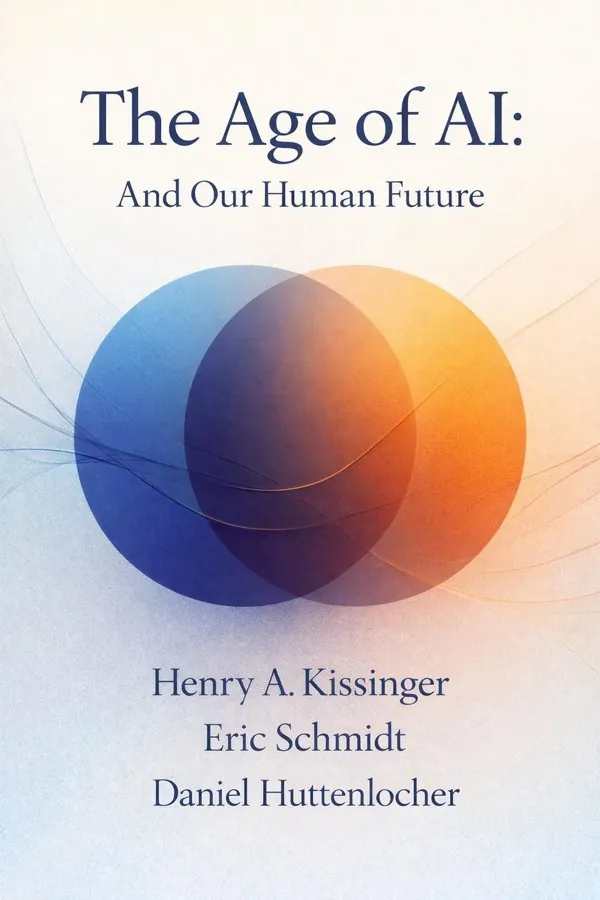
The Age of AI: And Our Human Future: Summary & Key Insights
by Henry A. Kissinger, Eric Schmidt, Daniel Huttenlocher
 10 min9 chaptersAudio available
Key Takeaways from The Age of AI: And Our Human Future
The most important mistake people make about AI is assuming it is simply human intelligence scaled up.
For centuries, human civilization has tied knowledge to explanation.
Transformative technologies do not merely add convenience; they reorganize civilization.
When a society adopts a new cognitive tool, people do not simply become more capable; they often become different thinkers.
A powerful technology does not become ethical by accident.
What Is The Age of AI: And Our Human Future About?
The Age of AI: And Our Human Future by Henry A. Kissinger, Eric Schmidt, Daniel Huttenlocher is a ai_ml book spanning 12 pages. Artificial intelligence is often discussed as a tool, a threat, or a business opportunity. The Age of AI: And Our Human Future argues that it is something even more consequential: a force that may alter how human beings understand knowledge, power, creativity, war, governance, and even themselves. Henry A. Kissinger, Eric Schmidt, and Daniel Huttenlocher combine the perspectives of diplomacy, technology leadership, and computer science to ask a question larger than whether AI will automate jobs or improve products. They ask what happens when machines can generate insights and decisions that humans cannot fully explain, yet increasingly rely upon. That question matters because AI is no longer a distant possibility. It already shapes search results, financial markets, medical diagnosis, military planning, logistics, recommendation systems, and public discourse. As these systems grow more capable, societies will face choices that are not merely technical but philosophical and political. This book stands out because it does not treat AI as a niche innovation. It treats it as a civilizational turning point. The result is a serious, accessible exploration of how humanity might preserve judgment, responsibility, and meaning in a world transformed by nonhuman intelligence.
This FizzRead summary covers all 9 key chapters of The Age of AI: And Our Human Future in approximately 10 minutes, distilling the most important ideas, arguments, and takeaways from Henry A. Kissinger, Eric Schmidt, Daniel Huttenlocher's work. Also available as an audio summary and Key Quotes Podcast.
The Age of AI: And Our Human Future
Artificial intelligence is often discussed as a tool, a threat, or a business opportunity. The Age of AI: And Our Human Future argues that it is something even more consequential: a force that may alter how human beings understand knowledge, power, creativity, war, governance, and even themselves. Henry A. Kissinger, Eric Schmidt, and Daniel Huttenlocher combine the perspectives of diplomacy, technology leadership, and computer science to ask a question larger than whether AI will automate jobs or improve products. They ask what happens when machines can generate insights and decisions that humans cannot fully explain, yet increasingly rely upon.
That question matters because AI is no longer a distant possibility. It already shapes search results, financial markets, medical diagnosis, military planning, logistics, recommendation systems, and public discourse. As these systems grow more capable, societies will face choices that are not merely technical but philosophical and political. This book stands out because it does not treat AI as a niche innovation. It treats it as a civilizational turning point. The result is a serious, accessible exploration of how humanity might preserve judgment, responsibility, and meaning in a world transformed by nonhuman intelligence.
Who Should Read The Age of AI: And Our Human Future?
This book is perfect for anyone interested in ai_ml and looking to gain actionable insights in a short read. Whether you're a student, professional, or lifelong learner, the key ideas from The Age of AI: And Our Human Future by Henry A. Kissinger, Eric Schmidt, Daniel Huttenlocher will help you think differently.
- ✓Readers who enjoy ai_ml and want practical takeaways
- ✓Professionals looking to apply new ideas to their work and life
- ✓Anyone who wants the core insights of The Age of AI: And Our Human Future in just 10 minutes
Want the full summary?
Get instant access to this book summary and 100K+ more with Fizz Moment.
Get Free SummaryAvailable on App Store • Free to download
Key Chapters
The most important mistake people make about AI is assuming it is simply human intelligence scaled up. The authors argue that artificial intelligence is not a faster version of human reasoning but a fundamentally different way of processing the world. Humans usually learn by linking experience, concepts, causes, and meanings. AI systems, especially modern machine learning models, often learn by detecting statistical patterns across vast amounts of data. They can produce useful answers, predictions, and strategies without possessing human-style understanding.
This difference matters because it changes what trust looks like. A doctor may explain why a diagnosis makes sense based on symptoms and medical principles. An AI system may reach a highly accurate diagnosis through correlations too complex for a human to trace. In chess and Go, AI has already demonstrated strategies that seem alien yet effective. In finance, logistics, and cybersecurity, systems can recognize subtle patterns invisible to human analysts. Their value lies partly in operating outside human intuition.
But that strength also creates dependence. If a machine can outperform us in crucial domains while remaining partly opaque, then we may begin acting on outputs we cannot truly interpret. That is a new historical condition. The authors urge readers to stop asking whether AI thinks like us and instead ask how institutions should respond to an intelligence that can exceed human capability without sharing human consciousness, judgment, or moral accountability.
Actionable takeaway: When evaluating AI tools, do not ask only, “Is it smart?” Ask, “How is it smart, what are its limits, and where must human judgment remain nonnegotiable?”
For centuries, human civilization has tied knowledge to explanation. We believed that to know something meant to understand why it worked. AI disrupts that assumption. The authors describe this as an epistemological shift: we are entering an age in which machines can produce reliable results without offering reasons in a form humans can easily grasp. In practical terms, we may know that an AI prediction is often correct while not fully understanding how the system arrived there.
This shift is already visible. Recommendation engines know what users are likely to click or buy, even when users themselves cannot explain their preferences. Medical algorithms can identify disease risk from scans with remarkable accuracy, sometimes discovering features that human experts had not recognized as important. Scientific tools may generate hypotheses or spot molecular structures faster than traditional research methods. In each case, knowledge becomes more predictive and less narratively coherent.
That creates both opportunity and unease. On one hand, societies gain powerful new tools for medicine, science, transportation, and public administration. On the other hand, institutions built on explanation, such as law, education, and democratic oversight, may struggle. A legal system wants reasons. A citizen wants accountability. A scientist wants causal understanding. If AI delivers performance without transparency, then human confidence in truth may weaken even as technical capability rises.
The authors suggest that the challenge is not to reject AI-generated knowledge but to build new norms for using it responsibly. We must decide where predictive success is enough and where explainability is essential. That distinction will shape everything from clinical practice to military command.
Actionable takeaway: In your work, separate decisions into two categories: those where accuracy is enough and those where explanation is required. Use AI differently in each.
Transformative technologies do not merely add convenience; they reorganize civilization. The authors place AI in the lineage of the printing press, the scientific revolution, and the nuclear age. Each innovation altered not only what humans could do but also how institutions were structured, how authority was justified, and how conflicts unfolded. AI belongs in that category because it changes the production of knowledge and the exercise of power at the same time.
The printing press broadened access to information and weakened monopolies on truth. The Enlightenment shifted societies toward reason, scientific inquiry, and modern political thought. Nuclear weapons forced humanity to confront a technology so powerful that strategy itself had to be reinvented. AI may prove comparable because it influences education, intelligence gathering, persuasion, warfare, commerce, and scientific discovery all at once. It is not one industry trend among many; it is a general-purpose force multiplier.
This historical lens is useful because it discourages simplistic forecasting. Past transformations produced both liberation and upheaval. New wealth appeared alongside instability. Old elites lost authority. New forms of competition emerged before laws and norms could catch up. Today, governments and companies that treat AI as merely another software upgrade may underestimate the scale of adaptation required.
For example, schools may need to rethink what it means to learn when systems can generate essays and solve complex problems. Militaries may need to reconsider command structures when machine-speed analysis affects battlefield choices. Diplomats may need to manage risks from autonomous systems much as earlier generations managed nuclear escalation.
Actionable takeaway: View AI decisions through a historical lens. Ask not just what the tool does today, but what institutions, habits, and power structures it could transform over the next decade.
When a society adopts a new cognitive tool, people do not simply become more capable; they often become different thinkers. The authors argue that AI will reshape human cognition by changing what we remember, how we decide, and when we defer to external systems. Just as calculators reduced the need for mental arithmetic and GPS altered spatial memory, advanced AI may weaken some cognitive muscles while amplifying others.
This rebalancing could be enormously beneficial. Researchers can use AI to summarize literature, detect anomalies in data, and propose fresh avenues for inquiry. Professionals can automate repetitive analysis and spend more time on strategy, empathy, or creative synthesis. Students can receive customized tutoring. Writers and designers can use AI as a brainstorming partner. In these cases, AI acts as cognitive augmentation.
Yet augmentation can quietly turn into dependency. If people stop practicing critical reasoning because systems provide instant answers, their ability to evaluate those answers may erode. If leaders become accustomed to machine-generated recommendations, they may lose confidence in their own judgment, especially in ambiguous situations where no clean data exists. This is particularly risky in education, management, and public decision-making, where learning often comes from wrestling with uncertainty rather than instantly resolving it.
The authors do not propose resisting cognitive tools. They propose preserving distinctly human capacities: context, moral reflection, imagination, and the ability to interpret meaning beyond data. The aim is not to compete with AI at pattern matching but to cultivate the forms of judgment machines cannot reliably supply.
Actionable takeaway: Use AI to accelerate routine thinking, but deliberately protect time for deep reading, independent analysis, and decisions made without automated prompts.
A powerful technology does not become ethical by accident. One of the book’s core arguments is that AI ethics cannot be treated as a public relations layer added after deployment. Because AI systems can influence hiring, lending, policing, healthcare, education, and warfare, ethical choices are embedded in design decisions from the beginning. Data selection, objective functions, optimization targets, and feedback loops all carry moral consequences.
Consider a hiring algorithm trained on historical company data. If the past reflects biased promotion patterns, the system may reproduce those patterns at scale. A medical model trained mostly on one population may perform poorly for others. A content recommendation system optimized only for engagement may amplify outrage, misinformation, or extremism. These failures are not random glitches. They arise when designers define success too narrowly.
The authors push readers beyond abstract discussions of fairness. Ethics in AI must involve accountability, traceability, institutional review, and limits on use. It must ask not only whether a system works but whether it should be used in a particular context at all. Facial recognition in a personal photo library is not the same as facial recognition in public surveillance. An algorithm that helps radiologists is not equivalent to one that replaces humane care decisions.
Ethics also requires leadership. Engineers cannot bear the full burden alone. Executives, policymakers, educators, and citizens must participate in setting boundaries. A society that waits for technical progress and hopes values will catch up later risks normalizing harmful systems before democratic debate occurs.
Actionable takeaway: Before adopting any AI system, ask three questions: what values are built into it, who is accountable when it fails, and what harms could scale if it succeeds too well?
The authors treat AI not only as a commercial breakthrough but as a geopolitical force. Nations that lead in AI may gain advantages in intelligence analysis, cyber operations, military planning, economic competitiveness, and influence over global standards. This makes AI a strategic technology, comparable in some ways to earlier breakthroughs that reshaped balances of power. Yet unlike many previous technologies, AI diffuses quickly across borders and can be developed by both states and private firms.
That creates a volatile environment. In military contexts, AI can accelerate decision cycles, improve target recognition, optimize logistics, and enhance autonomous or semi-autonomous systems. In cyber conflict, machine-speed offense and defense may outpace traditional human oversight. In diplomacy, leaders may face pressure to act faster because adversaries can process information and respond more rapidly. Faster systems can produce not only stronger defenses but also more unstable crises.
There is also a strategic governance challenge. If competing powers race to deploy increasingly capable AI without shared norms, they may create risks similar to arms races: secrecy, mistrust, accidental escalation, and inadequate safeguards. At the same time, overregulation by one country could leave it vulnerable if rivals move ahead recklessly. This tension between caution and competition is central to the AI age.
The authors imply that security policy must evolve beyond technical superiority. It must include confidence-building measures, channels of communication, and international frameworks for managing systems whose speed and opacity could undermine strategic stability. This is especially urgent where lethal force or critical infrastructure is involved.
Actionable takeaway: Whether in government or business, treat AI as a strategic capability. Build policies for resilience, human override, and crisis communication before systems become too embedded to restrain.
The economic story of AI is not simply that machines will replace workers. The authors present a more complex picture: AI will reorganize value creation, alter competitive advantages, and reward those who can combine data, computation, talent, and institutional adaptability. Some jobs will be automated, others will be redesigned, and entirely new roles will emerge around supervising, integrating, and governing intelligent systems.
In practice, AI may automate pattern-heavy tasks such as customer service triage, fraud detection, document review, scheduling, and parts of coding or marketing. But many occupations are bundles of tasks rather than single functions. A lawyer does not only review documents; a teacher does not only deliver information; a manager does not only produce reports. AI may strip away repetitive components while making human skills such as persuasion, trust-building, judgment, and cross-domain thinking more valuable.
Still, the transition may be painful. Workers in routine cognitive roles could face pressure before retraining systems are ready. Companies with vast data and computing power may widen their lead, concentrating wealth and influence. Regions that lack digital infrastructure may fall behind. Without policy responses, productivity gains could coexist with greater inequality and social fragmentation.
The authors encourage a broader understanding of economic adaptation. Education systems must emphasize flexibility and lifelong learning. Businesses must redesign workflows rather than simply cut headcount. Governments may need to rethink labor policy, antitrust, social protections, and public investment in digital capacity. The central issue is not whether AI brings growth, but who captures its benefits and how societies maintain cohesion during the shift.
Actionable takeaway: Prepare for AI economically by mapping the tasks in your role, strengthening your human advantages, and investing continuously in skills that complement automation rather than compete with it.
A recurring concern in the book is the mismatch between the speed of AI development and the slowness of political institutions. Democracies deliberate, legal systems evolve through precedent, and bureaucracies move cautiously. AI advances through rapid iteration, private-sector competition, and global diffusion. If governance remains reactive, societies may find themselves ruled by technical realities they never consciously chose.
Good AI governance is not the same as blanket restriction. The authors point toward a more demanding task: creating institutions capable of understanding enough about AI to steer it wisely. That includes standards for safety testing, transparency requirements, auditability, procurement rules, liability frameworks, and international dialogue. It also means deciding which decisions should never be fully delegated to machines, regardless of efficiency gains.
Examples are easy to imagine. A city using AI in traffic management may improve mobility with low moral risk. A court using AI in sentencing recommendations raises far deeper concerns about fairness, due process, and legitimacy. A hospital using AI to flag suspicious scans differs from using AI to ration treatment. Governance must be context-sensitive, not one-size-fits-all.
The authors also suggest that leaders need technical literacy. Public officials do not need to become coders, but they do need enough understanding to ask the right questions and resist being dazzled by complexity. Similarly, private companies cannot claim neutrality when their systems reshape civic life. Governance in the AI age will require collaboration across science, policy, philosophy, and law.
Actionable takeaway: Support or create decision processes that require human review, independent auditing, and clear accountability for high-stakes AI uses before those systems become normalized.
The deepest question in the book is not what AI can do, but what humans should remain. If machines can compose text, diagnose illness, design molecules, defeat champions, and generate strategy, people may begin to ask what is uniquely theirs. The authors refuse easy answers. They do not claim that human value lies only in outperforming machines. Instead, they suggest that the rise of AI pushes humanity toward a renewed examination of purpose, dignity, and freedom.
This issue appears in everyday life as much as in philosophy. If AI personal assistants anticipate our needs, do they increase freedom or subtly narrow it by shaping choices in advance? If creative tools generate music, images, or prose instantly, does that democratize creativity or weaken the satisfaction of mastery? If educational systems over-personalize learning, do students gain support or lose the formative struggle through which character is built? Convenience can enrich life, but it can also flatten experience.
The authors envision the need for a “new Enlightenment,” not in the sense of returning to the past, but in articulating principles adequate to a new age. Humanity must preserve spaces where reflection, responsibility, and moral agency are exercised rather than outsourced. Religious traditions, humanistic education, civic institutions, and the arts may become more important, not less, because they cultivate forms of meaning that efficiency cannot replace.
The book ultimately asks readers to see AI as a mirror. It exposes what we value by forcing us to choose what we will delegate and what we insist on doing ourselves. Human purpose will not survive automatically. It must be consciously defended.
Actionable takeaway: Decide which parts of your life you want AI to optimize and which you want to remain distinctly human, even if that choice is slower, harder, or less efficient.
All Chapters in The Age of AI: And Our Human Future
About the Authors
Henry A. Kissinger was one of the most influential diplomats of the twentieth century, serving as U.S. Secretary of State and National Security Advisor and winning the Nobel Peace Prize. Eric Schmidt is a leading technology executive best known for helping build Google into a global powerhouse as CEO and later executive chairman. Daniel Huttenlocher is a distinguished computer scientist, educator, and academic leader who became the inaugural dean of the MIT Schwarzman College of Computing. Together, the three authors bring a rare combination of geopolitical strategy, technological leadership, and scientific expertise. That blend gives The Age of AI unusual authority: it is informed not only by theory, but by direct experience in statecraft, digital innovation, and the frontiers of computing.
Get This Summary in Your Preferred Format
Read or listen to the The Age of AI: And Our Human Future summary by Henry A. Kissinger, Eric Schmidt, Daniel Huttenlocher anytime, anywhere. FizzRead offers multiple formats so you can learn on your terms — all free.
Available formats: App · Audio · PDF · EPUB — All included free with FizzRead
Download The Age of AI: And Our Human Future PDF and EPUB Summary
Key Quotes from The Age of AI: And Our Human Future
“The most important mistake people make about AI is assuming it is simply human intelligence scaled up.”
“For centuries, human civilization has tied knowledge to explanation.”
“Transformative technologies do not merely add convenience; they reorganize civilization.”
“When a society adopts a new cognitive tool, people do not simply become more capable; they often become different thinkers.”
“A powerful technology does not become ethical by accident.”
Frequently Asked Questions about The Age of AI: And Our Human Future
The Age of AI: And Our Human Future by Henry A. Kissinger, Eric Schmidt, Daniel Huttenlocher is a ai_ml book that explores key ideas across 9 chapters. Artificial intelligence is often discussed as a tool, a threat, or a business opportunity. The Age of AI: And Our Human Future argues that it is something even more consequential: a force that may alter how human beings understand knowledge, power, creativity, war, governance, and even themselves. Henry A. Kissinger, Eric Schmidt, and Daniel Huttenlocher combine the perspectives of diplomacy, technology leadership, and computer science to ask a question larger than whether AI will automate jobs or improve products. They ask what happens when machines can generate insights and decisions that humans cannot fully explain, yet increasingly rely upon. That question matters because AI is no longer a distant possibility. It already shapes search results, financial markets, medical diagnosis, military planning, logistics, recommendation systems, and public discourse. As these systems grow more capable, societies will face choices that are not merely technical but philosophical and political. This book stands out because it does not treat AI as a niche innovation. It treats it as a civilizational turning point. The result is a serious, accessible exploration of how humanity might preserve judgment, responsibility, and meaning in a world transformed by nonhuman intelligence.
You Might Also Like
Life 3.0
Max Tegmark
10 min
Superintelligence
Nick Bostrom
10 min
TensorFlow in Action
Thushan Ganegedara
10 min
AI Made Simple: A Beginner’s Guide to Generative AI, ChatGPT, and the Future of Work
Rajeev Kapur
10 min
AI Snake Oil
Arvind Narayanan, Sayash Kapoor
10 min
AI Superpowers: China, Silicon Valley, and the New World Order
Kai-Fu Lee
10 minBrowse by Category
Ready to read The Age of AI: And Our Human Future?
Get the full summary and 100K+ more books with Fizz Moment.