
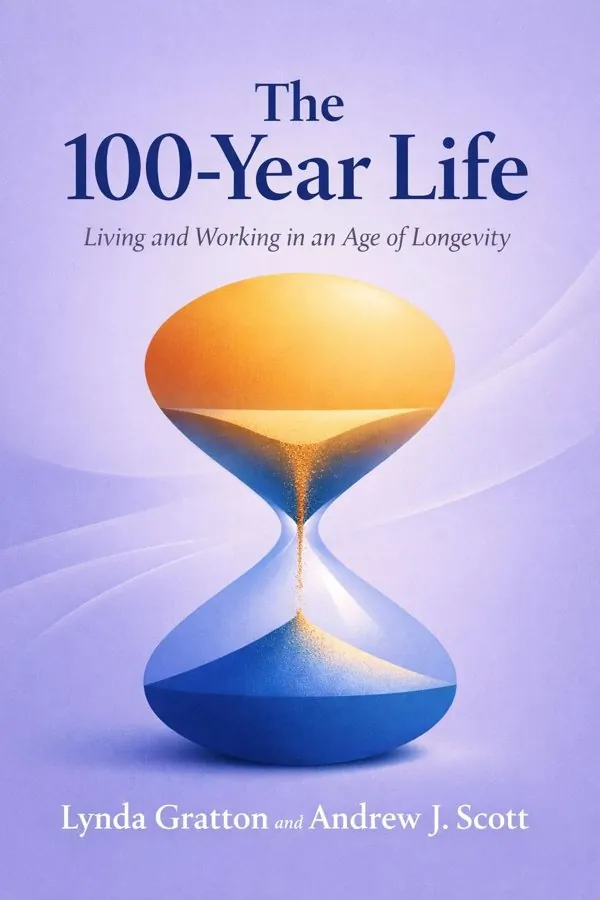
The 100-Year Life: Living and Working in an Age of Longevity: Summary & Key Insights
by Lynda Gratton, Andrew J. Scott
 10 min9 chaptersAudio available
Key Takeaways from The 100-Year Life: Living and Working in an Age of Longevity
A longer life is not just more years tacked onto old patterns; it changes the entire architecture of how life is lived.
The old life script feels natural only because it was historically convenient, not because it is timeless.
In a 100-year life, your most valuable assets may not be the ones listed on a balance sheet.
The dream of stopping work completely at 60 becomes much harder to sustain when life may continue for four more decades.
In a long life, reinvention is no longer a crisis response; it is a normal skill.
What Is The 100-Year Life: Living and Working in an Age of Longevity About?
The 100-Year Life: Living and Working in an Age of Longevity by Lynda Gratton, Andrew J. Scott is a economics book. What if living to 100 stopped being an exception and became a normal expectation? In The 100-Year Life, Lynda Gratton and Andrew J. Scott argue that longer lives will reshape everything: education, careers, retirement, relationships, identity, and the economy itself. This is not a book about aging in the narrow sense. It is a practical and strategic guide to how individuals, families, companies, and governments must adapt to a world where many people will live decades longer than previous generations. The authors show why the old three-stage life model—education, work, retirement—no longer fits a century-long lifespan, and why clinging to it creates financial, emotional, and social strain. Gratton, a leading thinker on the future of work, and Scott, a renowned economist specializing in longevity and macroeconomics, combine behavioral insight with economic analysis to make a compelling case: longevity is both a gift and a challenge. Those who understand its implications can design richer, more flexible, and more resilient lives. This book matters because the future it describes has already begun.
This FizzRead summary covers all 9 key chapters of The 100-Year Life: Living and Working in an Age of Longevity in approximately 10 minutes, distilling the most important ideas, arguments, and takeaways from Lynda Gratton, Andrew J. Scott's work. Also available as an audio summary and Key Quotes Podcast.
The 100-Year Life: Living and Working in an Age of Longevity
What if living to 100 stopped being an exception and became a normal expectation? In The 100-Year Life, Lynda Gratton and Andrew J. Scott argue that longer lives will reshape everything: education, careers, retirement, relationships, identity, and the economy itself. This is not a book about aging in the narrow sense. It is a practical and strategic guide to how individuals, families, companies, and governments must adapt to a world where many people will live decades longer than previous generations. The authors show why the old three-stage life model—education, work, retirement—no longer fits a century-long lifespan, and why clinging to it creates financial, emotional, and social strain. Gratton, a leading thinker on the future of work, and Scott, a renowned economist specializing in longevity and macroeconomics, combine behavioral insight with economic analysis to make a compelling case: longevity is both a gift and a challenge. Those who understand its implications can design richer, more flexible, and more resilient lives. This book matters because the future it describes has already begun.
Who Should Read The 100-Year Life: Living and Working in an Age of Longevity?
This book is perfect for anyone interested in economics and looking to gain actionable insights in a short read. Whether you're a student, professional, or lifelong learner, the key ideas from The 100-Year Life: Living and Working in an Age of Longevity by Lynda Gratton, Andrew J. Scott will help you think differently.
- ✓Readers who enjoy economics and want practical takeaways
- ✓Professionals looking to apply new ideas to their work and life
- ✓Anyone who wants the core insights of The 100-Year Life: Living and Working in an Age of Longevity in just 10 minutes
Want the full summary?
Get instant access to this book summary and 100K+ more with Fizz Moment.
Get Free SummaryAvailable on App Store • Free to download
Key Chapters
A longer life is not just more years tacked onto old patterns; it changes the entire architecture of how life is lived. Gratton and Scott argue that rising life expectancy is one of the most profound economic and social shifts of our time. If many people now have a realistic chance of living to 100, then assumptions built for a 70- or 80-year lifespan no longer work well. The traditional sequence of study in youth, full-time work in midlife, and retirement in old age becomes financially unstable and personally limiting.
The authors explain that longevity creates both opportunity and pressure. On the positive side, more years can mean more chances to learn, reinvent, build relationships, and pursue meaningful work. On the difficult side, longer lives require more savings, longer employability, better health habits, and more adaptability. A pension system designed around brief retirements struggles when retirement lasts 30 years. A career chosen at 22 may not satisfy someone for 50 years. Family structures also change as more generations overlap and caregiving responsibilities expand.
Imagine two workers with similar incomes. One assumes life will unfold traditionally and plans for retirement at 60. The other expects a longer lifespan and builds a more flexible path with periodic retraining, health investment, and income diversification. Over time, the second person is better positioned for change because they planned for longevity rather than resisting it.
The key insight is that living longer is not merely a medical fact; it is a planning revolution. Actionable takeaway: review your financial, career, and life plans through the lens of a 100-year lifespan, and ask what must change if you expect to remain active, healthy, and engaged for much longer than previous generations.
The old life script feels natural only because it was historically convenient, not because it is timeless. One of the book’s central arguments is that the three-stage model—education first, work second, retirement last—is breaking down under the weight of longevity. This structure made sense when formal education happened early, careers were relatively stable, and retirement was short. But in a world of longer lives, rapid technological change, and evolving identities, this sequence becomes too rigid.
Gratton and Scott show that people can no longer expect one qualification to last a lifetime or one uninterrupted career to provide security and purpose for 40 or 50 years. Nor can they assume retirement will be fully funded by employers or states. Instead, life is becoming multi-stage. People may move in and out of learning, work, caregiving, entrepreneurship, portfolio careers, and reinvention at several points across adulthood.
A practical example is the mid-career professional who pauses to upskill in data analysis, shifts industries in their 40s, launches a small business in their 50s, and combines part-time work with mentoring in their 70s. That path would have once seemed unusual; the authors suggest it may become normal. This does not mean instability for its own sake. It means designing life in stages that reflect changing capacities, ambitions, and market realities.
The emotional shift matters as much as the economic one. People need to let go of the idea that success is a straight line. Nonlinear lives may be smarter, healthier, and more sustainable in the age of longevity. Actionable takeaway: replace fixed age-based expectations with stage-based planning, and map several possible transitions you may make over the next 20 to 30 years.
In a 100-year life, your most valuable assets may not be the ones listed on a balance sheet. The authors distinguish between tangible assets, such as savings and property, and intangible assets, which include productive skills, vitality, reputation, relationships, adaptability, and self-knowledge. As life gets longer and careers less linear, these intangible assets become essential to resilience and fulfillment.
Productive assets include knowledge, expertise, and the ability to keep contributing economically. Vitality assets include physical health, mental well-being, friendships, family bonds, and emotional energy. Transformational assets include the capacity to change, experiment, and navigate transitions without losing direction. A person with strong savings but weak health, outdated skills, and low adaptability is vulnerable. By contrast, someone with moderate wealth but strong health habits, a learning mindset, and a broad network may be far better equipped for a long future.
Consider a manager in her late 40s whose industry is disrupted by automation. If she has invested only in income and status, the shock can be destabilizing. But if she has maintained her health, nurtured diverse relationships, learned continuously, and developed confidence in navigating change, she has multiple ways to respond. She can retrain, consult, collaborate, or pivot.
This idea broadens how we think about life planning. It is not enough to ask, “How much money do I need?” We must also ask, “What kind of person do I need to become to flourish over a long life?” Actionable takeaway: make an inventory of your productive, vitality, and transformational assets, then choose one habit in each category to strengthen over the next year.
The dream of stopping work completely at 60 becomes much harder to sustain when life may continue for four more decades. Gratton and Scott do not argue that people should simply work forever in the same exhausting way. Instead, they propose a reimagining of later life: less full-stop retirement, more “re-creation.” This means designing later years around renewed purpose, flexible work, learning, contribution, and choice rather than a single permanent exit from economic activity.
The problem with conventional retirement is twofold. Financially, it is difficult to support decades of consumption without income. Psychologically, a sudden loss of structure, identity, and social connection can be deeply unsettling. Many people do not merely need money from work; they also need meaning, belonging, routine, and challenge. A longer life increases the importance of staying engaged.
Re-creation can take many forms. Someone might reduce hours rather than quit entirely, combine freelance work with volunteering, mentor younger workers, start a passion-driven business, or return to study. The point is not to glorify endless productivity. It is to create a sustainable, flexible, and fulfilling later stage that matches longer lifespans.
This shift also affects policy and employers. Societies need age-inclusive workplaces, reskilling opportunities, and structures that support phased transitions rather than abrupt retirement cliffs. Individuals, meanwhile, must stop imagining retirement as a distant reward and start seeing later life as another design challenge.
Actionable takeaway: instead of asking when you can stop working, ask what mix of income, purpose, flexibility, and contribution you want in the later decades of your life, and begin building toward that vision now.
In a long life, reinvention is no longer a crisis response; it is a normal skill. The authors emphasize that technological change, globalization, and shifting labor markets make continuous adaptation essential. If a working life may span 50 or 60 years, very few people will thrive by relying on one qualification, one profession, or one identity. Learning must become recurring rather than front-loaded.
This has major implications for how people approach careers. Early choices become less final. Midlife transitions become more common. Portfolio careers—combining multiple projects or roles—gain appeal. Time spent learning later in life should not be seen as failure or delay but as strategic renewal. The authors encourage readers to view their careers as evolving journeys rather than ladders climbed once.
A practical example is an accountant who recognizes that automation is reshaping routine tasks. Rather than waiting for displacement, she builds new strengths in advisory work, communication, digital tools, and strategic analysis. Or think of a teacher who moves into educational design, coaching, or online learning after updating their capabilities. These transitions become easier when learning is habitual, not emergency-driven.
Reinvention also requires identity flexibility. Many people cling to titles long after those titles stop serving them. But in the age of longevity, a rigid self-concept can become a liability. The ability to say, “I used to do this, now I do that,” is a strength.
Actionable takeaway: create a recurring learning plan—whether annually or every few years—that updates your skills, expands your options, and prepares you for career shifts before they become urgent.
A 100-year life cannot be built by individual planning alone; it depends heavily on the quality of human relationships. Gratton and Scott stress that longer lives increase the importance of family structures, partnerships, friendships, and social networks. As lifespans extend, people may experience more life stages with spouses, more years of parenting and grandparenting, and more responsibilities toward older relatives. Social bonds become both a source of vitality and a practical support system.
Long lives can enrich relationships by creating more shared time, but they can also strain them. Traditional expectations about marriage, caregiving, gender roles, and household labor may no longer fit neatly. If both partners need to keep working longer, if one person wants to retrain midlife, or if multiple generations require care at once, couples and families must negotiate more actively than past models assumed.
The book also points to the economic value of networks. Opportunities for reinvention, collaboration, and resilience often come through people, not institutions. A broad and diverse network can expose you to ideas, jobs, emotional support, and practical help during transitions. Isolation, by contrast, becomes more costly in a long life.
For example, someone planning a midlife career change will do better if they have maintained friendships across industries, stayed connected to former colleagues, and built trust within their community. Likewise, older adults who remain socially engaged tend to preserve well-being more effectively than those who withdraw.
Actionable takeaway: invest intentionally in close relationships and broad networks, treating them not as optional extras but as core long-life assets that support health, opportunity, and resilience.
Many people suffer not because change happens, but because their identity was built for a shorter, more predictable life. One of the subtler insights in The 100-Year Life is that longevity challenges the stories people tell about who they are. In a traditional model, identity often tied tightly to a single role: student, worker, retiree. But in a multi-stage life, that simplicity disappears. People may have several careers, different family roles, changing priorities, and multiple periods of self-renewal.
This requires a more flexible sense of self. Instead of defining life through fixed milestones by fixed ages, individuals need narratives that allow for exploration, pauses, experimentation, and reinvention. A person who believes they “should have it all figured out” by 30 or 40 may feel unnecessary failure when life evolves. The authors suggest a more adaptive approach: identity as a developing process rather than a completed product.
This matters practically as well as psychologically. When people over-identify with one professional role, transitions become harder. A lawyer leaving practice, an executive stepping down, or a parent returning to paid work after caregiving may struggle if they equate worth with one chapter of life. But if identity is rooted in values, strengths, curiosity, and purpose rather than status alone, change becomes less threatening.
A useful application is to ask not just “What do I do?” but “What capacities and commitments do I carry across different stages?” This broader identity allows continuity without rigidity. It helps people survive disruption without feeling erased.
Actionable takeaway: rewrite your personal narrative around enduring values and evolving strengths, so you can adapt to major life changes without losing a sense of meaning or self-respect.
Longevity is not simply a personal lifestyle issue; it is an institutional challenge that affects the economy at every level. Gratton and Scott make clear that individuals cannot solve everything alone. Schools, employers, pension systems, healthcare providers, and governments were largely designed around shorter lifespans and more linear careers. If those structures remain unchanged, people will bear unnecessary risk and inequality will deepen.
Education systems, for instance, still assume most formal learning happens at the start of life. But a 100-year life calls for modular, accessible, lifelong education. Employers often prize youth while underinvesting in older workers, even though businesses need experienced talent and age-diverse teams. Pension systems may be under pressure if they support long retirements without corresponding changes in savings behavior, retirement ages, or work patterns. Healthcare systems must shift attention from acute care alone toward prevention, vitality, and long-term functional well-being.
The economic implications are significant. Countries that adapt well could benefit from a healthier, more experienced, and more productive population. Those that do not may face fiscal stress, labor shortages, and social conflict between generations. Employers that redesign jobs for flexibility and reskilling may gain loyalty and capability. Those that ignore longevity may lose valuable workers too early.
For readers, this idea is empowering in a broader sense: it reminds us that personal adaptation should be paired with civic awareness. The future of longevity depends partly on policy, culture, and organizational design.
Actionable takeaway: advocate for institutions that support lifelong learning, flexible work, healthy aging, and phased transitions, while also choosing employers and communities that are better aligned with the realities of longer lives.
The ultimate message of the book is not merely that we will live longer, but that we must become better designers of our lives. Longevity creates more time, but extra time alone does not guarantee fulfillment. Without intentional planning, a longer life can amplify financial mistakes, unhealthy habits, shallow relationships, and career stagnation. With thoughtful design, it can become richer, more varied, and more meaningful.
Gratton and Scott encourage readers to think in terms of scenarios rather than rigid plans. Because long lives include uncertainty, the goal is not perfect prediction but greater preparedness. This means balancing exploration with security, earning with learning, ambition with health, and independence with connection. It also means making peace with multiple transitions rather than waiting for one final state of arrival.
A practical way to apply this is to treat life as a portfolio. You are managing not just money, but time, energy, relationships, skills, identity, and opportunity. A healthy long-life strategy might include saving consistently, exercising regularly, revisiting career options every few years, maintaining cross-generational friendships, and experimenting with new roles before old ones collapse. Small recurring adjustments matter more than one dramatic decision.
The book’s optimism lies in this idea: longevity can expand human possibility if matched by imagination and responsibility. A century-long life can hold many chapters, each with its own purpose.
Actionable takeaway: set aside time each year for a “life design review” covering finances, health, work, learning, and relationships, and use it to make deliberate adjustments for the decades ahead.
All Chapters in The 100-Year Life: Living and Working in an Age of Longevity
About the Authors
Lynda Gratton and Andrew J. Scott are respected thinkers on work, economics, and longevity. Gratton is a professor at London Business School and one of the world’s leading voices on the future of work, organizational change, and human capital. Her research focuses on how technology, globalization, and shifting social expectations are transforming careers and workplaces. Scott is an economist known for his work on macroeconomics, aging, and the financial implications of longer lives. He has held prominent academic roles and written widely on demographic change and economic policy. Together, they combine expertise in business, labor markets, and long-term economic trends. Their collaboration in The 100-Year Life offers a powerful and practical framework for understanding how increased longevity will reshape individual choices and society as a whole.
Get This Summary in Your Preferred Format
Read or listen to the The 100-Year Life: Living and Working in an Age of Longevity summary by Lynda Gratton, Andrew J. Scott anytime, anywhere. FizzRead offers multiple formats so you can learn on your terms — all free.
Available formats: App · Audio · PDF · EPUB — All included free with FizzRead
Download The 100-Year Life: Living and Working in an Age of Longevity PDF and EPUB Summary
Key Quotes from The 100-Year Life: Living and Working in an Age of Longevity
“A longer life is not just more years tacked onto old patterns; it changes the entire architecture of how life is lived.”
“The old life script feels natural only because it was historically convenient, not because it is timeless.”
“In a 100-year life, your most valuable assets may not be the ones listed on a balance sheet.”
“The dream of stopping work completely at 60 becomes much harder to sustain when life may continue for four more decades.”
“In a long life, reinvention is no longer a crisis response; it is a normal skill.”
Frequently Asked Questions about The 100-Year Life: Living and Working in an Age of Longevity
The 100-Year Life: Living and Working in an Age of Longevity by Lynda Gratton, Andrew J. Scott is a economics book that explores key ideas across 9 chapters. What if living to 100 stopped being an exception and became a normal expectation? In The 100-Year Life, Lynda Gratton and Andrew J. Scott argue that longer lives will reshape everything: education, careers, retirement, relationships, identity, and the economy itself. This is not a book about aging in the narrow sense. It is a practical and strategic guide to how individuals, families, companies, and governments must adapt to a world where many people will live decades longer than previous generations. The authors show why the old three-stage life model—education, work, retirement—no longer fits a century-long lifespan, and why clinging to it creates financial, emotional, and social strain. Gratton, a leading thinker on the future of work, and Scott, a renowned economist specializing in longevity and macroeconomics, combine behavioral insight with economic analysis to make a compelling case: longevity is both a gift and a challenge. Those who understand its implications can design richer, more flexible, and more resilient lives. This book matters because the future it describes has already begun.
You Might Also Like
Business Adventures
John Brooks
10 min
Nudge
Richard H. Thaler, Cass R. Sunstein
10 min
The Hitchhiker"s Guide to the Galaxy
Douglas Adams
10 minThe Muqaddimah
Ibn Khaldun
10 minThe Outsiders
William N. Thorndike
10 min
A Little History of Economics
Niall Kishtainy
10 minBrowse by Category
Ready to read The 100-Year Life: Living and Working in an Age of Longevity?
Get the full summary and 100K+ more books with Fizz Moment.