
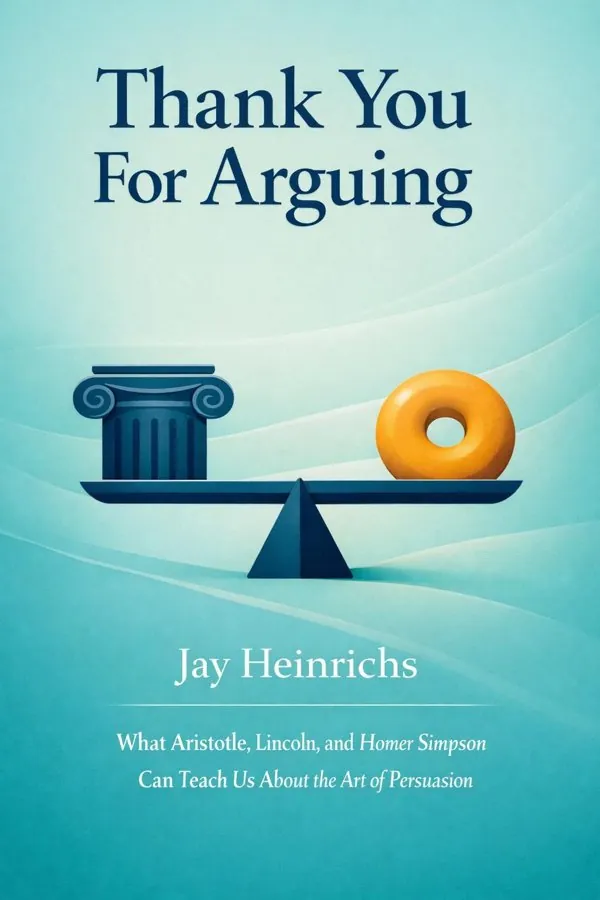
Thank You For Arguing: What Aristotle, Lincoln, and Homer Simpson Can Teach Us About the Art of Persuasion: Summary & Key Insights
 10 min11 chaptersAudio available
What Is Thank You For Arguing: What Aristotle, Lincoln, and Homer Simpson Can Teach Us About the Art of Persuasion About?
Thank You For Arguing: What Aristotle, Lincoln, and Homer Simpson Can Teach Us About the Art of Persuasion by Jay Heinrichs is a communication book spanning 11 pages. This book is a comprehensive guide to the art of persuasion, blending classical rhetoric with modern examples from politics, advertising, and pop culture. Jay Heinrichs explains how techniques from Aristotle and Cicero can be applied today to win arguments, influence others, and communicate more effectively.
This FizzRead summary covers all 11 key chapters of Thank You For Arguing: What Aristotle, Lincoln, and Homer Simpson Can Teach Us About the Art of Persuasion in approximately 10 minutes, distilling the most important ideas, arguments, and takeaways from Jay Heinrichs's work. Also available as an audio summary and Key Quotes Podcast.
Thank You For Arguing: What Aristotle, Lincoln, and Homer Simpson Can Teach Us About the Art of Persuasion
This book is a comprehensive guide to the art of persuasion, blending classical rhetoric with modern examples from politics, advertising, and pop culture. Jay Heinrichs explains how techniques from Aristotle and Cicero can be applied today to win arguments, influence others, and communicate more effectively.
Who Should Read Thank You For Arguing: What Aristotle, Lincoln, and Homer Simpson Can Teach Us About the Art of Persuasion?
This book is perfect for anyone interested in communication and looking to gain actionable insights in a short read. Whether you're a student, professional, or lifelong learner, the key ideas from Thank You For Arguing: What Aristotle, Lincoln, and Homer Simpson Can Teach Us About the Art of Persuasion by Jay Heinrichs will help you think differently.
- ✓Readers who enjoy communication and want practical takeaways
- ✓Professionals looking to apply new ideas to their work and life
- ✓Anyone who wants the core insights of Thank You For Arguing: What Aristotle, Lincoln, and Homer Simpson Can Teach Us About the Art of Persuasion in just 10 minutes
Want the full summary?
Get instant access to this book summary and 100K+ more with Fizz Moment.
Get Free SummaryAvailable on App Store • Free to download
Key Chapters
Let’s start with Aristotle—the thinker who turned argument into art. He identified three essential ingredients of persuasion: ethos, pathos, and logos. Each appeal moves people differently, but together they form a complete picture of how humans make decisions.
Ethos is credibility. When an audience trusts you, they’ll follow your reasoning. It’s not about authority alone but about decorum—fitting yourself to your listeners’ expectations. You build ethos by aligning your character with what your audience values. Lincoln did this masterfully: in moments of national tension, he spoke with humility and empathy, personifying the moral seriousness his listeners needed. Ethos isn’t static. It’s fluid; it changes with every context. The key is knowing what kind of person your audience needs you to be.
Pathos appeals to emotion. Logic can outline a case, but emotion propels action. A parent doesn’t convince a child to eat broccoli by reciting nutritional facts; they persuade through humor, tone, or a touch of guilt. The emotional temperature of a conversation determines whether persuasion will take root. By controlling mood—through storytelling, imagery, or framing—you create the emotional conditions for agreement.
Then there’s logos: reasoning itself. Here lies the architecture of argument—the examples, evidence, and the subtle art of the enthymeme, where you let your listener complete the logic themselves. This cooperation in reasoning builds internal agreement far more effectively than simply dictating conclusions.
These three appeals are not isolated tricks. They form a dynamic triangle. Great persuasion weaves ethos into credibility, wraps pathos around feeling, and anchors both in logos. Once you learn to tune them together, argument stops being about domination. It becomes about discovery—how you and your listener can see the same truth from different sides.
Every argument lives in time. Aristotle divided them into three kinds depending on where their focus lies: forensic, demonstrative, and deliberative. Forensic arguments dwell in the past—they assign blame or innocence. Lawyers thrive here, using evidence to reconstruct events. Demonstrative arguments occupy the present—they praise or condemn, shape values, and define identity. You find these in ceremonies, speeches, or social debate. Deliberative arguments look forward; they’re about choice, policy, and the future.
Why does this matter? Because your argument’s temporal focus shapes its mood and strategy. If you’re stuck fighting about who caused a mess (forensic), you’re not solving the problem; you’re litigating history. To persuade productively, you often need to move the conversation toward the future—toward choice rather than blame.
Lincoln, again, was a master of deliberative argument. Instead of dwelling on division, he spoke about what could be, turning crisis into shared responsibility. That shift—from the anger of the past to the possibility of the future—is one of rhetoric’s most powerful moves. The moment you change time, you change the argument’s purpose.
+ 9 more chapters — available in the FizzRead app
All Chapters in Thank You For Arguing: What Aristotle, Lincoln, and Homer Simpson Can Teach Us About the Art of Persuasion
About the Author
Jay Heinrichs is an American author, journalist, and consultant specializing in rhetoric and persuasive communication. He has worked as a magazine editor and teaches the principles of classical rhetoric applied to modern contexts.
Get This Summary in Your Preferred Format
Read or listen to the Thank You For Arguing: What Aristotle, Lincoln, and Homer Simpson Can Teach Us About the Art of Persuasion summary by Jay Heinrichs anytime, anywhere. FizzRead offers multiple formats so you can learn on your terms — all free.
Available formats: App · Audio · PDF · EPUB — All included free with FizzRead
Download Thank You For Arguing: What Aristotle, Lincoln, and Homer Simpson Can Teach Us About the Art of Persuasion PDF and EPUB Summary
Key Quotes from Thank You For Arguing: What Aristotle, Lincoln, and Homer Simpson Can Teach Us About the Art of Persuasion
“Let’s start with Aristotle—the thinker who turned argument into art.”
“Aristotle divided them into three kinds depending on where their focus lies: forensic, demonstrative, and deliberative.”
Frequently Asked Questions about Thank You For Arguing: What Aristotle, Lincoln, and Homer Simpson Can Teach Us About the Art of Persuasion
Thank You For Arguing: What Aristotle, Lincoln, and Homer Simpson Can Teach Us About the Art of Persuasion by Jay Heinrichs is a communication book that explores key ideas across 11 chapters. This book is a comprehensive guide to the art of persuasion, blending classical rhetoric with modern examples from politics, advertising, and pop culture. Jay Heinrichs explains how techniques from Aristotle and Cicero can be applied today to win arguments, influence others, and communicate more effectively.
You Might Also Like
Magic Words: The Science and Secrets Behind Seven Words That Motivate, Engage, and Influence
Tim David
10 min
Talking Across The Divide: How to Communicate with People You Disagree with and Maybe Even Change the World
Justin Lee
10 min
The Exceptional Presenter: A Proven Formula to Open Up! and Own the Room
Timothy J. Koegel
10 min
4 Essential Keys to Effective Communication in Love, Life, Work--Anywhere!: Including the 12-Day Communication Challenge!
Bento C. Leal III
10 min
Active Listening Techniques: 30 Practical Tools to Hone Your Communication Skills
Nisha Gupta
10 min
Bargaining for Advantage: Negotiation Strategies for Reasonable People
G. Richard Shell
10 minBrowse by Category
Ready to read Thank You For Arguing: What Aristotle, Lincoln, and Homer Simpson Can Teach Us About the Art of Persuasion?
Get the full summary and 100K+ more books with Fizz Moment.