
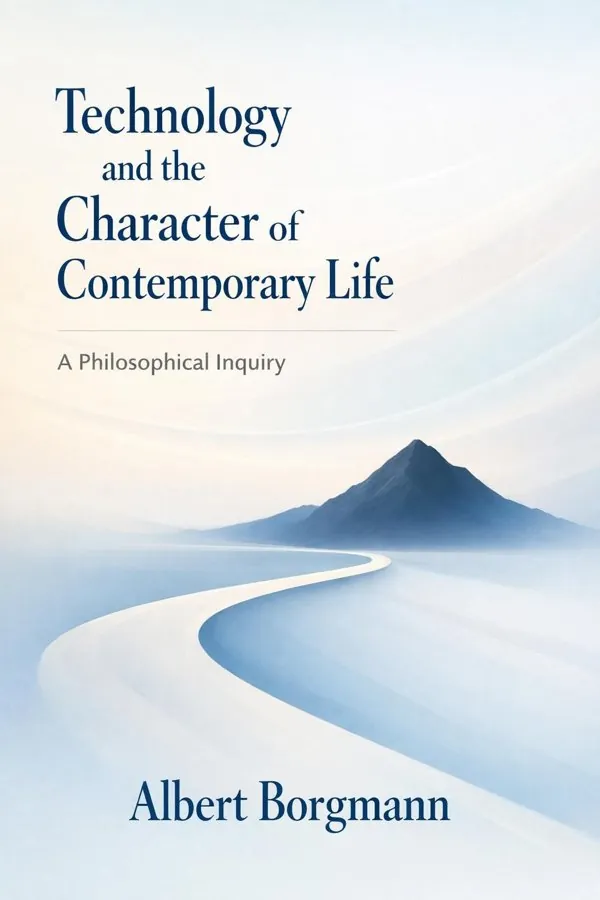
Technology and the Character of Contemporary Life: A Philosophical Inquiry: Summary & Key Insights
 10 min6 chaptersAudio available
What Is Technology and the Character of Contemporary Life: A Philosophical Inquiry About?
Technology and the Character of Contemporary Life: A Philosophical Inquiry by Albert Borgmann is a western_phil book spanning 6 pages. In this influential work, Albert Borgmann explores how modern technology shapes the structure and meaning of contemporary life. He introduces the concept of the 'device paradigm' to describe how technological devices simplify and obscure the engagement between humans and the world, leading to a loss of focal practices that once grounded human experience. Borgmann argues for a renewed attention to these practices as a way to restore balance and authenticity in a technologically dominated culture.
This FizzRead summary covers all 6 key chapters of Technology and the Character of Contemporary Life: A Philosophical Inquiry in approximately 10 minutes, distilling the most important ideas, arguments, and takeaways from Albert Borgmann's work. Also available as an audio summary and Key Quotes Podcast.
Technology and the Character of Contemporary Life: A Philosophical Inquiry
In this influential work, Albert Borgmann explores how modern technology shapes the structure and meaning of contemporary life. He introduces the concept of the 'device paradigm' to describe how technological devices simplify and obscure the engagement between humans and the world, leading to a loss of focal practices that once grounded human experience. Borgmann argues for a renewed attention to these practices as a way to restore balance and authenticity in a technologically dominated culture.
Who Should Read Technology and the Character of Contemporary Life: A Philosophical Inquiry?
This book is perfect for anyone interested in western_phil and looking to gain actionable insights in a short read. Whether you're a student, professional, or lifelong learner, the key ideas from Technology and the Character of Contemporary Life: A Philosophical Inquiry by Albert Borgmann will help you think differently.
- ✓Readers who enjoy western_phil and want practical takeaways
- ✓Professionals looking to apply new ideas to their work and life
- ✓Anyone who wants the core insights of Technology and the Character of Contemporary Life: A Philosophical Inquiry in just 10 minutes
Want the full summary?
Get instant access to this book summary and 100K+ more with Fizz Moment.
Get Free SummaryAvailable on App Store • Free to download
Key Chapters
We often think of technology as a set of tools extending human capability, a neutral means serving diverse ends. Yet contemporary life shows that technology is not neutral; it organizes our world and molds our expectations. The problem is not that devices exist, but that they have become the unquestioned framework of living. They promise liberation from toil and bring astonishing abundance, but they also flatten the landscape of meaning. When every difficulty can be solved by a technical fix, the moral and existential dimensions of life — its trials, commitments, and delights — are dulled.
Technological progress has transformed more than our environment; it has transformed the structure of our experience. Tasks that once united people in shared purpose — preparing food, maintaining a home, educating children — have been outsourced to systems. Freedom has been redefined as the absence of engagement, and comfort has replaced participation as the measure of success. We thus face not just environmental or economic issues, but the erosion of our moral and communal bearings. This is what I call the problem of technology: it is a cultural condition we inhabit, not a set of tools we control.
To grasp the depth of this transformation, I introduce the notion of the device paradigm. A device, as I use the term, is not just a machine; it is a pattern of separation between means and ends. The device delivers a commodity — warmth, light, nourishment, entertainment — while concealing the machinery, skill, and engagement required to produce it. The paradigm of the device, then, is a cultural logic that prizes availability and convenience while hiding the conditions of production.
Consider again the hearth and the furnace. The hearth requires tending, collecting wood, controlling fire. It engages body, mind, and community. The furnace, by contrast, provides heat instantly and anonymously. The commodity is the same, but the human relation differs profoundly. Under the device paradigm, we are consumers of results, not participants in their making. The world becomes something presented to us, ready-made, instead of something we make present through effort and care.
This paradigm extends to every corner of life: from music delivered through headphones instead of played around a piano, to food obtained through a drive-thru rather than grown or cooked. In each case, the device simplifies and detaches. The danger is not that devices are evil but that, by their success and invisibility, they render the older forms of engagement increasingly irrelevant. The device paradigm thus defines the texture of technological culture — efficient, abundant, and strangely hollow.
+ 4 more chapters — available in the FizzRead app
All Chapters in Technology and the Character of Contemporary Life: A Philosophical Inquiry
About the Author
Albert Borgmann (born 1937) is a German-born American philosopher known for his work in the philosophy of technology. He served as a professor at the University of Montana and is recognized for developing the concept of the 'device paradigm' and for his contributions to understanding the cultural and ethical dimensions of technology.
Get This Summary in Your Preferred Format
Read or listen to the Technology and the Character of Contemporary Life: A Philosophical Inquiry summary by Albert Borgmann anytime, anywhere. FizzRead offers multiple formats so you can learn on your terms — all free.
Available formats: App · Audio · PDF · EPUB — All included free with FizzRead
Download Technology and the Character of Contemporary Life: A Philosophical Inquiry PDF and EPUB Summary
Key Quotes from Technology and the Character of Contemporary Life: A Philosophical Inquiry
“We often think of technology as a set of tools extending human capability, a neutral means serving diverse ends.”
“To grasp the depth of this transformation, I introduce the notion of the device paradigm.”
Frequently Asked Questions about Technology and the Character of Contemporary Life: A Philosophical Inquiry
Technology and the Character of Contemporary Life: A Philosophical Inquiry by Albert Borgmann is a western_phil book that explores key ideas across 6 chapters. In this influential work, Albert Borgmann explores how modern technology shapes the structure and meaning of contemporary life. He introduces the concept of the 'device paradigm' to describe how technological devices simplify and obscure the engagement between humans and the world, leading to a loss of focal practices that once grounded human experience. Borgmann argues for a renewed attention to these practices as a way to restore balance and authenticity in a technologically dominated culture.
You Might Also Like
A Little History of Philosophy
Nigel Warburton
10 min
Areopagitica
John Milton
10 min
How To Think Like A Philosopher: Essential Principles For Clear Thinking
Peter Cave
10 min
Language, Truth and Logic
A. J. Ayer
10 min
The Age of Reason
Thomas Paine
10 min
The Essays
Michel De Montaigne
10 minBrowse by Category
Ready to read Technology and the Character of Contemporary Life: A Philosophical Inquiry?
Get the full summary and 100K+ more books with Fizz Moment.