
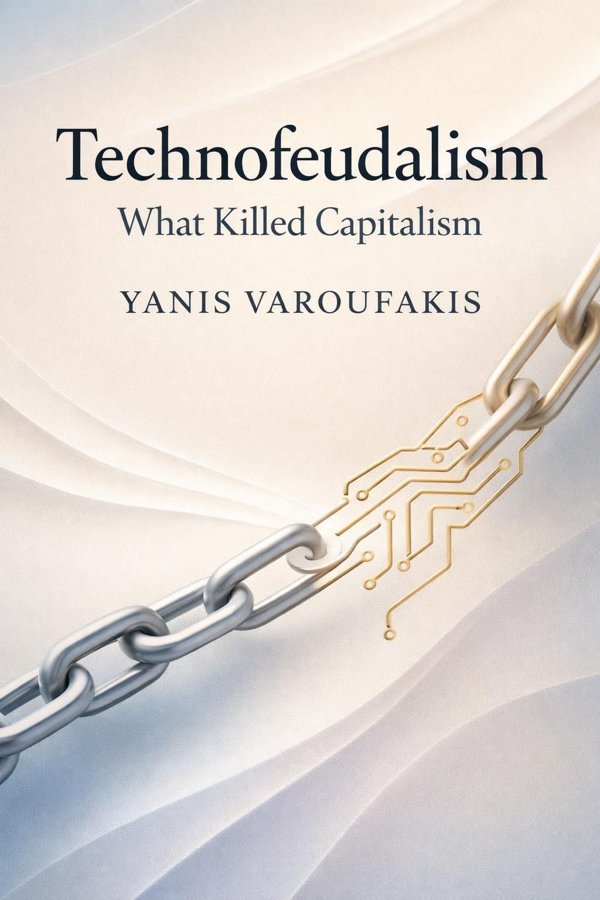
Technofeudalism: What Killed Capitalism: Summary & Key Insights
 10 min8 chaptersAudio available
What Is Technofeudalism: What Killed Capitalism About?
Technofeudalism: What Killed Capitalism by Yanis Varoufakis is a economics book spanning 8 pages. In this groundbreaking work, economist Yanis Varoufakis argues that capitalism has been replaced by a new system he calls technofeudalism. Through a blend of history, economics, and political analysis, Varoufakis explores how technology giants have seized control of markets, data, and social structures, creating a new form of digital feudalism that reshapes power and inequality worldwide.
This FizzRead summary covers all 8 key chapters of Technofeudalism: What Killed Capitalism in approximately 10 minutes, distilling the most important ideas, arguments, and takeaways from Yanis Varoufakis's work. Also available as an audio summary and Key Quotes Podcast.
Technofeudalism: What Killed Capitalism
In this groundbreaking work, economist Yanis Varoufakis argues that capitalism has been replaced by a new system he calls technofeudalism. Through a blend of history, economics, and political analysis, Varoufakis explores how technology giants have seized control of markets, data, and social structures, creating a new form of digital feudalism that reshapes power and inequality worldwide.
Who Should Read Technofeudalism: What Killed Capitalism?
This book is perfect for anyone interested in economics and looking to gain actionable insights in a short read. Whether you're a student, professional, or lifelong learner, the key ideas from Technofeudalism: What Killed Capitalism by Yanis Varoufakis will help you think differently.
- ✓Readers who enjoy economics and want practical takeaways
- ✓Professionals looking to apply new ideas to their work and life
- ✓Anyone who wants the core insights of Technofeudalism: What Killed Capitalism in just 10 minutes
Want the full summary?
Get instant access to this book summary and 100K+ more with Fizz Moment.
Get Free SummaryAvailable on App Store • Free to download
Key Chapters
To understand technofeudalism, we must first recall how capitalism came to dominate in the first place. Capitalism’s birth was not an event but a process—a dissolution of feudal bonds, a liberation of capital and labor from hereditary landholding. Once markets and money became the central arbiters of value, the world reorganized itself around profit derived from production and circulation. The merchant and the manufacturer displaced the landlord. The industrial revolution gave capitalists dominion over the factory floor, and the 20th century saw finance rise to discipline both industry and labor from above.
By the late 20th century, however, something profound began to shift. The digital revolution promised liberation—instant communication, distributed knowledge, decentralized creativity—but instead it prepared the soil for a concentration of control unseen since premodern times. With the proliferation of data, we entered a new phase where the traditional relationship between labor, capital, and land was redrawn. Land morphed into cloud infrastructure; capital became data networks; labor became platform participation. Yet we continued to speak as if the old categories still applied.
The financialization wave of the 1980s and 1990s was capitalism’s last great spasm—a moment when the system consumed itself. The 2008 global crisis, in my view, marked the moment capitalism died as a coherent set of relations. Its corpse, however, still walks among us, animated by the digital infrastructures that replaced markets as the primary sites of accumulation. Those infrastructures are not markets at all; they are private networks imposing access terms on users. This is why, after 2008, the profit motive increasingly gave way to rent seeking by digitally endowed monopolies. We came full circle—from feudal rents extracted from peasants to digital rents extracted from users.
Cloud capital is the linchpin of technofeudalism. Unlike industrial capital—machines, factories, shipping fleets—cloud capital is intangible yet immensely powerful. It consists of data centers, algorithms, platforms, and the sprawling digital ecosystems built around them. Its owners are not mere entrepreneurs but architects of environments. When you connect to Amazon, Google, or Facebook, you are not entering a market; you are stepping into a privately owned sphere that dictates your every interaction through algorithmic mediation.
This new capital form thrives on a feedback loop of surveillance and behavioral capture. Every click enriches the cloud lord’s domain. Unlike a capitalist entrepreneur who risks investment to produce commodities, the cloud lord’s wealth grows by administering the digital space itself. They charge rents not for goods but for permitting participation. The old logic of supply and demand dissolves into the logic of extraction-by-access.
Cloud capital also depends on the fusion of state and corporate power. Public investment, research funding, and monetary policy underpin the infrastructure of the cloud. Yet ownership is private, meaning that social cooperation—our collective online activity—is immediately enclosed as private property. Every exchange generates data that does not belong to us, but to the platform. In this way, cloud capital feeds parasitically upon the social body, transforming our everyday existence into a perpetual source of rent.
If industrial capitalism turned human labor into a commodity, cloud capitalism turns human attention and interaction into raw material. The wealth of cloud lords lies in orchestrating flows of information and predicting behavior. We become both producers and products, our digital residues lubricating a system that no longer needs markets to function.
+ 6 more chapters — available in the FizzRead app
All Chapters in Technofeudalism: What Killed Capitalism
About the Author
Yanis Varoufakis is a Greek economist, academic, and former finance minister of Greece. He is known for his critical views on global capitalism and his bestselling books on economics and politics, including 'Talking to My Daughter About the Economy' and 'Adults in the Room'.
Get This Summary in Your Preferred Format
Read or listen to the Technofeudalism: What Killed Capitalism summary by Yanis Varoufakis anytime, anywhere. FizzRead offers multiple formats so you can learn on your terms — all free.
Available formats: App · Audio · PDF · EPUB — All included free with FizzRead
Download Technofeudalism: What Killed Capitalism PDF and EPUB Summary
Key Quotes from Technofeudalism: What Killed Capitalism
“To understand technofeudalism, we must first recall how capitalism came to dominate in the first place.”
“Cloud capital is the linchpin of technofeudalism.”
Frequently Asked Questions about Technofeudalism: What Killed Capitalism
Technofeudalism: What Killed Capitalism by Yanis Varoufakis is a economics book that explores key ideas across 8 chapters. In this groundbreaking work, economist Yanis Varoufakis argues that capitalism has been replaced by a new system he calls technofeudalism. Through a blend of history, economics, and political analysis, Varoufakis explores how technology giants have seized control of markets, data, and social structures, creating a new form of digital feudalism that reshapes power and inequality worldwide.
More by Yanis Varoufakis

You Might Also Like

Business Adventures
John Brooks
10 min
Nudge
Richard H. Thaler, Cass R. Sunstein
10 min
The Hitchhiker"s Guide to the Galaxy
Douglas Adams
10 minThe Muqaddimah
Ibn Khaldun
10 minThe Outsiders
William N. Thorndike
10 min
A Little History of Economics
Niall Kishtainy
10 minBrowse by Category
Ready to read Technofeudalism: What Killed Capitalism?
Get the full summary and 100K+ more books with Fizz Moment.