
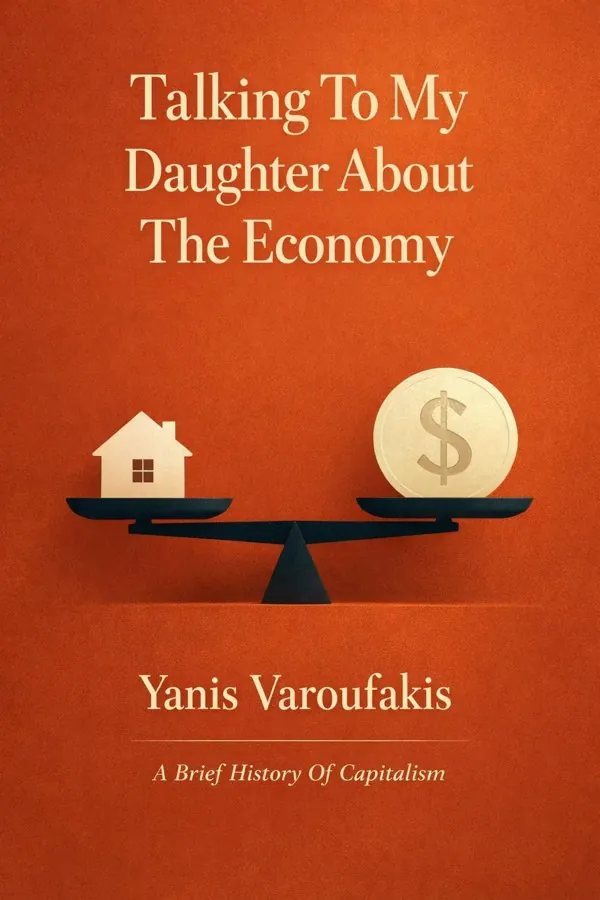
Talking To My Daughter About The Economy: A Brief History Of Capitalism: Summary & Key Insights
 10 min13 chaptersAudio available
What Is Talking To My Daughter About The Economy: A Brief History Of Capitalism About?
Talking To My Daughter About The Economy: A Brief History Of Capitalism by Yanis Varoufakis is a economics book spanning 13 pages. In this book, Yanis Varoufakis explains the complex world of economics in simple, accessible language through a series of letters to his teenage daughter. He explores the origins of capitalism, the role of money, labor, and markets, and how economic systems shape societies and human relationships. The work aims to demystify economic concepts and encourage critical thinking about inequality and global financial structures.
This FizzRead summary covers all 13 key chapters of Talking To My Daughter About The Economy: A Brief History Of Capitalism in approximately 10 minutes, distilling the most important ideas, arguments, and takeaways from Yanis Varoufakis's work. Also available as an audio summary and Key Quotes Podcast.
Talking To My Daughter About The Economy: A Brief History Of Capitalism
In this book, Yanis Varoufakis explains the complex world of economics in simple, accessible language through a series of letters to his teenage daughter. He explores the origins of capitalism, the role of money, labor, and markets, and how economic systems shape societies and human relationships. The work aims to demystify economic concepts and encourage critical thinking about inequality and global financial structures.
Who Should Read Talking To My Daughter About The Economy: A Brief History Of Capitalism?
This book is perfect for anyone interested in economics and looking to gain actionable insights in a short read. Whether you're a student, professional, or lifelong learner, the key ideas from Talking To My Daughter About The Economy: A Brief History Of Capitalism by Yanis Varoufakis will help you think differently.
- ✓Readers who enjoy economics and want practical takeaways
- ✓Professionals looking to apply new ideas to their work and life
- ✓Anyone who wants the core insights of Talking To My Daughter About The Economy: A Brief History Of Capitalism in just 10 minutes
Want the full summary?
Get instant access to this book summary and 100K+ more with Fizz Moment.
Get Free SummaryAvailable on App Store • Free to download
Key Chapters
Before coins ever jingled in pockets, before merchants crossed oceans, societies thrived through exchange. But exchange did not begin with trade as we know it; it began with reciprocity — with neighbors helping one another, with families sharing harvests and labor without keeping score. When I explained this to my daughter, I told her that what modern economists often forget is that our ancestors did not calculate value in the cold language of prices. Value was embedded in relationships. The tribe, the village, the kinship network — these were the first economies. They functioned not through contracts, but through trust.
This is crucial because it means that the economy was not born from greed or competition, but from cooperation and interdependence. Reciprocity secured survival, yes, but it also bound communities through gratitude and obligation. To give was to belong; to refuse was to isolate oneself. Markets, in that sense, emerged from social creativity, from humans finding ways to balance their needs collectively rather than through conquest.
As societies grew, so did the complexity of their exchanges. A basket of grain for a fishing net became harder to calculate once communities diversified. The seeds of a more abstract form of value were sown — the idea that something external could represent worth and help coordinate exchange among strangers. Yet, even then, economy and morality were intertwined. The market was an extension of human bonds, not a substitute for them.
Money, I explained to my daughter, was born not because barter was inefficient — a myth textbooks often repeat — but because societies became too large to rely on personal trust. When rulers began collecting taxes and armies needed to be fed, tokens of value appeared. These tokens — first metal, later paper — carried authority. They were not inventions of free markets but of states and institutions wanting to control flows of goods and obligations. To owe in money was to be bound in a web of promises.
What fascinated me most, and what I hoped my daughter would grasp, is that money is simultaneously magical and fictional. It exists because we all act as if it does. It is, in truth, a social contract written on metal or paper, and now in digital code. That belief allows complete strangers to cooperate — to build cities, trade across oceans, finance ideas. But it also allows inequality to calcify, because those who command the creation of money often command society itself.
When we think of money as neutral, we blind ourselves to its power. The birth of money turned economies into systems of debt, hierarchy, and domination. Yet it also gave us a tool — a symbol of possibility — that could serve emancipation if controlled democratically.
+ 11 more chapters — available in the FizzRead app
All Chapters in Talking To My Daughter About The Economy: A Brief History Of Capitalism
About the Author
Yanis Varoufakis is a Greek economist, academic, and politician known for his work on game theory and his tenure as Greece’s Minister of Finance during the 2015 debt crisis. He has taught economics at several universities and is a prominent critic of austerity policies and global financial institutions.
Get This Summary in Your Preferred Format
Read or listen to the Talking To My Daughter About The Economy: A Brief History Of Capitalism summary by Yanis Varoufakis anytime, anywhere. FizzRead offers multiple formats so you can learn on your terms — all free.
Available formats: App · Audio · PDF · EPUB — All included free with FizzRead
Download Talking To My Daughter About The Economy: A Brief History Of Capitalism PDF and EPUB Summary
Key Quotes from Talking To My Daughter About The Economy: A Brief History Of Capitalism
“Before coins ever jingled in pockets, before merchants crossed oceans, societies thrived through exchange.”
“Money, I explained to my daughter, was born not because barter was inefficient — a myth textbooks often repeat — but because societies became too large to rely on personal trust.”
Frequently Asked Questions about Talking To My Daughter About The Economy: A Brief History Of Capitalism
Talking To My Daughter About The Economy: A Brief History Of Capitalism by Yanis Varoufakis is a economics book that explores key ideas across 13 chapters. In this book, Yanis Varoufakis explains the complex world of economics in simple, accessible language through a series of letters to his teenage daughter. He explores the origins of capitalism, the role of money, labor, and markets, and how economic systems shape societies and human relationships. The work aims to demystify economic concepts and encourage critical thinking about inequality and global financial structures.
More by Yanis Varoufakis


You Might Also Like

Business Adventures
John Brooks
10 min
Nudge
Richard H. Thaler, Cass R. Sunstein
10 min
The Hitchhiker"s Guide to the Galaxy
Douglas Adams
10 minThe Muqaddimah
Ibn Khaldun
10 minThe Outsiders
William N. Thorndike
10 min
A Little History of Economics
Niall Kishtainy
10 minBrowse by Category
Ready to read Talking To My Daughter About The Economy: A Brief History Of Capitalism?
Get the full summary and 100K+ more books with Fizz Moment.